

A reader emailed me a few weeks ago with a question that sounds simple until you actually try to answer it: “My advisor keeps saying he’s a fiduciary. Is that just a fancy word for good, or does it actually mean something?”
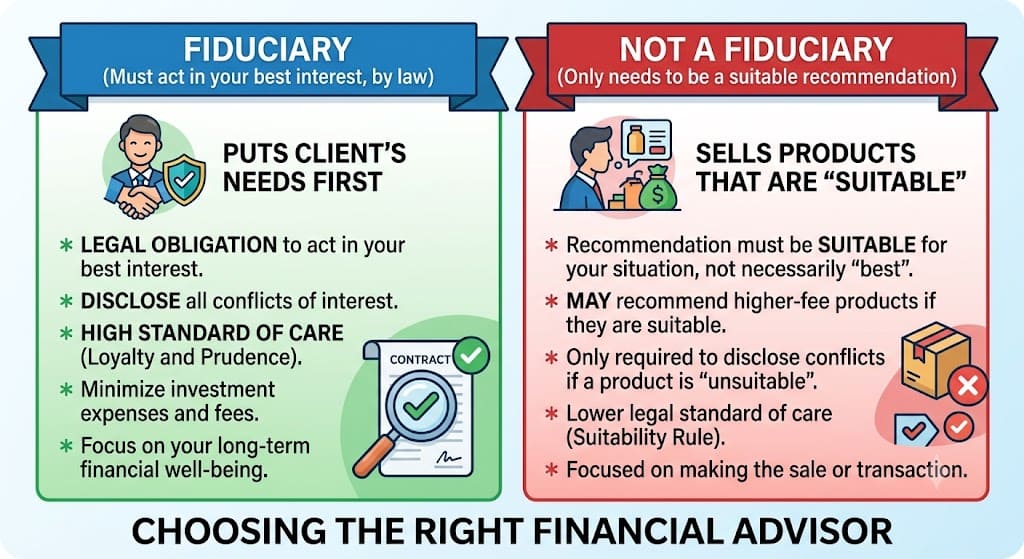
It does mean something. A fiduciary is a person or organization with a legal duty to act in someone else’s best interest, ahead of their own, whenever they manage that person’s money, property, or affairs. So that’s the whole concept in one sentence. It sounds obvious, and that’s exactly why it matters: the law doesn’t hold most financial professionals to that standard, even though plenty of them will happily let you assume otherwise.
Where the word actually comes from
“Fiduciary” traces back to the Latin fidere, meaning “to trust.” That’s not just trivia, either. It’s the legal hinge the whole relationship swings on: you hand someone your trust, and the law tries to make sure that trust doesn’t get abused.
You’ll run into the word in a few different flavors:
- Fiduciary duty – the legal obligation itself
- Fiduciary relationship – the bond between the fiduciary and the person they serve (sometimes called the “principal” or “beneficiary”)
- Fiduciary account – a bank or brokerage account held by one party for someone else’s benefit, like a trust account or a custodial account for a minor
- Fiduciary bond – an insurance-style bond some courts require an appointed trustee, executor, or guardian to carry, as protection if they mismanage the assets
The core duties every fiduciary owes
Different professions layer on their own rules, but nearly every fiduciary relationship comes back to the same handful of obligations. The Consumer Financial Protection Bureau frames it as four duties for anyone acting under a power of attorney or similar role, and these scale up cleanly to any other fiduciary relationship:
- Act only in the other person’s best interest. Not “a reasonable option.” Their best option, even when a different one would pay the fiduciary more.
- Manage money and property carefully. That covers paying bills, overseeing accounts, making prudent investments, and generally avoiding carelessness with someone else’s assets.
- Keep the money separate. A fiduciary’s own funds and the assets they manage never mix. Ever.
- Keep records. True, complete records, not a rough memory of what happened to the money.
On top of that, professional standards for financial advisors and trustees usually add a few more layers: good faith (honest, sincere decisions), confidentiality (not sharing what they learn about your finances), and disclosure (telling you about anything that could bias their advice, including how they get paid).
Who actually is a fiduciary
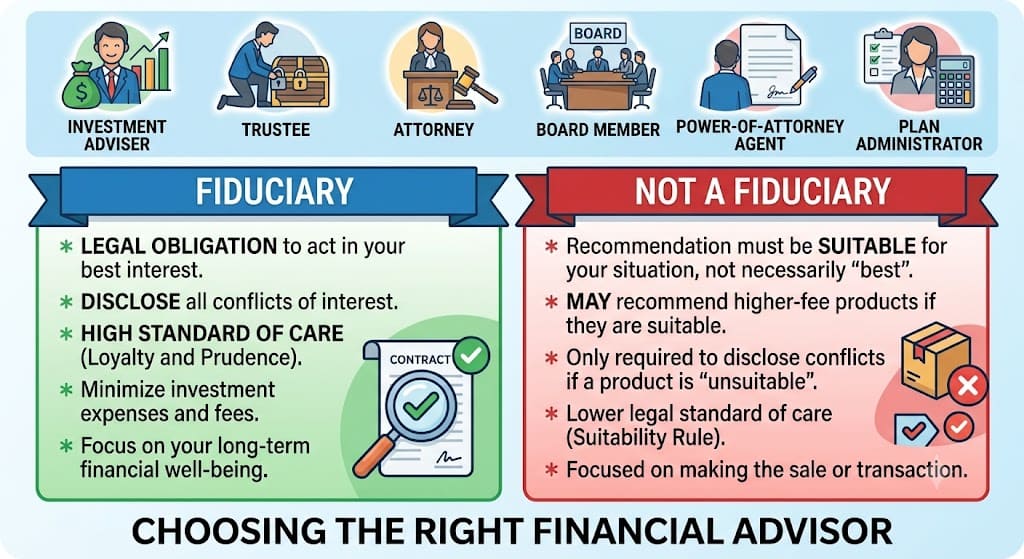
“Fiduciary” isn’t one job title. Instead, it’s a legal status that attaches to several different roles:
- Investment advisers, who register with the SEC or a state regulator under the Investment Advisers Act of 1940
- Trustees, who manage a trust’s assets for its beneficiaries
- Attorneys, in their dealings with clients
- Corporate board members and officers, who owe fiduciary duties to shareholders
- Agents acting under a power of attorney, guardians or conservators of property, and Social Security representative payees
- Retirement plan administrators, who owe fiduciary duties to plan participants
Here’s the part that trips people up: “financial advisor” isn’t on that list, because it isn’t a legally defined role. It’s just a catch-all marketing term, and that’s exactly why the next section matters more than any other in this piece.
Not every financial advisor is a fiduciary (this is the part people get wrong)
I used to assume anyone with “advisor” in their title had to act in my best interest. They don’t. There are three overlapping categories, and they’re held to genuinely different legal standards.
| Role | Standard they’re held to | Governing rule |
|---|---|---|
| Investment adviser (RIA) | Fiduciary duty, at all times | Investment Advisers Act of 1940 |
| Broker-dealer | Best interest, only at the moment of a recommendation | SEC Regulation Best Interest (Reg BI), effective 2020 |
| Financial planner | Depends on credentials and business model | Varies (CFP Board Code of Ethics if CFP-certified) |
As of 2026, these standards remain in effect and haven’t been repealed or replaced.
A broker-dealer buys and sells investments for you and can offer advice tied to those transactions. Under Reg BI, they have to act in your best interest, but only right when they make that specific recommendation. So that’s a real improvement over the older “suitability” standard, which only required a broker to reasonably believe an investment suited you, not necessarily that it was the best option available. Even so, it’s still a lower bar than the ongoing fiduciary duty an investment adviser carries every day of the relationship.
A financial planner sits in between. Whether they owe you a fiduciary duty depends entirely on their credentials and how their business runs. The CFP Board’s Code of Ethics binds every Certified Financial Planner to fiduciary conduct, for instance. But a planner without that designation might not answer to any particular standard at all.
Even robo-advisors don’t automatically dodge this. If a robo-advisor registers as an investment adviser with the SEC, which most well-known ones do, it owes the same fiduciary duty a human advisor would.
What it costs to work with a fiduciary
Fiduciary status is a legal obligation, not a pricing tier, so the fee depends on the role and the professional, not on whether “fiduciary” is in the arrangement. Here’s what the current industry data actually shows:
| Fee model | Typical rate (2026) | Source |
|---|---|---|
| Assets under management (AUM) | ~0.96% average, most commonly 0.75%-1.5% for $500K-$1M portfolios | Envestnet | MoneyGuide, 2026 State of Financial Planning Fees Study |
| Hourly | Median around $300/hour, ranging roughly $120-$400 | Kitces Research, 2024 advisor survey |
| Standalone flat-fee plan | Median $3,000 | Kitces Research, 2024 advisor survey |
| Trustees and estate fiduciaries | Hourly billing or a set percentage, scaled to the estate’s size and complexity | Varies by state and appointing court |
AUM fees usually shrink as your balance grows, too. Someone with $2 million invested typically pays a noticeably lower percentage than someone with $500,000, even at the same firm.
Either way, ask for the fee structure in writing before you sign anything. A fiduciary duty doesn’t stop someone from charging you for their time. It just stops them from recommending something because it pays them more.
How to check if your advisor is really a fiduciary
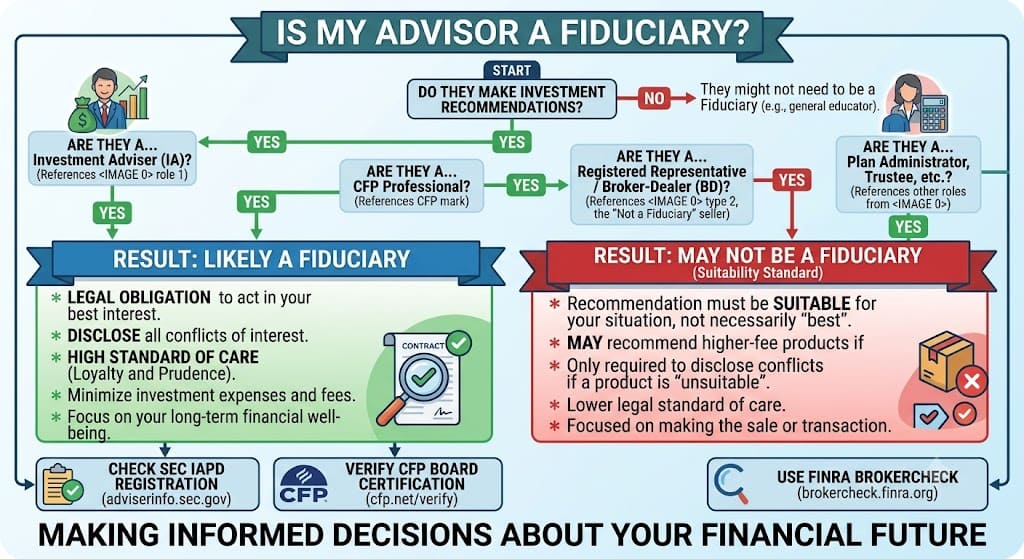
Don’t just take someone’s word for it. Instead, verify it the same way you’d verify any other legal status:
- Ask directly, and expect a clear yes-or-no answer, not a dodge.
- Check their SEC registration through the Investment Adviser Public Disclosure website and read their Form ADV, which lists fees, conflicts of interest, and any disciplinary history.
- Run broker-dealers through FINRA’s BrokerCheck to confirm their registration and standard of care.
- Look for a CFP designation, then confirm it directly through the CFP Board’s website.
So if you’re running the math on what a fiduciary’s fees would actually cost you over time against what you’re saving or investing, try FinToku’s Retirement Calculator. It’s a quick way to see how a 1% annual fee compounds against your balance over 20 or 30 years, and honestly, it’s a sobering exercise the first time you do it.
Key Takeaways
- A fiduciary has a legal duty to put your interests ahead of their own, not just a professional obligation to be helpful.
- “Financial advisor” is a marketing term, not a legal one. Investment advisers, broker-dealers, and financial planners each answer to a different, specific standard.
- Broker-dealers only have to act in your best interest at the moment of a recommendation, under SEC Regulation Best Interest. Investment advisers, on the other hand, owe that duty continuously.
- You can verify fiduciary status yourself through the SEC’s Investment Adviser Public Disclosure site, FINRA BrokerCheck, or the CFP Board, instead of relying on someone’s word for it.
- Fiduciary duty doesn’t mean free. It just means they have to disclose any fee they charge you, and any recommendation has to be about you, not their commission.
Frequently Asked Questions
What is the downside of a fiduciary? There isn’t really a downside to the legal standard itself. In practice, though, vetting a true fiduciary and understanding their fee structure takes more effort upfront than just hiring the first advisor you find.
How do fiduciaries make money? Through disclosed fees: a percentage of assets managed (averaging around 0.96% annually as of 2026, per Envestnet’s fee study), a flat fee for a defined service, or an hourly rate (median around $300/hour). What they can’t do, though, is take undisclosed commissions for steering you toward a specific product.
What’s the difference between a fiduciary and a financial advisor? “Financial advisor” describes what someone does. “Fiduciary” describes the legal standard they answer to. Some financial advisors are fiduciaries. Plenty aren’t, which is exactly why it’s worth asking.
Why would someone need a fiduciary? Anytime you hand decision-making power over your money or property to someone else, whether that’s an investment adviser managing your portfolio, a trustee overseeing an inheritance, or an agent acting under a power of attorney, a fiduciary duty is what legally obligates them to act for you rather than for themselves.
What is a fiduciary breach? A breach happens when a fiduciary acts against the interests the law requires them to protect, through things like misappropriating funds, hiding a conflict of interest, self-dealing, or plain negligence. So it can carry real legal consequences for the fiduciary.
Either way, before you hire anyone to manage your money, ask the fiduciary question directly, then verify the answer through the SEC or FINRA databases above instead of taking it on faith.
Read More
FinToku’s blog is still building out its investing and advisor-related coverage, so there isn’t a perfectly matched follow-up piece yet. In the meantime, these cover adjacent ground on making better money decisions:
- Financial Goals You Should Set Every Year
- Financial Mistakes That Keep People Broke (and How to Actually Stop)
Disclaimer
This article is for general informational purposes only, and it shouldn’t be taken as financial, tax, or legal advice. The fee ranges and standards above are general and can vary by state, firm, and individual circumstances. So before hiring a financial advisor, trustee, or anyone else in a fiduciary role, it’s worth confirming their specific registration and fee structure directly, and checking with a qualified professional about your own situation. You can also read FinToku’s full Financial Disclaimer.
Published by Saad Faisal for FinToku (fintoku.com) · Published August 1, 2026 · Updated August 1, 2026 FinToku provides free finance tools and guides to help you make smarter money decisions.