
A reader wrote in a few weeks ago asking which budgeting app “everyone” had switched to after Mint shut down. There isn’t one answer. Intuit discontinued Mint in March 2024, and the apps that absorbed its users split off in different directions: some chased automation, some doubled down on manual control, some went all-in on couples’ finances. The best budgeting app in 2026 depends less on features and more on which budgeting method you’ll actually keep using past week three.
That’s the part most “best of” lists skip. Below is a comparison of the seven apps worth your time in 2026, what they cost as of this writing, and which budgeting style each one is really built for, plus a quick way to test a method for free before you pay for an app.
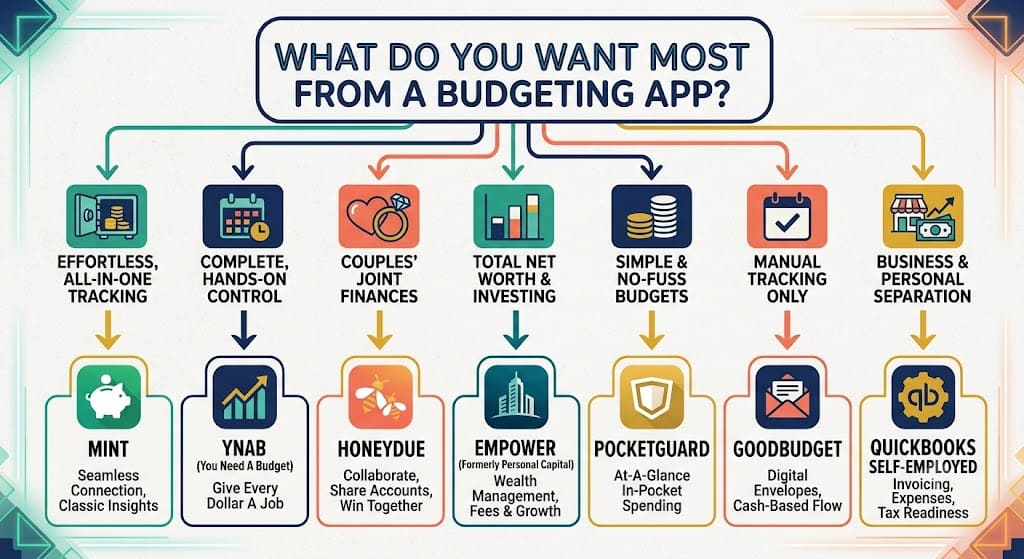
Quick Verdict
- Want full control over every dollar? YNAB.
- Want automation and a Mint-style dashboard? Monarch Money.
- Want cash-envelope budgeting without carrying cash? Goodbudget.
- Following Dave Ramsey’s plan? EveryDollar.
- Just want to know what’s safe to spend today? PocketGuard.
- Budgeting with a partner? Honeydue.
- Want net worth tracking for free? Empower.
Budgeting App Pricing and Ratings, Compared (as of July 2026)
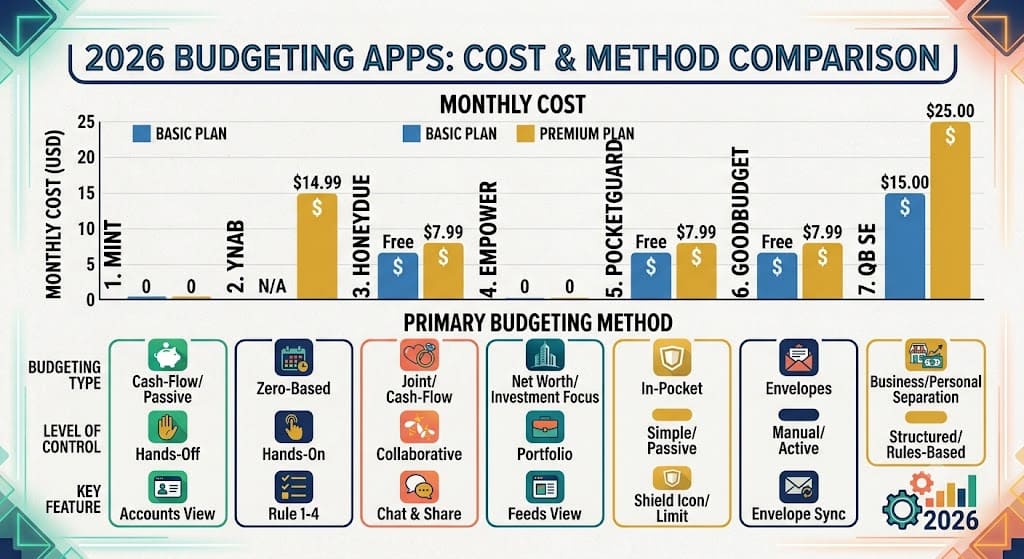
| App | Free Version | Paid Price | Method | App Store / Google Play |
|---|---|---|---|---|
| YNAB | 34-day trial only | $14.99/mo or $109/yr | Zero-based | 4.8 / 4.5 |
| Monarch Money | 7-day trial only | $14.99/mo or $99.99/yr | Flex or category | 4.9 / 4.8 |
| Goodbudget | Yes, limited envelopes | $10/mo or $80/yr (Premium) | Envelope | 4.6 / 3.3 |
| EveryDollar | Yes, manual entry only | $17.99/mo or $79.99/yr | Zero-based | 4.7 / 4.3 |
| PocketGuard | 7-day trial only | $12.99/mo or $74.99/yr | Spending guardrails | 4.6 / 4.2 |
| Honeydue | Yes, fully free | N/A | Shared tracking | 4.5 / 4.2 |
| Empower | Yes, fully free | N/A | Net worth + spending snapshot | 4.6 / 3.3 |
Pricing and ratings pulled from each provider’s published plans and NerdWallet’s editorial review, checked March 17, 2026. Confirm current pricing on each app’s site before subscribing, since budgeting apps change plans often.
YNAB: Best for Hands-On, Zero-Based Budgeting
YNAB (You Need A Budget) is the app people either love or quietly abandon after two weeks. There isn’t much middle ground. It runs on zero-based budgeting: every dollar you earn gets assigned a job the moment it hits your account, before you spend a cent of it.
The app started as a spreadsheet in 2004 and still carries that DNA. You can sync your bank accounts or skip syncing entirely and enter transactions by hand. YNAB Together lets up to five people share one budget, which works well for a household splitting bills across accounts.
Where it wins: if you want to get hands-on with your money, not just watch an app summarize it, nothing here forces the habit as effectively.
Where it loses: the daily decisions YNAB asks for are exactly what burns people out. If checking a budgeting app already feels like a chore, YNAB will amplify that, not fix it.
Cost: $14.99/month or $109/year, with a 34-day free trial and a free year for college students.
Monarch Money: Best Mint Replacement
Monarch Money is the app most former Mint users landed on, and it shows. You get automatic transaction syncing, net worth tracking, an investment dashboard, and bill reminders in one place. You can also switch between a high-level “flex” budget and a detailed category-by-category one.
What sets it apart from a pure tracker is the collaboration layer. Couples can tag shared expenses, set joint savings goals, and add a household member to one subscription at no extra cost. A recent AI assistant and weekly spending recaps have pushed it further toward “automated command center” than “budget I fill in myself.”
Where it wins: if you want the passive, everything-in-one-dashboard feeling Mint used to give you, minus the ads, Monarch is the closest match.
Where it loses: it’s not cheap, and beginners can feel buried under the customization options before they’ve even set a first budget.
Cost: $14.99/month or $99.99/year for the core plan, with a 7-day free trial. Monarch also introduced a $199/year Plus tier in 2026 with deeper forecasting tools, aimed at power users rather than everyday budgeters.
Goodbudget: Best for Digital Envelope Budgeting
Goodbudget takes the classic cash-envelope system and moves it onto your phone. You divide your income into virtual envelopes (groceries, rent, gas) and once an envelope is empty, spending in that category stops until next month.
The free version caps you at one account and a limited number of envelopes, entered by hand rather than synced. Premium unlocks unlimited envelopes, up to five devices, and account linking for automatic tracking. It’s one of the few apps here genuinely built for two people sharing a budget without merging every account.
If you’d rather keep the envelope method literal instead of digital, a physical cash envelope wallet system works the same way Goodbudget does, just with real bills instead of a screen. (Quick heads up, this is an affiliate link, so FinToku may earn a small commission if you buy through it. I only link to things I’d actually recommend. Full details in our Affiliate Disclosure.)
Where it wins: if the psychological trick of a literal “empty envelope” is what keeps you from overspending, this is the most faithful digital version of that.
Where it loses: the interface is dated next to Monarch or Copilot, and manual entry on the free tier is a real time cost.
Cost: Free for basic use; Goodbudget Premium is $10/month or $80/year.
EveryDollar: Best for Dave Ramsey’s Zero-Based Method
EveryDollar is built by Ramsey Solutions and follows the same zero-based logic as YNAB with a simpler interface. The free version requires manual transaction entry and asks you to build a fresh monthly budget from scratch. The paid tier, relaunched in January 2026, adds bank syncing, a “margin finder” tool that hunts for slack in your existing budget, and access to Ramsey’s coaching content.
Where it wins: if you’re already following Ramsey’s debt snowball or Baby Steps, EveryDollar is the app built to match that system exactly, no adapting required.
Where it loses: the free tier’s manual entry gets old fast, and there’s no investment tracking at any price.
Cost: Free for basic use; EveryDollar Plus is $17.99/month or $79.99/year, with a 14-day trial.
PocketGuard: Best for a Quick “Can I Spend This?” Answer
PocketGuard skips the elaborate category system in favor of one number: how much is safely left to spend today, after bills, debts, and savings goals are subtracted from your income. Its “Pace” feature, new on iOS in 2026, warns you if you’re burning through that number faster than the days left in the month suggest (Android support is expected later in 2026).
Where it wins: for someone who wants a guardrail, not a full accounting system, this answers the one question that actually changes daily behavior.
Where it loses: if you want granular control over specific categories, PocketGuard’s simplicity starts to feel like a limitation instead of a feature.
Cost: $12.99/month or $74.99/year, with a 7-day free trial.
Honeydue: Best for Budgeting With a Partner
Honeydue is built around one problem: you and a partner want visibility into shared money without necessarily merging every account. Both people sync accounts, credit cards, and loans, and each person controls exactly what the other can see. Shared spending limits trigger alerts to both partners, and there’s an in-app chat for the “hey, what was this charge” conversation that usually happens over text instead.
Where it wins: it’s the only app on this list purpose-built for two people with genuinely separate finances who still want one shared view.
Where it loses: there’s no desktop version, and its planning tools are thin compared to YNAB or Monarch. It shows you where the money went, not where it’s going.
Cost: Free.
Empower: Best Free Option for Net Worth Tracking
Empower (formerly Personal Capital) is primarily an investment-tracking tool, and its budgeting features reflect that. You can sync checking, savings, credit cards, IRAs, 401(k)s, mortgages, and loans, and Empower rolls all of it into a net worth tracker and a categorized spending snapshot.
Where it wins: if your priority is seeing the whole financial picture, investments included, at zero cost, nothing free comes closer.
Where it loses: there’s no way to proactively assign money to categories before you spend it. Empower tells you what happened, not what to do next.
Cost: Free.
How to Actually Pick One
Every app on this list solves a different problem, so the honest first question isn’t “which app has the best reviews,” it’s “which budgeting method will I keep doing in month three.” Jesse Mecham, the founder of YNAB, built his book You Need a Budget around one idea: give every dollar a job before you spend it, rather than reacting to a bank balance after the fact. That’s the zero-based approach YNAB and EveryDollar both run on.
Dave Ramsey’s The Total Money Makeover takes a related but more structured route, pairing zero-based budgeting with a strict debt payoff order. If that framework already resonates with you, EveryDollar will feel native. If you’d rather see automated forecasts than build a budget by hand, that points toward Monarch or PocketGuard instead.
Before you commit to a paid subscription, it’s worth testing the method itself for free. I ran a basic 50/30/20 split through FinToku’s Budget Planner & 50/30/20 Calculator before ever paying for an app, mostly to see if flex budgeting made sense for my income before deciding whether I needed YNAB’s stricter version of the same idea. If the split feels workable there, a lighter free app is probably enough. If you keep blowing past the categories, that’s a sign you want the more structured, hands-on tools like YNAB or EveryDollar.
Are Budgeting Apps Safe to Connect to Your Bank?
Yes, for the most part, though the rules governing that connection are still in flux. The Consumer Financial Protection Bureau finalized its Personal Financial Data Rights Rule in October 2024, giving consumers a formal right to securely share account data with third-party apps like the ones above. That rule has since been challenged in court by banking industry groups, and in early 2026 a federal judge enjoined the CFPB from enforcing it while the Bureau reconsiders several core provisions, including who counts as an authorized third party and whether banks can charge fees for data access. The original April 2026 compliance deadlines are on hold as a result, so for now the underlying protections operate more as an ongoing negotiation between banks, aggregators, and regulators than as settled law.
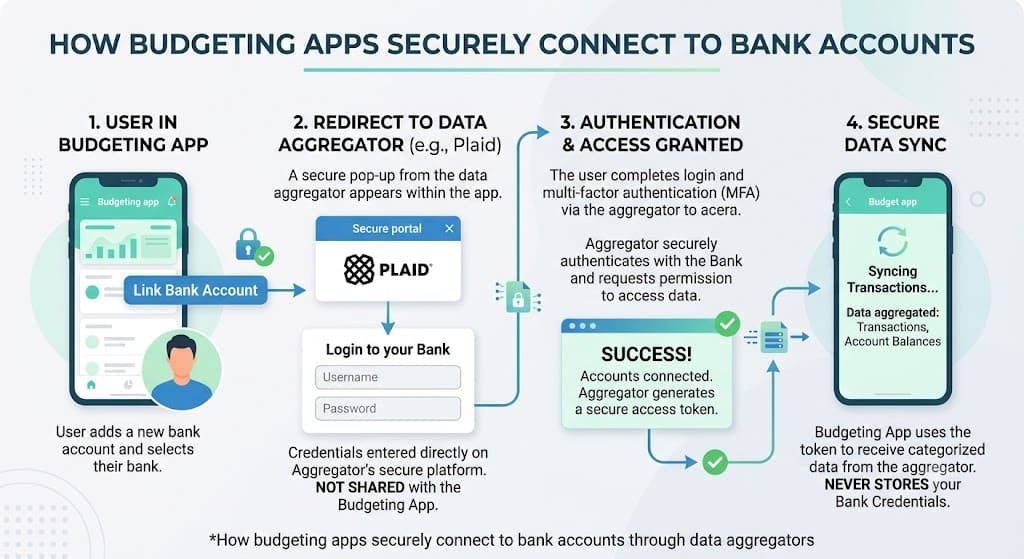
In practice, most budgeting apps don’t touch your bank credentials directly. They connect through aggregators like Plaid or MX, which generate a secure token instead of storing your login. Look for apps that mention bank-grade encryption and multi-factor authentication, and if you’d rather skip syncing altogether, YNAB and Goodbudget both support fully manual entry.
Key Takeaways
- YNAB and EveryDollar both use zero-based budgeting, where every dollar gets assigned a job before you spend it; YNAB is more flexible, EveryDollar follows Dave Ramsey’s system more directly.
- Monarch Money is the most common replacement for Mint, which Intuit shut down in March 2024, thanks to its automated tracking and net worth dashboard.
- Free options exist for every budgeting style: Goodbudget for envelope budgeting, EveryDollar for basic zero-based budgeting, Honeydue for couples, and Empower for net worth tracking.
- Most budgeting apps connect to your bank through an aggregator like Plaid rather than storing your login directly, and apps like YNAB and Goodbudget let you skip syncing entirely.
- The right app depends on the budgeting method you’ll actually keep using, not just which app has the highest star rating.
Frequently Asked Questions
What is the best free budgeting app in 2026? Goodbudget, EveryDollar, Honeydue, and Empower all have genuinely usable free tiers. Which is “best” depends on your method: Goodbudget for envelope budgeting, EveryDollar for zero-based budgeting, Honeydue for couples, and Empower for net worth and spending tracking combined.
What budgeting app replaced Mint? Monarch Money is the most commonly cited Mint replacement, since it offers similar automated tracking with a cleaner interface and added features like collaborative budgeting for couples.
Are free budgeting apps that connect to my bank account safe? Most reputable apps use third-party aggregators like Plaid or MX, which generate secure tokens instead of sharing your bank login directly. Look for bank-grade encryption and multi-factor authentication, and read how each app describes its data-sharing practices before connecting an account.
What’s the best budgeting app for couples? Honeydue and Goodbudget are both built for two people managing money together, with Honeydue focused on shared visibility with privacy controls, and Goodbudget focused on shared envelope budgeting.
Is there a good budgeting app for seniors or people who want something simple? Goodbudget’s envelope system and PocketGuard’s single “safe to spend” number are both easier to learn than YNAB or Monarch’s more detailed category systems, since neither requires understanding a full zero-based budget to get value from it.
If you’re still deciding, try running your numbers through FinToku’s free Budget Planner & 50/30/20 Calculator first. It takes a few minutes and tells you a lot about which of these apps is worth paying for.
Read More
- The 50/30/20 Budget Rule Explained (And Why It Might Not Fit Your Paycheck)
- Paycheck Budgeting for Beginners: How to Make Your Money Last Between Paydays
- How to Budget on an Irregular Income (2026 Guide)
Disclaimer
This article is for general informational purposes only and shouldn’t be taken as financial advice. Pricing, features, and free-tier limits for the apps above change often, so confirm current terms directly with each provider before subscribing. You can also read FinToku’s full Financial Disclaimer.
Published by Saad Faisal for FinToku (fintoku.com) · Published July 27, 2026 · Updated July 27, 2026 FinToku provides free finance tools and guides to help you make smarter money decisions.