

Most budgets don’t fail on day 30. They fail around day 9, right after rent and the car payment both land in the same week and “monthly budget” stops meaning much of anything. That’s usually the moment people give up on budgeting altogether, when the real problem was smaller than it felt: the budget was built around a month, but money doesn’t arrive in months. It arrives in paychecks.
Paycheck budgeting for beginners fixes that mismatch directly. Instead of dividing spending across 30 days, you divide it across however many paydays you actually get, and you assign every bill to the specific paycheck that has to cover it. It’s one of the simplest budgeting methods to start with, and it’s built specifically to stop you from running out of money between paydays.
What Is Paycheck Budgeting?
Paycheck budgeting is a method where you plan your spending around each individual payday instead of the calendar month, assigning bills, savings, and spending money to the paycheck that will actually cover them. If you’re paid twice a month, that means building two smaller budgets a month instead of one big one, each tied to a real deposit date.
It sounds like a small shift. In practice, it’s the difference between “I have $5,300 this month” (which invites you to spend early and scramble later) and “I have $2,650 landing on the 15th, and $1,900 of it is already spoken for” (which doesn’t).
How Paycheck Budgeting Works: 4 Steps
1. Find your real take-home pay, per paycheck
Your net income, not your salary, is what a paycheck budget runs on. Net income is what actually lands in your account after taxes, insurance, and retirement contributions come out, and it’s usually 20-30% less than the number on your offer letter. Pull your last two or three pay stubs and write down the actual deposit amount for each one, not an average.
If your pay varies week to week (tips, overtime, gig work), use your lowest realistic paycheck as your baseline. Treat anything above it as a bonus, not baseline income.
2. Map your bills to specific paydays
This is the part a monthly budget skips, and a paycheck budget can’t. Pull up a calendar, mark your pay dates, then go through every bill’s due date and assign it to whichever paycheck arrives before it’s due. Rent due the 1st goes on your last paycheck of the month. A card due the 20th might land squarely on a mid-month payday instead.
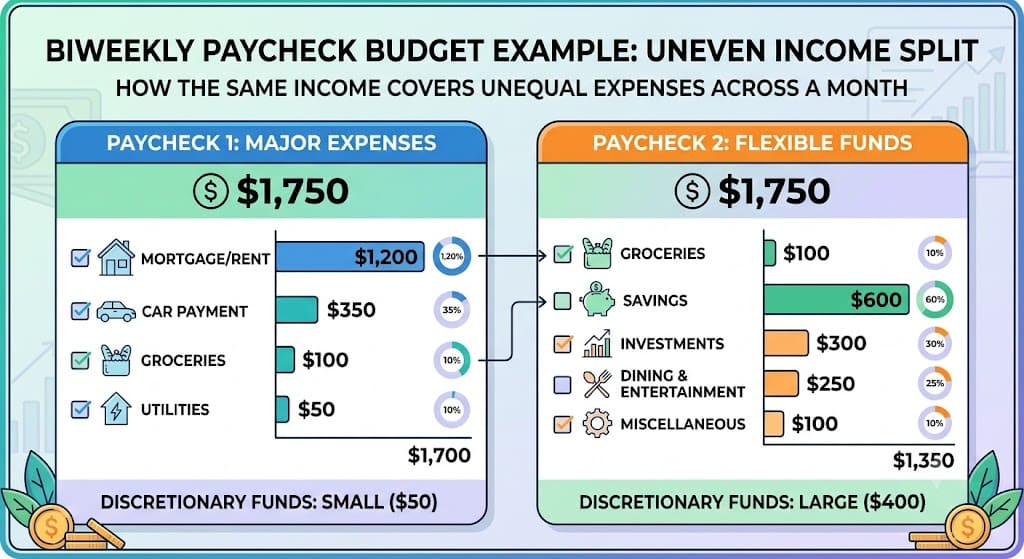
Once every bill has a paycheck attached to it, you’ll usually see a lopsided pattern: one paycheck absorbs most of your fixed costs and feels tight, while the other has more breathing room. That’s normal, and it’s exactly what a monthly average hides from you.
3. Build in sinking funds for the in-between costs
Not everything shows up on a schedule. Car registration, holiday spending, a friend’s wedding three states away: these are predictable expenses with unpredictable timing, and they’re what derail a paycheck budget fastest if you don’t plan for them. A sinking fund is a small, fixed amount you set aside from every paycheck toward one of these future costs, so the money’s already there when the bill shows up instead of coming out of nowhere.
Setting aside $40 from each of 24 paychecks (twice a month) toward “car stuff” adds up to $960 over a year, which covers most surprise repairs before they turn into a credit card balance. If you’re paid every two weeks instead — 26 paychecks a year rather than 24 — the same $40 per paycheck adds up to $1,040 instead, so double-check which schedule you’re actually on before you rely on the total.
4. Track what’s left, then adjust
Whatever’s left after bills and sinking funds is your spending money for that pay period, not the whole month. Track it the way you’d track a monthly budget (an app, a spreadsheet, or a notebook all work fine), and if a category runs dry before the next paycheck, treat that as a signal to trim it next time, not a reason to panic.
FinToku’s Paycheck Calculator can handle the take-home pay math from step 1 if you’d rather skip doing it by hand, and the Budget Planner & 50/30/20 Calculator is a quick way to sanity-check the bill-to-paycheck split from step 2 once you’ve mapped it out.
A Sample Semi-Monthly Paycheck Budget
Here’s what steps 1 through 3 look like put together, for someone earning $2,650 per paycheck (paid twice a month) in take-home pay.
Sample semi-monthly paycheck budget
| Category | Item | Paycheck 1 | Paycheck 2 |
|---|---|---|---|
| Take-home pay | $2,650 | $2,650 | |
| Fixed bills | Rent | $1,900 | — |
| Car payment | — | $410 | |
| Utilities & phone | $210 | — | |
| Sinking funds | Car maintenance, gifts | $40 | $40 |
| Savings | Emergency fund | $150 | $150 |
| Spending money | Groceries, gas, everything else | $350 | $2,050 |
Paycheck 1 is tight because rent lands there. Paycheck 2 has far more room. That’s exactly the kind of thing a single monthly total, like “$5,300 income, $5,300 expenses,” hides from you, and it’s the reason so many people feel broke during one specific week even though their monthly numbers look fine on paper.
Choosing a Budgeting Method That Fits Your Paycheck
Paycheck budgeting decides when your money gets used. You still need a method for deciding what it gets used on. These four pair well with a paycheck-based schedule:
| Method | Good for | How it works |
|---|---|---|
| 50/30/20 rule | People who want simple percentages, not line items | 50% of each paycheck to needs, 30% to wants, 20% to savings/debt |
| Zero-based budget | Detail-oriented planners who want every dollar assigned | Every dollar of each paycheck gets a job before you spend it |
| Cash envelope | People who tend to overspend on cards | Withdraw cash per category each payday; stop when the envelope’s empty |
| Pay-yourself-first | Savers who don’t want to think about the rest | A fixed amount moves to savings the moment each paycheck lands, before bills |
None of these is wrong on its own. California’s Department of Financial Protection and Innovation notes that the CFPB recommends a flexible approach like the 50/30/20 rule as a starting split, but pay-yourself-first tends to work better for people who keep meaning to save and never quite getting to it, since the saving happens before there’s a chance to spend it.
Where Beginners Usually Go Wrong
Budgeting off gross salary instead of net pay is the single most common mistake, and it’s why a budget can look fine on paper while still running short every payday. The fix from step 1, using your actual deposit amount, solves this on its own.
The second mistake is ignoring irregular expenses until they hit, then treating each one as a surprise. They’re not surprises. They’re predictable costs with unpredictable timing, which is exactly why sinking funds exist.
The third: giving up after one rough pay period. A paycheck budget doesn’t need to be perfect the first cycle. It needs one adjustment after you see where the plan and reality disagreed, then another, until the two actually match.
Current Savings Benchmarks (as of July 2026)
| Benchmark | Figure | Source, date |
|---|---|---|
| Emergency fund size | 3-6 months of expenses; the FDIC’s guidance leans toward 6 | FDIC, cited via California DFPI, June 2026 |
| Recommended savings rate | ~20% of take-home pay (the “20” in 50/30/20) | CFPB, cited via California DFPI, June 2026 |
| Americans saving less due to inflation | 54% | Bankrate 2026 Emergency Savings Report, Feb. 2026 |
| Avg. household monthly spending | About $6,600/month | BLS data cited in Motley Fool analysis, 2025 |
(Note: confirm these figures against the live sources before publishing — benchmark tables like this can drift out of date between drafts.)
Key Takeaways
- Paycheck budgeting assigns bills, savings, and spending to specific paydays instead of dividing spending across a full calendar month.
- A paycheck budget should run on net income (take-home pay), which is typically 20-30% lower than gross salary.
- Sinking funds set aside a small fixed amount per paycheck for predictable-but-irregular costs like car repairs or holiday spending — just confirm whether you’re on a semi-monthly (24 paycheck) or true biweekly (26 paycheck) schedule, since the yearly total changes.
- The FDIC’s guidance points toward an emergency fund covering up to six months of expenses, with 3-6 months as the range most financial experts cite.
- A paycheck budget doesn’t need to work perfectly in the first cycle; it needs one adjustment after each pay period until the plan matches reality.
Frequently Asked Questions
How do I budget money for beginners on a low income?
Start with your two or three biggest fixed bills and add sinking funds later, once those are covered. On a tight income, even $10-20 per paycheck toward an emergency fund matters more than which exact budgeting method you pick.
What’s the simplest way to budget my paycheck?
The 50/30/20 split is the easiest to start with because it only requires three categories, needs, wants, and savings, applied to each paycheck rather than the full month.
How do I make a monthly budget template for paycheck budgeting?
Build a simple spreadsheet with one column per paycheck instead of one per month, list every bill under the paycheck that covers it, and add rows for sinking funds and savings. FinToku’s Budget Planner & 50/30/20 Calculator can run this calculation for you.
How much should I put into a weekly or biweekly budget calculator?
Enter your actual net pay for that period, not an average. A weekly or biweekly calculator is only as accurate as the take-home number you put into it — and double-check whether your calculator assumes 24, 26, or 52 pay periods a year, since that changes any yearly total it gives you.
How do I budget and save money for beginners at the same time?
Treat savings as a bill, not a leftover. Assign a specific dollar amount to savings on a specific paycheck the same way you’d assign rent, so it happens before discretionary spending gets a chance to eat into it.
If you want to go deeper on the numbers behind that 20% savings target, FinToku’s 50/30/20 Budget Rule Explained covers why that split doesn’t always land evenly across two paychecks, and How to Build an Emergency Fund in 6 Months walks through the sinking-fund math from step 3 above in more detail. For a plain-English look at how a “want” quietly turns into a “need” over time, see Lifestyle Inflation: How Your Wants Quietly Become “Needs”, which the FTC’s own budgeting guide touches on too.
Ready to see your own numbers? Run your net pay through FinToku’s Paycheck Calculator, then map it against your bills using the Budget Planner & 50/30/20 Calculator.
Read More
- The 50/30/20 Budget Rule Explained (And Why It Might Not Fit Your Paycheck)
- How to Build an Emergency Fund in 6 Months (Even on a Tight Budget)
- How Much Should You Save Each Month? A Realistic, No-Guilt Answer
Disclaimer
This article is for general informational purposes only and shouldn’t be taken as financial advice. The paycheck amounts and bill splits in the sample budget above are illustrative examples, not a template for your specific numbers. Before making real changes to how you manage your paychecks, it’s worth running your own figures through a calculator or checking with a qualified financial advisor. You can also read FinToku’s full Financial Disclaimer.
Published by Saad Faisal for FinToku (fintoku.com) · Published July 21, 2026 · Updated July 21, 2026
FinToku provides free finance tools and guides to help you make smarter money decisions.