

Every dollar sitting in a savings account is doing one of two jobs. It’s either protecting you from a disaster, or it’s waiting for a bill you already know is coming. Mix those two jobs up, and you’ll drain your safety net paying for things that were never emergencies in the first place.
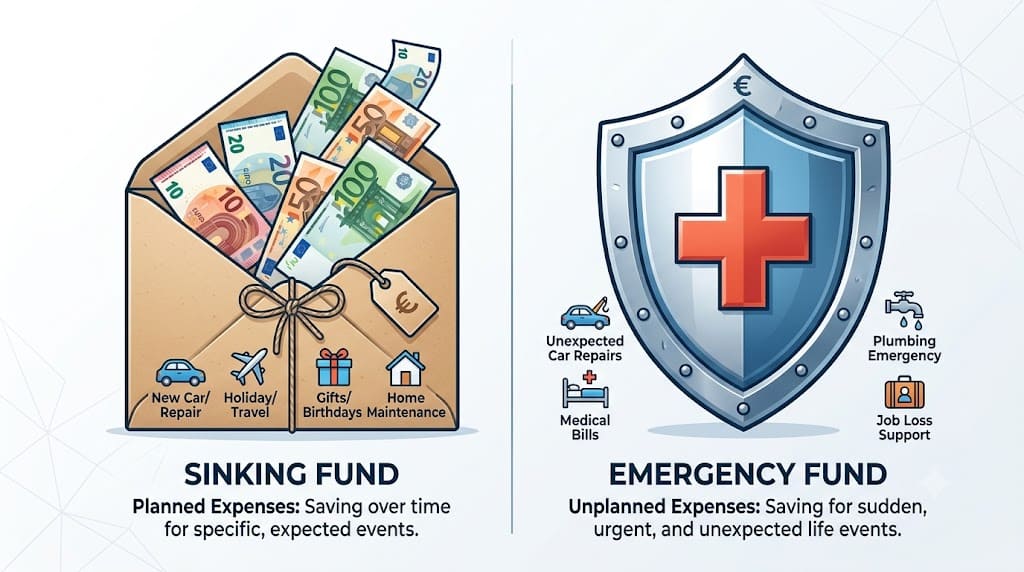
A sinking fund is money you save on purpose for a specific, planned expense, like car insurance, a holiday trip, or next year’s tuition bill. An emergency fund is money you keep untouched for the unplanned stuff: a layoff, a totaled car, a surprise ER visit. Both matter. They just don’t do the same job, and treating them as one big pile of “savings” is exactly how careful savers still end up reaching for a credit card.
Sinking Fund vs. Emergency Fund at a Glance
| Sinking Fund | Emergency Fund | |
|---|---|---|
| Purpose | Planned, known expenses: insurance premiums, holidays, car maintenance | Unplanned, urgent expenses: job loss, medical bills, major repairs |
| How much to save | Total cost ÷ months until you need it | 3 to 6 months of essential expenses (see below) |
| Number of funds | Usually several, one per goal | One combined fund |
| When you use it | On a schedule, you know the date | Only when something genuinely goes wrong |
| Best place to keep it | High-yield savings, labeled sub-accounts | High-yield savings or money market account |
As of July 2026. According to the Federal Reserve’s 2025 report on 2024 household finances, 55% of U.S. adults said they’d set aside enough to cover three months of expenses in an emergency fund, basically a coin flip. Ramsey Solutions recommends a $1,000 starter emergency fund ($500 if you earn under $20,000 a year) before tackling anything else.
What Is a Sinking Fund?
A sinking fund is a savings pool you build gradually by dividing the total cost of a known future expense by the number of months you have to save for it, so the bill never has to compete with your regular budget the month it lands.
Say your car insurance renews every six months at $900. Instead of scrambling for it in month six, you set aside $150 a month starting now. When the bill arrives, the money’s already sitting there, and it never touched your emergency fund.
Common Sinking Fund Categories
Sinking funds work for almost any expense you can see coming, even if you don’t know the exact date:
- Car insurance, registration, and maintenance
- Holiday and birthday gifts
- Annual subscriptions and memberships
- Home repairs and appliance replacements
- Vet bills and pet care
- Travel and vacations
- Weddings and big family events
A decent test: if a bill regularly makes you think “I should have planned for this,” it belongs in a sinking fund, not your emergency fund.
What Is an Emergency Fund?
An emergency fund is cash you keep on hand strictly for a genuine financial emergency, like a layoff, an unplanned medical bill, or a major home or car repair, and it’s sized in months of expenses rather than tied to a single purchase.
The defining trait isn’t the dollar amount, it’s that you can’t predict when (or if) you’ll need it. That unpredictability is exactly what separates it from a sinking fund, where you already know the date and the number.
How Much Should You Keep in an Emergency Fund?
Most guidance clusters around what’s often called the 3-6-9 rule: three months of essential expenses if your income is stable and you have some kind of safety net, six months if you have a mortgage, kids, or other fixed obligations, and nine months if you’re self-employed or your income swings a lot.
Start smaller if that number feels impossible. A $1,000 starter fund covers most minor emergencies while you’re still working on debt or your first sinking funds, and building your emergency fund gradually still beats not starting. If you want a fuller walkthrough of getting there on a real budget, I broke down the month-by-month version in how to build an emergency fund in 6 months.
Sinking Fund vs. Savings Account: Not the Same Thing
A savings account is just a place to hold money for any purpose. A sinking fund is a strategy, a plan for money set aside toward a specific goal with a deadline. You could have five sinking funds and keep every one of them inside a single savings account, as long as you’re actually tracking which dollars belong to which goal.
That last part is where people slip. Without labels or separate sub-accounts, a “vacation fund” and a “new tires fund” blur into one number, and it becomes easy to convince yourself the money’s fair game for something else.
Which Should You Build First?
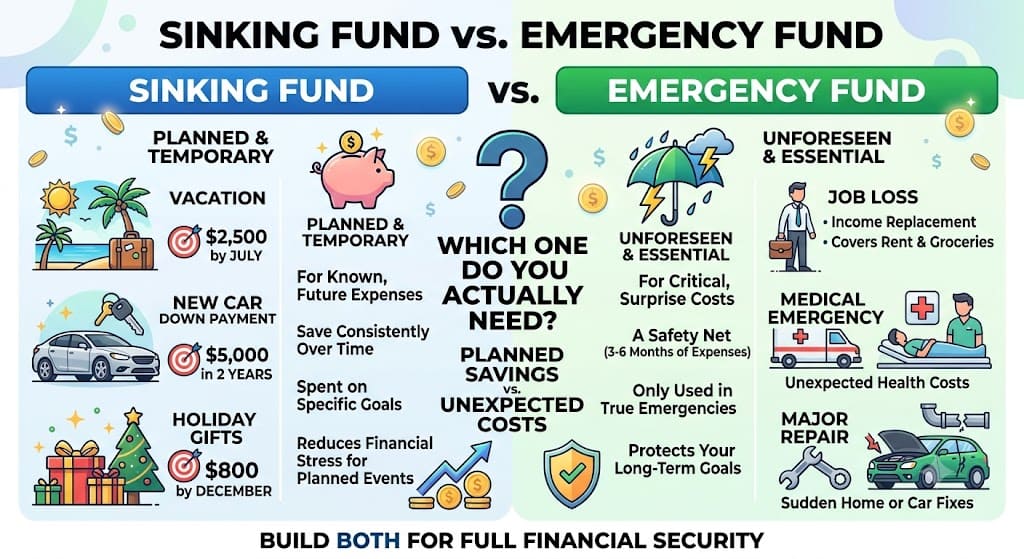
Build the emergency fund first. It’s the one thing standing between you and a credit card the moment something breaks. Get a starter fund in place (even $500 to $1,000), then you can run one or two sinking funds in parallel while you keep growing the emergency fund toward that 3-6-9 target.
Once the emergency fund reaches a comfortable baseline, that’s when it makes sense to layer in three to five sinking fund categories. Trying to launch eight sinking funds at once, before the emergency fund exists, usually just means every fund grows too slowly to matter.
How to Set Up a Sinking Fund in 4 Steps
- Name the goal and the total cost. “Christmas 2026, $600” beats a vague “gifts” category every time.
- Set the timeline. How many months until you need the money?
- Divide total cost by months. $600 over 8 months is $75 a month. That’s the whole formula.
- Automate the transfer. Set it to move on payday, before you have a chance to spend it elsewhere.
Common Mistakes That Blow Up Both Funds
Raiding the emergency fund for planned expenses. If you know it’s coming, it’s not an emergency, no matter how the timing feels.
Keeping everything in one unlabeled account. A single “savings” balance with no breakdown is the fastest way to lose track of what’s actually available to spend.
Launching too many sinking funds at once. There’s only so much money to split each month. Start with the two or three categories causing the most stress, then add more once the habit sticks.
Where to Keep Sinking Funds and Emergency Funds
Both belong somewhere safer than checking, but not locked away. A high-yield savings account is the usual answer for both: you avoid the temptation of easy checking-account access, and you actually earn something on the balance while it sits there. A money market account works too if you want occasional check-writing. I’d steer clear of CDs for either fund, since the whole point is being able to reach the money without a penalty. If you’re weighing the tradeoffs, I compared the two directly in high-yield savings account vs. CD.
Want to see what a realistic monthly split actually looks like on your own paycheck? Run your numbers through FinToku’s Budget Planner & 50/30/20 Calculator before you set the transfer amounts. It’s faster than guessing, and it’ll show you what’s actually left over once rent and bills are accounted for.
Key Takeaways
- A sinking fund is for planned, known expenses; an emergency fund is for unplanned, urgent ones. Never use one for the other’s job.
- Size a sinking fund by dividing the total cost by the months you have to save. Size an emergency fund in months of essential expenses (the 3-6-9 rule).
- Build a starter emergency fund of $500 to $1,000 before layering in sinking funds.
- Keep both in a high-yield savings account, ideally with clearly labeled sub-accounts so the money doesn’t blur together.
- Start with 2-3 sinking fund categories, not eight. Add more once the habit is automatic.
Frequently Asked Questions
What is the 3-6-9 rule for emergency funds?
It’s a sizing guideline: save 3 months of essential expenses if your income is stable with some safety net, 6 months if you have a mortgage or dependents, and 9 months if you’re self-employed or your income is irregular. It’s a starting point, not a hard rule.
How much should I keep in a sinking fund?
Exactly the cost of the specific goal you’re saving for, divided across however many months you have until you need it. There’s no universal target because every sinking fund is tied to a different, known expense.
What does Dave Ramsey say about sinking funds?
Ramsey’s team describes a sinking fund as setting aside a little money every month for something specific you know is coming, calculated by dividing the total cost by the number of months until the expense. He recommends keeping them in a separate account from your emergency fund and building your starter emergency fund first.
What’s the sinking fund formula?
Total cost of the expense, divided by the number of months until you need it, equals your monthly contribution. A $1,200 vacation in 10 months means $120 a month.
Can you have too much in an emergency fund?
Yes, technically. Cash sitting in a savings account earns far less than it would invested, so piling up well beyond 6-9 months of expenses (absent a specific reason like irregular income) usually means money that could be working harder elsewhere. Most people are nowhere near that problem, though. Underfunding is the far more common issue.
If you’re still building yours, run the math on your specific expenses using FinToku’s Budget Planner rather than guessing at a round number.
Read More
- How to Build an Emergency Fund in 6 Months (Even on a Tight Budget)
- High-Yield Savings Account vs CD: Which Wins in 2026?
- The 50/30/20 Budget Rule Explained
Disclaimer
This article is for general informational purposes only and shouldn’t be taken as financial advice. The dollar figures used here (the $900 insurance premium, the $600 holiday budget) are illustrative examples, not universal targets. Before setting your own savings goals, it’s worth reviewing your actual expenses or checking with a financial advisor who can look at your specific situation. You can read FinToku’s full Financial Disclaimer.
Published by Saad Faisal for FinToku (fintoku.com) · Published July 21, 2026 · Updated July 21, 2026 FinToku provides free finance tools and guides to help you make smarter money decisions.