
A high-yield savings account vs CD decision landed in my inbox in April. My neighbor texted me asking if she should move her $15,000 house-down-payment fund into a CD before rates dropped again. She’d been sitting in a high-yield savings account, watching the APY tick down every few weeks. She wanted to lock something in before it ticked down more.
Short answer: it depends on when she needs that $15,000. Longer answer, keep reading.
Both a high-yield savings account (HYSA) and a certificate of deposit (CD) are low-risk, FDIC-insured places to park cash. Both pay more than a regular bank account. The real difference comes down to one question: can you leave the money alone for a fixed stretch, or do you need to grab it whenever you want?
What each one actually is
Before you can settle a high-yield savings account vs CD question, it helps to be clear on what each product actually does.
A high-yield savings account works like a regular savings account, just with a meaningfully better rate. It usually comes from an online bank with lower overhead than a branch-heavy competitor. The rate is variable, so it moves with the broader interest-rate environment. You can withdraw whenever you want, though some banks still cap the number of transfers per month.
A CD locks a set amount of money for a fixed term, typically anywhere from a few months to five years. You lock in the rate the day you open it. Pull the money out early and you’ll usually give up some or all of the interest you’ve earned as a penalty.
The FDIC insures both types up to $250,000 per depositor, per bank. Neither one is a place to expect stock-market-style growth. They’re for cash you want safe, not cash you’re trying to grow aggressively.
High-Yield Savings Account vs CD: Comparing the Actual Numbers
Where rates stand right now
As of early July 2026, rates on the two products have been sitting close together. Top nationally available high-yield savings accounts have been advertising APYs in roughly the 4.0%–4.5% range. Short-term CDs (six to eighteen months) have landed in a similar 4.0%–4.4% band, per rate trackers from Bankrate and NerdWallet. That’s well above the FDIC’s reported national average of around 0.38% for a plain savings account. That gap is what makes shopping around worth the ten minutes it takes. Both figures move regularly, so check current numbers before deciding.
What the gap actually looks like
Here’s a simplified way to think about the tradeoff. Say you have $10,000 to park for a year:
| Scenario | Assumed rate | Approx. 1-year earnings on $10,000 |
|---|---|---|
| 12-month CD, rate locked today | 3.75% (illustrative) | ~$375, guaranteed |
| HYSA, rate drifts down over the year | starts ~4.00%, averages ~3.25% (illustrative) | ~$325 |
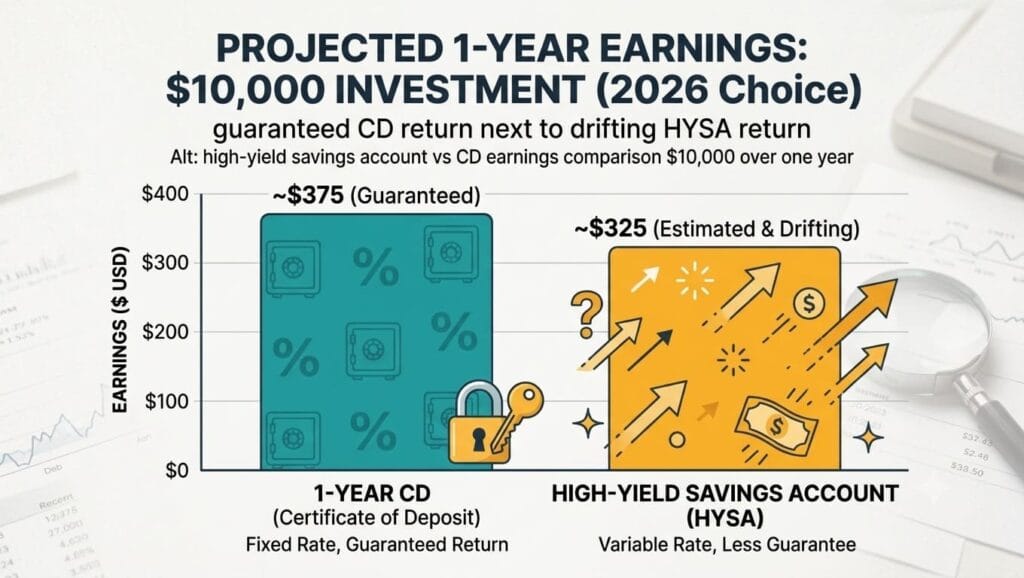
That’s roughly a $50 gap on $10,000, real money, but not the kind of gap that should override everything else about your situation. On $50,000 or more, the same math starts to matter a lot more. That’s worth sitting with if you’re deciding where to park a larger cash cushion.
I’ll be honest: for money I might need on short notice, that $50 isn’t worth losing the ability to move fast. For money I’ve already decided I won’t touch for a year, I’d rather have the guarantee.
When a CD makes more sense
- You want a guaranteed return and don’t want to babysit rate changes.
- You’re saving toward a specific, date-based goal, like a wedding, a tax bill, or a car you’ll buy in 14 months.
- You’re genuinely comfortable not touching the money for the full term. If there’s real doubt about that, a CD’s early withdrawal penalty will find you.
When a high-yield savings account makes more sense
- You need full, penalty-free access to the cash. This is the right home for an emergency fund, full stop.
- You’re still adding to the balance regularly. CDs typically don’t accept more deposits after the initial one; savings accounts do.
- You want the flexibility to move if a better rate shows up somewhere else, or if your plans change.
High-Yield Savings Account vs CD: Which One Fits You
Neither product is universally “better.” It’s really a liquidity question dressed up as a rate question. A rough way to sort it:
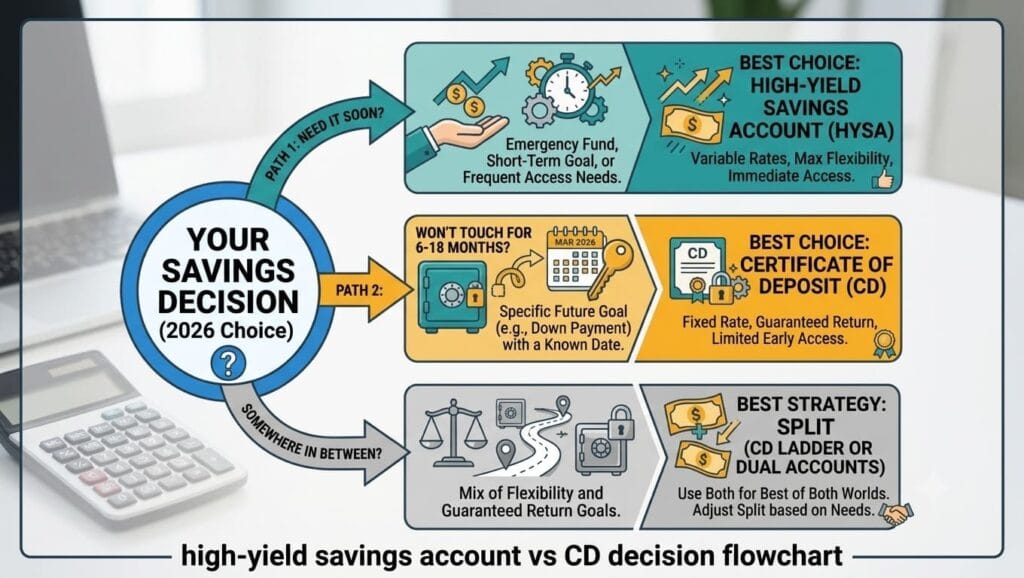
- Emergency fund → HYSA, no contest. You don’t want a penalty standing between you and a broken water heater.
- Money you already know you won’t need for 6–18 months → CD, especially if today’s rate looks good relative to where rates seem headed.
- Undecided, or somewhere in between → split it. Keep the “might need this soon” portion in a HYSA and put the “definitely won’t touch this” portion in a CD.
That third option is more common than people think. It’s also the logic behind CD laddering: opening several CDs with staggered terms instead of one lump CD, so you get better long-term rates without giving up all your liquidity at once. If you’re weighing a single CD against a HYSA, it’s worth reading up on laddering before you decide. It can capture a lot of the CD rate advantage while keeping money coming free on a regular schedule.
Sometimes the real question is a CD against financing something instead, like whether to fund a purchase with savings or borrow for it. FinToku built its Loan Comparator for exactly that side of the decision.
Key Takeaways
- The FDIC insures both HYSAs and CDs up to $250,000 per depositor, per bank. The real tradeoff is liquidity, not safety.
- A CD locks your rate for the full term; a HYSA’s rate moves with the market, up or down.
- On $10,000, the gap between a locked CD rate and a drifting HYSA rate has recently been in the ballpark of $50 a year, meaningful on larger balances, less so on smaller ones.
- Emergency funds belong in a HYSA. Money earmarked for a specific date more than six months out is a better fit for a CD.
- Splitting funds between both, or laddering CDs, avoids having to make an all-or-nothing bet on where rates go next.
Frequently Asked Questions
Is a HYSA or CD better for an emergency fund? A HYSA. Emergency funds need to be accessible without penalty, and a CD’s early withdrawal penalty works directly against that.
Can you lose money in a CD or high-yield savings account? Not your principal, as long as you stay under FDIC limits and don’t withdraw from a CD early enough to eat into the principal itself (rare, but possible with steep penalties on short-term CDs). The bigger risk is opportunity cost, not loss.
What happens if I withdraw from a CD before it matures? You’ll typically forfeit some or all of the interest earned, and in some cases a portion of principal on very short terms. Check the terms before you open one, since each bank sets its own penalty.
Are high-yield savings rates expected to drop further in 2026? Rates on HYSAs move with broader monetary policy. The Federal Reserve has held its benchmark federal funds rate steady at 3.50%–3.75% at every 2026 meeting so far, after cutting it three times in late 2025. Reporting from outlets like NerdWallet and Forbes Advisor says the next move is genuinely up for debate. Some observers now expect a hike rather than a cut, given persistent inflation. That uncertainty is exactly why some savers choose to lock part of their cash into a CD now.
How much would $10,000 earn in a CD vs. a HYSA over a year? It depends entirely on current rates at the time, but recently the gap between a locked 12-month CD and a drifting HYSA has landed somewhere around $50 on $10,000. See the table above for the illustrative math.
If you’re still not sure which side of the high-yield savings account vs CD decision you land on, run your own numbers against your actual timeline. A stranger’s example is just a starting point. The right answer changes the moment your timeline does.
Disclaimer
This article is for general informational purposes and isn’t financial or tax advice. Rates, terms, and FDIC coverage details change; confirm current numbers directly with any bank before opening an account. See FinToku’s full Financial Disclaimer for more.
By Saad Faisal · Published July 11, 2026