

I did the math on my own paycheck the first time I heard about the 50/30/20 rule, and it took about four minutes to realize something: my rent alone was already past the “needs” limit. Not close to it. Past it.
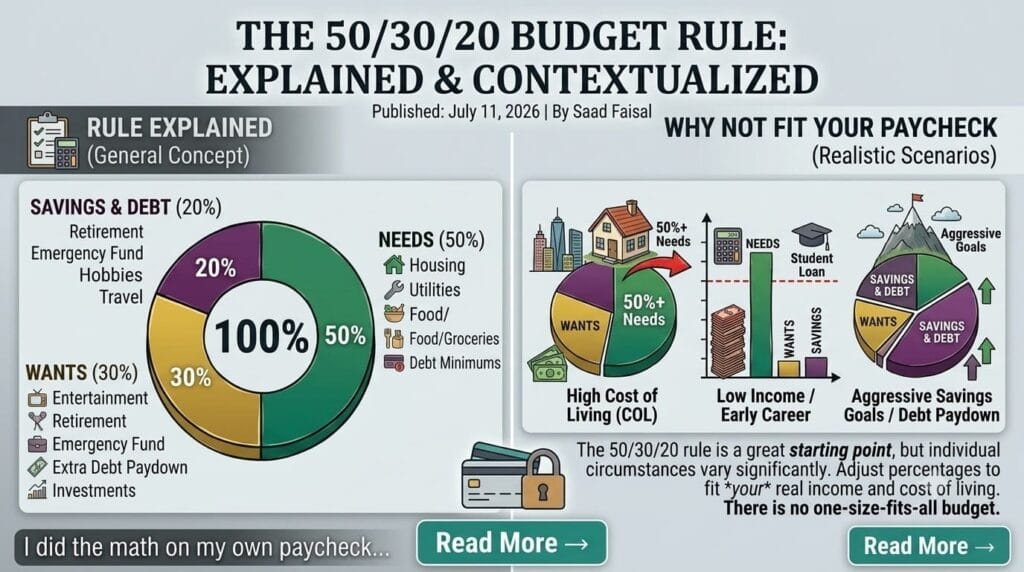
That’s usually how this goes. The 50/30/20 rule says to split your after-tax income into 50% for needs, 30% for wants, and 20% for savings and extra debt payments. It’s simple, it’s popular, and for a lot of people in 2026, especially in expensive cities, the “50%” part doesn’t survive contact with an actual rent bill. That doesn’t mean the rule is useless. It means you need to know what it’s actually good for before you build a budget around it.
What Is the 50/30/20 Budget Rule?
The 50/30/20 rule is a budgeting method that divides your after-tax (take-home) income into three fixed categories: 50% for needs, 30% for wants, and 20% for savings and extra debt repayment. It’s a percentage-based framework, not a line-item budget. You’re sorting spending into three buckets instead of tracking every purchase.
Say your monthly take-home pay is $4,000. Under the rule, you’d aim for roughly $2,000 on needs, $1,200 on wants, and $800 on savings. Clean numbers, easy to remember, and that’s exactly the point: the rule trades precision for something people will actually stick with.
Where the Rule Actually Came From
This one’s worth getting right, because most articles get it wrong or skip it entirely. The 50/30/20 rule wasn’t invented by a bank marketing team. It comes from Senator Elizabeth Warren, back when she was a Harvard Law bankruptcy researcher, and her daughter Amelia Warren Tyagi. They laid it out in their 2005 book All Your Worth: The Ultimate Lifetime Money Plan, aimed at working families whose spending had gotten out of sync with their income.
If you want the full framework straight from the source, Warren and Tyagi’s All Your Worth: The Ultimate Lifetime Money Plan lays out the original thinking in more detail than any blog post can.
Twenty years later, it’s become the default budgeting advice at nearly every bank and insurer’s “financial wellness” blog, including the Consumer Financial Protection Bureau’s own youth financial education materials, which teach the 50-30-20 split as a standard budgeting activity. That’s a good sign the framework has staying power. It doesn’t mean the original percentages still hold up for every household, which is the part most explainers skip.
The Three Buckets, Broken Down
50%: Needs
Needs are the expenses you can’t skip without real consequences: rent or mortgage, utilities, groceries, minimum debt payments, insurance, transportation, and childcare. The test I actually use: could you get evicted, lose your job, or go without medical care if you cut this? If yes, it’s a need.
A few things people misfile here. Minimum payments on a credit card count as a need; anything above the minimum goes in your savings/debt bucket instead. Streaming subscriptions, a newer phone than you strictly require, and a gym membership almost always belong in wants, even though they feel routine.
30%: Wants
Wants are the spending that makes life enjoyable but isn’t required to keep your household running: dining out, entertainment, travel, hobbies, non-essential shopping, upgrades on things that already work fine. This is deliberately the most flexible bucket. It’s also the first place to cut when money’s tight.
20%: Savings and Extra Debt Repayment
This is the future-facing bucket: emergency fund contributions, retirement savings (401(k), IRA), investing, and any debt payment beyond the required minimum. A quick clarification that trips people up: your own 401(k) contributions count toward the 20%, but an employer match doesn’t. Treat the match as a bonus, not part of your target.
If you’re carrying high-interest debt, most versions of this rule (including Warren’s original) say to hit that debt hard first, before piling extra cash into savings. A 24% credit card APR is a guaranteed “return” no investment can consistently beat.
Is the 50/30/20 Rule Actually Realistic in 2026?
Honestly? For a lot of people, no, not at the letter of the percentages. This is the part most bank blogs gloss over with a soft “it may not fit everyone,” so let’s be specific about why.
Housing costs have outpaced income growth for years now, and in most metro areas, rent or a mortgage payment alone eats a huge share of take-home pay before utilities, groceries, or insurance even enter the picture (FinToku’s guide on how much house you can really afford goes deeper on why a lender’s pre-approval number and your actual “needs” budget are rarely the same figure). Ramsey Solutions has argued that when you account for typical US household spending, needs alone regularly run well past 50% of take-home pay, citing Census Bureau income and expense data, which would leave little or nothing for the 30% and 20% buckets as written.
That’s not a reason to throw the framework out. It’s a reason to treat “50/30/20” as a starting ratio, not a pass/fail test. If your needs are at 65% right now, the useful question isn’t “am I failing the rule.” It’s “which of these is actually a need, and where’s my real flexibility.”
Signs the classic split probably isn’t realistic for you right now:
- You live in a high cost-of-living metro area
- You’re carrying significant student loan or credit card debt
- Your income is irregular (freelance, commission, gig work)
- You’re supporting dependents on a single income
How to Calculate Your Own 50/30/20 Budget
- Find your net income. Use what actually lands in your bank account after taxes and payroll deductions, not your gross salary.
- Multiply by the percentages. Needs = income × 0.50. Wants = income × 0.30. Savings/debt = income × 0.20.
- Track a month of real spending and sort it into the same three buckets.
- Compare the two. The gap between your target and your actual spending is where the real decisions are.
Worked example: $4,500/month take-home pay
| Category | Percentage | Target amount |
|---|---|---|
| Needs | 50% | $2,250 |
| Wants | 30% | $1,350 |
| Savings & extra debt | 20% | $900 |
If your paycheck is variable (freelance, hourly, commission-based), base the percentages on a rolling average of your last 3-6 months of income rather than a single good or bad month. It smooths out the swings and keeps the budget usable instead of constantly out of date.
I ran my own numbers through FinToku’s Budget Planner & 50/30/20 Calculator before writing this, mostly to double-check my own math, and it’s faster than a spreadsheet if you just want the three target numbers without building anything yourself.
What to Do When You Can’t Hit the Numbers
If needs are eating past 50%, you’ve got three real levers, not two: cut wants further, extend your timeline on savings, or actually reduce a need (a cheaper apartment, a lower car payment, a different commute). Most people only ever pull the first lever, then decide the whole system doesn’t work.
A few adjusted splits that show up often when 50/30/20 doesn’t fit:
| Variant | Needs | Wants | Savings/Debt | Best for |
|---|---|---|---|---|
| Classic 50/30/20 | 50% | 30% | 20% | Moderate cost-of-living, stable income |
| 60/30/10 | 60% | 30% | 10% | High-rent metro areas |
| 70/20/10 | 70% | 20% | 10% | Early-career, still building savings habit |
| 80/20 (savings-first) | n/a | n/a | 20% off the top | People who want simplicity without categorizing every want |
None of these are official. They’re just the same idea with the dial turned to match your actual cost of living. The goal is a savings percentage you’ll consistently hit, not a number that looks good on paper for one month and then gets abandoned.
Key Takeaways
- The 50/30/20 rule splits after-tax income into 50% needs, 30% wants, and 20% savings/extra debt repayment.
- It comes from Elizabeth Warren and Amelia Warren Tyagi’s 2005 book All Your Worth, not a bank or fintech company.
- Minimum debt payments count as a need; anything above the minimum counts as savings/debt repayment.
- In high cost-of-living areas, needs commonly exceed 50% of take-home pay, so treat the ratio as a flexible starting point, not a strict rule.
- If the classic split doesn’t fit, adjusted versions like 60/30/10 or 70/20/10 keep the same structure with more realistic percentages.
Frequently Asked Questions
Is the 50/30/20 rule based on gross or net income?
Net income: your take-home pay after taxes and payroll deductions, not your gross salary. Using gross income will make every category look smaller than what you can actually spend.
Does a 401(k) contribution count toward the 20%?
Your own contributions do. Employer matching does not; treat the match as a bonus on top of your 20% target, not a substitute for it.
What if I can only save 10% right now?
That’s a reasonable place to start. Begin with whatever percentage is realistic, automate it so it happens without a decision each month, and shift more from wants to savings as your income or expenses change.
Is the 50/30/20 rule realistic for high-cost cities?
Often, no, not at the exact percentages. Needs frequently exceed 50% of take-home pay in expensive metro areas. An adjusted split like 60/30/10 keeps the same structure while matching real housing costs.
What’s the difference between a need and a want?
A need is required to keep your household running or your obligations current: housing, utilities, minimum debt payments, basic groceries, insurance. A want makes life better but isn’t required for survival: dining out, entertainment, upgrades, travel.
Whatever split you land on, the mechanics are the same as any percentage-based budget: figure out your real take-home pay, decide what your three buckets should be this month, and check in against actual spending regularly rather than setting it once and forgetting it.
Once you’ve got a real number for your 20% bucket, FinToku’s High-Yield Savings Account vs CD guide is a reasonable next stop for figuring out where that money should actually sit.
By Saad Faisal · Published July 11, 2026
Disclaimer
This article is for general informational purposes only and shouldn’t be taken as financial or tax advice. The dollar amounts here are illustrative examples, not guarantees; your own needs, wants, and savings capacity depend on your specific income, location, and obligations. Before making a real budgeting or debt-repayment decision, it’s worth checking with a qualified financial advisor who can look at your actual numbers. Read FinToku’s full Financial Disclaimer for more.
(Quick heads up: the book link above is an affiliate link, so FinToku may earn a small commission if you buy through it. Full details in our Affiliate Disclosure.)