

The short answer: there’s no single “best” auto loan rate in 2026 — it depends on your credit score, whether you’re buying new or used, and who you borrow from.
Right now, new-car loans average 6.93% APR on a 60-month term, according to Bankrate’s weekly lender survey. Borrowers with top-tier (“super prime”) credit are seeing rates closer to 4.7%, while borrowers with poor credit are paying 16% or more for the same car.
Auto loan APR is the total yearly cost of a car loan expressed as a percentage, combining the interest rate with any lender fees. It’s the number to compare across offers, not the “rate” a dealer quotes verbally, since fees can turn two loans with the same interest rate into very different APRs.
I learned this the expensive way, back in my twenties. Without shopping around first, I walked straight into a dealership and financed a car there. I took the rate the finance manager offered and drove off feeling pretty good about myself.
It wasn’t until a friend refinanced hers a year later, dropping her rate by almost four points, that I found out how much I’d overpaid. That single decision cost me a few thousand dollars in interest I never had to pay.
The rest of this piece breaks down exactly where those numbers come from, which lenders are publishing the lowest rates this month, and how to land on the low end of them.
Average auto loan rates right now
The current average new-car auto loan rate sits at 6.93% for a 60-month term, based on Bankrate’s weekly survey of the country’s largest banks and thrifts. Used-car rates run considerably higher, not just a fraction of a point higher, since lenders price in faster depreciation and more uncertainty about a used vehicle’s condition.
Edmunds put the average used-car rate at 10.4% APR as of May 2026, versus 6.9% for new; Cox Automotive’s sales-weighted numbers for the same month ran even higher, at 12.29% for used against 9.87% for new. The exact figure moves depending on whether a source is averaging advertised rates or actual closed loans, but every major tracker agrees on the shape of it: used financing costs several points more per dollar borrowed than new.
That’s the market average, though. Your actual rate depends almost entirely on one thing: your credit score.
Auto loan rates by credit score
According to Experian’s State of the Automotive Finance Market report, the average new-car auto loan rate for borrowers with “super prime” credit was 4.66% in the fourth quarter of 2025, versus an average 16.01% for borrowers with “deep subprime” credit.
That’s not a rounding difference. It’s the gap between paying for a car and paying for a car twice over.
| Credit tier | Score range | New car APR | Used car APR |
|---|---|---|---|
| Super prime | 781–850 | 4.66% | 7.70% |
| Prime | 661–780 | 6.27% | 9.98% |
| Nonprime | 601–660 | 9.57% | 14.49% |
| Subprime | 501–600 | 13.17% | 19.42% |
| Deep subprime | 300–500 | 16.01% | 21.85% |
Source: Experian State of the Automotive Finance Market, Q4 2025.
I’ll be honest, the jump from “prime” to “nonprime” is the one that catches people off guard. A 40-point drop in your score, from 665 to 625, can add three or four points of APR. If you’re anywhere near a tier boundary, it’s worth spending a month paying down a credit card balance before you apply.
LendingTree’s own marketplace data backs this up from a different angle: average car loan offers range from 6.81% to 23.82% APR, with rates for bad-credit borrowers running a little over 15 percentage points higher than those for excellent-credit borrowers.
What’s actually driving your rate (and what isn’t)
Every auto loan APR stacks three things on top of each other, and only one of them is really about you.
The lender’s cost of capital. Banks borrow at rates tied to the Federal Reserve and the bond market. When the Fed moves, auto rates follow within weeks.
Your risk premium. This is the part you control. Higher credit score, lower premium: a 720+ borrower might pay a point or two above the lender’s base rate, while a 580 borrower can pay eight points more or higher.
The dealer markup, if you finance through the lot. When you finance through a dealer, the dealer gets a “buy rate” from the bank and is often allowed to mark it up before passing it to you, typically half a point to two and a half points, and they keep the spread. This is the single easiest markup to avoid, and most people don’t even know it exists.
The fix is simple, if a little annoying: walk into the dealership with a pre-approval already in hand from a bank or credit union, and make the dealer beat it instead of setting the number.
Where rates are headed for the rest of 2026
Bankrate’s 2026 forecast, from senior industry analyst Ted Rossman, expects the average 60-month new-car rate to keep drifting down modestly through the year, continuing the slow decline that ran through 2025. Rossman’s baseline projection has the average new-car rate settling around 6.40% by year-end, built on an assumption of roughly three quarter-point rate cuts from the Federal Reserve.
That’s a real but small improvement: on a typical loan, a move from 7% to 6.40% works out to only about $11 a month. Car prices, insurance, and the rest of ownership costs matter more to the total bill than a fraction of a point of APR. If you don’t need to buy right now, waiting for a small rate dip isn’t likely to change your math much; if you do need a car, locking in today and refinancing later if rates fall further is a reasonable middle path.
New vs. used, and why used loans cost more per dollar borrowed
New cars almost always get the better rate. For the same lender and the same borrower profile, used-vehicle APRs typically run half a point to a point and a half above new-vehicle APRs, since older cars carry more depreciation risk for the lender.
The market-wide gap looks bigger than that, several points, per the Edmunds and Cox Automotive figures above. That’s mainly because the average used-car buyer skews toward a lower credit tier and a different mix of lenders than the average new-car buyer, not because any single lender charges a dramatically different rate for the same risk.
But new cars also cost more overall. Per Experian’s Q1 2026 report, the average auto loan amount in the first quarter of 2026 was $43,925 for new vehicles versus $27,070 for used vehicles, so even with the higher rate, a used-car loan often ends up cheaper month to month.
The average monthly payment reached a record $770 for new vehicles in Q1 2026, up 2.9% from a year earlier, while used-vehicle payments averaged $531, per the same Experian report. If either of those numbers feels steep against your budget, that’s not just you. It’s the market.
The loan-term trap: why 72 and 84 months feel safer than they are
A longer auto loan term lowers your monthly payment but raises your total interest cost. It also keeps you owing more than the car is worth for longer, since cars depreciate faster than a stretched-out loan pays down principal in the early years. This is the part almost nobody talks about, and it’s probably the single biggest lever on how much you actually pay.
The average loan term for a new vehicle was 69.48 months in Q1 2026, and 67.73 months for a used vehicle, both well past the once-standard 60-month loan, according to Experian’s Q1 2026 State of the Automotive Finance Market report. And it’s getting longer: the share of new-vehicle loans stretching past six years hit 35.55% in Q1 2026, up from 30.83% a year earlier, while loans longer than 85 months grew from 2.95% to 3.33% over the same period.
People stretch the term because it’s the most direct way to shrink a monthly payment. The trade-off shows up later, in interest paid and in how long you stay upside-down on the car.
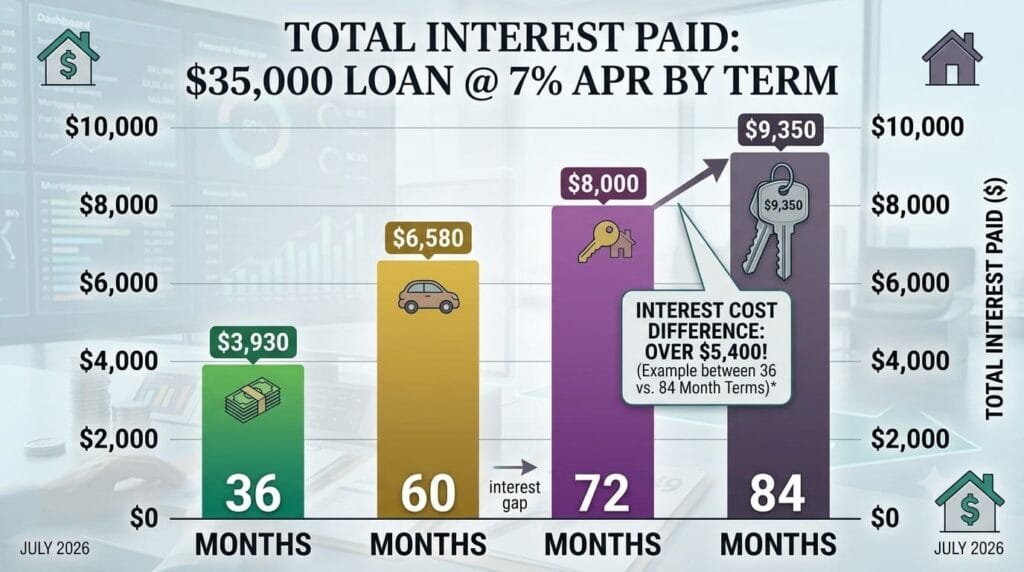
Run the math on a $35,000 loan at 7% APR and the difference is stark. (If you want to plug in your own numbers instead of mine, FinToku’s Car Payment & In-House Financing Calculator will run the monthly payment and total interest for any loan amount, rate, and term.)
| Term | Monthly payment | Total interest paid |
|---|---|---|
| 36 months | ~$1,081 | ~$3,930 |
| 60 months | ~$693 | ~$6,580 |
| 72 months | ~$597 | ~$8,000 |
| 84 months | ~$528 | ~$9,350 |
That’s roughly $5,400 more in interest between the shortest and longest common term, on the exact same loan amount and rate. The monthly payment relief is real, but it isn’t free.
Buying used, private-party, or certified pre-owned
Used-car loans carry their own quirks. Three things compound to make used-car loans pricier per dollar borrowed than a new-car loan from the same lender. Faster first-year depreciation, more variance in a used vehicle’s actual condition, and lenders capping loan terms lower (or refusing to finance anything past roughly 10 model years or 125,000 miles) all add up.
If you’re buying from a private seller rather than a dealer, your lender options narrow. Navy Federal, PenFed, LightStream, and USAA all handle private-party loans, but plenty of online marketplaces don’t. Certified pre-owned (CPO) vehicles sometimes get a small break: manufacturer-backed CPO programs from brands like Toyota, Honda, and BMW occasionally publish promotional rates one to two points below their standard used-car APR. Ask specifically before you finance.
How to actually shop for the best rate
- Check your credit score first. You need at least good credit, generally a score of 670 or higher, to land anywhere near the average rates above.
- Get preapproved with three to five lenders inside a short window. Most credit scoring models group auto-loan inquiries made within roughly two weeks into a single hit on your score, so rate-shopping doesn’t cost you the way people assume it does. FinToku’s Loan Comparator is built for exactly this — line up the offers you get back side by side and see which one actually wins on total cost, not just the advertised rate.
- Compare APR, not the advertised rate. APR bakes in fees; a 5.9% rate with $500 in fees can cost more than a 6.1% rate with none.
- Put down 10–20%. A bigger down payment lowers what you finance and can shave a quarter to half a point off your rate, since you’re borrowing less of the vehicle’s value.
- Bring your best offer to the dealer and ask them to beat it. Don’t let the finance office set the number first.
If you want to go deeper on the negotiation side before you walk into a dealership, this car-buying negotiation guide is worth a read. Heads up, that’s a link I’d earn a small commission on if you buy through it (more on that in FinToku’s affiliate disclosure).
Refinancing: the fix if you already took a bad rate
Refinancing an auto loan replaces your current loan with a new one, ideally at a lower rate, and it’s the standard fix if you financed through a dealer without shopping around first or if your credit has improved since you borrowed.
If you’re in my old position, a rate you didn’t shop for, refinancing is very much on the table. Per Experian’s Q1 2026 report, the average refinanced interest rate in Q1 2026 was 8.05%, down from 10.29% before refinancing, which lowered the average monthly payment by $81 for consumers who refinanced during the quarter. Credit unions handled the largest share of that refinancing activity, at 63.43%.
Refinancing makes the most sense if your credit has improved since you first borrowed, if rates have dropped, or if you took a dealer-marked-up rate the first time around (which, statistically, a lot of first-time buyers do).
Where the best rates actually come from: real lenders, real rates
Credit unions dominate the low end of the market right now, and it isn’t close. Navy Federal Credit Union currently advertises the lowest widely-available new-car rate at 3.89% APR. Here’s what’s actually advertised as of early-to-mid July 2026:
The 2026 rate table
| Lender | Type | New-car APR from | Notes |
|---|---|---|---|
| Navy Federal Credit Union | Credit union (military) | 3.89% | Lowest widely-advertised rate this month; membership requires a military/DoD connection |
| PenFed Credit Union | Credit union (open to all) | 3.39% via car-buying service, 4.19% without | Anyone can join with a small account opening; rate gap for skipping the car-buying service is real |
| Southeast Financial Credit Union | Credit union (open to all) | 3.50% on short (12-month) terms | Rates rise on longer terms; a 60-month loan runs closer to 5.50% |
| Carputty | Direct lender / credit line | 4.33% | Six-figure financing available; requires 680+ credit |
| Chase Bank | National bank | 5.84% | Own-site example: $45,000 new-car loan, 60 months, excellent credit; refinance quotes run closer to 6.29% |
| myAutoLoan | Lending marketplace | 6.49% | Sends your application to multiple lenders at once; works with scores as low as 600 |
| LightStream | Online bank (Truist) | 6.49% with autopay | Unsecured loan, funds go straight to you, no vehicle lien; good-to-excellent credit only |
| Autopay | Refinance marketplace | 4.85% | Shops your file across a large lender network; useful below 700 FICO |
| Tenet | Direct lender | 5.99% | Specializes in EV and plug-in hybrid financing only |
Rates are “as low as” figures for the most qualified borrowers, pulled directly from each lender’s published rate page and Bankrate/LendingTree’s most recent reviews as of July 2026. Your actual offer will depend on your credit, term, and the vehicle. Capital One is a notable exception: Bankrate’s own review confirms Capital One doesn’t publish an APR range at all, so a prequalification is the only way to see where you’d land.
What the patterns mean for you
A few patterns stand out here:
- Credit unions consistently win on rate because they’re member-owned and don’t need to build a dealer-style markup into the price. The catch is membership: Navy Federal and USAA require a military or DoD connection, while PenFed and Southeast Financial are open to anyone willing to open a small savings account.
- Marketplaces like myAutoLoan and Autopay don’t lend directly. They shop your application across their lender network, which is genuinely useful if your credit is closer to fair than excellent.
- Online lenders like LightStream move fast and skip the vehicle lien entirely, but they’re strictly for borrowers with strong credit already.
- Specialty lenders like Tenet only make sense if you’re already narrowed in on an EV; otherwise a generalist lender will usually beat them.
- National banks are a mixed bag on transparency. Chase actually publishes real rate examples on its own site (5.84% APR on a $45,000, 60-month new-car loan for excellent credit as of late June 2026), while Capital One and Bank of America don’t publish ranges at all and only show you a number after a soft-pull prequalification.
- Dealership financing is the most convenient in the moment and the most likely to carry a markup, unless you arrive with a competing offer already in hand.
A new tax break most car buyers haven’t heard of yet
Interest on qualifying new-car loans is now federally tax-deductible, up to $10,000 a year, for tax years 2025 through 2028, under the One Big Beautiful Bill Act (OBBBA). It’s a break that didn’t exist the last time most people financed a car.
You don’t have to itemize to claim it, but the fine print narrows things fast. Per IRS guidance on the deduction, the vehicle must be new (used cars don’t qualify), personally used, under 14,000 pounds, and finally assembled in the U.S. That last requirement covers roughly half of vehicles sold domestically, per the IRS.
The loan itself must have originated after December 31, 2024. Eligibility phases out above $100,000 of modified adjusted gross income for single filers ($200,000 for joint filers), and disappears entirely at $150,000 ($250,000 joint).
Don’t expect a $10,000 windfall, though. Cox Automotive’s analysis of a typical 72-month new-car loan puts first-year interest at somewhere around $3,000 to $3,800. That means most qualifying buyers will see their taxable income reduced by a few thousand dollars, not the full cap, which works out to a few hundred dollars of actual tax savings depending on your bracket. It’s real money, just not the headline number some people are expecting.
The bigger picture: auto debt in 2026
U.S. auto loan debt hit a record $1.685 trillion in the first quarter of 2026, and the subprime tier is carrying almost all of the strain from that debt load, not prime borrowers.
That balance is up another $18 billion from the previous quarter alone, according to LendingTree’s analysis of New York Fed data. It isn’t happening in a vacuum, either: auto debt has grown 57.3% over the past decade, from $1.071 trillion in Q1 2016. Americans took out roughly $182 billion in new auto loans in that single quarter, split about $104 billion for borrowers under 50 and $78 billion for borrowers 50 and older, per New York Fed data.
Subprime borrowers are also making up a growing share of that lending: Experian puts subprime’s share of total vehicle financing at 15.75% in Q1 2026, up from 14.40% a year earlier, as lenders extend credit access even as affordability worsens.
The strain is showing up most in the subprime tier. Subprime 60-plus-day delinquencies hit a record 6.90% in January 2026, per Fitch Ratings’ subprime auto ABS index, as tracked by Wolf Street, a 32-year high stretching back to 1994; the rate eased only slightly to 6.80% in February.
Repossession volumes have followed: lenders had already repossessed more than 2.2 million vehicles by the end of 2025, with industry projections putting the full-year total above 3 million — numbers last seen in the aftermath of the 2008 financial crisis, per CU Repossessions’ analysis of Recovery Database Network data, as reported by Newsweek. Prime borrowers, by contrast, remain in solid shape, with 60-plus-day delinquencies holding near 0.5-0.6% throughout 2025 – a more-than-tenfold gap versus subprime. Lower-credit-tier buyers who stretched into longer, larger loans are feeling almost all of that pain.
Key Takeaways
- Average new-car auto loan APR sits at 6.93% for a 60-month term as of July 2026, but credit tier drives your actual rate far more than the market average does.
- Super-prime borrowers pay around 4.7% on new cars versus roughly 16% for deep-subprime borrowers, a gap of over 11 percentage points.
- Loan terms are stretching longer: over a third of new-car loans now run past six years, which lowers the monthly payment but adds thousands in extra interest.
- Getting preapproved with a bank or credit union before visiting a dealership is the single most effective way to avoid a dealer markup.
- U.S. auto loan debt hit a record $1.685 trillion in Q1 2026, and subprime delinquencies hit a 32-year high of 6.90% in January 2026. Refinancing activity is rising as borrowers who took high first-time rates look to correct course.
- New federal law lets you deduct up to $10,000 a year in interest on a qualifying new, U.S.-assembled car loan through 2028, even if you don’t itemize. Most buyers will see a few hundred dollars of real savings rather than the full cap.
Frequently Asked Questions
What credit score is needed to buy a car? You’ll get the most favorable terms with good or excellent credit, a score of 670 or higher. Lower scores can still qualify, just at meaningfully higher APRs.
Can I negotiate my auto loan rate? Yes. If you’re financing through a dealer, the rate they offer can be higher than what the underlying lender actually proposed, since dealers can mark it up. Bringing a competing preapproval gives you real leverage.
What are typical used car loan interest rates? Experian’s most recent data puts used-car APRs at roughly 7.7% for super-prime borrowers up to nearly 22% for deep-subprime borrowers, generally running a bit above new-car rates at the same credit tier.
Why would a lender deny an auto loan application? Common reasons include a low credit score, a high debt-to-income ratio, or income the lender can’t verify.
Can I deduct car loan interest on my taxes? Yes, if the vehicle is new, U.S.-assembled, for personal use, and the loan originated after December 31, 2024. The deduction caps at $10,000 a year through 2028 and phases out above $100,000 of income for single filers.
Is it better to get a longer loan term for a lower payment? It lowers your monthly payment, but it isn’t free. Stretching a $35,000, 7% APR loan from 60 to 84 months adds roughly $2,800 in extra interest, and keeps you upside-down on the car for longer.
If you’re weighing your own numbers, run a few loan-amount and term combinations before you commit. The difference between a 60-month and 84-month term is bigger than it looks on a monthly-payment sticker.
By Saad Faisal · Published July 11, 2026 · Updated July 11, 2026
Disclaimer
This article shares general information, not personalized financial, tax, or legal advice — every lender prices risk a little differently, and rates move week to week. The specific numbers here (the credit-tier APRs, the $35,000 loan-term comparison, the OBBBA deduction phase-outs) are examples pulled from the sources cited above, not guarantees of what you’ll be offered. Before you sign anything, confirm current rates directly with a lender and check the tax-deduction details with a tax professional who can look at your actual return. For more, see FinToku’s full Financial Disclaimer.