

Figuring out how much house you can afford isn’t the same question as “how much will a lender approve me for.” Here’s how to actually work out your number.
Quick answer: most lenders cap your housing payment at 28% of gross monthly income and your total debt at 36% (the 28/36 rule), which for a $90,000 salary works out to roughly $2,100 a month in housing costs before taxes and insurance eat into that. But “what a lender approves” and “what actually feels comfortable” are two different numbers, and the gap between them is where most home-buying regret comes from.
The two rules everyone actually uses
Two shortcuts show up again and again, whether you’re talking to a loan officer or reading a financial planner’s blog.
The 28/36 rule. Your monthly housing costs (principal, interest, property taxes, and insurance, sometimes shortened to PITI) shouldn’t exceed 28% of your gross (pre-tax) monthly income. Your total debt, including that housing payment plus car loans, student loans, and credit cards, shouldn’t exceed 36%. Conventional lenders lean on this ratio constantly, though FHA loans allow a looser 31/43 split and VA loans use a single combined 41% ceiling.
The income-multiple rule. A simpler gut check: aim for a home priced at roughly 2.5 to 4 times your gross annual income. It ignores your specific debt load and the mortgage rate you’re locked into, so treat it as a sanity check, not a spreadsheet.
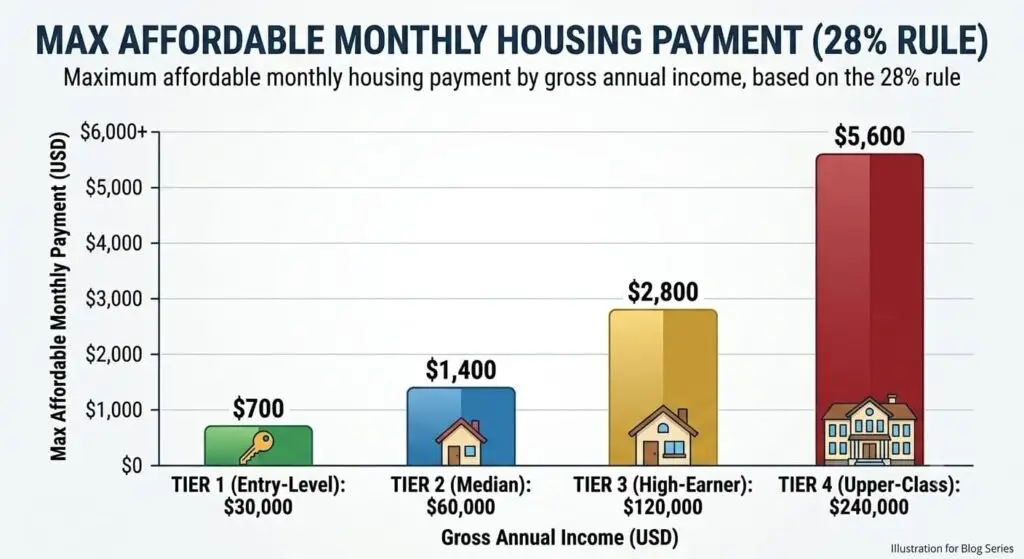
Here’s roughly how those two rules translate across a few income levels. These are illustrative: your real number depends on your rate, down payment, and debts, so treat this as a starting point, not a promise.
| Gross annual income | Max housing payment (28% rule) | Rough home price range (2.5–4x income) |
|---|---|---|
| $60,000 | ~$1,400/mo | $150,000–$240,000 |
| $90,000 | ~$2,100/mo | $225,000–$360,000 |
| $120,000 | ~$2,800/mo | $300,000–$480,000 |
| $180,000 | ~$4,200/mo | $450,000–$720,000 |
[GRAPHIC: bar chart comparing max monthly housing payment across the four income tiers above. Alt text: “Maximum affordable monthly housing payment by gross annual income, based on the 28% rule”]
Notice the home-price range is wide. That’s the point: a $90,000 earner with no other debt and a big down payment lands near the top of that range, while the same earner with a car payment and student loans lands near the bottom, sometimes below it.
What actually shows up in your monthly payment
I used to think “mortgage payment” just meant principal and interest. It doesn’t, and this is where a lot of first-time buyers get surprised.
Your full monthly housing cost usually breaks down into five pieces:
- Principal and interest: the actual loan repayment, driven by your rate and term
- Property taxes: vary enormously by state, from under 0.3% of home value a year in Hawaii to over 2.2% in New Jersey
- Homeowners insurance: typically $1,200–$3,000+ a year depending on your location and the home’s age
- PMI (private mortgage insurance): kicks in if your down payment is under 20%, usually 0.5%–1.5% of the loan amount annually
- HOA fees: only if the property has one, but they can run $200–$500 a month in some communities and lenders count them against your DTI
On a $400,000 home in a high-tax state, property taxes and insurance alone can add $700–$900 a month on top of principal and interest. Skip that step and you’ll underestimate your real payment by a wide margin.
How much your interest rate actually moves the number
This is the variable people underestimate the most. As of mid-2026, 30-year fixed rates have been sitting in the mid-6% range, but even a small shift matters more than most buyers expect.
Take a $400,000 loan on a 30-year fixed term. At 6%, principal and interest run about $2,398 a month. Push that same loan to 7%, and you’re paying roughly $2,661, about $263 more every month for the exact same house. Roughly speaking, every quarter-point rate increase shaves 2–3% off the home price you can afford at a fixed monthly payment. That’s real money, and it’s exactly why getting quotes from more than one lender is worth the hour it takes. Your credit score is a big part of which rate you actually get offered, so it’s worth checking yours before you start shopping, not after.
The gap between “qualify for” and “should spend”
Here’s the thing nobody tells you until you’re sitting across from a loan officer: the amount a lender approves you for is usually the most you could stretch to, not a recommendation. Conventional lenders will sometimes go up to 45% DTI, and FHA loans can stretch past 55% in certain cases. That doesn’t mean you should use all of it.
Buying at your absolute max is how people end up “house poor”: approved for the loan, but with nothing left over for a broken water heater, a slow month at work, or, you know, actually enjoying the house. A rough guideline I like: aim to spend around 80% of your maximum approval. If a lender says you qualify for $400,000, shopping in the $320,000–$350,000 range usually leaves real breathing room.
Two other things worth factoring in before you get attached to a number:
- Closing costs typically run 2%–5% of the loan amount, on top of your down payment.
- Annual maintenance is commonly budgeted at around 1% of the home’s value. On a $350,000 home, that’s roughly $3,500 a year, or close to $300 a month, that most affordability calculators quietly leave out.
How much house can you afford, step by step
- Add up your gross monthly income: salary before taxes, plus any co-borrower’s income if you’re buying together.
- List your existing monthly debts: car payments, student loans, credit card minimums, anything recurring.
- Run the 28/36 math to get your lender-approved ceiling.
- Subtract your actual monthly expenses: groceries, childcare, the gym membership you keep meaning to cancel. Lenders don’t see these, but your bank account does.
- Land on a number below the ceiling that still leaves 3–6 months of expenses in savings after closing.
If step 4 feels tedious, it’s worth doing properly rather than eyeballing it. I built out a full monthly budget in a spreadsheet before I ever looked at listings, and it changed my target price by almost $40,000 from what the lender initially approved. (If you don’t already have a budgeting system you like, “You Need A Budget” by Jesse Mecham is worth the few hours it takes to read.)
Once you have a real monthly number in mind, it’s worth running it through an actual mortgage calculator rather than guessing backward from a home price. I plugged a few scenarios into FinToku’s Mortgage & Home Loan Calculator before writing this, and seeing the principal-and-interest split change across different rates made the “quarter-point matters” point above a lot more concrete than it sounds on paper.
Key takeaways
- The 28/36 rule caps your housing payment at 28% of gross monthly income and total debt at 36%, though FHA and VA loans allow more room.
- Your real monthly cost includes property taxes, insurance, PMI, and HOA fees, not just principal and interest.
- A quarter-point rate increase typically cuts your affordable home price by 2–3% for the same monthly payment.
- Lender pre-approval shows your maximum, not a recommendation. Aiming for around 80% of that ceiling leaves room for maintenance, emergencies, and closing costs.
- Budget separately for closing costs (2–5% of the loan) and annual maintenance (around 1% of home value).
FAQ
What is the 28/36 rule for home affordability?
The 28/36 rule says your housing costs shouldn’t exceed 28% of your gross monthly income, and your total debt payments (housing plus car loans, student loans, and credit cards) shouldn’t exceed 36%. It’s the most common benchmark conventional lenders use, though it’s a guideline, not a legal limit.
How much house can I afford on a $100,000 salary?
At $100,000 a year, your gross monthly income is about $8,333. Using the 28% rule, your maximum housing payment would be roughly $2,333 a month, which (depending on your rate, down payment, and existing debt) typically translates to a home in the $300,000–$450,000 range.
Is it different for FHA or VA loans?
Yes. FHA loans generally allow a 31/43 DTI split instead of 28/36, and VA loans use a single combined debt ratio around 41%. Both can stretch your qualifying amount further than a conventional loan, but a higher ceiling isn’t automatically a better financial decision.
What does it mean to be “house poor”?
Being house poor means your mortgage payment takes up so much of your income that you have little left for savings, emergencies, or everyday spending, even though you technically qualified for the loan. It’s the most common reason financial planners recommend spending below your maximum approval, not at it.
How much does a higher interest rate actually cost me?
On a $400,000 loan, moving from a 6% to a 7% rate adds roughly $260 to your monthly payment for the identical home. As a rough rule, every quarter-point rate increase reduces the home price you can afford by about 2–3% at the same monthly payment.
Ready to run your own numbers?
Try FinToku’s Mortgage & Home Loan Calculator to see how your rate, down payment, and loan term change your real monthly payment before you start touring homes.
This article is for general informational purposes only and shouldn’t be taken as financial or tax advice. The income levels, rates, and home prices used above are illustrative examples, not guarantees. Mortgage rates and lending standards shift often, so confirm current numbers with a lender before making a real decision. Everyone’s financial situation is different; it’s worth checking with a qualified mortgage professional or financial advisor who can look at your specific numbers. See FinToku’s full Financial Disclaimer.
(Quick heads up: the book link above is an affiliate link, and FinToku may earn a small commission if you buy through it. I only link to things I’d actually recommend. Full details in our Affiliate Disclosure.)
By Saad Faisal · Published July 8, 2026 · Updated July 8, 2026