
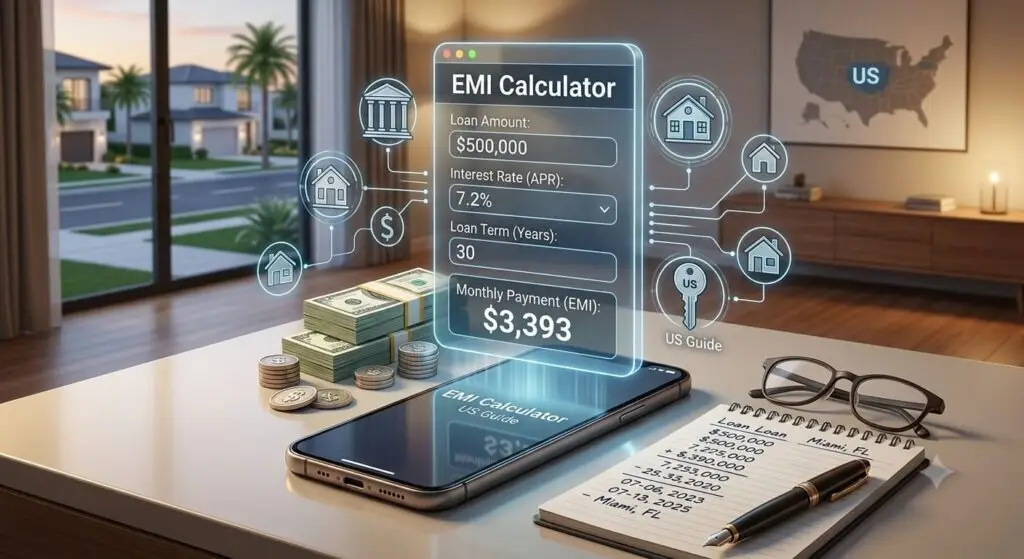
My cousin in Mumbai texted me his home loan “EMI” last year like it was the most obvious term in the world. I just stared at the message for a second. I’d financed a car and a mortgage in the US by then, and I’d never once used an EMI calculator by that name – I just called it a monthly payment calculator. Turns out I’d been running the exact same math my whole life.
An EMI calculator estimates the fixed amount you’ll pay each month toward a loan. It combines principal and interest, based on your loan amount, interest rate, and term. If you’re in the US, you’ve already used this math – on a mortgage, auto loan, or personal loan. EMI is just the term the rest of the world uses for it. Punch in your three numbers and the calculator does the rest.
EMI (Equated Monthly Installment) is the fixed payment a borrower makes every month on a loan. It combines principal repayment and interest, and continues until the loan is paid off in full. It’s most common in India, the UK, and the Middle East. In the US, people usually just call the same fixed payment a “monthly loan payment.”
Why You’re Seeing “EMI” on a US Loan
Here’s the thing that would’ve saved me some confusion: EMI and “monthly payment” aren’t two different calculations. They’re the same formula with a regional name attached. Say you’re comparing a US lender’s quote against an EMI figure from an Indian bank, a UK building society, or a Dubai lender. If the loan amount, rate, and term match, the numbers should land in the same place once you convert currency. The math doesn’t care what you call it.
Where it does get confusing is language. US lenders talk about APR, “monthly payment,” and amortization schedules. International and expat-focused sites talk about EMI, tenure, and processing fees. Maybe you’re a US-based borrower who’s run into “EMI” while researching an international lender or refinancing from abroad. Or maybe you just found this EMI calculator through search. Either way, you’re in the right place – everything below uses dollars and US loan conventions.
The EMI Calculator Formula (and How to Actually Calculate It)
The formula looks intimidating the first time you see it, but it’s really just three inputs feeding one equation:
EMI = [P × r × (1+r)ⁿ] / [(1+r)ⁿ – 1]
- P = principal (the amount you’re borrowing)
- r = your monthly interest rate (annual rate ÷ 12)
- n = total number of monthly payments (loan term in months)
Say you borrow $25,000 at a 7% annual rate for 5 years. Your monthly rate is 7% ÷ 12 = 0.5833%, and n = 60 months. Run that through the formula and you get an EMI of $495.03 a month. Over the full 5 years, you’d pay $29,701.80 total – meaning $4,701.80 of that is interest.
I ran this exact scenario through FinToku’s EMI Calculator before writing this, mostly to double-check my own math. It landed on the same number. That’s really the whole value of using a calculator instead of the formula by hand – one typo in the exponent and you’re off by hundreds of dollars.
What Actually Changes Your Monthly Payment
Three things move your EMI, and they don’t move it equally.
Loan amount. This one’s linear – borrow twice as much, pay roughly twice as much per month, all else equal.
Interest rate. This is where people underestimate the impact. A rate that looks “close enough” on paper compounds differently over years. Even half a percentage point can shift your total interest by hundreds of dollars on a mid-size loan.
Loan term. Longer terms lower your monthly payment but raise your total interest cost. Shorter terms do the opposite. There’s no universally “right” answer – it depends on whether you’re optimizing for monthly cash flow or total cost.
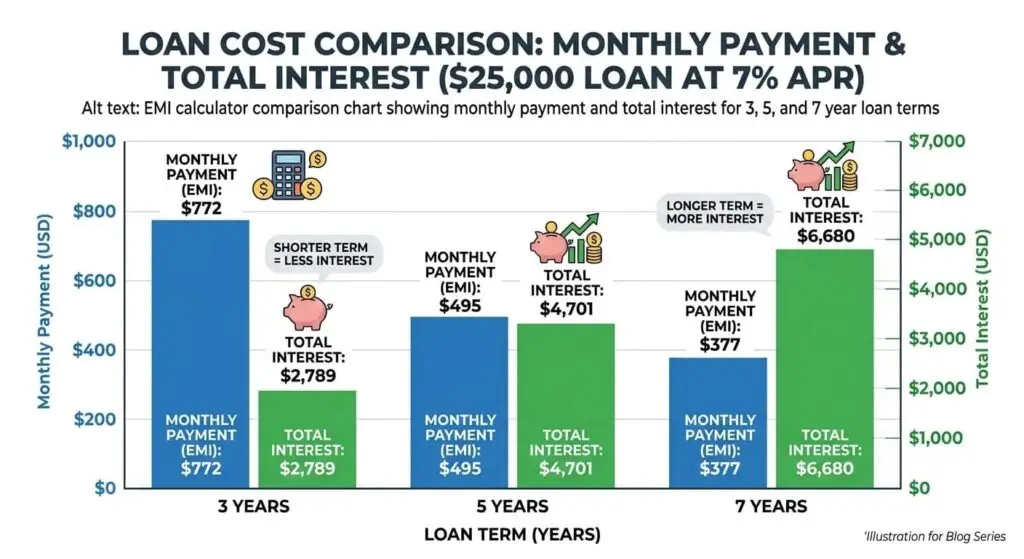
Here’s what that $25,000 loan at 7% looks like across three common term lengths:
| Loan Term | Monthly Payment | Total Interest Paid | Total Paid |
|---|---|---|---|
| 3 years | $771.93 | $2,789.39 | $27,789.39 |
| 5 years | $495.03 | $4,701.80 | $29,701.80 |
| 7 years | $377.32 | $6,694.63 | $31,694.63 |
Going from a 3-year to a 7-year term cuts your monthly payment by more than half. But it more than doubles the interest you’ll pay over the life of the loan. Neither choice is wrong – it just depends on what you’re actually solving for.
Fixed Rate vs. Variable Rate: Does Your EMI Change?
On a fixed-rate loan, no – your EMI stays exactly the same every month until payoff, regardless of what market rates do. That’s most US auto loans, personal loans, and fixed-rate mortgages.
On a variable-rate loan, your payment can shift when the underlying index rate resets. That covers adjustable-rate mortgages, some private student loans, and certain lines of credit. Some lenders instead keep your payment fixed and quietly extend the term when rates rise. So it’s worth asking your lender which one you have – don’t assume. The Consumer Financial Protection Bureau has a breakdown of fixed vs. adjustable-rate mortgages, and it’s a solid five-minute read before you sign anything with an ARM attached.
Honestly, I think a lot of borrowers skip this question because the initial rate on a variable loan looks better. Then they get surprised two years in. If a lender can’t clearly say whether your rate is fixed or variable, push on that before you sign anything.
What Happens If You Prepay
Paying extra toward principal – even $50 or $100 a month on top of your EMI – shortens your loan term and cuts your total interest. That’s because a smaller balance means the lender charges less interest on it. On that same $25,000 / 7% / 5-year loan, an extra $100 a month would shave off roughly a year. You’d save several hundred dollars in interest too.
A few things to check before you do this. Some US lenders charge a prepayment penalty, particularly on mortgages within the first few years. The CFPB’s guide to prepayment penalties explains what to look for in your closing documents and what questions to ask before you sign. Others let you prepay freely, but apply the extra amount to a future payment instead of the principal – unless you specifically mark it “principal only.” I got this wrong myself on an early auto loan payment. I assumed extra money automatically went to principal, and it took a call to the lender to fix it.
EMI Calculators by Loan Type
The formula stays identical across loan types – what changes is the range of numbers you’re plugging in and what else might be layered on top.
- Mortgage / home loan: Largest principal and longest term, often 15-30 years. You’ll usually need to add property tax and insurance separately from the core EMI.
- Auto loan: Shorter term (3-7 years typically), and the rate often depends heavily on your credit tier.
- Personal loan: Usually unsecured, shorter terms, and typically a higher rate than a mortgage or auto loan since there’s no collateral backing it.
- Student loan: Often has a deferment or grace period before EMI-style payments start. The basic formula above doesn’t account for that on its own. One thing in your favor: federal law bans prepayment penalties on both federal and private student loans, so extra payments always go toward cutting your balance faster – no catch.
If you’re weighing more than one loan offer side by side, run each through a Loan Comparator rather than eyeballing the rate sheets. A lower rate with a longer term can end up costing more than a slightly higher rate on a shorter one.
Key Takeaways
- EMI stands for Equated Monthly Installment. It’s the same fixed monthly payment US borrowers call a “loan payment” – just under a different name used mainly outside the US.
- The EMI formula uses three inputs: principal, monthly interest rate, and number of months. A $25,000 loan at 7% for 5 years works out to $495.03/month.
- Longer loan terms lower your monthly EMI but increase total interest paid; shorter terms do the reverse.
- Your EMI stays fixed on a fixed-rate loan, but can change over time on a variable-rate loan.
- Prepaying extra toward principal shortens your loan and cuts total interest, but check for prepayment penalties first.
Frequently Asked Questions
Is EMI the same as a loan payment?
Yes. EMI and “monthly loan payment” describe the same fixed monthly amount covering principal and interest. India, the UK, and the Middle East commonly use the term EMI, while US lenders default to “monthly payment.”
What does EMI stand for?
EMI stands for Equated Monthly Installment. It’s “equated” because the payment amount stays the same every month for the life of a fixed-rate loan – even though the split between principal and interest shifts over time.
How do you calculate EMI in the US?
The formula is identical everywhere: EMI = [P × r × (1+r)ⁿ] / [(1+r)ⁿ – 1]. P is your loan amount in dollars, r is your monthly interest rate, and n is the number of monthly payments. A US lender builds its amortization schedule on this same math.
Is an EMI calculator accurate for US loans?
It’s accurate for estimating principal and interest, since that math doesn’t vary by country. It won’t automatically include US-specific extras like PMI, property tax escrow, or origination fees – unless the calculator specifically asks for them. Confirm those separately with your lender.
What’s the difference between EMI and APR?
EMI is a dollar amount (your monthly payment). APR is a percentage rate – per the CFPB, it reflects your interest rate plus points, broker fees, and other loan charges, not just the base rate. Two loans with the same EMI can still have different APRs if their fee structures differ. That makes APR the better number for comparing offers side by side.
Does EMI include both principal and interest?
Yes – every EMI payment splits between paying down principal and covering interest. Early in the loan, more of each payment goes to interest. Later on, more goes to principal, even though the total payment amount doesn’t change.
Run your own numbers through FinToku’s EMI Calculator before you commit to a rate – it takes less time than reading this article did.
Disclaimer
This article is for general informational purposes only and shouldn’t be taken as financial or lending advice. The $25,000 loan example above uses illustrative numbers, not a quote. Your actual rate, term, and fees will depend on your lender and credit profile. Before taking out a loan, run your specific numbers by a loan officer or financial advisor – they can look at your full picture. You can also read FinToku’s full Financial Disclaimer.
By Saad Faisal · Published July 9, 2026