

You’ve made the same resolution before: this is the year you finally get your money together. Then March hits, something breaks, and the plan quietly disappears. That’s not a willpower problem. It’s usually a goal-setting problem.
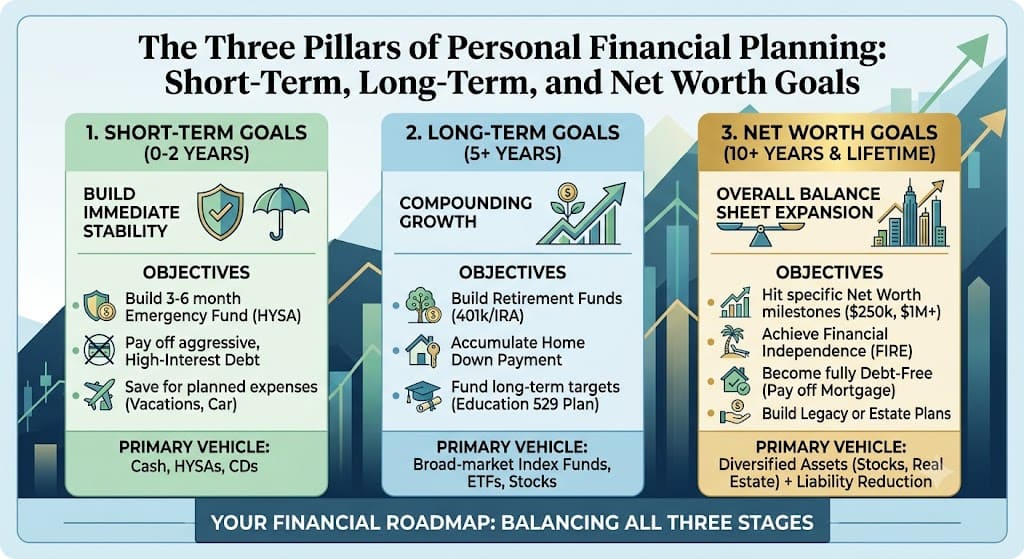
Setting financial goals every year matters because your income, expenses, and debts change every year too, even when it doesn’t feel like it. A useful annual goal list covers three things: a short-term cushion (your emergency fund), a medium-term cleanup (high-interest debt and your budget), and a long-term push (retirement and bigger purchases). Do all three, even in small amounts, and you’re ahead of most people.
Why “Save More Money” Isn’t a Real Goal
A goal like “save more” or “get better with money” fails for a simple reason: it’s not measurable, so you can never actually finish it. The SMART framework fixes that by forcing five details into every goal: Specific, Measurable, Achievable, Relevant, and Time-bound.
In practice that means turning “save more” into “set aside $3,600 in a high-yield savings account by December 31.” One version you can track week to week. The other just sits there making you feel vaguely guilty.
A quick gut check before you write anything down: 90% of Americans said they set a financial goal for the year, according to a 2025 NerdWallet/Harris Poll survey, but nearly half either weren’t on track to hit it or weren’t sure. Vague goals are almost certainly why.
Short-Term Financial Goals (Next 6-12 Months)
These are the goals with the most immediate payoff, and they’re the right place to start if you haven’t set any goals before.
Build (or Rebuild) Your Emergency Fund
An emergency fund is 3-6 months of essential expenses parked somewhere you can reach in a day or two, not invested and not sitting in your checking account where it blends in with rent money. The point isn’t growth. It’s a wall between a bad week and a bad year.
Right now that wall matters more than usual. Only 47% of Americans say they could cover a surprise $1,000 expense from savings, per Bankrate’s 2026 Emergency Savings Report, and 29% say they’re carrying more credit card debt than emergency savings. If either of those describes you, this goal jumps to the top of the list, ahead of almost everything else here.
Start smaller than you think you need to. A $500 or $1,000 starter fund covers most one-off emergencies (a car repair, a vet bill) while you build toward the full 3-6 months. Automate a fixed transfer on payday so it happens before you can spend the money, and keep it in a high-yield savings account rather than a regular one. The gap is bigger than it looks: the national average savings rate was 0.38% APY in mid-2026, while the top high-yield accounts were paying north of 4%. On a $5,000 balance, that’s the difference between earning about $19 a year and about $200.
Run your own numbers through FinToku’s Emergency Fund Calculator to see what your actual 3-6 month target looks like.
Pay Off High-Interest Debt
High-interest debt, mainly credit cards, works against every other goal on this list because the interest is compounding faster than almost anything you could realistically earn by saving instead. The average APR on credit card accounts carrying a balance hit 22.15% in Q2 2026, according to Federal Reserve data reported by LendingTree, and the average American now carries somewhere around $6,600-$6,700 in credit card debt.
Two payoff methods work, and the “best” one is whichever you’ll actually stick with:
- Debt snowball: pay minimums on everything, then throw extra money at your smallest balance first. Faster wins, more motivation.
- Debt avalanche: pay minimums on everything, then throw extra money at your highest-interest balance first. Slower wins, less total interest paid.
If you’ve stalled out on a payoff plan before, the snowball method’s quick early wins are usually the more honest choice. There’s also a piece on FinToku about common financial mistakes that keep people stuck that’s worth a look if debt keeps creeping back after you pay it down.
Build (or Fix) a Real Budget
A budget isn’t a spreadsheet you fill out once and abandon. It’s the thing that tells you, honestly, whether your other goals are realistic given what you actually earn and spend. If you’ve never tracked a full month of spending against income, that’s goal one, before any dollar targets.
Two percentage-based methods show up constantly in financial planning, and they solve slightly different problems:
| Rule | Needs/Bills | Wants | Savings/Debt | Best for |
|---|---|---|---|---|
| 50/30/20 | 50% | 30% | 20% | Balanced budgets with moderate fixed costs |
| 70/20/10 | 70% | (folded into the 70%) | 20% savings + 10% debt/giving | Higher cost-of-living areas or tighter cash flow |
Neither rule is a law. Pick whichever percentages you can actually hit for three months running, then adjust. FinToku’s Budget Planner & 50/30/20 Calculator will split your take-home pay for you automatically if you want a starting point.
Long-Term Financial Goals (1+ Years)
Long-term goals take longer to show progress, which is exactly why they’re easy to keep pushing to “next year.” Set at least one now.
Increase Your Retirement Contribution
If your employer offers any kind of 401(k) or 403(b) match, contributing enough to capture the full match is close to a guaranteed return, something almost nothing else on this list can claim. Beyond the match, a common rule of thumb is contributing 10-15% of gross income toward retirement across all accounts.
If that number feels impossible right now, don’t let that stop you from doing something. Even a 1% increase this year, automated so you never see the money, compounds meaningfully by the time you actually need it. FinToku’s Retirement Calculator can show you what a small contribution bump actually turns into over 20 or 30 years. If you’re earlier in your career, Retirement Planning in Your 20s walks through the account types in plain language.
Save Toward a Major Purchase
A home down payment, a car, or a wedding all work the same way mathematically: pick the number, pick the date, then divide. Saving 10-20% of a home’s price is the standard target for avoiding private mortgage insurance (PMI), though plenty of buyers put down less and accept the PMI cost as a trade-off for buying sooner.
Keep major-purchase savings separate from your emergency fund. Mixing the two means a car repair can quietly eat your house down payment, and neither goal gets fully funded.
Increase Your Net Worth, Not Just Your Bank Balance
Net worth (what you own minus what you owe) is a more honest scoreboard than your checking account balance, because it accounts for the debt you’re carrying alongside whatever you’re saving. Set a target of checking it quarterly rather than obsessing over it monthly. FinToku’s Financial Health Score Calculator is a fast way to get a snapshot if you’ve never calculated it before.
Common Mistakes That Derail Annual Financial Goals
Setting the goal is the easy part. Here’s where most people actually lose the thread:
- Too many goals at once. Pick two or three for the year, not eight. Split attention gets you partial progress on everything and full progress on nothing.
- No number attached. “Save more” isn’t trackable. “Save $3,600” is.
- No automation. Goals you have to remember to act on monthly get skipped the first busy month.
- Emergency fund and major-purchase savings in the same account. They compete with each other every time something goes wrong.
- Never revisiting the goal. A quarterly check-in, even five minutes, catches drift before it becomes a wasted year.
Financial Goal Benchmarks (as of mid-2026)
| Metric | Current figure | Source |
|---|---|---|
| Americans who set a financial goal for the year | 90% | NerdWallet/Harris Poll, 2025 |
| Americans who could cover a $1,000 emergency from savings | 47% | Bankrate Emergency Savings Report, 2026 |
| Average credit card debt per American | ~$6,595-$6,715 | TransUnion / Capital One, early 2026 |
| Average APR on credit card accounts accruing interest | 22.15% | Federal Reserve G.19 / LendingTree, Q2 2026 |
| National average savings account rate | 0.38% APY | NerdWallet, July 2026 |
| Top high-yield savings account rates | ~4.15-4.21% APY | Bankrate / CNBC, July 2026 |
Key Takeaways
- A financial goal only works if it’s specific and measurable: “save $3,600 by December” beats “save more,” every time.
- Build a starter emergency fund of $500-$1,000 before anything else if you don’t have savings that could cover a surprise expense today.
- High-interest credit card debt, averaging over 22% APR in 2026, should usually be paid down before extra money goes toward long-term investing.
- Automate contributions to retirement and savings goals so progress doesn’t depend on remembering to act each month.
- Pick two or three goals for the year, not eight, and check in on them quarterly rather than only at year-end.
Frequently Asked Questions
What are 5 good financial goals to set? A solid annual list usually includes: building a 3-6 month emergency fund, paying off high-interest debt, contributing enough to capture any employer retirement match, creating a working budget, and saving toward one specific bigger purchase (a home, car, or similar).
What’s the difference between short-term and long-term financial goals? Short-term financial goals are ones you can realistically hit within about a year, like a starter emergency fund or paying off a single credit card. Long-term financial goals, like retirement savings or a home down payment, typically take several years or more.
What is the 70/20/10 rule for money? The 70/20/10 rule splits after-tax income into 70% for living expenses and discretionary spending, 20% for savings, and 10% for debt payoff or giving. It’s often used as an alternative to the 50/30/20 rule for people with higher fixed costs relative to income.
How many financial goals should I set at once? Two or three is realistic for most people in a given year. Trying to tackle debt payoff, an emergency fund, retirement, and a home down payment all at full speed simultaneously usually means none of them get funded consistently.
How often should I revisit my financial goals? A quarterly check-in is enough to catch a goal that’s drifted off track without turning your finances into a full-time hobby. Waiting until year-end to look means twelve months of unnoticed drift.
What is the $27.40 rule? The $27.40 rule is a daily savings challenge: set aside $27.40 every day, which works out to about $10,000 over a full year (365 x $27.40 is roughly $10,001). It’s less a formal financial principle than a way to make a five-figure savings goal feel like a small daily habit instead of one intimidating lump sum.
If you’re setting these goals for the first time this year, start with the emergency fund calculation and go from there. It’s less overwhelming than trying to plan the whole year at once.
Read More
- Sinking Fund vs. Emergency Fund: Which One Do You Actually Need?
- Retirement Planning in Your 20s: A Straightforward Guide
- Paycheck Budgeting for Beginners: How to Make Your Money Last Between Paydays
Disclaimer
This article is for general informational purposes only and shouldn’t be taken as financial or tax advice. The percentages and dollar figures used above (like the 70/20/10 and 50/30/20 splits) are examples, not guarantees, and everyone’s situation is different. Before making a real financial decision, it’s worth checking with a qualified financial advisor who can look at your specific income, debts, and goals. You can also read FinToku’s full Financial Disclaimer.
Published by Saad Faisal for FinToku (fintoku.com) · Published July 26, 2026 · Updated July 26, 2026 FinToku provides free finance tools and guides to help you make smarter money decisions.