

Being broke rarely comes down to income. The financial mistakes that keep people broke are usually a handful of ordinary, repeatable habits. Spending before saving, carrying credit card debt, skipping the emergency fund top the list. They quietly cancel out whatever comes in, no matter how large that number gets.
The fix isn’t a single dramatic move. It’s identifying which of these habits applies to you, then changing the order things happen in.
1. You spend first, save whatever’s left over
This is the habit almost every financial mistake on this list traces back to. Money comes in. You cover bills and “fun” spending first, and saving only happens if something’s left over. Most months, nothing is.
Flip the order instead. Treat savings like a bill you pay the day you get paid, before anything else touches that money. Even 10% works better than “whatever’s left,” because whatever’s left has a way of always being zero.
I set up a recurring transfer for the same day as my paycheck. Within about three months, I stopped noticing the money was even gone. It’s a small mechanical change, but it’s the one underneath most of the others.
2. You don’t actually know where your money goes
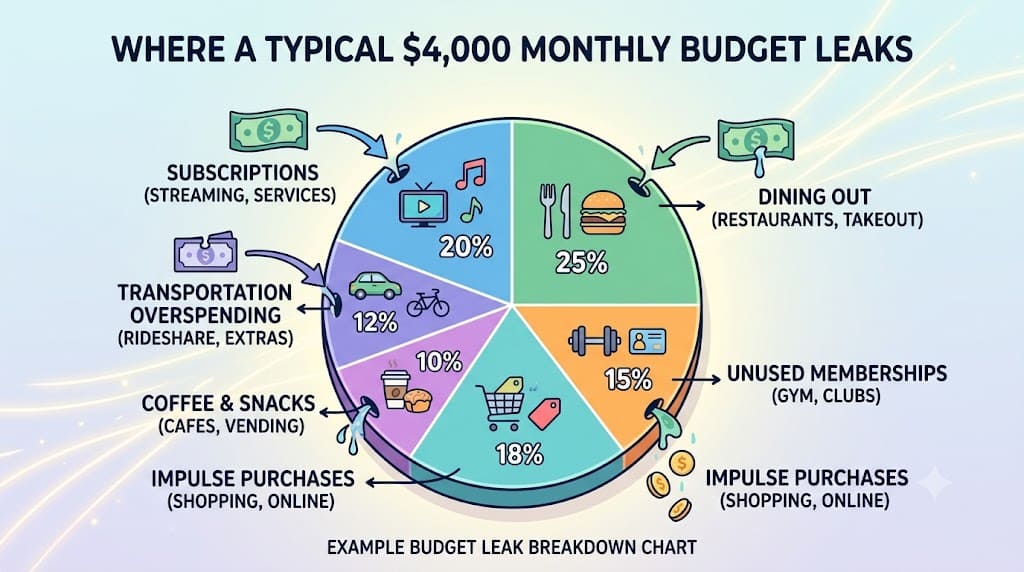
Not having a budget doesn’t feel like a mistake in the moment. It feels like nothing, which is exactly the problem. Without some way of tracking money in and out, small leaks add up fast. A forgotten subscription, a few extra takeout orders a week: it’s money you can’t fully account for by the end of the month.
You don’t need a complicated system. A notes app, a spreadsheet, or a physical planner (something like Planberry’s Weekly Budget Planner) all work. What matters is that you’re actually looking at the numbers monthly, not just hoping they work out.
3. You have no real emergency fund
An emergency fund is money you set aside specifically to cover an unplanned expense: a car repair, a medical bill, a slow month. The point is covering it without going into debt. It’s not a savings goal for something fun. It’s the thing that keeps a bad week from becoming a bad year.
This is the mistake with the most current, and honestly kind of alarming, data behind it. According to Bankrate’s 2026 Annual Emergency Savings Report, just 47% of Americans have enough liquidity to cover a $1,000 emergency expense. Only 30% would actually pay for it out of savings rather than a credit card or loan. That’s not a fringe problem. That’s roughly half the country one bad week from debt.
Start smaller than you think you need to. Even $500 tucked away breaks the cycle of every surprise expense turning into a new credit card balance.
4. You’re only paying the credit card minimums
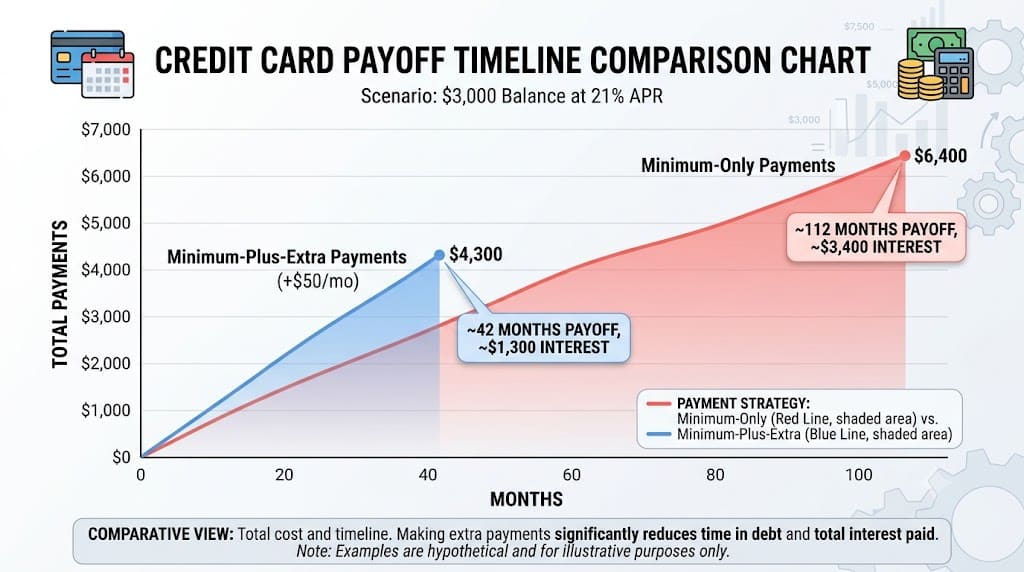
Paying just the minimum feels responsible because, technically, you’re paying something. But minimum payments stretch a balance out for years while interest does most of the work. The average credit card carries an interest rate around 21%, according to the Federal Reserve’s G.19 consumer credit release. That means a big chunk of every minimum payment isn’t shrinking what you owe. It’s covering interest on what you already owed last month.
| Approach | What happens |
|---|---|
| Minimum payments only | Balance shrinks slowly; most of the payment goes to interest |
| Minimum + a fixed extra amount | Balance drops faster; total interest paid drops noticeably |
| Avalanche method (highest interest first) | Fastest payoff if you’re juggling more than one card |
If you’re carrying a balance on more than one card, pick whichever method you’ll actually stick with. The “best” method on paper is worthless if you abandon it in month two.
5. You keep waiting to invest “until you have more money”
This is a quiet one because it doesn’t cost anything today. It costs you later, which is exactly what makes it easy to keep putting off. Compounding needs time more than it needs a large starting amount. And time is the one thing you can’t buy back once a decade has passed.
Warren Buffett is the extreme version of this. He built the overwhelming majority of his net worth after he turned 50, because compounding gets steeper the longer money sits invested. You don’t need Buffett-level returns for the lesson to apply. You just need to start before you feel “ready,” because ready rarely arrives on its own.
6. Every raise turns into a raise in spending
Lifestyle creep is what happens when your spending rises to match your income every time it goes up. Your actual financial position never improves, no matter how much you earn. A bigger apartment, a nicer car payment, eating out more: each one is small, and each one feels earned. Together, though, they cancel out the raise.
I got this one wrong myself the first time I got a real bump in pay. I upgraded almost everything within a year, and ended up right back at the same zero balance at the end of the month, just a fancier version of it. The fix that actually worked was boring. For every raise, I automatically increased savings by half of the new amount and let myself spend the rest guilt-free.
7. You finance things that lose value the moment you drive them off the lot
Cars, boats, and the latest gadgets all depreciate. That means they’re worth less the day after you buy them than the day you bought them. Financing a depreciating asset with a long loan term adds up fast. You can end up paying more in interest than the thing is even worth by the time it’s paid off.
That doesn’t mean never finance a car. It means matching the loan term to how long you’ll actually keep the thing. And it means being honest about whether “affording the payment” is the same as affording the vehicle. Usually, it isn’t.
8. You blow windfalls instead of using them to get ahead
Tax refunds, work bonuses, even the rare lottery win: these should be some of the easiest wins in personal finance, and they’re often the opposite. Money that shows up unexpectedly doesn’t feel like it counts the same as a paycheck, so people spend it just as fast.
The better move is to pick one thing before the windfall lands: the emergency fund, the credit card balance, an extra loan payment. Send it straight there before it has a chance to feel like “extra” spending money.
Key Takeaways
- Nearly half of Americans (47%, per Bankrate’s 2026 report) can’t cover a $1,000 emergency without borrowing. An emergency fund isn’t optional, it’s the difference between a bad week and a bad year.
- The average credit card carries roughly 21% interest, so minimum payments mostly cover interest, not the balance itself.
- Lifestyle creep, spending more every time you earn more, quietly cancels out raises and bonuses if you don’t build in automatic savings increases.
- Waiting to invest “until you have more money” costs more than most people expect, since compounding rewards time more than it rewards a large starting amount.
- Windfalls like tax refunds and bonuses disappear fast unless you decide where they’re going before the money lands.
Frequently Asked Questions
What are the most common financial mistakes people make? The most common ones are spending before saving, carrying credit card debt on minimum payments, having no emergency fund, and delaying investing. They’re common precisely because none of them feel urgent in the moment.
What’s actually considered a “financial mistake”? Broadly, it’s any repeated money habit that leaves you worse off over time even though it feels manageable day to day. Not a single bad purchase, but a pattern that compounds against you.
What financial mistakes do young adults make most often? Lifestyle creep tends to hit hardest early in a career. So does financing cars or gadgets on longer terms than makes sense, and putting off investing because retirement feels far away. The earlier you correct those habits, the less they cost to fix.
How do I actually stop repeating the same money mistakes? Pick one habit from this list, not all eight. Automate the fix (a transfer, a payment increase) so it doesn’t depend on willpower every month. Only add a second change once the first one feels normal.
Does a low credit score really keep you broke? Yes, in a compounding way. It raises what you pay on loans, credit cards, and sometimes insurance, which quietly increases nearly every other expense on this list. Fixing it isn’t fast, but it’s one of the few mistakes with a clear, trackable path back out.
If you want to see exactly how much minimum payments versus paying extra actually costs you, run your own numbers. The difference is usually bigger than it looks on paper.
Read More
- Lifestyle Inflation: How Your Wants Quietly Become “Needs”: the psychology behind mistake #6 above, plus a “from-zero” test for catching it before it compounds.
- How to Build an Emergency Fund in 6 Months (Even on a Tight Budget): a month-by-month plan for actually fixing mistake #3.
- The 50/30/20 Budget Rule Explained: a concrete framework for the budgeting habit in mistake #2.
Disclaimer
This article is for general informational purposes only and shouldn’t be taken as financial or tax advice. The numbers I’ve used here, like the $3,000 credit card example, are illustrative, not a description of your specific situation. Before making a real financial decision, it’s worth checking with a qualified financial advisor who can look at your actual numbers. You can also read FinToku’s full Financial Disclaimer.
(Quick heads up: the planner link above is an affiliate link, so FinToku may earn a small commission if you buy through it. I only link to things I’d actually use myself. Full details in our Affiliate Disclosure.)
By Saad Faisal · Published July 24, 2026 · Updated July 24, 2026