
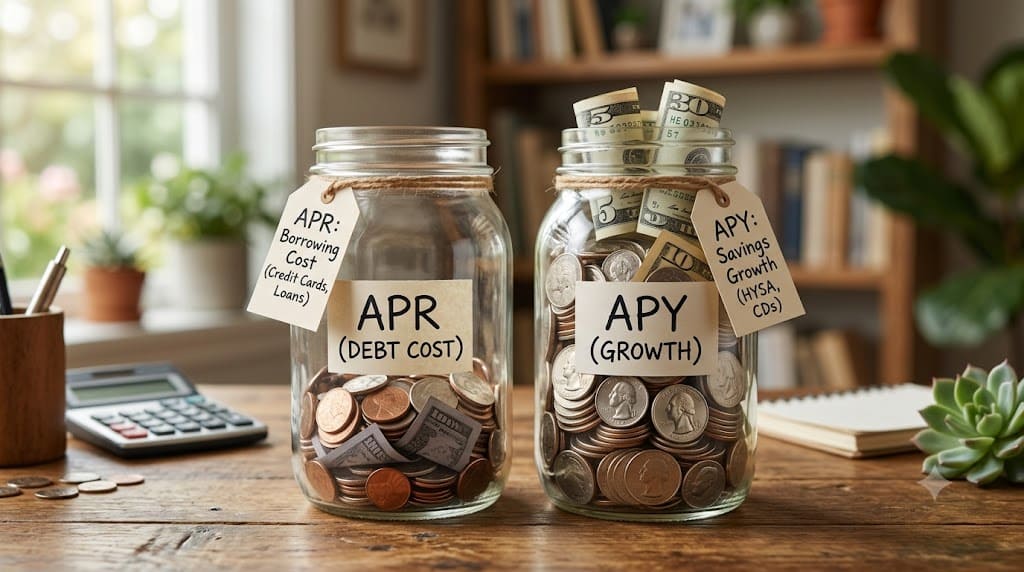
I once had two banking apps open side by side: my credit card, sitting at 22.9% APR, and my savings account, offering 4.1% APY. Same three letters rearranged, completely different meaning, and mixing them up can cost you real money either way.
Annual percentage rate (APR) is what a lender charges you each year to borrow money, and it usually includes fees on top of the interest rate. Annual percentage yield (APY) is what a bank pays you each year on savings or a CD, and it already bakes in compounding. The short version: you want APR low and APY high, since one is a cost and the other is a payout.
What Is APR?
APR stands for annual percentage rate. It’s the yearly cost of borrowing money on a credit card, personal loan, auto loan, or mortgage, expressed as a percentage that combines your interest rate with most of the fees the lender tacks on. That’s why a loan’s APR usually runs a bit higher than its advertised interest rate.
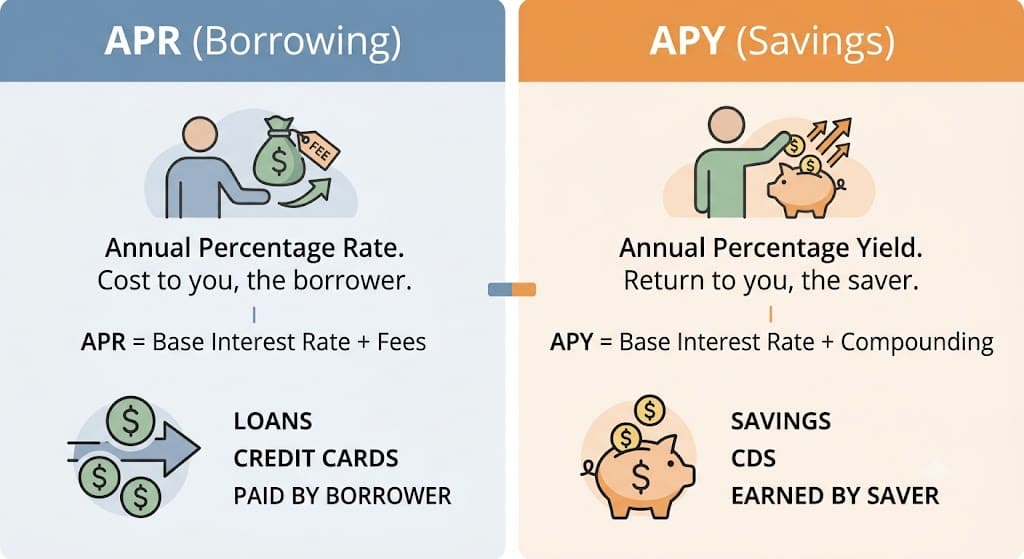
Mortgages, auto loans, personal loans, student loans, and credit cards all quote an APR. Lenders are legally required to disclose it under the Truth in Lending Act, precisely so you can compare offers apples-to-apples instead of getting seduced by a low headline interest rate that hides steep fees.
What Is APY?
APY stands for annual percentage yield. It’s the total interest you actually earn in a year on a savings account, CD, or money market account, once compounding is factored in. The more often your interest compounds (daily beats monthly beats annually), the more your real return creeps above the stated rate.
Say a savings account advertises 4% interest. Compounded monthly, that works out to an APY of about 4.07%. Compounded daily, it edges up to roughly 4.08%. It’s not a huge gap on paper, but stack it over years and a full percentage point of APY difference between two banks adds up fast.
Quick Verdict
If you’re borrowing, chase the lowest APR you can qualify for since every point saves you real interest. If you’re saving, chase the highest APY, and don’t stop at the interest rate alone: compounding frequency and fees both move the number that ends up in your account.
APR vs. APY at a Glance (as of August 2026)
| APR | APY | |
|---|---|---|
| Applies to | Loans, credit cards, mortgages | Savings, CDs, money market accounts |
| Who benefits from a high number | Nobody, lower is better | You, the saver |
| Includes fees | Yes | Usually not, since deposit accounts rarely charge fees |
| Includes compounding | Only reflects the rate you’re charged, not compounding gains | Yes, this is the whole point of APY |
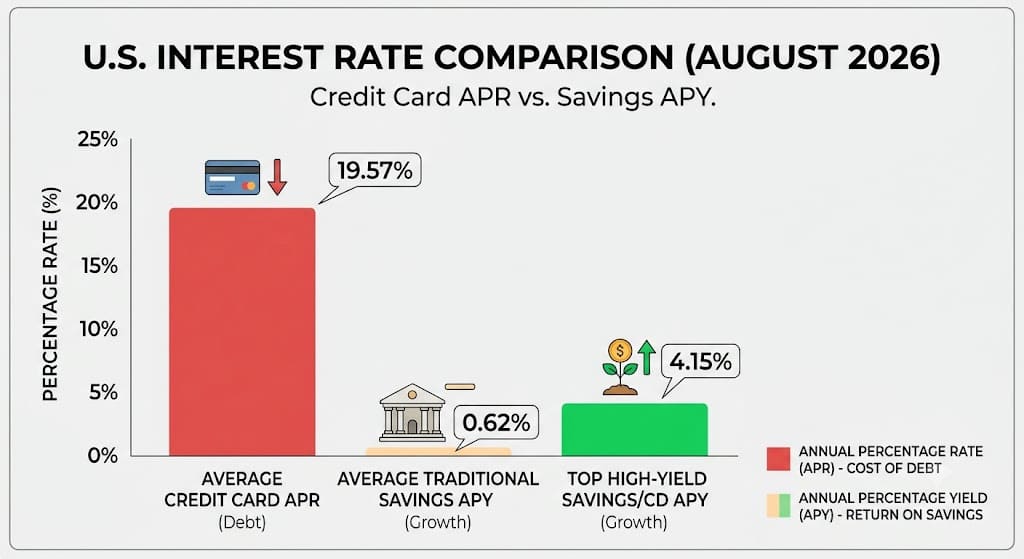
| Current average | 19.57% weekly average across existing accounts (Bankrate, July 30, 2026); 22.15% among accounts carrying a balance (Federal Reserve G.19, Q2 2026) | Under 0.6% on a traditional savings account (FDIC); the best high-yield savings accounts were paying 4.15% to 4.21% APY in late July 2026 (Bankrate, CNBC Select) |
| Best rates available | Well-qualified borrowers regularly beat the 19.57% average; new-card offers averaged 23.79% (LendingTree) | Top CDs reached up to 4.40% APY in early August 2026 (NerdWallet) |
When APR Is the Number to Watch
Pros of paying attention to APR:
- It bundles the interest rate and most lender fees into one number, so two loans with similar rates but different closing costs won’t fool you.
- It’s federally mandated and standardized, so you can compare a credit union’s offer against a big bank’s on equal footing.
Cons:
- APR still doesn’t capture every possible fee (some closing costs on mortgages fall outside it), so read the loan estimate too.
- A card’s purchase APR, cash advance APR, and penalty APR can all differ. One number on the homepage isn’t the whole story.
When APY Is the Number to Watch
Pros of paying attention to APY:
- It already includes compounding, so you’re comparing real earning power, not just a headline rate.
- Deposit accounts rarely carry fees that eat into APY, unlike loans.
Cons:
- Most savings account APYs are variable and can drop the moment the Federal Reserve cuts rates, even without a warning email.
- A great APY on a CD locks your money away for the term. Break it early and an early-withdrawal penalty can wipe out months of that yield.
Which One Fits Your Situation?
- Shopping for a credit card or personal loan? Compare APRs, not just interest rates, and check whether it’s fixed or variable.
- Opening a savings account or CD? Compare APYs, and confirm the compounding frequency, since daily compounding will always beat monthly on paper.
- Carrying a credit card balance? Your APR is costing you every single day it’s outstanding. Paying it down usually beats chasing a slightly better APY somewhere else.
- Sitting on an emergency fund? APY is your friend here. I ran a rough comparison through FinToku’s CD Calculator before writing this, and even a one-point APY gap on a $10,000 balance meant a noticeably different payout by maturity.
Key Takeaways
- APR is the yearly cost of borrowing, including most fees; APY is the yearly return on savings, including compounding.
- You want APR low and APY high, since they measure opposite sides of the same interest coin.
- The average credit card rate sat at 19.57% in late July 2026, while a traditional savings account still paid under 0.6% APY, and the best high-yield savings and CD offers topped 4%.
- Compounding frequency (daily vs. monthly vs. annually) changes your real APY even when the stated interest rate stays the same.
- Always check whether a quoted rate is fixed or variable before assuming it will stay put.
Frequently Asked Questions
Which is better, APR or APY?
Neither is universally “better,” they measure different things. A low APR benefits you as a borrower, while a high APY benefits you as a saver, so the right one to focus on depends on which side of the transaction you’re on.
How much is 4% APY on $1,000?
At a flat 4% APY compounding annually, $1,000 earns about $40 in interest over one year, bringing the balance to roughly $1,040. More frequent compounding (monthly or daily) nudges that slightly higher.
Is an APY of 3% good?
It depends on the account type. As of August 2026, 3% is well above the sub-0.6% rate on a typical traditional savings account, but it trails the top high-yield savings and CD offers, which were running as high as 4.15% to 4.40%. So 3% is decent, not exceptional.
Is 24% APR good or bad?
For a credit card, 24% sits above the current weekly average of about 19.6% and would be considered high, especially for someone with strong credit who could likely qualify for a lower rate elsewhere.
Run your own numbers before deciding either way. FinToku’s Loan Comparator lets you stack a few real APRs side by side so you’re not guessing.
Read More
Disclaimer
This article is for general informational purposes only and shouldn’t be taken as financial advice. The rate figures above reflect national averages as of late July/early August 2026 and change constantly, sometimes weekly, so the APR or APY on any specific loan or account you’re offered may look very different. Before making a real borrowing or savings decision, it’s worth comparing current offers directly and, for anything significant, checking with a qualified financial advisor. You can also read FinToku’s full Financial Disclaimer.
Published by Saad Faisal for FinToku (fintoku.com) · Published August 1, 2026 · Updated August 1, 2026 FinToku provides free finance tools and guides to help you make smarter money decisions.