

A reader wrote in a few weeks ago asking what a “benchmark” was. She’d been reading about her 401(k) fund for twenty minutes and kept hitting words that all seemed to mean “good” or “risky” without telling her which. That’s the real problem with investing jargon. It’s not that any single term is hard. It’s that fifteen of them show up in the same paragraph and nobody stops to explain any of them.
Investing terms are the vocabulary that describes what you own, how it’s expected to behave, and how risky it is. Once you know a small core set (asset, stock, bond, fund, diversification, risk, return) the rest mostly click into place, because most other terms are just variations on those seven ideas. This guide covers the terms you’ll actually run into as a new investor, grouped by where they show up, plus straight answers to the specific investing questions people search for most.
Investing terms for opening an account
Before you own anything, you need somewhere to hold it. These are the words that show up first.
Investment means putting money into something (stocks, bonds, real estate, a fund) with the expectation it grows or pays you income over time. That’s the whole idea in one sentence, and it’s also what separates investing from saving: a savings account protects your money, investing tries to grow it.
A brokerage account is a regular investment account you open with a firm like Fidelity, Schwab, or a robo-advisor. No contribution limits, no withdrawal restrictions, but you owe taxes on what you earn. It’s usually the first account people open.
A retirement account, like a 401(k), IRA, or Roth IRA, is built specifically for retirement savings and comes with tax perks a regular brokerage account doesn’t. Trade-off: there are rules and often penalties around when you can touch the money.
Time horizon is simply how long until you need the money. Five years away, twenty years away, and “not sure yet” all call for different mixes of stocks and bonds, which is why almost every other decision on this list traces back to it.
Investing terms for what you’re actually buying
This is where most of the confusion lives, because these words get used interchangeably when they shouldn’t be.
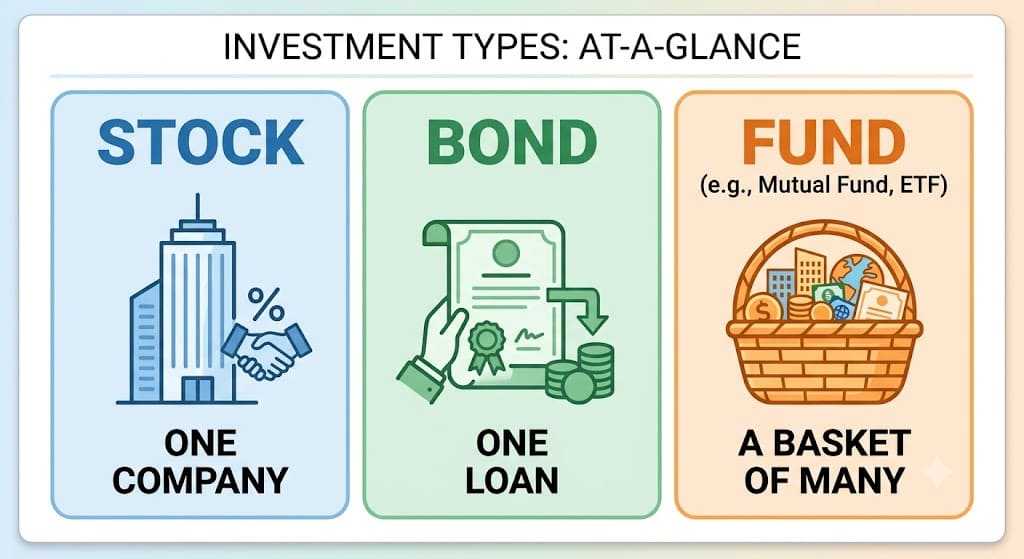
A stock is a small ownership slice of a company. Buy one share of a company and, technically, you own a tiny piece of it. If the company does well, your slice is usually worth more. If it doesn’t, it’s worth less. There’s no floor on how far it can fall.
A bond is a loan, not ownership. You lend money to a company or government, and they pay you interest until they pay back the principal. Bonds are generally steadier than stocks and pay less over long stretches, which is exactly why people hold both.
A mutual fund pools money from a lot of investors and buys a mix of stocks, bonds, or both on their behalf, run by a professional manager. An ETF (exchange-traded fund) does something similar, but trades on an exchange all day like a stock instead of pricing once after markets close. An index fund (which can be structured as either a mutual fund or an ETF) doesn’t try to beat the market, it just tracks one, like the S&P 500, by holding roughly what that index holds.
Honestly, if I were explaining this to a friend who just wanted the short version: stocks are pieces of one company, bonds are loans to one entity, and funds are baskets that hold a bunch of stocks or bonds at once so you’re not betting on just one thing.
Honestly, if a term in this guide clicks but you want the fuller story behind it, a beginner-friendly investing book does a better job than any glossary at connecting the dots between definitions. (Quick heads up, that link would be an affiliate one, so FinToku may earn a small commission if you buy through it. Full details in our Affiliate Disclosure.) The Little Book of Common Sense Investing
Investing terms for building a portfolio
Once you own a few of the things above, these words describe how they fit together.
Your portfolio is just the full collection of everything you own across every account. Asset allocation is how you split that portfolio between stocks, bonds, and cash, and it should roughly match your time horizon and how much volatility you can stomach without panic-selling.
Diversification means not putting all your money into one stock, one sector, or one country. It won’t stop losses in a bad year, but it keeps one bad bet from wiping out the whole account.
Rebalancing is the maintenance step nobody talks about enough. If stocks have a great year, they can grow to make up more of your portfolio than you planned, quietly shifting your risk higher without you doing anything. Rebalancing means selling a bit of what’s grown and buying more of what hasn’t, to get back to your original mix.
Investing terms for market-watching
These are the words you’ll see in headlines and on your brokerage app’s homepage.
Market capitalization, or market cap, measures a company’s size: share price multiplied by total shares outstanding. Large-cap companies tend to be steadier; small-cap companies tend to be riskier but have more room to grow.
A bull market is a stretch where prices are generally rising and confidence is high. A bear market is the opposite, usually defined as a drop of 20% or more from a recent high. Both are a normal, recurring part of investing, not a sign something’s broken.
Volatility describes how much an investment’s price swings, in either direction, over a given period. A highly volatile stock can jump or drop 5% in a day. A low-volatility bond fund barely moves. Volatility and risk get used as synonyms, but they’re not quite the same thing: volatility is about how bumpy the ride is, risk is about the chance you don’t get the outcome you were hoping for.
A benchmark is the yardstick used to judge how an investment performed. The S&P 500 (500 large US companies) and the Dow Jones Industrial Average (30 large US companies) are the two you’ll hear most. When someone says “the market was up today,” they usually mean one of these two moved.
Investing terms about risk, return, and growth
Risk is the chance your investment doesn’t do what you hoped, including the chance you lose money. Return is what you actually earn, shown as a percentage, made up of price gains plus anything paid out along the way.
A dividend is a piece of a company’s profit paid directly to shareholders, usually every quarter. Not every stock pays one. The ones that do tend to be larger, more established companies.
Compounding is what happens when your returns start earning their own returns. Say you invest $500 and it earns 8% this year, that’s $40. Next year, you’re earning 8% on $540, not $500, and the gap widens every year after that. It’s slow at first and then genuinely surprising over a couple of decades, which is the entire argument for starting early rather than starting big. If you want to see the math on your own numbers instead of taking my word for it, FinToku’s Rule of 72 Calculator gives you a rough estimate of how many years it takes an investment to double at a given return.
Dollar-cost averaging means investing a fixed amount on a regular schedule (weekly, monthly, whatever) regardless of what the market is doing that day. When prices are high, your money buys fewer shares. When prices dip, it buys more. It doesn’t guarantee a profit, but it does take “trying to time the market” off your plate entirely. If this sounds familiar, it’s basically the same mechanic behind a SIP (systematic investment plan), which you can model with FinToku’s SIP Calculator.
Stocks vs. bonds vs. cash: a quick comparison
| Asset type | What it is | Typical long-run annual return | Typical risk |
|---|---|---|---|
| Stocks (US large-cap) | Ownership in a company | ~10% (S&P 500 average since 1957, as of Dec. 2025) | Highest volatility, no guarantee |
| Bonds (long-term US) | A loan to a company or government | ~5.4% (long-run average since 1926) | Moderate, steadier than stocks |
| Cash / CDs / savings | Money held, not invested | Lowest of the three, varies with current rates | Very low, but doesn’t outpace inflation as reliably |
Stock figure: Fidelity Investor Education, calculated from S&P 500 total returns since the index’s 1957 launch, data through December 2025. Bond figure: Vanguard long-run asset-class data (US bonds since 1926), as cited via Yahoo Finance/GOBankingRates reporting. Both re-checked as of this article’s publish date; long-run averages like these move slowly, but always confirm against a live source before quoting them elsewhere. Past performance doesn’t predict future returns.
What are the 7 main types of investments?
There’s no single official list, but most financial educators group investments into roughly the same seven buckets: stocks, bonds, mutual funds, ETFs, real estate (including REITs), cash equivalents (like CDs and money market accounts), and retirement-specific vehicles (like 401(k)s and IRAs), which technically wrap around several of the categories above rather than standing apart from them. Some lists swap in commodities or cryptocurrency as a seventh instead of retirement accounts. If you’re just starting out, you genuinely don’t need to touch all seven. Stocks, bonds, and a couple of funds cover most beginner portfolios just fine.
What are the “5 P’s” of investing?
You’ll see a few different “5 P’s” frameworks floating around, but the version that gets cited most often comes from investor Tom Gardner at The Motley Fool: People (the quality of a company’s leadership), Profitability (how financially strong the business actually is), Potential (how much room it has to grow), Position (how it stacks up against competitors), and Purpose (what the business is actually trying to accomplish). It’s a framework for evaluating individual companies before you buy their stock, not a universal rule every investor follows, so treat it as one useful lens rather than gospel.
What is the 30/30/30/10 rule for investing?
This one genuinely has two different meanings depending on where you read it, so it’s worth being precise. The more common version is a budgeting rule, not strictly an investing one: 30% of take-home pay to housing, 30% to other needs, 30% to savings and financial goals (including investing), and 10% to wants. A less common variation applies the same ratio directly to a portfolio: 30% stocks, 30% bonds, 30% real estate, and 10% cash. Neither version is an official standard the way, say, an IRA contribution limit is. Treat both as a rough starting template to adjust, not a formula to follow exactly.
7 rules of investing worth actually remembering
There isn’t one canonical numbered list here either, but these seven show up consistently across serious investing advice, and they’re the ones I’d actually want a new investor to walk away with:
- Only invest money you won’t need in the next few years. Markets don’t care about your rent due date.
- Diversify. Don’t let one stock or one sector decide your outcome.
- Understand what you own before you buy it. If you can’t explain it in one sentence, that’s worth noticing.
- Fees compound too, just against you. A 1% annual fee sounds small until you see it over 20 years.
- Time in the market usually beats timing the market. Missing just the market’s ten best days over a decade can meaningfully drag down your returns.
- Rebalance periodically instead of never touching your allocation again.
- Know your actual risk tolerance, not the risk tolerance you’d like to have. A portfolio you can’t emotionally hold through a bad year isn’t the right portfolio, no matter how good it looks on paper.
Common mistakes people make even after learning the words
I’ll be honest: knowing the vocabulary doesn’t automatically stop people from making the same mistakes. The most common one I see is confusing “I understand this term” with “I’ve thought about how this applies to my actual money.” Someone can define diversification perfectly and still hold 90% of their portfolio in one stock because it’s their employer’s. Someone can know what volatility means and still panic-sell during a 15% dip anyway. The terms are the starting line, not the finish line. Pairing this vocabulary with an actual look at your own numbers (what you’re saving, what it might grow into, what a market drop would actually cost you) is what turns definitions into decisions.
Key Takeaways
- Most investing jargon breaks down into a small set of core ideas: what you own (asset, stock, bond, fund), how it’s split up (allocation, diversification), and how it performs (risk, return, volatility).
- Stocks are ownership, bonds are loans, and funds are baskets that hold many of either at once.
- Compounding and dollar-cost averaging are the two concepts that reward starting early and staying consistent over trying to time the market perfectly.
- There’s no single official version of the “5 P’s,” the “7 types,” or the “30/30/30/10 rule.” Different sources define them differently, so treat each as a rough framework, not a fixed formula.
- Learning the vocabulary is only useful once you apply it to your own numbers, not just to the article you’re reading.
Frequently Asked Questions
What’s the difference between a stock and a share? They’re basically the same thing in everyday use. “Stock” usually refers to ownership in a company generally, while a “share” is one individual unit of that ownership.
Do I need to know all of these terms before I start investing? No. The core five (asset, stock, bond, fund, diversification) cover most of what a beginner needs. The rest you’ll pick up naturally as questions come up.
Is a higher-risk investment always a higher-return investment? Not guaranteed, just historically more likely over long periods. Higher risk means a wider range of outcomes, including worse ones, not a promise of a better one.
What’s a good first investing term to actually understand deeply? Diversification. It underlies almost every other decision on this list, and it’s the one habit that protects you even when you get other things wrong.
If you’re mapping out how these terms apply to your own savings, run your numbers through FinToku’s Retirement Calculator to see how time horizon and contribution size actually play out over the years, rather than just in theory.
Read More
- How Inflation Affects Your Savings
- Passive Income vs Active Income: What’s the Real Difference
- Financial Goals You Should Set Every Year
Disclaimer
This article is for general informational purposes only and shouldn’t be taken as financial, tax, or legal advice. The return figures above are historical long-run averages, not guarantees or predictions, and every investor’s actual situation, risk tolerance, and timeline are different. Before making a real investing decision, it’s worth checking with a qualified financial advisor who can look at your specific circumstances. You can also read FinToku’s full Financial Disclaimer.
Published by Saad Faisal for FinToku (fintoku.com) · Published August 1, 2026 · Updated August 1, 2026 FinToku provides free finance tools and guides to help you make smarter money decisions.