
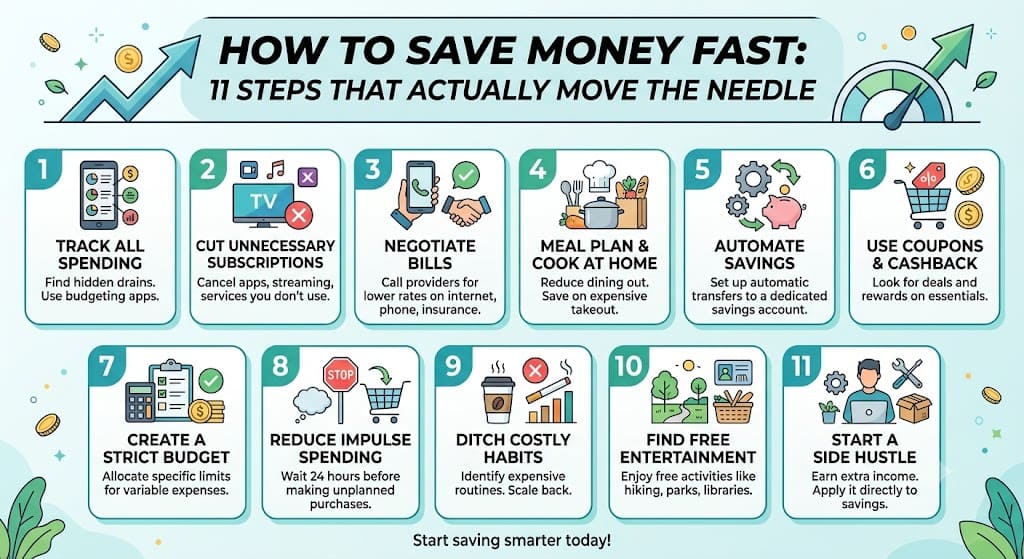
If you need cash fast, the quickest wins come from cutting recurring costs you’re not using, moving your savings into an account that actually pays interest, and giving yourself a short, aggressive challenge instead of a vague “save more” goal. Here’s the full step-by-step, plus the numbers that make it worth doing right now.
“It is not the man who has too little, but the man who craves more, that is poor.” Seneca, Roman Stoic philosopher, Letters to Lucilius
That idea is basically the whole premise of this article. Most people don’t have a fast-money problem. They have a “not looking closely enough” problem.
Step 1: Track every dollar for one week, not one month
You don’t need a month of data to find the leaks. One week is usually enough to spot the pattern, because most spending habits repeat every seven days anyway (the same coffee run, the same lunch order, the same late-night app purchase).
Pull your last week of bank and card transactions and sort them into three piles: needs, wants, and “wait, what is this.” That third pile is where the fast money usually hides. Mine was a meditation app I signed up for during a stressful week in March and never opened again.
Step 2: Cancel or pause subscriptions you can’t name from memory
This is the single fastest win because it requires zero behavior change going forward. If you can’t say what a recurring charge is for without checking your statement, cancel it. You can always resubscribe later if you actually miss it.
Benjamin Franklin put it better than I can: “Beware of little expenses; a small leak will sink a great ship.” A $12.99 subscription feels too small to matter, right up until you count four of them.
Check your phone’s app store subscription list, not just your bank statement, since some charges route through Apple or Google and won’t show up clearly on a bank line item.
Step 3: Move your savings into a high-yield account
This one step can be worth more than months of skipping coffee. As of July 2026, the FDIC’s reported national average for a plain savings account sits around 0.38% APY, while the top nationally available high-yield savings accounts are advertising APYs in roughly the 4.0% to 4.5% range. On $5,000 in savings, that gap is the difference between earning less than $20 a year and earning close to $200, just for moving money you already have.
Look for an FDIC-insured online bank, since those tend to carry the lowest overhead and pass more of it back to you as interest. If you’re also weighing a CD for part of that cash, FinToku’s High-Yield Savings Account vs CD guide breaks down when the lock-in is actually worth it.
Step 4: Run a short, aggressive no-spend challenge
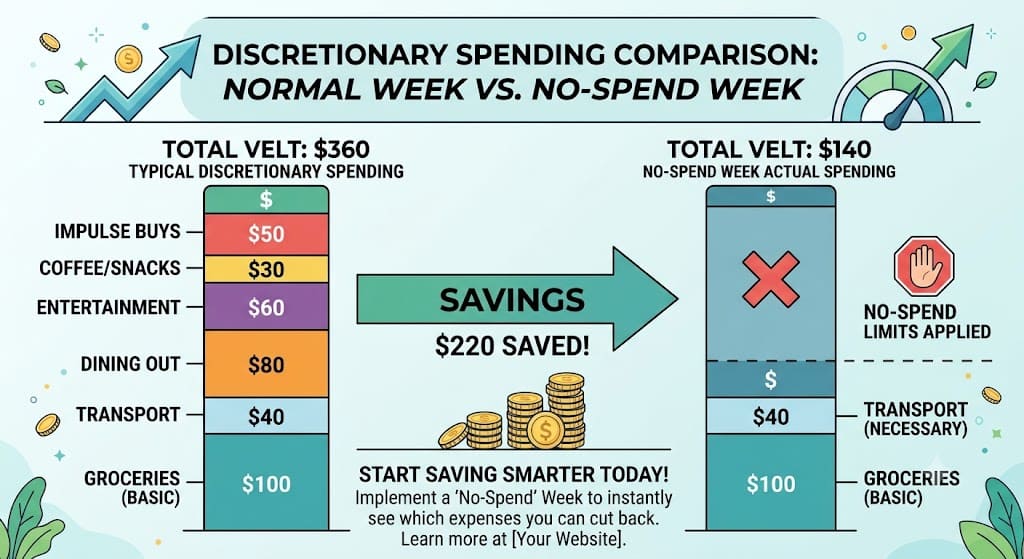
A full month of no discretionary spending sounds miserable and most people quit by day 10. A 7 to 14 day version is easier to actually finish, and finishing matters more than the exact length. Pick a start date, tell one other person so you have some accountability, and only spend on true essentials for that window.
“Wealth consists not in having great possessions, but in having few wants.” Epictetus, Stoic philosopher, Enchiridion
A no-spend challenge doesn’t just save you money for a week or two. It resets what “wanting” something even feels like, which is the part that actually sticks.
Step 5: Pick one budgeting method and stick with it for a full pay cycle
Don’t try to design the perfect system before you start. Just pick one:
- 50/30/20: 50% needs, 30% wants, 20% savings and debt payoff
- Zero-based budgeting: every dollar gets assigned a job before the month starts
- Pay-yourself-first: savings gets moved out automatically the day you’re paid, before anything else touches it
- Envelope method: cash (or a separate account) for each spending category, and when it’s gone, it’s gone
Pay-yourself-first is the one I actually recommend for “fast” results specifically, because it removes willpower from the equation entirely. If the money’s already moved before you see it, you can’t accidentally spend it.
If you want the actual numbers instead of guessing at percentages, run your take-home pay through FinToku’s Budget Planner & 50/30/20 Calculator. It splits your income into needs, wants, and savings for you and shows your real savings rate, including any leftover cash you haven’t assigned yet.
Step 6: Automate a transfer the day you get paid
Set up a recurring transfer from checking to your high-yield savings account for the same day your paycheck lands. Even a modest amount, say $50 or $100 per paycheck, adds up faster than most people expect once it’s automatic instead of a decision you have to make twice a month.
Step 7: Meal plan for one week before you grocery shop
Groceries and takeout together are usually the second-biggest leak after subscriptions and impulse buys. You don’t need a fancy system, just a rough plan for seven dinners before you walk into the store, so you’re not deciding what to eat while standing in the aisle hungry.
Step 8: Sell what you’re not using
This is the fastest way to generate cash you can put straight toward a goal, because it’s money in hand within days, not weeks. Go through one closet, one drawer, or your garage and list anything you haven’t touched in six months on a local marketplace app. My cousin funded half a car repair this way in a single weekend.
Step 9: Shop secondhand for anything on your near-term list
Before buying something new, check if a “like new” or open-box version exists. This works especially well for electronics, furniture, and kids’ clothes and gear, categories where the depreciation curve is steep in the first year but the item itself is barely used.
Step 10: Check your withholding if you’re getting a big tax refund
A large annual tax refund means you gave the government an interest-free loan all year. Adjusting your W-4 withholding puts that money in your paycheck now instead of in April, and you can route the difference straight into your savings automation from Step 6 instead of waiting for a refund check. FinToku’s Paycheck Calculator shows how a withholding change actually moves your per-check take-home pay before you touch your real W-4.
Step 11: Improve your credit score before you need it
This one doesn’t put cash in your pocket today, but it saves real money the moment you need a loan or a lower interest rate. As of July 2026, the average credit card interest rate runs somewhere between about 19.6% and 21%, depending on whether you look at new-offer averages or existing-account averages, and a stronger credit score is one of the few levers that can knock several points off that rate on your next card or loan. Paying down balances and disputing any errors on your report are the two fastest moves here.
Worked example: what a fast week actually looks like
Say you earn $4,000 a month. In one week you cancel two unused subscriptions ($35), skip takeout twice in favor of a meal plan ($60), and move $2,000 in idle checking-account cash into a 4.2% APY savings account. You haven’t changed your income at all, but you’ve freed up $95 in recurring monthly cash flow and started earning roughly $84 a year in interest you weren’t earning before. None of that required a side hustle or a big lifestyle overhaul.
Common mistakes that slow this down
- Trying every tip at once. Pick two or three from this list for week one. Trying all eleven simultaneously is how people burn out by day four.
- Leaving savings in a checking account “for now.” That “for now” account is usually paying close to 0%, so every week it sits there is a week of lost interest.
- Setting a no-spend challenge with no end date. Open-ended restriction fails. A defined 7 to 14 day window with a clear finish line succeeds far more often.
- Ignoring small recurring charges because they’re “only $8.” Three or four of those add up to real money over a year, and they’re the easiest wins on this entire list.
Where the money actually comes from: current savings and rate data
| Metric | Figure | As of |
|---|---|---|
| National average savings account APY (FDIC) | ~0.38% | July 2026 (FDIC national rate report) |
| Top high-yield savings account APY | ~4.0%–4.5% | July 2026 (Bankrate / NerdWallet) |
| Average credit card interest rate, new offers | ~19.6%–19.7% | Early-mid July 2026 (Bankrate) |
| Average credit card APR, existing accounts | ~20.9% | Q2 2026 (LendingTree) |
| U.S. adults with no emergency savings at all | 24% | 2026 (Bankrate Emergency Savings Survey) |
| Federal funds rate range | 3.50%–3.75% | Held steady at every 2026 meeting so far |
Both the savings and credit card figures move often, and different trackers use slightly different methodologies (new-offer averages run lower than existing-account averages, for instance), so treat this table as a snapshot rather than a fixed number, and check current rates before making a real decision.
If you’re weighing several budgeting methods against each other before picking one for Step 5, here’s how they stack up:
| Method | Best for | Tradeoff |
|---|---|---|
| 50/30/20 | Beginners who want simple ratios | Less precise than zero-based for tight budgets |
| Zero-based | People who want full control over every dollar | Takes more time to set up and maintain |
| Pay-yourself-first | Anyone who struggles with willpower | Doesn’t force spending discipline elsewhere |
| Envelope | Visual/tactile spenders, cash-preference households | Harder to use for online purchases |
I’ve also seen a few readers pair this with a budgeting book to keep the automation from Step 6 on track, You Need a Budget is the one I’d point to specifically, since it’s built around the same pay-yourself-first idea this section leans on, rather than checking things manually every week. (Quick heads up, that’s an affiliate link, so FinToku may earn a small commission if you buy through it. I only link to things I’d actually use myself. Full details in our Affiliate Disclosure.)
Read More
- How to Build an Emergency Fund in 6 Months (Even on a Tight Budget): the month-by-month version of Steps 3 and 6 above, if your real goal is a full emergency fund rather than a fast one-week win.
- The 50/30/20 Budget Rule Explained: a deeper look at the budgeting method from Step 5, including what to do when the classic split doesn’t fit your rent.
- High-Yield Savings Account vs CD: Which Wins in 2026?: for once you’ve built up more cash than you need sitting in checking and want to know where it should actually live.
Key Takeaways
- Moving idle savings from a near-0% account into a high-yield savings account paying roughly 4% to 4.5% APY can add close to $200 a year in interest on just $5,000, with zero change to your income or spending.
- Canceling unused subscriptions is the fastest win on this list because it requires no ongoing willpower once it’s done.
- A short 7 to 14 day no-spend challenge succeeds far more often than an open-ended one because it has a clear finish line.
- Automating a transfer on payday removes the decision-making step that causes most savings plans to quietly fail.
- As of July 2026, average credit card rates run roughly 19.6% to 21% depending on the tracker, which makes paying down balances and improving your credit score a real (if slower) form of saving money.
Frequently Asked Questions
How fast can I actually save money? You can free up real cash within a single week just by canceling unused subscriptions and moving idle savings into a higher-yield account. Bigger goals, like building a full emergency fund, realistically take months, but the first visible progress can show up almost immediately.
Should I save money or pay off debt first? If your debt carries a high interest rate, like the roughly 20% average on credit cards right now, paying that down usually beats what you’d earn in a savings account. A common middle ground is building a small starter emergency fund (around $500 to $1,000) first, then aggressively attacking high-interest debt.
What’s the fastest way to save $1,000? Combine a short no-spend challenge, selling unused items for quick cash, and moving whatever you already have sitting in checking into a high-yield savings account. Most people can reach $1,000 faster by freeing up existing cash than by trying to cut their way there through daily habits alone.
Is a no-spend challenge actually effective? Yes, especially over a short window. It works less because of the money saved during the challenge itself and more because it resets your sense of what you actually need to buy, which tends to stick even after the challenge ends.
How much should I keep in an emergency fund? Most guidance points to three to six months of essential expenses, but if you’re starting from zero, aim for a smaller first milestone like $500 to $1,000 before worrying about the full target. Getting past $0 is the psychologically hardest part.
If you’re just getting started, run your own numbers first: figure out what one week of unused subscriptions and idle savings interest is actually costing you before you touch anything else on this list.
Disclaimer
This article is for general informational purposes only and shouldn’t be taken as financial or tax advice. Everyone’s situation is different, and the interest rates and figures I’ve used here are current as of the date above but change often. Before adjusting your withholding, moving savings, or making a real financial decision based on any of this, it’s worth checking with a qualified financial advisor or tax professional who can look at your specific numbers. You can also read FinToku’s full Financial Disclaimer.
By Saad Faisal · Published July 14, 2026 · Updated July 14, 2026 Published by Saad Faisal for FinToku (fintoku.com) FinToku publishes free, no-signup finance calculators and practical money guidance.