
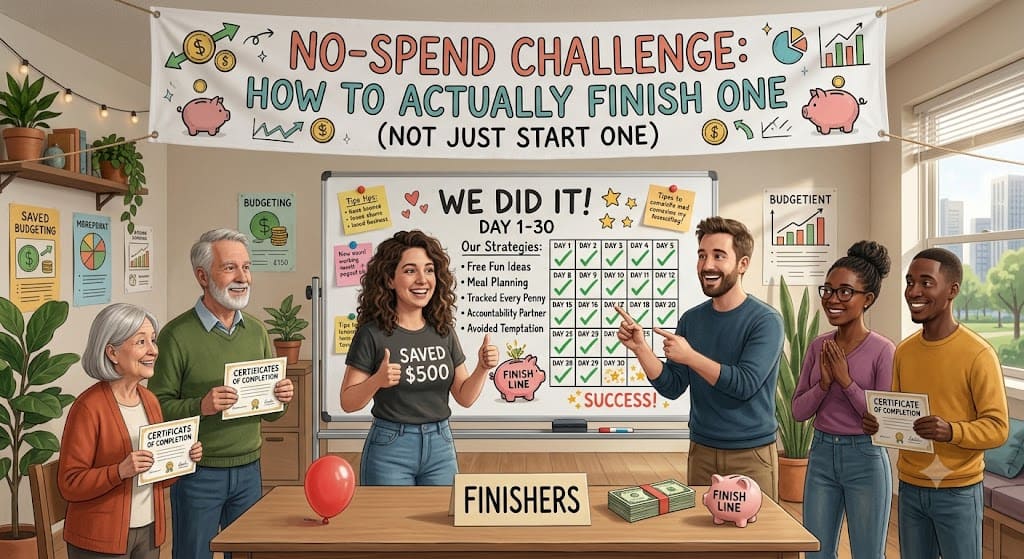
A no-spend challenge is a set period, usually a week to a month, where you pause spending on anything beyond your basic needs like housing, groceries, utilities, and transportation. Everything else, dining out, online shopping, subscriptions you forgot you had, gets put on hold so you can see exactly where your money actually goes.
It sounds simple, and it mostly is. But here’s what nobody tells you upfront: about a third of people who try one don’t finish it. Not because the concept is hard, but because most people skip the planning and go straight to “I’m just not going to spend money,” which lasts about four days.
What Counts as “No Spend”
The confusing part of any no-spend challenge is the name itself. You’re not actually spending zero dollars. You still pay rent, keep the lights on, and buy groceries. What you’re cutting is the discretionary stuff: restaurants, coffee runs, new clothes, streaming add-ons, that occasional Amazon “just because” order.
A rough necessity checklist looks like this:
Usually allowed:
- Rent or mortgage, utilities, insurance
- Groceries (the pantry kind, not takeout)
- Gas, transit, car payments
- Medical expenses and prescriptions
- Debt payments you’re already committed to
Usually paused:
- Dining out, delivery apps, coffee shops
- Clothes, shoes, home decor
- Entertainment purchases and non-essential subscriptions
- Impulse buys of any kind, even small ones
Your own list can be stricter or looser than mine. Some people keep their $150 dining-out budget and just cut the extras around it, the way one blogger I read about structures her No Spend January. Others go cold turkey on Amazon specifically because that’s where their money quietly leaks out. The point isn’t a universal rulebook, it’s identifying where your money actually goes and drawing a line around it on purpose.
Does It Actually Work? Here’s the Data
This is where most articles on this topic get a little hand-wavy, so let’s put some real numbers on it.
| Metric | Figure | Source | As of |
|---|---|---|---|
| Average monthly household spending on dining, shopping, and entertainment | ~$1,050 | BLS Consumer Expenditure Survey | 2026 |
| Realistic savings from one 30-day no-spend challenge | $300-$750 | SuperMoney analysis of BLS spending data | 2026 |
| Americans who’ve tried a no-spend challenge | 1 in 4 | NerdWallet | March 2026 |
| Of those who tried it in January, share who failed | 1 in 3 | NerdWallet | March 2026 |
| Americans who couldn’t cover a surprise $1,000 expense from savings | 53% | Bankrate 2026 Emergency Savings Report | February 2026 |
So the challenge genuinely works, when it’s finished. The gap between $1,050 in typical discretionary spending and the $300-$750 people actually save tells you something too: nobody cuts every dollar of “wants” spending, and you’re not supposed to. A birthday gift you can’t skip, a friend’s dinner you actually want to attend, that’s fine. The goal is intentional spending, not a spending vow of silence.
The failure rate is the more interesting number. One in three people who start in January don’t finish. In my experience, and in what I’ve seen from people who write about their own attempts, the ones who quit almost always skipped the planning steps below and went straight to willpower. Willpower runs out. A plan doesn’t.
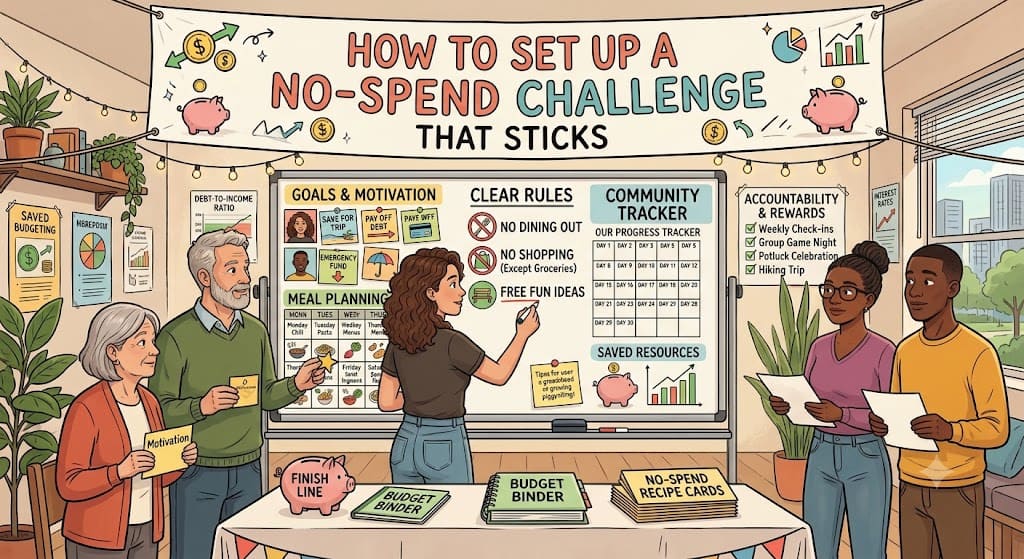
How to Set Up a No-Spend Challenge That Sticks
Think of the whole thing as a budget reset rather than a punishment. You’re not swearing off spending forever, you’re pressing pause long enough to see your habits clearly.
1. Pick a real number, not a vague goal
“Save money” isn’t a goal you can check off. “Save $400 toward my emergency fund” is. With 53% of Americans unable to cover a $1,000 surprise expense, an emergency fund is a genuinely common reason people run this challenge in the first place, and it gives you something concrete to picture when the willpower dips on day 12.
2. Choose your timeframe honestly
A full month is the most common length, and it’s long enough to see the number move without feeling endless. If that sounds intimidating, a no-spend week or even a no-spend weekend teaches you the same lesson at a smaller scale. Avoid starting during a month with a birthday, holiday, or trip already booked. You’re not testing your willpower against unfair odds, you’re setting rules you can actually keep.
3. Write your specific rules down before day one
Vague rules are where challenges quietly fall apart. “No unnecessary spending” leaves too much room for justifying a $6 latte as “necessary.” Write the actual list: no restaurants, no clothing purchases, groceries only from a written list, no browsing shopping apps. The more specific the rule, the less negotiating you’ll do with yourself at 9pm when you’re tired and Uber Eats is one tap away.
4. Stock up before you start, not during
Do a full pantry and fridge inventory before your challenge begins. I made this mistake the first time, ran out of coffee filters on day six, and used it as an excuse to justify a whole Target run. A little prep, plus a rough meal plan for the week, removes most of the decisions that trip people up.
5. Remove the triggers, don’t just resist them
Delete shopping apps. Unsubscribe from promotional emails. Log out of saved payment info on sites you browse when bored. This isn’t about having more discipline, it’s about needing less of it. If the “buy now” button takes an extra 90 seconds of typing in your card number, a surprising number of impulse buys just don’t happen.
6. Track every day, even the bad ones
A simple calendar where you mark spend or no-spend days works fine, and there’s something satisfying about a visible streak. The No Spend Challenge Workbook: 52 Weeks to Financial Reset is a low-tech option if you’d rather not stare at an app, since it’s built around the same weekly check-in habit. If you slip up, mark it and keep going. One red mark doesn’t undo the whole month, and treating it that way is exactly the all-or-nothing thinking that makes people quit on day 12 instead of finishing at day 30.
7. Tell someone
Challenges done alone are easier to quietly abandon. Tell a friend, post about it, find one other person doing the same thing. It’s a small thing that makes a real difference in whether you cross the finish line.
What Happens After the Challenge Ends
This part matters more than people expect, and it’s where two of the four articles I researched for this piece and I largely agree: the risk isn’t the challenge itself, it’s what personal finance writers call revenge spending, where you “reward” yourself for a month of restraint by spending more than usual once it’s over.
Before your challenge ends, decide in advance what happens to the money you saved. Move it straight into savings or toward debt the same day, before it has a chance to feel like “extra” cash burning a hole in your account. Then take a few minutes to actually look back:
- What did you miss the most, and was it actually important to you?
- Where did you overspend before, that you now see clearly?
- What’s one no-spend habit worth keeping permanently, even outside a formal challenge?
Some people run this challenge once a year in January. Others do it every quarter. There’s no wrong cadence, the only real failure is not finishing the one you start.
Key Takeaways
- A no-spend challenge means pausing nonessential spending, not all spending, for a set period, usually a week to a month.
- The average US household spends roughly $1,050 a month on dining, shopping, and entertainment, and a realistic no-spend month saves $300-$750 of that.
- About 1 in 3 people who start a no-spend challenge in January don’t finish it, almost always because they skipped planning and relied on willpower alone.
- Writing specific rules and prepping your pantry before day one matters more than any single motivation trick.
- Deciding where your saved money goes before the challenge ends helps prevent revenge spending once it’s over.
Frequently Asked Questions
Can I buy food during a no-spend challenge? Yes. Groceries for meals you cook at home are considered a necessity in almost every version of this challenge. What usually gets cut is restaurants, delivery apps, and coffee shops.
Can you use gift cards during a no-spend challenge? It depends on your own rules. Some people treat gift cards as free money and use them freely. Others avoid them entirely because using one can feel like permission to shop, which defeats the point for anyone trying to break that specific habit.
What happens if I break my no-spend challenge? Nothing catastrophic. Mark the day as a slip, note what triggered it, and pick the challenge back up the next day. Treating one off day as a total failure is the thinking that makes people quit early instead of finishing with a smaller, still-real amount saved.
Does a no-spend challenge actually work? Yes, based on BLS spending data, a typical household can realistically save $300 to $750 in a single 30-day challenge. It works best when paired with a specific rule set and a plan for the money afterward, rather than willpower alone.
How long should a no-spend challenge last? A month is the most common length, but a week or a weekend works for a first attempt. Choose a length you can commit to fully rather than an ambitious one you’ll likely abandon.
If you’re trying to figure out where your money is actually going before you set your no-spend rules, it’s worth sitting down with last month’s bank statement for 20 minutes. You’ll probably find your own version of my four DoorDash orders.
By Saad Faisal · Published July 14, 2026
Disclaimer
This article is for general informational purposes only and shouldn’t be taken as financial advice. The savings figures above are based on national averages and are examples, not guarantees. Before making decisions about your budget, savings, or debt payoff, it’s worth checking with a qualified financial professional who can look at your specific situation. You can also read FinToku’s full Financial Disclaimer.
(Quick heads up: the tracker journal link above is an affiliate link, so FinToku may earn a small commission if you buy through it. Full details in our Affiliate Disclosure.)
Published by Saad Faisal for FinToku (fintoku.com) FinToku publishes free, no-signup finance calculators and practical money guidance.