
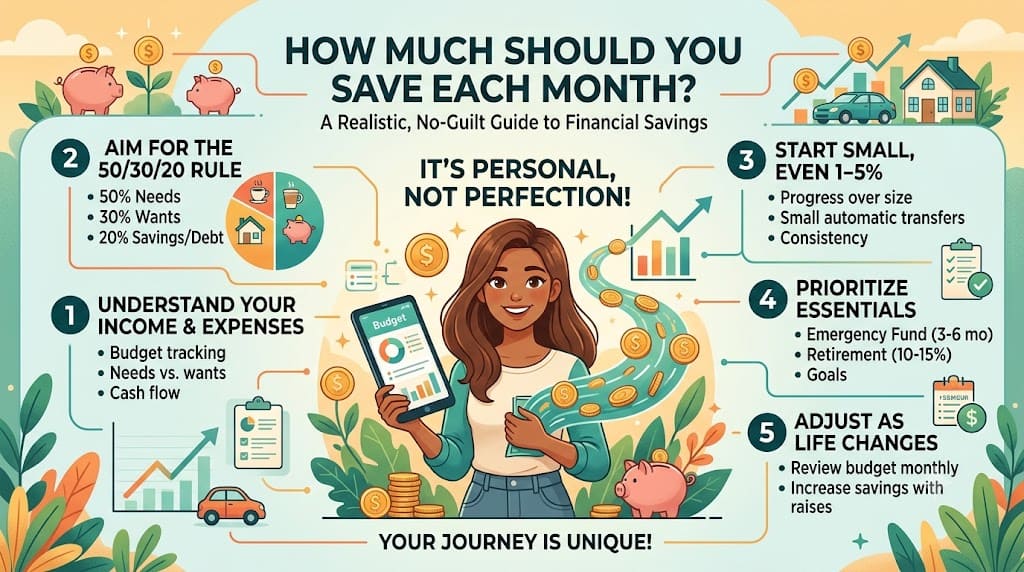
Most financial planners suggest saving 15% to 20% of your gross income each month, split across an emergency fund, retirement, and specific goals. If that’s out of reach right now, saving 5% to 10% consistently and building up from there works too. What matters more than hitting a specific number is starting, automating it, and adjusting as your income changes.
The 50/30/20 rule, and why it’s a starting point, not a rulebook
The most-cited framework here is the 50/30/20 budget: 50% of your take-home pay toward needs (rent, groceries, utilities), 30% toward wants, and 20% toward savings and debt repayment. It’s popular because it’s simple. It’s also, honestly, a little unrealistic if you live somewhere rent alone eats 40% of your check.
I ran my numbers through FinToku’s Currency Converter once while comparing a job offer in a different city, and the cost-of-living gap alone would have blown up a strict 50/30/20 split. Frameworks are a starting point. Your actual rent, your actual debt, your actual goals adjust the math from there.
If you want the deeper breakdown of that split (where the 20% actually comes from, and the adjusted versions people use when their rent alone blows past 50%), FinToku has a full explainer on the 50/30/20 budget rule. Running your own numbers through FinToku’s Budget Planner & 50/30/20 Calculator is faster than doing this math by hand, too.
The 15-20% income guideline
Separately from the 50/30/20 split, most planners recommend putting 15% to 20% of your gross (pre-tax) income toward savings overall, including any employer 401(k) match, your emergency fund, and money earmarked for specific goals like a down payment. This isn’t a competing rule so much as the same target expressed a different way.
What a realistic monthly number actually looks like
Here’s where most articles get vague. So let’s get concrete. This is illustrative, based on common 15-20% guidance, not a personalized recommendation:
| Annual income | 10% (getting started) | 15% (on track) | 20% (aggressive) |
|---|---|---|---|
| $40,000 | $333/mo | $500/mo | $667/mo |
| $60,000 | $500/mo | $750/mo | $1,000/mo |
| $80,000 | $667/mo | $1,000/mo | $1,333/mo |
| $100,000 | $833/mo | $1,250/mo | $1,667/mo |
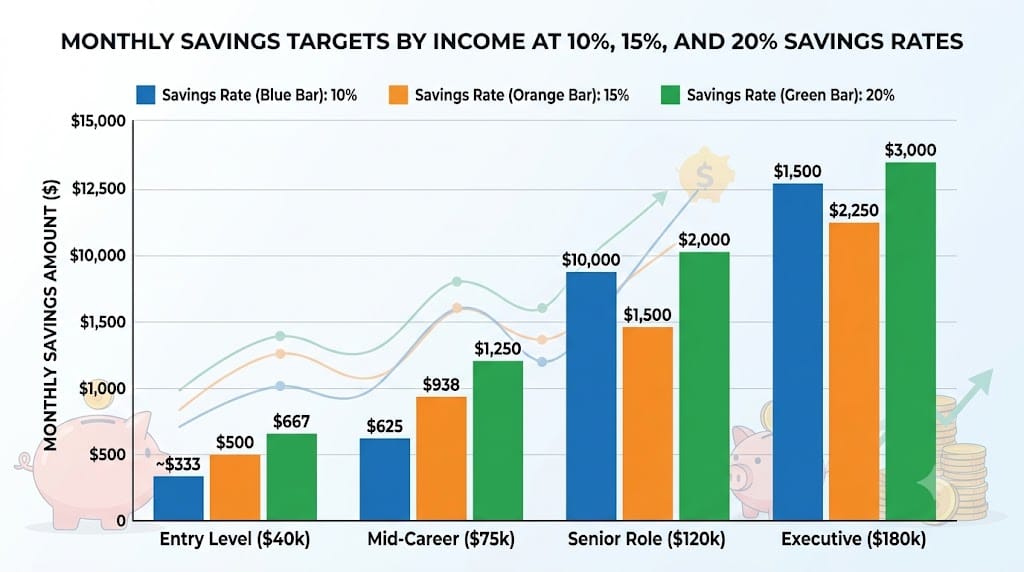
If your number looks impossible right now, that’s information, not failure. It usually means the fixed costs (rent, debt, childcare) genuinely don’t leave room for 20%, and the fix is starting lower and building, not beating yourself up over the gap.
Emergency fund or retirement match first?
This is the actual decision point most guides gloss over. In order:
- Get the full employer 401(k) match, if you have one. It’s close to a guaranteed return: an immediate 50-100% gain the moment it hits your account. Skipping it to build savings elsewhere almost never makes mathematical sense.
- Build a starter emergency fund of $500 to $1,000. Enough to cover a car repair or a broken laptop without a credit card. FinToku’s month-by-month plan to build an emergency fund in 6 months walks through exactly how to automate this step.
- Pay down high-interest debt (anything above roughly 8-10% APR, credit cards especially). A 24% APR balance is a guaranteed “return” that beats almost anything else you could do with that money.
- Build the emergency fund up to 3-6 months of expenses.
- Everything else: additional retirement contributions, a house down payment, specific goals.
Real talk: most people don’t move through this list in a clean order. You’ll probably work on two of these at once, and that’s fine.
Where the data actually stands right now
<sup>Figures below reflect the most recent data available from each source as of July 2026.</sup>
| Metric | Figure | Source |
|---|---|---|
| Median earnings, ages 25-34 (full-time) | $59,280/year ($1,140/week) | Bureau of Labor Statistics, Q1 2026 |
| Average balance, transaction accounts, under 35 | $20,540 | Federal Reserve Survey of Consumer Finances, 2022 (most recent wave available; the 2025 survey is still in the field) |
| Median balance, transaction accounts, under 35 | $5,400 | Federal Reserve Survey of Consumer Finances, 2022 |
| Adults who could cover a surprise $1,000 expense from savings | 47% | Bankrate’s 2026 Annual Emergency Savings Report, based on a December 2025 survey |
That last stat is the one that stuck with me. Fewer than half of U.S. adults could handle a $1,000 surprise without going into debt for it. If you’re not there yet, you’re not the outlier the headlines make you feel like.
Where to actually keep the money
Where you park your monthly savings matters almost as much as how much you save:
- 0-3 years out (emergency fund, near-term goals): a high-yield savings account. You want the money liquid and earning something better than a traditional bank’s 0.01% APY.
- 3-10 years out (a house down payment, a career break fund): still mostly HYSA or CDs. You generally don’t want market risk on money you’ll need on a specific timeline. If you’re weighing the two against each other, FinToku’s High-Yield Savings Account vs CD breakdown covers which wins for which timeline.
- 10+ years out (retirement): a 401(k) up to the match, then an IRA, then back to the 401(k) or a taxable brokerage account. This is where market risk has time to average out.
[GRAPHIC: Simple horizontal timeline mapping 0-3 years, 3-10 years, and 10+ years to HYSA, CDs, and 401(k)/IRA/brokerage respectively – alt text: “Where to keep savings by time horizon: high-yield savings, CDs, and retirement accounts”]
Can you save too much?
It sounds like a good problem, but it’s a real one. If maxing out retirement accounts means skipping your kid’s school trip or never seeing your family because you’re picking up extra shifts, the math has stopped serving you. Saving is supposed to buy you options later, not misery now. If you genuinely can’t tell whether you’re saving “enough” or “too much,” that’s a good sign it’s worth a session with a fee-only financial planner rather than another calculator.
Key Takeaways
- Most planners recommend saving 15-20% of gross income monthly, but 5-10% consistently is a legitimate starting point if 20% isn’t realistic yet.
- Get your full employer 401(k) match before building savings elsewhere. It’s close to a guaranteed return.
- A starter emergency fund of $500-$1,000 matters more early on than hitting a perfect percentage.
- Only 47% of U.S. adults could cover a surprise $1,000 expense from savings, according to Bankrate’s 2026 Annual Emergency Savings Report.
- Where you keep the money (high-yield savings vs. 401(k)/IRA) matters as much as how much you set aside.
Frequently Asked Questions
Is 20% too much to save each month? Not inherently, but it’s not mandatory either. It’s a widely cited guideline, not a requirement. If it’s not realistic given your rent, debt, or income, a lower percentage that you can sustain beats an ambitious target you abandon after two months.
What if I can’t save 20% of my paycheck? Save what you can, even if it’s 5%. Automate it so it happens before you see the money, and increase the percentage by 1% every time you get a raise.
How much should I have saved by 30? There’s no single right answer, but a commonly cited benchmark is roughly one year’s salary saved (mostly in retirement accounts) by 30. Federal Reserve data puts the actual median much lower for that age group, so don’t panic if you’re not there.
Should I build an emergency fund or pay off debt first? Get a small starter emergency fund ($500-$1,000) in place first, then attack high-interest debt (above roughly 8-10% APR) before building the fund up to 3-6 months of expenses.
Can you save too much money? Yes, if it comes at the cost of your present-day quality of life or you’re neglecting near-term needs to hit an arbitrary long-term number. Saving should create options, not stress.
If you want a faster way to see your own numbers instead of eyeballing the table above, run your income through FinToku’s Budget Planner & 50/30/20 Calculator this week and see where the 15-20% actually lands for you.
Keep Reading
- How to Build an Emergency Fund in 6 Months (Even on a Tight Budget)
- The 50/30/20 Budget Rule Explained
- High-Yield Savings Account vs CD: Which Wins in 2026?
- 401(k) vs. IRA: which should you fund first? (not yet published; a natural next companion piece)
Disclaimer
This article is for general informational purposes only and shouldn’t be taken as financial or tax advice. The dollar figures in the income table above are illustrative examples based on common percentage guidelines, not a personalized recommendation. Retirement account rules, contribution limits, and account specifics change, so it’s worth checking with a qualified financial advisor before making decisions based on this article. You can also read FinToku’s full Financial Disclaimer.
Published by Saad Faisal for FinToku (fintoku.com) FinToku publishes free, no-signup finance calculators and practical money guidance.
By Saad Faisal · Published July 14, 2026 · Updated July 14, 2026