

Twenty-nine percent of U.S. adults say their income varies from month to month. For people who do any gig work, that number jumps to 41%. Nobody hands those workers a different kind of budgeting spreadsheet.
Budgeting on an irregular income means something specific. Build your plan around your lowest realistic month, not your average one. Cover essential expenses first. Set aside money for taxes before you touch anything else. Keep a buffer fund that absorbs the gap when a slow month hits. It’s less about predicting the future. It’s about deciding, in advance, what every dollar does the moment it lands.
What Counts as Irregular Income, Exactly
Irregular income is any pay that changes in amount, timing, or both from one pay period to the next. That covers freelance invoices, commission checks, seasonal work, tips, gig app payouts, and self-employment profit that swings with demand.
It’s different from a variable expense (like a utility bill that’s higher in July). With irregular income, the uncertainty sits on the money coming in, not just on what’s going out. That’s why a fixed-paycheck budget tends to fall apart the first uneven month.
Step 1: Find Your Baseline Income
Pull your last 6 to 12 months of income and find your single lowest month. That number, not your average, becomes the foundation of your core budget.
This feels overly cautious the first time you do it. It isn’t. Budgeting off the average means roughly half your months come in under plan. That’s exactly the setup that leads to credit card debt during slow stretches. Budgeting off the low end means most months leave you with extra. Extra is a much easier problem to have.
If you’re brand new to irregular work, you may not have 6 months of history yet. Guess conservatively, then revise the number once you do.
Step 2: List Essential Expenses First
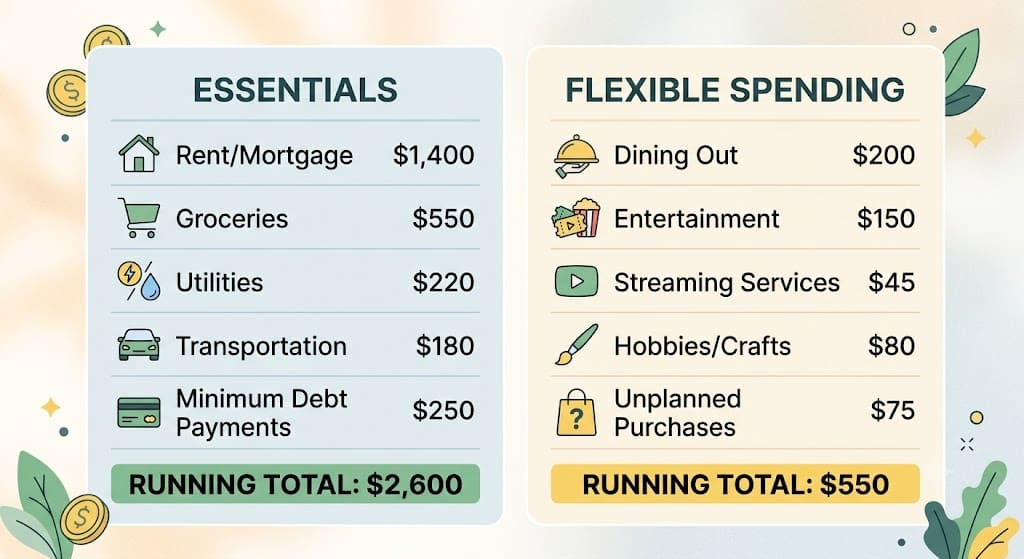
Write down every cost you have to pay no matter what. Think rent or mortgage, utilities, groceries, minimum debt payments, insurance, and transportation. Add them up. That total is the number your baseline income needs to clear every single month.
Everything else, dining out, subscriptions, hobbies, comes after that. Fund it only once you’ve covered the essentials, and only in months where the money’s actually there.
Step 3: Pick a Budgeting Method That Fits How You Get Paid
Two approaches dominate this space. They work differently enough that it’s worth picking one on purpose. Don’t just drift into whichever you read about first.
| Method | How it works | Best for |
|---|---|---|
| Zero-based budgeting | You assign every dollar a job the moment it arrives, until the balance hits zero | Unpredictable “feast or famine” income (freelancers, commission) |
| Baseline + average budgeting | You plan spending around your average monthly income, with the lowest month as a floor | Semi-predictable income with a known slow season (seasonal work, teachers) |
Zero-based budgeting means you don’t plan spending against money you haven’t received yet. You assign real dollars to real categories as they land. That keeps you from spending against an invoice a client hasn’t paid yet. Baseline-and-average budgeting works better when you can see the slow months coming. You just need to save ahead of them.
Either way, run your actual numbers through FinToku’s Budget Planner & 50/30/20 Calculator. See how a given month’s income splits across needs, wants, and savings before you commit to a plan.
Step 4: Build Your Buffer Before You Touch the Extras
In any month you earn more than your baseline, the surplus goes to your buffer fund first. Not to savings goals, not to debt payoff, not to a nicer dinner. The buffer is what turns next month’s shortfall into a non-event instead of a crisis.
Once you’ve saved one month of essential expenses, keep going toward three. Eventually aim for six if your income swings are wide. The Consumer Financial Protection Bureau recommends this kind of buffer for one specific reason: it keeps a temporary income drop from turning into new debt. That’s exactly the failure point irregular earners hit most often.
FinToku’s Emergency Fund Calculator can help. Plug in your actual essential-expense total from Step 2 to set a real target.
Step 5: Set Aside Money for Taxes If You’re Self-Employed
If nobody’s withholding taxes from your pay, that job falls to you. A common starting point is setting aside 25% to 30% of every payment you receive. Put it into a separate account you don’t touch for anything else.
The IRS generally requires self-employed workers to make quarterly estimated tax payments. That kicks in once you expect to owe $1,000 or more for the year. Missing a quarter can mean a penalty, even if you’re square by April. Setting the money aside the day it arrives is far less painful than scrambling for it in a lump sum.
Step 6: Automate the Transfers, Then Revisit Monthly
Set up automatic transfers on payday. Send a fixed amount to your buffer. Send a percentage to taxes if that applies, and the rest to your spending categories. Automating removes the daily decision of whether to move the money, which is where most budgets quietly fail.
Then actually revisit the plan every month. Irregular income means your numbers move. A budget you haven’t touched in three months is really just a guess.
A Worked Example
Say a freelance graphic designer’s income over the past year ranged from $2,400 to $6,800 a month. Her low was $2,400. Essential expenses come to $2,100.
She builds her core budget around $2,400, which leaves $300 of breathing room even in the worst month. In a $5,000 month, she covers the $2,100 in essentials and sets aside 28% ($1,400) for taxes. She puts $1,000 into her buffer fund until it hits three months of expenses. After that, she allocates what’s left to savings goals and discretionary spending.
The numbers above are illustrative, not a template to copy. Run your own income range and expenses through the calculator above. See what your version of this looks like.
Common Mistakes That Sink an Irregular Income Budget
- Budgeting off the average instead of the low. It looks fine on paper until a genuinely slow month hits and there’s no cushion.
- Spending an invoice before it’s paid. Forecasted money isn’t real money until it lands in the account.
- Skipping the tax set-aside “just this once.” That gap doesn’t close itself, and it compounds every quarter you ignore it.
- Treating a good month as free money. The whole point of a buffer is catching that surplus before lifestyle creep does.
Irregular Income and Emergency Savings: The Data
| Metric | Figure | Source (as of) |
|---|---|---|
| U.S. adults whose income varies month to month | 29% | Federal Reserve, SHED 2024 report (published May 2025) |
| Adults who did any gig work in the prior month | 20% | Federal Reserve, SHED 2024 report (published May 2025) |
| Gig workers reporting month-to-month income variation | 41% | Federal Reserve, SHED 2024 report (published May 2025) |
| U.S. adults who could not cover a $400 emergency expense with cash or equivalent | 37% | Federal Reserve, SHED 2025 report (published May 2026) |
| Commonly recommended self-employment tax set-aside | 25-30% of income | General financial-planning guideline, 2026 (the IRS sets the quarterly payment requirement, not this percentage) |
Key Takeaways
- Build your core budget around your lowest realistic income month, not your average one. Most months will then leave you ahead instead of short.
- Cover essential expenses first, then taxes if you’re self-employed, then your buffer fund, before you fund any discretionary spending.
- Zero-based budgeting fits genuinely unpredictable “feast or famine” income; baseline-and-average budgeting fits income with a known slow season.
- A buffer fund of three to six months of essential expenses is what actually smooths out an irregular income. A bigger paycheck alone won’t do it.
- Set aside 25% to 30% of self-employment income for taxes as it arrives. The IRS expects quarterly payments, not one lump sum in April.
Frequently Asked Questions
What counts as irregular income? Irregular income is any pay that changes in amount or timing between pay periods. That includes freelance work, commissions, tips, seasonal jobs, gig app earnings, and self-employment profit.
What makes a budget a zero-based budget? A zero-based budget assigns every dollar of income to a specific job: bills, savings, taxes, spending. It keeps going until the total reaches zero. No money sits unassigned.
Is there a good template for budgeting on an irregular income? A spreadsheet or app that lets you plug in a different figure each month works better. A fixed template can’t keep up with income that moves. FinToku’s Budget Planner & 50/30/20 Calculator does this without needing a static template at all.
How is budgeting for irregular expenses different from budgeting for irregular income? Irregular expenses, like an annual insurance premium, are predictable in size but not monthly. Divide the total by the months until it’s due, then save that amount each month. Irregular income is unpredictable on the money coming in, which is the harder problem this guide addresses.
What are the key components of a budget that actually works with irregular income? Five things make this work: a baseline on your lowest month and essentials first. Then taxes set aside if you’re self-employed, a buffer for slow months, and a monthly review. Skip that review, and the plan stops matching reality within a season.
If your income changed again this month, run the new numbers through FinToku’s Budget Planner & 50/30/20 Calculator. Do it before you spend a dollar of it.
Read More
- Paycheck Budgeting for Beginners: How to Make Your Money Last Between Paydays
- Sinking Fund vs. Emergency Fund: Which One Do You Actually Need?
- Best Tax Deductions for Freelancers in 2026 (Full List + Worksheet)
Disclaimer
This article offers general information only. It isn’t financial or tax advice. The income and expense figures in the worked example are illustrative, not guarantees. The tax set-aside percentage is a general starting point, not a calculation of what you’ll actually owe. Before making a real financial or tax decision, it’s worth checking with a qualified financial advisor or tax professional. They can look at your specific situation. You can also read FinToku’s full Financial Disclaimer.
Published by Saad Faisal for FinToku (fintoku.com) · Published July 26, 2026 · Updated July 26, 2026 FinToku provides free finance tools and guides to help you make smarter money decisions.