

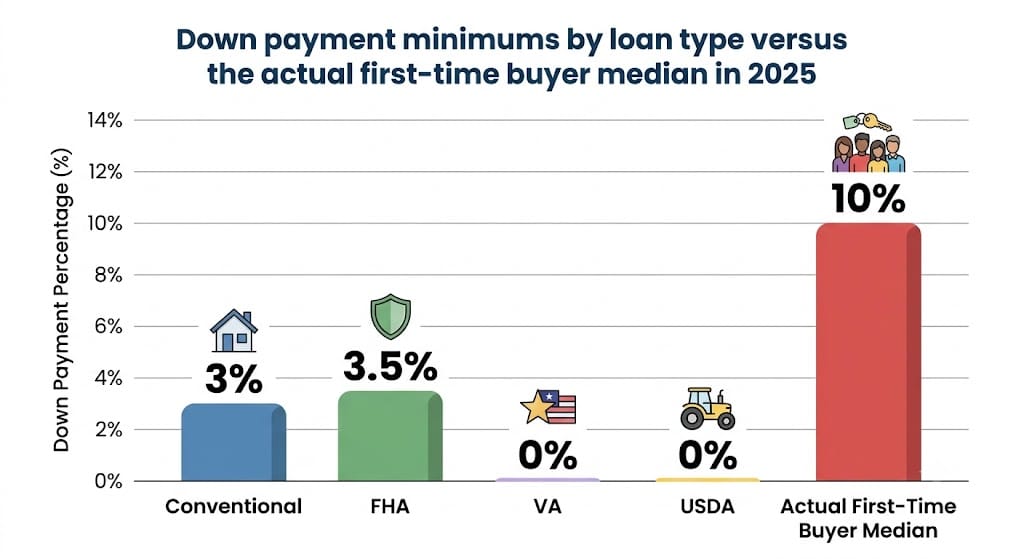
You’ve probably heard you need 20% saved before you can buy a house. You don’t, and holding onto that belief is itself one of the priciest down payment mistakes first-time buyers make. The median first-time buyer put down just 10% in 2025, according to the National Association of Realtors, and several loan programs allow 3%, 3.5%, or even 0% down. The real risk isn’t putting down too little. It’s what happens next: draining every account to get there, missing a program that could have helped, or showing up at closing short on cash.
Here are the nine down payment mistakes that actually cost first-time buyers money, and what to do instead of each one.
Mistake 1: Believing You Need 20% Down
Putting 20% down is optional for the vast majority of mortgages, not a requirement to qualify.
That myth alone stops people from even starting the process. Conventional loans through programs like Fannie Mae’s HomeReady or Freddie Mac’s Home Possible go as low as 3% down. FHA loans require 3.5% down with a credit score of 580 or higher (10% if your score falls between 500 and 579). VA and USDA loans can go to 0% down for eligible borrowers.
The trade-off is private mortgage insurance, or PMI, which kicks in on conventional loans below 20% down. It’s not a penalty. It’s the cost of buying sooner instead of waiting years to save an extra 10 or 15 percentage points, and you can request its removal once you hit 20% equity.
Mistake 2: Draining Your Entire Savings to Hit a Bigger Number
Emptying your bank account to push your down payment higher is one of the fastest ways to turn a home purchase into a financial emergency.
It feels responsible in the moment. A bigger down payment means a smaller loan, a lower monthly payment, and maybe no PMI. But a house with zero cash cushion behind it is fragile. The furnace that dies in month two, the job that gets cut in month four, the roof that needs patching before winter, none of that waits for your savings to recover.
Aim to keep at least three to six months of expenses in reserve after closing, separate from whatever you’re putting down. If that number feels impossible right now, that’s a signal to put less down, not to skip the reserve. FinToku’s Emergency Fund Calculator can show you exactly what that cushion should look like for your own budget before you commit to a down payment number.
Mistake 3: Not Checking What Your Specific Loan Type Actually Requires
Down payment minimums aren’t one number. They shift by loan type, and guessing instead of checking is how buyers over-save for years or apply for the wrong program.
| Loan type | Minimum down payment | Mortgage insurance | Source (as of 2026) |
|---|---|---|---|
| Conventional (HomeReady / Home Possible) | 3% | PMI required below 20% down; cancels once you reach 20% equity | Consumer Financial Protection Bureau |
| FHA | 3.5% (credit score 580+); 10% (score 500-579) | Mortgage insurance premium (MIP) required, stays for the loan’s life unless 10%+ is put down | FHA / U.S. Dept. of Housing and Urban Development |
| VA | 0% for eligible veterans and active-duty service members | No monthly PMI; one-time VA funding fee applies | U.S. Dept. of Veterans Affairs |
| USDA | 0% in eligible rural and suburban areas | USDA guarantee fee, no traditional PMI | U.S. Dept. of Agriculture |
| Actual first-time buyer median | 10% | N/A | National Association of Realtors, 2025 Profile of Home Buyers and Sellers |
| Actual repeat buyer median | 23% | N/A | National Association of Realtors, 2025 Profile of Home Buyers and Sellers |
Run your own numbers before you assume you’re priced out. FinToku’s Home Affordability Calculator and Mortgage & Home Loan Calculator let you plug in a real income and down payment amount and see the actual monthly payment, not a rule of thumb.
Mistake 4: Overlooking Down Payment Assistance Programs and Grants
Skipping down payment assistance research is one of the most expensive mistakes on this list, because the money is often just sitting there unclaimed.
There’s no single nationwide “$7,500 government grant,” but plenty of real programs land near that number. Illinois’ 1stHomeIllinois program offers up to $7,500 in forgivable assistance. Bank of America’s America’s Home Grant offers up to $7,500 in lender credits toward closing costs. Nearly every state runs its own down payment assistance program through its housing finance agency, and amounts commonly range from $5,000 to $25,000 or more, sometimes structured as grants, sometimes as deferred or forgivable loans.
California buyers specifically should look at CalHFA’s MyHome Assistance Program, a deferred second loan worth up to 3.5% (FHA) or 3% (conventional) of the purchase price. If you’re buying anywhere else, HUD keeps a directory of local homebuying assistance programs by state, which is a better starting point than guessing based on a headline you saw once.
Mistake 5: Forgetting the Down Payment Isn’t Your Only Cash Need at Closing
Your down payment and your total cash to close are two different numbers, and mixing them up is how buyers show up short on closing day.
Closing costs typically run 2% to 5% of the purchase price on top of the down payment itself. That covers the appraisal, title insurance, lender fees, and prepaid items like the first year of homeowners insurance. On a $350,000 home, that’s an extra $7,000 to $17,500 you need in addition to whatever you’re putting down.
Ask your lender for a Loan Estimate early so the full number, not just the down payment slice, is in front of you before you get attached to a house.
If you want the full closing-cost walkthrough in book form, the Home Buying Kit for Dummies is a solid, unbiased place to start. (Heads up, that’s an affiliate link, so FinToku may earn a small commission if you buy through it. Full details in our Affiliate Disclosure.)
Mistake 6: Not Understanding How Your Down Payment Affects Your Pricing Tier
A slightly bigger down payment doesn’t just look better on paper. It can move you into a cheaper rate tier entirely, and most first-time buyers never check.
Lenders price loans using a grid based on credit score and loan-to-value ratio (how much you’re borrowing versus the home’s value). Crossing certain down payment thresholds, even by a few thousand dollars, can drop your rate and your PMI cost at the same time. Two buyers with identical credit scores but different down payment percentages can end up with meaningfully different monthly payments on the exact same house.
Before you lock in a number, ask your loan officer how the pricing grid changes if you put down 5% more. It’s a five-minute question that can save thousands over the life of the loan.
Mistake 7: Letting a Bigger Down Payment Talk You Out of Other Safeguards
Buyers who stretch to hit a large down payment sometimes waive other protections to save money elsewhere, and a skipped home inspection is the most common casualty.
A professional inspection can uncover foundation issues, roof damage, or electrical problems that cost far more to fix than the inspection itself. Waiving it to look more competitive in a bidding war, or because the budget already feels tight after the down payment, trades a small known cost for a large unknown one.
If your budget is genuinely too tight to cover both a solid down payment and a proper inspection, that’s a sign to put less down, not to skip the inspection.
Mistake 8: Moving Money Around or Taking on New Debt Right Before Closing
Lenders re-verify your income, debt, and credit right before closing, not just when you apply, and unexplained changes in that window can delay or kill your approval.
New credit cards, a car loan, a job change, or a large unexplained deposit into your account can all trigger a second review. That’s true even if the money is perfectly legitimate. Keep your financial picture as boring as possible between application and closing day.
Mistake 9: Not Documenting Gift Funds Properly
Down payment gifts from family are common and completely allowed, but an undocumented gift is one of the fastest ways to stall a closing that was otherwise ready to go.
Lenders need a signed gift letter confirming the money is a gift, not a loan you’re expected to repay, along with a paper trail showing where it came from. Sort this out weeks before closing, not the day the funds land in your account.
Where Buyers Actually Get Their Down Payment Money (2025 Data)
| Source | Share of first-time buyers using it |
|---|---|
| Personal savings | 59% |
| Financial assets (retirement accounts, investments) | 26% |
| Gift or loan from relatives or friends | 22% |
Source: National Association of Realtors, 2025 Profile of Home Buyers and Sellers (figures don’t sum to 100% because buyers can combine sources).
Key Takeaways
- The median first-time buyer put down just 10% in 2025, not 20%, and conventional, FHA, VA, and USDA programs all allow less than 20% down.
- PMI on a conventional loan isn’t permanent. It can be canceled once you reach 20% equity, so a smaller down payment now doesn’t mean paying it forever.
- Down payment assistance programs commonly provide $5,000 to $25,000 or more through state housing agencies, lenders, or nonprofits, and most first-time buyers never check what they qualify for.
- Your down payment and your total cash to close are different numbers. Closing costs alone typically add 2% to 5% of the purchase price on top.
- New debt, job changes, or large unexplained deposits between mortgage application and closing can delay or derail approval, so keep your finances stable during that window.
Frequently Asked Questions
What’s the minimum down payment for a first-time home buyer? It depends on the loan. Conventional loans can go as low as 3%, FHA loans require 3.5% with a 580+ credit score, and VA or USDA loans can require 0% down for eligible borrowers.
Is there really a $7,500 government grant for first-time home buyers? Not as a single nationwide program, but several real programs land near that figure, including lender credits like Bank of America’s America’s Home Grant and state programs such as Illinois’ 1stHomeIllinois. Availability depends on your state, income, and lender.
Do first-time home buyers need 20% down? No. The 20% figure only matters for avoiding PMI on a conventional loan. The actual median first-time buyer put down 10% in 2025.
What down payment mistakes should California buyers watch for? The biggest one is assuming state or local assistance doesn’t apply because of the state’s high home prices. Programs like CalHFA’s MyHome Assistance Program specifically target California’s higher price points.
What are the requirements for a first-time home buyer loan? Requirements vary by program, but generally include a minimum credit score (580 for FHA’s lowest down payment tier), proof of income, a manageable debt-to-income ratio, and documentation for any down payment funds, including gifts.
Run your own numbers through FinToku’s Home Affordability Calculator before you settle on a down payment target. It’s free, takes a couple of minutes, and shows you the real monthly payment behind whatever percentage you’re considering.
Read More
- How Much House Can You Really Afford? (Not What a Calculator Says)
- FHA Loan Requirements 2026: Credit Score, Down Payment & Limits Explained
- Best Home Loan in the US: What the Data Actually Shows in 2026
Disclaimer
This article is for general informational purposes only and shouldn’t be taken as financial, tax, or legal advice. Loan requirements, PMI rules, and down payment assistance programs change and vary by lender, state, and individual circumstances, so the figures above are a starting point, not a guarantee. Before deciding how much to put down, it’s worth checking current terms with a qualified lender or HUD-approved housing counselor who can look at your specific situation. You can also read FinToku’s full Financial Disclaimer.
Published by Saad Faisal for FinToku (fintoku.com) · Published July 26, 2026 · Updated July 26, 2026 FinToku provides free finance tools and guides to help you make smarter money decisions.