

The short answer: there’s no single “best” home loan. The right one depends on your credit score, how much you’re putting down, and whether you qualify for a government-backed program. Right now, the average 30-year fixed rate sits at 6.49%, but what you’ll actually be offered could run anywhere from the mid-6% range to well past 7%, depending on your credit tier.
A mortgage is a loan used to buy real estate, repaid monthly with interest over a set term, usually 15 or 30 years. The lender holds a lien on the property until it’s paid off, and if you stop paying, they can foreclose. The “best” mortgage isn’t the one with the flashiest advertised rate. It’s the one that matches your credit profile, your down payment, and how long you plan to stay in the house.
I’ll admit, the first time I compared mortgage quotes I made the same mistake almost everyone makes: I focused on the interest rate and ignored the APR. One lender’s “lower rate” came with over $4,000 in extra fees baked in. It wasn’t until I lined the loan estimates up side by side that I saw the cheaper-looking offer wasn’t actually cheaper. FinToku’s Mortgage & Home Loan Calculator is a quick way to run that same side-by-side math on your own numbers before you talk to a single lender.
The rest of this piece breaks down exactly where today’s rates come from, how much your credit score really costs you, and what the different loan types actually get you.
Current mortgage rates, and why the “average” isn’t your rate
The 30-year fixed-rate mortgage averaged 6.49% for the week of July 9, 2026, according to Freddie Mac’s Primary Mortgage Market Survey, up slightly from 6.43% the week before and down from 6.72% a year earlier. The 15-year fixed averaged 5.82% over the same week.
Here’s the catch: that PMMS number assumes a borrower with excellent credit putting 20% down on a conventional loan. Most buyers don’t fit that exact profile, which is exactly why the “average rate” you see in headlines and the rate on your actual loan estimate can look pretty different.
Rates also vary by loan type. As of July 2026, sample rates from The Mortgage Reports, sourced from Curinos data, showed conventional 30-year loans at 6.56% (6.635% APR), FHA loans at 6.476% (6.542% APR), and VA loans at 6.466% (6.497% APR). FHA and VA typically undercut conventional slightly because the government backing lowers the lender’s risk.
One thing worth knowing before you start comparing numbers across different sites: rate trackers don’t all measure the same thing. Freddie Mac’s weekly survey assumes 20% down and excellent credit. Bankrate’s daily survey showed the 30-year average at 6.58% on July 11, 2026, a full nine basis points above Freddie Mac’s most recent weekly figure, mostly because it’s a different lender panel measured on a different day. Neither number is wrong; they’re just answering slightly different questions. Your actual quote will differ from both.
A real, dated example from an actual lender: as of July 10, 2026, Navy Federal Credit Union published a 30-year conventional rate of 6.000% (6.142% APR) on a $300,000 loan for a 720-FICO borrower putting 20% down, and a 30-year VA rate of 5.625% (6.045% APR) on the same loan amount. Those numbers already undercut the FICO-tier and Curinos averages above, a reminder that credit unions, which don’t need to build dealer- or shareholder-style margins into their pricing, are consistently worth getting a quote from even if you end up borrowing elsewhere.
Mortgage rates by credit score
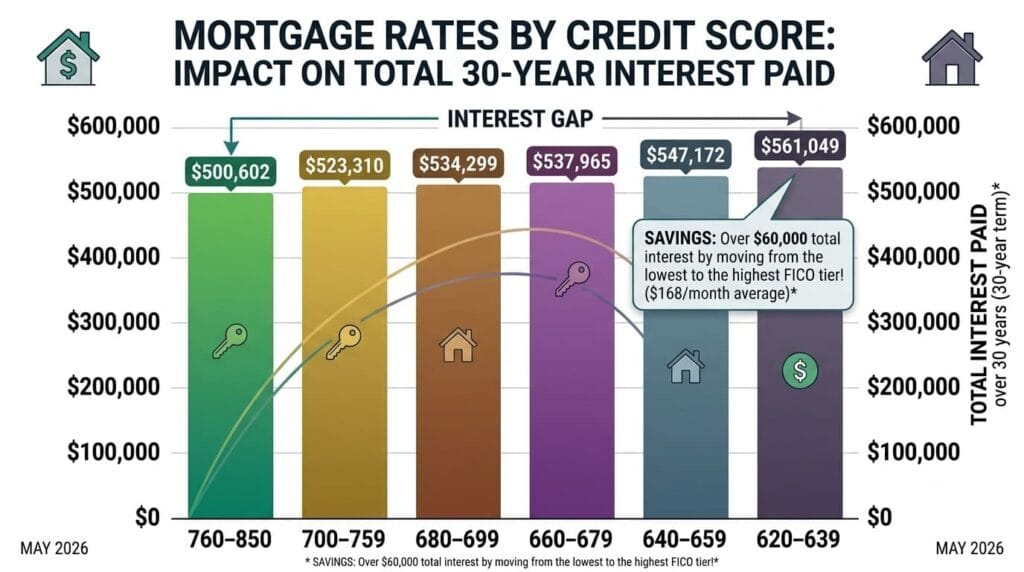
Your credit score moves your rate more than almost anything else in the equation. Here’s how average APRs broke down by FICO tier as of May 2026, based on myFICO’s loan-level pricing data:
| FICO score | Average APR | Monthly payment* | Total interest (30 yrs)* |
|---|---|---|---|
| 760–850 | 6.70% | $2,442 | $500,602 |
| 700–759 | 6.95% | $2,505 | $523,310 |
| 680–699 | 7.07% | $2,535 | $534,292 |
| 660–679 | 7.11% | $2,545 | $537,965 |
| 640–659 | 7.21% | $2,571 | $547,172 |
| 620–639 | 7.36% | $2,610 | $561,049 |
Based on the Mortgage Bankers Association’s average new-home loan amount of $378,384 as of April 2026.
Look at the gap between the top and bottom rows. Moving from the lowest tier to the highest one saves roughly $168 a month and just over $60,000 in interest across the life of the loan, on the exact same loan amount. That’s the single biggest lever most buyers have, and it’s the one people spend the least time on before applying.
If you’re sitting close to a tier boundary (say 615 instead of 620), it’s worth pausing your application for a month or two and paying down a card balance first. The jump between tiers isn’t gradual; it’s a step function.
What actually moves your rate (and what doesn’t)
Every mortgage rate stacks a few things on top of each other:
The bond market and the Fed. Mortgage rates track the 10-year Treasury yield more closely than the Fed funds rate directly, but Fed policy still moves both. When the Fed signals cuts, mortgage rates tend to drift down in anticipation, not necessarily on the day of the announcement.
Your risk profile. Credit score is the biggest factor, but debt-to-income ratio and loan-to-value ratio (how much you’re borrowing relative to the home’s value) matter too. A bigger down payment lowers your loan-to-value and can shave a quarter-point or more off your rate.
Loan type. Conventional, FHA, VA, and USDA loans each carry different risk to the lender, and it shows up in the rate.
Discount points. You can pay upfront to buy your rate down. Whether that math works depends on how long you’ll stay in the home: pay points on a loan you refinance two years later and you likely never break even.
Loan types compared: which one fits you
Most home loans fall into one of these categories, and eligibility tends to matter more than rate when you’re picking:
| Loan type | Min. credit score | Min. down payment | Best for |
|---|---|---|---|
| Conventional | 620 | 3% | Buyers with solid credit who don’t need a government backstop |
| FHA | 500 (10% down) / 580 (3.5% down) | 3.5% | Lower credit scores or limited savings |
| VA | No VA-set minimum; lenders often want 620 | 0% | Veterans, active military, and eligible spouses |
| USDA | Typically 640 | 0% | Rural and some suburban buyers within income limits |
A conventional loan isn’t backed by the federal government, but it typically follows Fannie Mae and Freddie Mac guidelines. Anything under 20% down usually means paying private mortgage insurance (PMI) until you build enough equity to drop it. Conventional loans that stay within the FHFA’s conforming loan limit ($832,750 in most counties for 2026) get the best pricing; go above that and you’re in jumbo-loan territory, where requirements tighten.
FHA loans are backed by the Federal Housing Administration and built for buyers who don’t have 20% saved or whose credit has some dings. The tradeoff is mortgage insurance premiums that, unlike conventional PMI, usually stick around for the life of the loan unless you refinance out.
VA loans are one of the best deals in lending if you qualify: no down payment, no monthly mortgage insurance, and often the lowest rates on the board. USDA loans work similarly for eligible rural and some suburban properties, with income caps attached.
FHA vs. conventional: what mortgage insurance actually costs you
The rate isn’t the whole story: mortgage insurance changes the real cost, and it works differently on each loan type. FHA charges a 1.75% upfront premium (usually financed into the loan) plus an annual MIP of about 0.55% for most 30-year borrowers, per HUD-sourced guidance compiled by Bankrate. If you put down less than 10%, that MIP sticks around for the entire loan term. It doesn’t cancel like conventional PMI does.
Here’s how that plays out on a $350,000 base loan amount over the first five years, using the rates above and an illustrative conventional PMI rate of 0.6% (actual PMI runs roughly 0.5%–1.5% depending on your credit and down payment, so treat this as directional):
| Conventional (10% down) | FHA (financed upfront MIP) | |
|---|---|---|
| Rate / APR | 6.56% | 6.476% |
| Loan amount financed | $350,000 | $356,125 (incl. 1.75% upfront MIP) |
| Monthly P&I | ~$2,226 | ~$2,245 |
| Monthly mortgage insurance | ~$175 (0.6% PMI) | ~$161 (0.55% MIP) |
| Total monthly, all-in | ~$2,401 | ~$2,406 |
| 5-year total (P&I + insurance) | ~$144,000 | ~$150,500 |
At similar credit and down payment levels, the two often land within a few dollars a month of each other. The real difference shows up over time. Conventional PMI cancels once you hit 20% equity; FHA’s MIP usually doesn’t unless you put down 10%+ (11-year cancellation) or refinance out entirely. If you can qualify conventional, that’s the loan most likely to get cheaper the longer you hold it.
Which lenders are actually offering the best terms
Rather than chase the single “best” lender (which changes by credit tier, loan type, and week), here’s how the qualifying bar differs across the field, based on NerdWallet’s lender research:
| Lender | Type | Min. credit score | Min. down payment | Best known for |
|---|---|---|---|---|
| Navy Federal Credit Union | Credit union (military) | Not disclosed | 0% | VA loans; real published rates below FICO-tier averages |
| Rocket Mortgage | Online lender | 620 | 3% | First-time buyers, fully digital process |
| Chase | National bank | 620 | 3% | Home loans overall; up to $5,000 in buyer grants |
| Veterans United | Direct VA lender | 620 | 0% | Largest VA loan originator by volume |
| Truist | National bank | 620 | 3% | Consistently low rates/fees vs. other large banks |
| Pennymac | Direct lender | 580 | 3.5% | FHA loans specifically |
| PNC Bank | National bank | 620 | 3% | HELOCs, down payment grants, no-PMI options |
| Bank of America | National bank | 720 | 5% | Jumbo loans |
| Better | Online lender | 640 | N/A (equity) | No lender fees; fast digital closings |
A few patterns worth noting: credit unions like Navy Federal don’t need to build shareholder margins into their pricing, which is why they can consistently beat national banks on rate. The tradeoff is membership eligibility. Online lenders trade in-person support for speed and lower fees. And a lender’s headline rating doesn’t always reflect what you’ll personally qualify for. The credit-score and down-payment columns matter more than the star rating if you’re not a top-tier borrower. If you’re weighing a credit union against a big bank or an online lender more broadly, FinToku’s credit union vs. bank vs. online lender comparison breaks down the same trade-offs in more depth.
Down payments and closing costs: what buyers are actually paying
Forget the old “20% or nothing” rule. Barely anyone follows it anymore. The median down payment across all buyers was 19% in 2025, according to the National Association of Realtors. But that number hides a big split: first-time buyers put down a median of just 10%, the highest that figure has been since 1989, while repeat buyers, who usually roll in equity from a previous sale, put down 23%.
First-time buyers also made up only 21% of all purchases in 2025, the lowest share NAR has recorded since it started tracking the data in 1981. Before the 2008 financial crisis, first-timers regularly made up around 40% of the market. That’s the affordability squeeze in one number. If you’re trying to figure out what you can realistically afford rather than just what you’d qualify for, FinToku’s How Much House Can You Really Afford? guide walks through the budget side of that question, not just the calculator math.
On top of the down payment, budget for closing costs, typically 2% to 5% of the loan amount, covering the appraisal, title work, origination fees, and prepaid items like homeowners insurance and property taxes. On a $400,000 loan, that’s $8,000 to $20,000 due at the closing table, separate from your down payment. FinToku’s Budget Planner & 50/30/20 Calculator can help you see how a future mortgage payment, plus those upfront costs, would actually fit into your monthly budget.
The national median home price hit $440,600 in June 2026, per NAR’s existing-home sales report, a record high, even as affordability has actually improved somewhat because wage growth has outpaced home-price growth over the past year.
The mortgage interest deduction most homeowners misunderstand
You can deduct interest on up to $750,000 of mortgage debt ($375,000 if married filing separately) if you took out the loan after December 15, 2017, and you itemize your deductions. Older loans keep the higher $1 million cap. This limit was made permanent under the One Big Beautiful Bill Act, per IRS Publication 936.
Here’s the part people miss: itemizing only helps if your total deductions beat the standard deduction, which is $16,100 for single filers and $32,200 for married couples filing jointly in 2026. Add up your mortgage interest, property taxes, and charitable giving. If it doesn’t clear that bar, you take the standard deduction and the mortgage interest deduction does nothing for you. This tends to matter most for larger loans and homeowners in high-property-tax states, not the median first-time buyer with a smaller balance.
The bigger picture: mortgage debt in 2026
Outstanding U.S. mortgage debt hit $13.19 trillion at the end of the first quarter of 2026, up $21 billion from the previous quarter, according to the New York Fed’s Household Debt and Credit Report. Mortgages now make up 70.2% of all household debt in the country, by far the largest category, per LendingTree’s analysis of the same New York Fed data.
The average mortgage balance per account climbed to $151,673 in Q1 2026, up from $119,766 in Q1 2020, a jump that tracks with rising home prices more than looser lending.
Delinquencies have ticked up but remain historically contained. Mortgages with payments 90 or more days late stood at 1.09% of balances in Q1 2026, up from 0.86% a year earlier. New foreclosures reached 227,360 consumers across all of 2025, a 30.6% jump from 2024’s 174,100, a real increase, but still well below pre-2008 levels. For context, that same period saw 13.12% of credit card balances seriously delinquent, so mortgage stress is nowhere near where the sharpest pain in household debt currently sits.
How to actually shop for the best home loan
- Check your credit score first. Even a 20-point move can bump you into a cheaper pricing tier. If you’re near a boundary, it’s worth waiting a billing cycle or two.
- Get preapproved with three to five lenders in a short window. Multiple mortgage inquiries within about two weeks typically count as a single hit to your score, so shopping around doesn’t cost what people assume it does. FinToku’s Loan Comparator is a fast way to line up the offers you get side by side once they start coming in.
- Compare APR, not just the advertised rate. APR folds in lender fees, so a slightly higher rate with no fees can beat a lower rate loaded with points and origination charges.
- Get real loan estimates, not just online quotes. A loan estimate is a standardized form every lender has to provide within three days of application. It’s the only way to compare offers apples-to-apples.
- Factor in the full loan type, not just the rate. A slightly higher FHA rate can still beat a lower conventional rate once you account for PMI duration and upfront mortgage insurance costs.
If you want a deeper walk-through of the negotiation side once you’re under contract, this home-buying guide is worth a read. Quick heads up, that’s a link I’d earn a small commission on if you buy through it (more in FinToku’s affiliate disclosure).
Key Takeaways
- The average 30-year fixed mortgage rate was 6.49% as of July 9, 2026, but your actual rate depends far more on your credit tier and loan type than on that headline number.
- Moving from the lowest to the highest FICO tier can save around $168 a month and over $60,000 in interest on a typical $378,384 loan.
- FHA, VA, and USDA loans exist specifically for buyers who can’t put 20% down or don’t have top-tier credit. VA loans in particular often beat conventional pricing for eligible borrowers.
- The median down payment was 19% overall in 2025, but just 10% for first-time buyers, whose share of the market fell to a record-low 21%.
- Mortgage interest is deductible on up to $750,000 of debt, but only if your itemized deductions exceed the 2026 standard deduction of $16,100 (single) or $32,200 (married filing jointly).
- U.S. mortgage debt hit a record $13.19 trillion in Q1 2026, and while delinquencies have ticked up to 1.09%, they remain far below the stress showing up in credit card debt.
Frequently Asked Questions
What credit score do I need for a home loan? Conventional loans generally require at least 620. FHA loans go as low as 580 with 3.5% down, or 500 with 10% down. VA and USDA loans don’t set a federal minimum, but most lenders still want to see 620 or better.
What’s the difference between a fixed-rate and adjustable-rate mortgage? A fixed-rate mortgage keeps the same interest rate for the entire term. An adjustable-rate mortgage (ARM) holds a fixed rate for an initial period (often 5 to 10 years), then adjusts periodically based on market conditions.
Is a 15-year or 30-year mortgage better? A 15-year loan carries a lower rate and far less total interest, but a noticeably higher monthly payment. A 30-year loan spreads the cost out and keeps payments lower, which is why it remains the most common choice, even though it costs more over the life of the loan.
How much are closing costs on a home loan? Typically 2% to 5% of the loan amount, covering the appraisal, title insurance, origination fees, and prepaid items. On a $400,000 loan, that’s roughly $8,000 to $20,000.
Can I deduct mortgage interest on my taxes? Yes, on up to $750,000 of mortgage debt ($1 million if the loan originated before December 16, 2017), but only if you itemize and your total deductions exceed the standard deduction.
Does getting preapproved by multiple lenders hurt my credit score? Not much. Credit scoring models generally treat multiple mortgage inquiries within a roughly two-week window as a single inquiry, so rate shopping is built into the system.
If you’re comparing your own numbers, run a few credit-tier and loan-type combinations before you commit to a lender. The difference between a 620 and a 760 credit score is often bigger than the difference between two lenders quoting the same tier.
By Saad Faisal · Published July 11, 2026 · Updated July 11, 2026
Disclaimer
This article shares general information, not personalized financial, tax, or legal advice. Every lender prices risk a little differently, and rates move week to week. The specific figures here (the credit-tier APRs, the FHA/conventional cost comparison, the lender qualifying criteria, the deduction thresholds) are examples pulled from the sources cited above, not guarantees of what you’ll be offered. The FHA-vs-conventional cost table in particular uses an illustrative PMI rate. Your actual private mortgage insurance cost will depend on your specific credit score and down payment. Before you sign anything, confirm current rates directly with a lender and check the tax-deduction details with a tax professional who can look at your actual return. For more, see FinToku’s full Financial Disclaimer.