
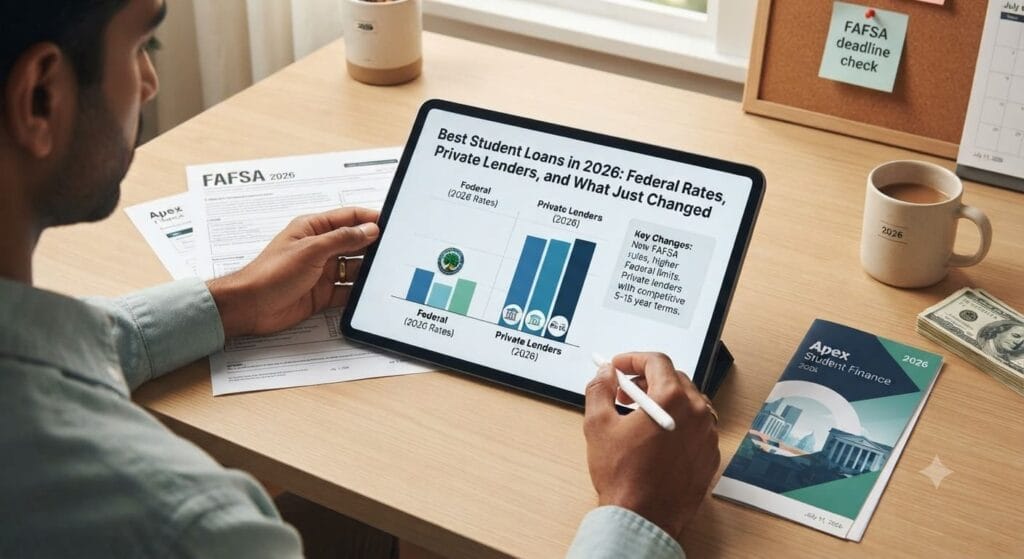
The short answer: there’s no single “best” student loan in 2026. Federal loans should almost always come first, thanks to their fixed rates and built-in protections. Private loans only make sense to fill whatever gap is left over.
Right now, federal undergraduate loans disbursed for the 2026-27 school year carry a fixed rate of 6.52%, up slightly from 6.39% the year before. Private lenders, meanwhile, advertise fixed rates as low as 2.39% APR for borrowers with excellent credit and a cosigner. Rates run as high as 18% APR for everyone else.
Student loan APR is the total yearly cost of borrowing for school. It combines the interest rate with any fees. It’s the number that actually determines what a loan costs you — not the “as low as” rate plastered across a lender’s homepage. Federal loans carry one APR for every borrower in a given loan type. Private loans price you individually, based on your credit and your cosigner’s.
A quick story before the numbers
I remember helping a friend’s kid compare offers last fall. Every school had already accepted him. Tuition bills were landing, and he was about to sign for a private loan at 11%. It was the first email in his inbox. He hadn’t even touched his federal aid offer yet. That’s an easy mistake to make when the forms and deadlines pile up. It’s also the single most expensive one on this list.
The rest of this piece breaks down where the current rates come from. It covers what changed under this year’s federal overhaul, and how to land on the cheaper end of the market, whichever way you borrow.
Federal student loan rates for 2026-27
Federal student loan interest rates reset every year, based on the May 10-year Treasury note auction. Once you borrow, the rate stays fixed for the life of the loan. For loans first disbursed between July 1, 2026 and June 30, 2027, the U.S. Department of Education’s published rates set undergraduate Direct Subsidized and Unsubsidized loans at 6.52%. Direct Unsubsidized loans for graduate students run 8.07%, and Direct PLUS loans for graduate students and parents run 9.07%.
Why rates went up this year
That’s a small increase from the year before, when a lower Treasury yield pushed undergraduate rates down to 6.39%. The College Investor’s coverage of the 2026-27 rate reset traces the jump to a slightly higher May 2026 Treasury auction. The government adds a fixed spread on top of that yield, and the spread itself hasn’t changed.
| Loan type | 2025-26 rate | 2026-27 rate |
|---|---|---|
| Direct Subsidized/Unsubsidized (undergrad) | 6.39% | 6.52% |
| Direct Unsubsidized (graduate) | 7.94% | 8.07% |
| Direct PLUS (grad & parent) | 8.94% | 9.07% |
Source: Federal Student Aid, via studentaid.gov and The College Investor.
Federal rates don’t factor in your credit score at all. A first-generation student and a borrower with an 800 credit score get the exact same undergraduate rate. That’s the whole point of the federal system, and it’s the biggest reason to exhaust federal aid before looking anywhere else.
Subsidized vs. unsubsidized: the part people skip
A subsidized loan doesn’t accrue interest while you’re in school at least half-time, during your six-month grace period, or during deferment — the government covers it. An unsubsidized loan starts accruing interest the day it’s disbursed, whether you’re in class or not. Both carry the same interest rate; the difference is entirely about who eats the interest before repayment starts. Dependent undergraduates can borrow up to $31,000 total, independent undergraduates up to $57,500, and graduate or professional students up to $138,500. Those figures stay in place for anyone who already had a loan disbursed before this year’s changes phase in (more on that below).
Private student loan rates right now
Private student loans fill the gap once federal aid runs out. Pricing here looks nothing like the federal system — it’s built almost entirely around your credit, your cosigner’s credit, and the lender you pick.
Current rate ranges by lender
As of July 2026, Credible’s marketplace data shows fixed private rates ranging from 2.39% to 17.99% APR and variable rates from 3.5% to 17.99% APR. U.S. News’ monthly lender survey put the average fixed range slightly narrower, at 3.60% to 15.12% for June 2026. Variable rates averaged 5.14% to 14.60%, both down a touch from the previous month.
| Lender | Type | Fixed APR from | Variable APR from | Notes |
|---|---|---|---|---|
| College Ave | Online lender | 2.39% | 3.89% | No cosigner needed for strong-credit borrowers; up to 20-year graduate terms |
| Sallie Mae | Bank | 2.39% | 3.75% | Widest name recognition; loans for part-time and continuing-ed students too |
| Ascent | Online lender | 2.69% | N/A | Up to 1% autopay discount and 1% cash back at graduation; will lend without a cosigner using GPA and school data instead |
| SoFi | Online bank | 2.45% | N/A | Career coaching, financial-planning perks, and a $250 cash bonus for a 3.0+ GPA bundled in; strong-credit borrowers only |
| Earnest | Online lender | 3.04% | 5.24% | Custom loan terms down to the month; 9-month grace period, longest on this list; cosigner release possible after 12 on-time payments |
Rates are “as low as” figures for the most creditworthy applicants and cosigners, including autopay discounts where the lender offers one. They’re pulled from each lender’s published rate page as of early-to-mid July 2026. Your actual offer depends on your and your cosigner’s credit, the school, and the degree program. Fixed rates at the bottom of these ranges require the strongest credit profiles, usually with a cosigner — a rate this low on your own is uncommon.
Why the rates vary so much
The gap between the best and worst advertised rate on that table is roughly 15 percentage points. That gap comes down almost entirely to creditworthiness. Most undergraduates don’t have the credit history to qualify alone. NerdWallet’s lender comparison notes that a cosigner with strong credit is often what actually unlocks the advertised low end, not the student’s own file.
What the lender differences actually mean for you
A few patterns are worth knowing before you apply anywhere:
- Online lenders (College Ave, Earnest, Ascent) generally beat traditional banks on rate and flexibility. They built their products around student borrowers specifically. Features like in-school deferment, skip-a-payment options, and shorter grace-period defaults tend to be more generous than what you’ll find at a big national bank.
- Ascent is the rare lender that will approve some borrowers without a cosigner. It uses future income potential, school, and GPA instead of a traditional credit file. That’s worth a look if you don’t have someone who can cosign.
- SoFi and Earnest bundle in perks beyond the rate itself. SoFi leans on membership benefits like financial planning and travel offers. Earnest’s Precision Pricing lets you pick a custom monthly payment, then back into a term that fits it, instead of choosing from fixed term lengths.
- Sallie Mae is the only lender here that regularly finances part-time and continuing-education students, a niche the others mostly skip.
- Cosigner release timelines vary a lot and matter more than the headline rate for a lot of borrowers. Earnest allows release after 12 consecutive on-time payments. Other lenders require 24 to 48 payments. If a parent is cosigning, ask about this before you sign, not after.
Federal vs. private: what you’re actually trading off
| Federal loans | Private loans | |
|---|---|---|
| Rate basis | Fixed by law, same for everyone | Based on credit/cosigner |
| Credit check | Not required (except PLUS) | Required |
| Income-driven repayment | Yes | No |
| Forgiveness programs (PSLF, etc.) | Yes | No |
| Deferment/forbearance | Standardized federal options | Lender-specific, often thinner |
| Fixed or variable rate | Fixed only | Choice of both |
Before you sign for a private loan, it’s worth running the actual numbers rather than just comparing headline rates. FinToku’s Private Student Loan Payment Calculator builds out the full amortization schedule from your balance, rate, and term. It also lets you test how extra payments would cut down your payoff time and total interest, before you ever borrow a dollar.
If you’re an international student comparing a U.S. loan offer against tuition or family support priced in another currency, FinToku’s Currency Converter is worth a quick check too.
What just changed: the OBBBA overhaul
Federal student loans got their biggest structural rewrite in over a decade this year. Most of it took effect on July 1, 2026. The One Big Beautiful Bill Act (OBBBA), also referred to by the administration as the Working Families Tax Cuts Act, eliminated Grad PLUS loans for new borrowers. It also capped how much graduate students and parents can borrow. And it replaced most income-driven repayment plans with two new options.
This is the part that barely made headlines outside financial-aid offices. But if you’re borrowing for grad school or as a parent this year, it changes your math more than any rate move does.
New borrowing limits
Grad PLUS is gone for new borrowers. Before this year, graduate and professional students could borrow up to their full cost of attendance through Grad PLUS, with only a minimal credit check. As of July 1, 2026, that program no longer accepts new borrowers. In its place, graduate students are limited to Direct Unsubsidized Loans with hard caps: $20,500 a year and $100,000 lifetime for most master’s and PhD programs. Professional-degree fields (medicine, law, dentistry, pharmacy, and similar — eleven fields in total) get $50,000 a year and $200,000 lifetime instead. Per ETS’s rundown of the new rules, the MBA doesn’t make that professional-degree list despite the name. MBA students borrow under the lower general graduate cap.
There’s a new lifetime ceiling on federal borrowing. All federal student loans combined, undergraduate and graduate, excluding Parent PLUS, now cap out at $257,500 per borrower over a lifetime. Several law and medical programs already cost more than that, so federal loans alone won’t cover the full bill for those students anymore.
Parent PLUS loans are capped too. Parents used to be able to borrow up to their child’s full cost of attendance with essentially no ceiling. New Parent PLUS borrowing now tops out at $20,000 a year and $65,000 over a lifetime, per student.
If you already had a loan before July 1, 2026, you’re not affected immediately. A legacy provision lets continuing students and parents keep borrowing under the old, higher limits. That runs for up to three more academic years, or until they finish the program, whichever comes first — as long as they stay enrolled in the same program at the same school.
The new federal repayment plans
Repayment changed just as much as borrowing did. Courts struck down the Saving on a Valuable Education (SAVE) plan in March 2026, after it had been tied up in litigation since 2024. In its place, the Department of Education rolled out the Repayment Assistance Plan (RAP) on July 1, 2026, alongside a new Tiered Standard plan. Anyone taking out a federal loan from this point forward can only choose between those two.
RAP sets your payment at 1% to 10% of your full adjusted gross income on a sliding scale — no income exemption, unlike older plans. The formula reduces your payment by $50 a month for each dependent you claim, with a $10 monthly floor no matter how little you earn. The upside: if your payment doesn’t cover the interest that accrued, RAP waives the difference rather than adding it to your balance. If your payment doesn’t cut at least $50 off your principal, the government covers the rest. That means your balance can’t silently grow the way it could under some older income-driven plans. Forgiveness kicks in after 30 years of qualifying payments — longer than the 20- or 25-year timelines under the plans it replaced. RAP still counts toward Public Service Loan Forgiveness. One notable exclusion: Parent PLUS loans aren’t eligible for RAP at all.
If you borrowed before July 1, 2026 and you’re already on IBR, PAYE, ICR, or the now-defunct SAVE plan, you don’t have to switch immediately. But PAYE and ICR sunset entirely by July 1, 2028, and anyone still enrolled when that happens gets automatically moved to RAP or, if ineligible, to IBR.
How to shop for the best rate
- File the FAFSA and take every dollar of federal aid first — subsidized before unsubsidized — before you look at a single private lender. The rate gap alone usually makes this an easy call.
- Get prequalified with two or three private lenders if you still have a gap to fill. Prequalification uses a soft credit pull, so it won’t ding your score the way a full application does. If you’re also weighing a credit union or your everyday bank against an online lender, FinToku’s credit union vs. bank vs. online lender comparison breaks down the same trade-offs for personal and other consumer loans. Most of it carries over.
- Add a cosigner if your own credit is thin. Most undergraduates don’t have enough credit history to qualify for a private loan’s lowest advertised rate alone. A cosigner with strong credit is often the deciding factor.
- Compare APR, not just the headline rate. A private loan with a slightly higher rate but no fees can beat a lower rate that comes loaded with origination charges.
- Ask about a cosigner-release policy before you sign, not after. Lenders like Earnest and Sallie Mae let a cosigner come off the loan after a set run of on-time payments. The exact requirements vary a lot by lender, though.
If you want a deeper walk-through of comparing offers side by side, this student loan borrower’s guide is worth a read before you commit to a lender. Heads up, that’s a link I’d earn a small commission on if you buy through it (more on that in FinToku’s affiliate disclosure).
Refinancing: when it makes sense (and when it doesn’t)
Refinancing replaces one or more existing loans with a new private loan, ideally at a lower rate. It’s worth considering once you’ve graduated, built some credit history, and landed steady income. It is never worth doing to a federal loan you might need income-driven repayment or forgiveness on later. Refinancing converts federal debt into private debt permanently, and there’s no undoing that.
When refinancing pays off
Refinance rates as of July 2026 run considerably lower than new in-school private loan rates, since refinance borrowers already have a credit and repayment history to underwrite against. Bankrate’s refinance lender review shows fixed refinance APRs from several top lenders starting in the high 3% to low 4% range for the most qualified borrowers. NerdWallet’s comparison of refinance companies lists Earnest, SoFi, ELFI, and Splash Financial all advertising fixed rates starting near 4% this month.
The math only works if your new rate meaningfully beats your current one and you don’t need federal protections. If you’re pursuing Public Service Loan Forgiveness, or your income is unpredictable enough that you might need an income-driven plan down the line, keep those loans federal. Shop refinancing only for any purely private balances.
One more thing worth checking before you refinance anything: some states run their own relief programs on top of whatever the federal government offers. They’re easy to miss. Maryland, for example, runs an annual Student Loan Debt Relief Tax Credit worth up to a few thousand dollars for eligible residents, separate from anything at the federal level. FinToku’s Maryland Student Loan Tax Credit Calculator estimates what a Maryland resident might qualify for. If you live somewhere else, it’s worth a quick search for your own state’s treasury or higher-education finance authority to see if something similar exists.
If your private loan is serviced by Firstmark Services, a common servicer for privately held student loans, our Firstmark Student Loan login, pay, and help guide walks through the different portals and payment options. It also covers what to know about cosigner release, before you call them.
The bigger picture: student debt in 2026
Total U.S. student loan debt reached roughly $1.87 trillion in the first quarter of 2026, up 3.3% from a year earlier, according to LendingTree’s analysis of Federal Reserve data. Federal loans make up about $1.69 trillion of that, held by 42.8 million borrowers; private debt accounts for the remaining $140 billion or so.
How much the average borrower owes
The average federal balance per borrower sits at roughly $39,600. That figure gets pulled upward by a relatively small number of very large graduate and professional-school balances — the median federal borrower owes closer to $20,000. Bachelor’s degree recipients from the class of 2024 who borrowed left school with an average of $29,560 in combined federal and private debt, per LendingTree’s graduating-class data.
Delinquency and default trends
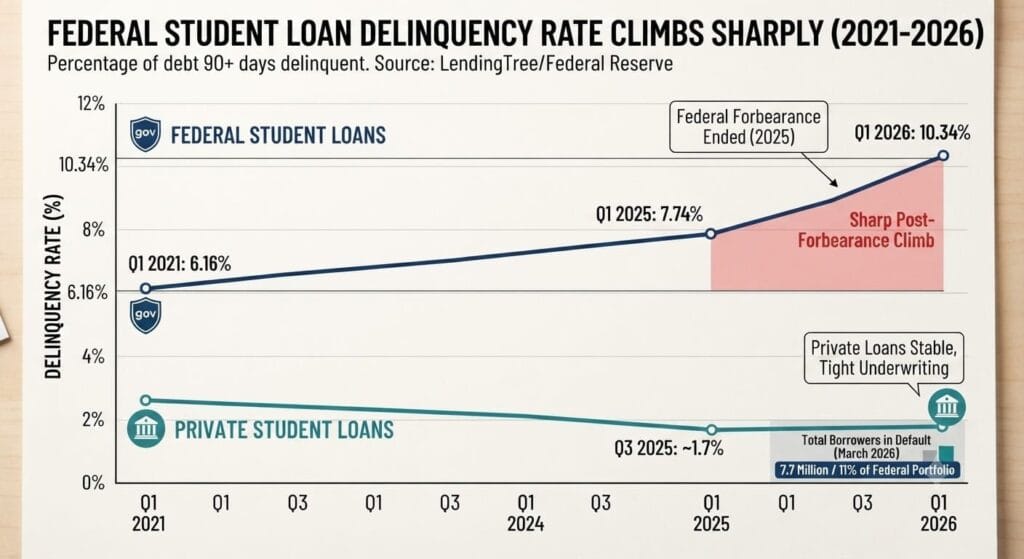
Delinquency has climbed sharply since pandemic-era forbearance ended. 10.34% of student loan debt was 90 or more days delinquent in the first quarter of 2026. That’s up from 7.74% a year earlier and 6.16% in early 2021, per the same LendingTree data pulled from Federal Reserve figures. Roughly 7.7 million borrowers, about 11% of the federal portfolio, were in default as of March 2026. Collections activity on defaulted loans is set to resume in fall 2026, after years on pause. Private loans look nothing like that picture: only about 1.7% were 90-plus days delinquent as of the third quarter of 2025. Private lenders never offered the broad pandemic forbearance federal loans did, and their underwriting screens more tightly at the front end.
Key Takeaways
- Federal undergraduate loans disbursed for 2026-27 carry a fixed 6.52% rate, with graduate and PLUS loans at 8.07% and 9.07% — the same for every borrower, regardless of credit.
- Private student loan rates span an enormous range, roughly 2.4% to 18% APR, driven almost entirely by the borrower’s and cosigner’s credit.
- The OBBBA overhaul eliminated Grad PLUS loans for new borrowers and capped graduate borrowing at $100,000-$200,000 lifetime, depending on the program. It also capped Parent PLUS at $65,000 lifetime per student. Both changes took effect July 1, 2026.
- The new Repayment Assistance Plan (RAP) replaced SAVE, and eventually PAYE and ICR, as the main income-driven option for new federal borrowers. Payments run 1-10% of income, with a 30-year forgiveness timeline.
- Total U.S. student debt hit roughly $1.87 trillion in Q1 2026. Delinquency has climbed to 10.34%, up from 7.74% a year earlier, as pandemic-era protections have fully unwound.
- Refinancing can meaningfully cut your rate after graduation, but only ever refinance private debt. Moving federal loans into a private refinance permanently forfeits income-driven repayment and forgiveness eligibility.
Frequently Asked Questions
What is the interest rate on student loans right now?
Federal undergraduate loans disbursed for the 2026-27 school year carry a fixed 6.52% rate. Private loan rates vary far more widely — roughly 2.4% to 18% APR, depending on credit and cosigner strength.
Should I take out a federal or private student loan?
Take federal loans first, always. Most types don’t require a credit check, they offer income-driven repayment and forgiveness programs, and they carry the same fixed rate for every borrower. Treat private loans as a last resort to cover whatever federal aid doesn’t.
What happened to the SAVE plan?
Courts struck down the SAVE plan in March 2026, after years of litigation. Borrowers who were on it are moving to other repayment options. The new Repayment Assistance Plan (RAP) now serves as the main income-driven plan for federal loans going forward.
Can I still get a Grad PLUS loan?
Not as a new borrower. Grad PLUS stopped accepting new borrowers as of July 1, 2026. If you had a federal loan disbursed before that date and stay enrolled in the same program, you can keep borrowing under the old rules for up to three more years.
Is it worth refinancing my student loans?
It can be, in the right situation. That means you have private loans (or federal loans you’re certain you won’t need income-driven repayment or forgiveness on), and you qualify for a meaningfully lower rate than what you’re currently paying. Refinancing federal loans is permanent and forfeits federal protections, so don’t make that decision lightly.
How much should I borrow for college?
As little as you can manage. Many advisors use a rule of thumb: keep total borrowing under your expected first-year salary after graduation. That’s a guideline, not a hard rule, so run your own numbers against your specific program and expected field before committing to any figure. FinToku’s Budget Planner & 50/30/20 Calculator can help you see how a projected loan payment would actually fit into a post-graduation budget. Our 50/30/20 budget rule breakdown explains the framework behind it, if you’re new to budgeting by percentage.
If you’re weighing offers right now, it’s worth running the actual numbers before you sign anything. A one-point difference in rate on a $30,000 balance adds up to real money over a 10-year term.
By Saad Faisal · Published July 11, 2026 · Updated July 11, 2026
Disclaimer
This article shares general information, not personalized financial or student aid advice. Federal loan rules are still being finalized in places, and private lender rates shift week to week. The specific figures here (federal rates, lender APR ranges, and the OBBBA borrowing caps) come from the sources cited above as of July 2026 and may have changed by the time you’re reading this. Before you borrow or refinance anything, confirm current terms directly with your school’s financial aid office and with any lender you’re considering. Talk to a qualified financial advisor about how this fits your specific situation. For more, see FinToku’s full Financial Disclaimer.