

Freelancers leave money on the table every filing season, not because they’re careless, but because nobody hands you a manual when you go from W-2 to 1099. If you’re self-employed and report income on Schedule C, the deductions below can lower both your income tax and your self-employment tax, and most of them apply whether you’re a designer, a writer, a developer, or driving for a rideshare app on the side. Here’s the full 2026 list, the numbers behind each one, and a worksheet-style table you can use to check your own return.
What actually counts as a deductible business expense
The IRS standard is simple to state and harder to apply: a business expense has to be ordinary (common in your line of work) and necessary (helpful for running it). It doesn’t need a formal contract, and it doesn’t need to be something every freelancer buys. A wedding photographer’s second lens and a coder’s monitor arm both qualify for the same reason: they’re normal costs of doing that specific job.
Two things trip people up. First, “necessary” doesn’t mean “essential to survival,” just legitimately useful for the business. Second, mixed-use items (your phone, your car, part of your home) only get partially deducted, based on the actual percentage used for work. Claiming 100% of a phone bill you also use to text your family is the fastest way to draw IRS attention.
2026 freelancer tax numbers at a glance
Rates, limits, and phaseouts change every year, and 2026 has several worth flagging before you start deducting anything.
| Item | 2026 figure | Source |
|---|---|---|
| Self-employment tax rate | 15.3% (12.4% Social Security + 2.9% Medicare) | IRS: Self-Employment Tax |
| Additional Medicare tax | 0.9% above $200,000 single / $250,000 married filing jointly | IRS Publication 505 |
| Standard mileage rate (Jan 1 – Jun 30, 2026) | 72.5 cents per business mile | IRS 2026 mileage rate announcement |
| Standard mileage rate (Jul 1 – Dec 31, 2026) | 76 cents per business mile, raised mid-year due to fuel costs | IRS Internal Revenue Bulletin 2026-29, Announcement 2026-11 |
| Home office (simplified method) | $5 per sq ft, up to 300 sq ft ($1,500 max) | IRS: Simplified Option |
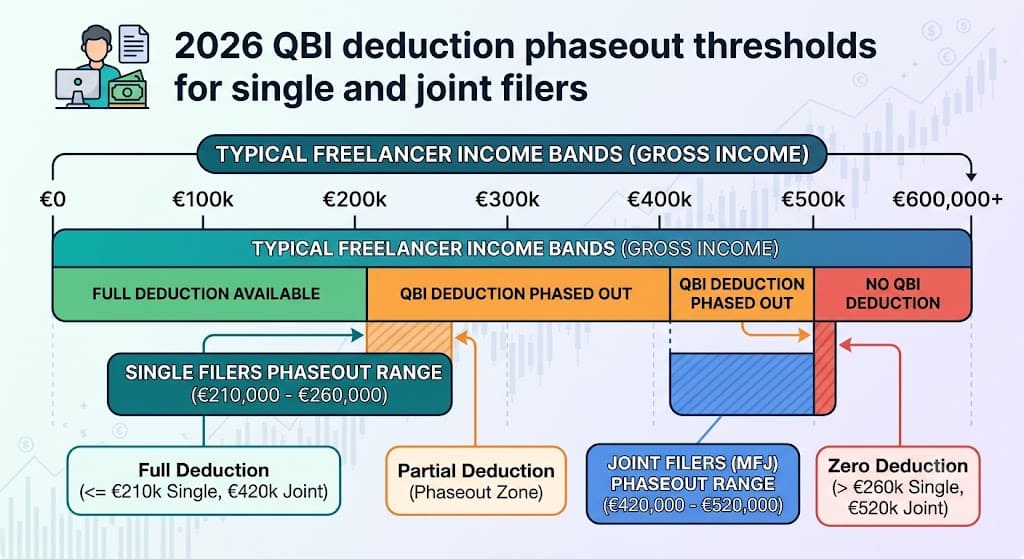
| QBI deduction phaseout begins | $201,750 single / $403,500 married filing jointly | IRS Rev. Proc. 2025-32, Section 4.26 |
| QBI deduction fully phased out | $276,750 single / $553,500 married filing jointly | IRS Rev. Proc. 2025-32, Section 4.26 |
| HSA contribution limit | $4,400 individual / $8,750 family (+$1,000 catch-up, age 55+) | IRS Rev. Proc. 2025-19 |
| SEP-IRA contribution limit | Lesser of 25% of compensation or $72,000 | IRS Publication 560 |
| Solo 401(k) combined limit | $72,000 (plus $8,000 catch-up, age 50+, or $11,250 for ages 60-63) | IRS Notice 2025-67 |
| Section 179 deduction limit | $2,560,000, phaseout starts at $4,090,000 | IRS Publication 946 |
| SALT deduction cap | $40,400 ($20,200 married filing separately) | Public Law 119-21 (OBBBA) |
As of the 2026 tax year. QBI thresholds and the mid-year mileage rate change reflect the One Big Beautiful Bill Act (OBBBA), signed July 2025. Confirm current figures against the linked IRS pages before filing, since thresholds adjust annually and are shown here for planning purposes only.
The deductions almost every freelancer qualifies for
Home office deduction
If you work from a space in your home used regularly and exclusively for business, you can deduct it two ways. The simplified method is $5 per square foot, capped at 300 square feet, so the most it’s worth is $1,500 with zero depreciation paperwork. The regular method lets you deduct the business-use percentage of your actual rent or mortgage interest, utilities, insurance, and repairs, which usually adds up to more if your home costs are high, but it means tracking every bill and filing Form 8829.
Run both numbers once before picking a method. A friend of mine stuck with the simplified method for three years because it was easier, then realized the regular method would’ve gotten her almost $2,200 more given her rent.
Vehicle and travel expenses
You get the same two-path choice here. Standard mileage means logging business miles and multiplying by the IRS rate. This one has a wrinkle for 2026: the rate started the year at 72.5 cents per mile, then the IRS bumped it to 76 cents per mile starting July 1, citing rising fuel costs. That means if you’re tracking mileage for the full year, you need to split your log at the June 30 line and apply the right rate to each half rather than using one flat number. Actual expenses means tracking gas, insurance, repairs, and depreciation, then applying your business-use percentage. Standard mileage wins for most freelancers because it’s simpler; actual expenses can pull ahead if you drive an expensive vehicle or put heavy miles on an older one.
Travel away from your tax home for client work, conferences, or trade shows is separately deductible: flights, hotels, and 50% of meals while traveling. Sightseeing tacked onto a business trip isn’t, so keep the two clearly separated in your records.
Health insurance premiums
If you pay for your own health, dental, vision, or qualifying long-term care coverage and aren’t eligible for an employer plan (yours or a spouse’s), you can deduct up to 100% of those premiums, plus coverage for your spouse and dependents under 27. This is claimed on Form 7206 and flows to Schedule 1, and it’s capped at your net self-employment income for the year, so it isn’t unlimited if your freelance income is thin.
Retirement contributions
A SEP-IRA lets you contribute up to 25% of your net self-employment compensation, capped at $72,000 for 2026. A Solo 401(k) works differently: you contribute as both “employee” and “employer,” with a combined 2026 limit of $72,000 (plus an $8,000 catch-up if you’re 50 or older). Both reduce your taxable income now and grow tax-deferred, and both need to be opened before year-end even if you fund them later.
Advertising, software, and everyday tools
This is the category with the most line items and the least drama. If it’s ordinary, necessary, and tied to your freelance work, it’s deductible:
- Website hosting, domain fees, and design costs
- Software subscriptions and apps (Adobe, QuickBooks, project management tools)
- Business cards, paid social ads, and print marketing
- Office supplies, from pens to a replacement laptop keyboard
- The business-use share of your phone and internet bill
- Legal, accounting, and consulting fees
- Business bank fees and payment processor charges (Stripe, PayPal, Square)
- Business insurance premiums (general liability, errors & omissions, business property)
- Courses, certifications, and conferences that maintain or improve skills you already use in your current work (not ones that qualify you for a new trade)
- Equipment and larger purchases, either expensed immediately under the $2,500 de minimis rule or depreciated over time, with Section 179 letting you write off qualifying equipment in full the year you place it in service
Meals with clients
If you take a client to lunch to actually discuss work, 50% of the cost is deductible. The meal can’t be lavish, and you or an employee needs to be present. Concert tickets and other entertainment aren’t deductible anymore, even with a client in the seat next to you.
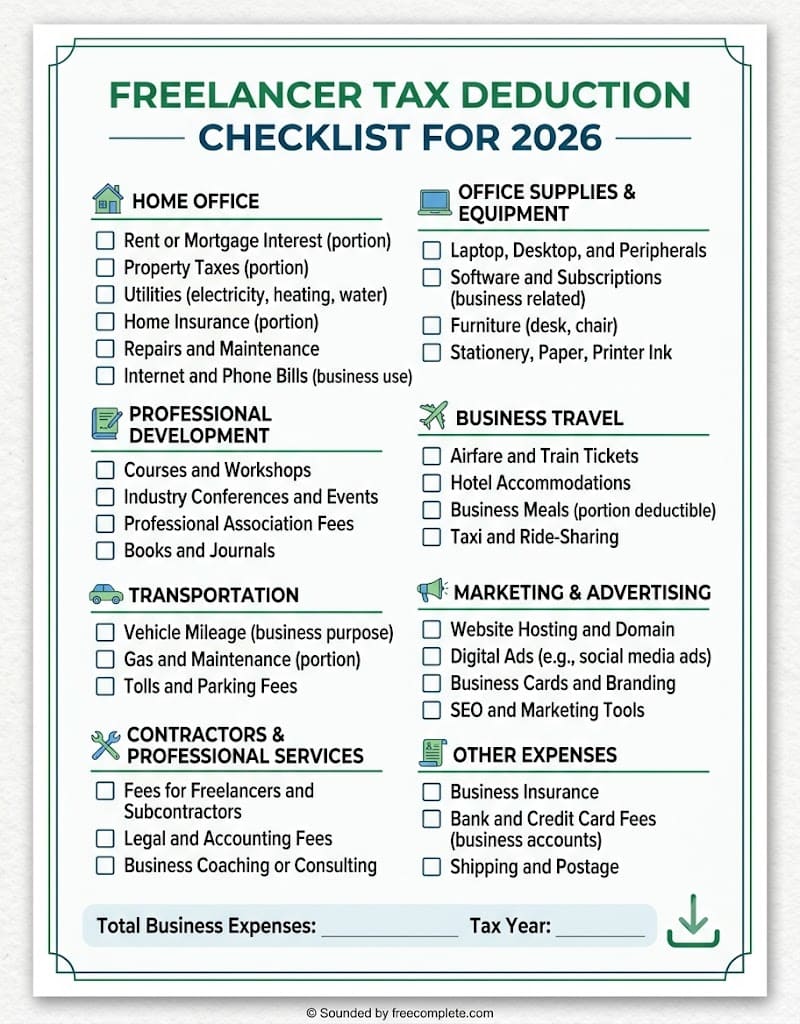
The freelancer deduction checklist
Use this as a quick self-audit before you file. It won’t replace a real Schedule C, but it catches the categories people forget most.
| Category | What to check | Deductible amount |
|---|---|---|
| Home office | Square footage used exclusively for work | $5/sq ft (up to 300 sq ft) or actual % |
| Vehicle | Business miles logged all year | 72.5¢/mile or actual expenses |
| Health insurance | Premiums paid, no employer plan available | Up to 100% |
| Retirement | SEP-IRA or Solo 401(k) contributions | Up to $72,000 |
| Self-employment tax | Half of your SE tax liability | 50% of SE tax owed |
| QBI deduction | Net qualified business income, income under phaseout | Up to 20% of QBI |
| Software & subscriptions | Business-use tools and apps | 100% (business-use share) |
| Phone & internet | Business-use percentage | Business-use % only |
| Professional fees | Legal, accounting, consulting invoices | 100% |
| Meals with clients | Business purpose documented | 50% |
| Equipment | Under $2,500/item or Section 179 election | 100% in year placed in service |
| Startup costs | First-year business setup costs | Up to $5,000, rest amortized |
Don’t skip the self-employment tax deduction and QBI
These two rarely get their own headline, but together they’re often worth more than every itemized expense above combined, and almost no one connects them into one picture.
Self-employment tax covers the Social Security and Medicare contributions an employer would normally split with you. As a freelancer, you pay both halves, 15.3% total, calculated on Schedule SE. The upside: you get to deduct half of that as an above-the-line adjustment on Schedule 1, which lowers your adjusted gross income without changing what you actually owed.
The QBI deduction (Qualified Business Income, or the Section 199A deduction) lets many freelancers deduct up to 20% of their net business income, separate from any specific expense. It’s calculated off your Schedule C profit, not your gross revenue, and for 2026 it starts phasing out at $201,750 for single filers and $403,500 for joint filers, disappearing entirely above $276,750 and $553,500. That phase-out range widened under the 2025 tax law (OBBBA), so if you were used to the older, narrower numbers, it’s worth re-checking where you actually land. If you’re anywhere near those thresholds, timing income and retirement contributions to stay under them can be worth real money.
Estimated quarterly taxes: the part the deduction lists skip
Deductions only help if you’re also paying tax the right way during the year, and freelancers owe the IRS as they earn, not just once in April. You generally need to make quarterly estimated payments if you’ll owe $1,000 or more for the year. The safe harbor is paying at least 90% of this year’s tax or 100% of last year’s (110% if last year’s adjusted gross income was over $150,000), whichever protects you from an underpayment penalty.
Running your projected net income through FinToku’s US Business Federal Income Tax Calculator before each quarterly deadline takes the guesswork out of this. I’d rather overestimate slightly and get a refund than underpay and owe a penalty on top of the tax itself.
Recordkeeping that actually holds up
None of this matters if you can’t back it up. The IRS generally wants you to keep receipts, mileage logs, and bank statements for three to seven years depending on the item. A simple system beats a perfect one: a dedicated business bank account, a mileage app instead of a paper log, and receipts filed by category within a couple months of the expense, not scrambled together every March.
How to actually claim these deductions
Most freelancers file as sole proprietors, which means these deductions go on your personal return, not a separate business filing:
- Schedule C reports your freelance income and most business expenses
- Schedule SE calculates your self-employment tax
- Schedule 1 carries over the SE tax deduction and health insurance deduction
- Form 8829 if you’re using the regular home office method
- Form 7206 for the self-employed health insurance deduction
- Form 4562 for depreciation and Section 179 elections
A tax professional isn’t required, but if your income has grown past the point where you can keep all of this in your head, one paid hour with a CPA often finds more in missed deductions than it costs.
Key Takeaways
- Freelancers can deduct home office, vehicle, health insurance, retirement contributions, and most ordinary business tools, all reported on Schedule C.
- The self-employment tax deduction (half of your 15.3% SE tax) and the QBI deduction (up to 20% of net business income) are separate from expense deductions and are worth checking even if you have few itemized write-offs.
- The 2026 standard mileage rate is 72.5 cents per mile for the first half of the year, then 76 cents per mile from July 1 onward after a mid-year IRS adjustment. The simplified home office deduction caps out at $1,500.
- QBI phases out starting at $201,750 (single) or $403,500 (joint) for 2026, fully disappearing at $276,750 / $553,500, so income timing matters if you’re near that range.
- Freelancers generally owe quarterly estimated taxes, and underpaying triggers a penalty even if you’re owed a refund come April.
Frequently Asked Questions
Is there a self-employed tax deductions worksheet I can use? Yes. The checklist table above covers the categories the IRS lets freelancers deduct most often. For a full worksheet, IRS Schedule C itself works as one, since it lists expense categories in the order the form expects them.
What’s the difference between a “self-employed tax deductions list” and a “1099 tax deductions list”? They’re the same thing described two ways. “1099” refers to how your income gets reported to you (Form 1099-NEC from clients); “self-employed” describes your tax status. The deductions available don’t change based on which term you searched.
Can I deduct 100% of my phone and internet bill? Only if you use them 100% for business, which is rare. Deduct the actual business-use percentage instead, based on a reasonable estimate of your call, data, or time split.
Is there a self-employment tax calculator I can use? FinToku’s US Business Federal Income Tax Calculator estimates your federal liability including the self-employment tax component, so you can see the after-deduction number before you file.
Do these deductions apply the same way to gig work and traditional freelancing? Mostly yes. Rideshare driving, delivery gig work, and freelance services all file on Schedule C and follow the same ordinary-and-necessary standard, though the specific expenses (mileage vs. software subscriptions, for example) will look different by profession.
If you’re still building your list of what to track this year, run your numbers through the Personal Income Tax Calculator once your deductions are totaled up. It’s the fastest way to see whether you’re on track for your next quarterly payment or heading for a surprise.
Read More
- Tax Planning Checklist 2026: What to Review Before You File
- Retirement Planning in Your 20s: A Straightforward Guide
Disclaimer
This article is for general informational purposes only and shouldn’t be taken as financial, tax, or legal advice. The rates and thresholds above reflect 2026 figures as sourced from the IRS, but your actual deductions depend on your specific business, income, and filing status. Before making a real tax decision, it’s worth checking with a qualified tax professional or CPA who can look at your full picture. You can also read FinToku’s full Financial Disclaimer.
Published by Saad Faisal for FinToku (fintoku.com) · Published July 23, 2026 · Updated July 23, 2026 FinToku provides free finance tools and guides to help you make smarter money decisions.