

You’ve priced out a cross-country move and the number made you sit down. Movers, a truck, a security deposit on the new place, maybe a month without a paycheck while you get settled. It adds up fast, and it’s the reason “personal loan for moving cross country” is one of the most-searched phrases in this whole category.
A personal loan for moving cross country is a lump sum of money, repaid in fixed monthly installments over a few years, that you can use for movers, truck rental, storage, or a new security deposit. It’s unsecured, meaning you don’t put your car or home up as collateral, and most lenders let you use the funds for pretty much anything related to the move.
That’s the short answer. The longer one has more to do with which lender you pick and whether you actually need to borrow at all.
What a Cross-Country Move Actually Costs
Distance changes the bill more than almost anything else. Hiring movers for a local move (under 100 miles) typically runs $878 to $2,556. Cross the country, and that range jumps to roughly $2,700 to $10,000 just for the moving company, according to 2025 HomeAdvisor data cited by NerdWallet.
Discover’s own figures land in a similar place: about $3,000 for a shorter long-distance move, up to $9,000 for a longer one, for a typical three- or four-bedroom household.
| Cost driver | Typical range | Source / as of |
|---|---|---|
| Local move (movers, <100 mi) | $878 – $2,556 | HomeAdvisor data, 2025 |
| Cross-country / long-distance move | $2,700 – $10,000+ | NerdWallet, Apr. 2026 |
| 3-4 bedroom household, longer distance | ~$9,000 | Discover, Jun. 2026 |
| Typical personal loan APR range | 7% – 36% | NerdWallet, Apr. 2026 (credit-dependent) |
| Typical origination fee | 0% – 12% | Varies by lender; several charge none |
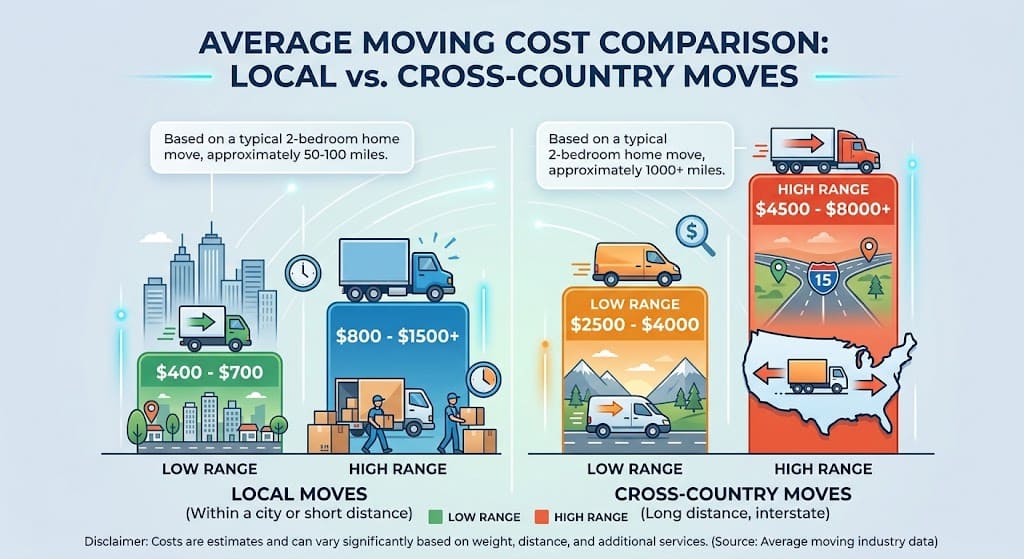
None of that includes boxes, gas, flights if you’re not driving, or the week of hotel stays that always seems to sneak in. Budget for that separately rather than assuming the mover’s quote is the whole number.
Where These Loans Actually Come From
“Moving loan” isn’t really its own product. It’s a personal loan, marketed with a moving-specific landing page, from one of three types of lenders:
Big banks (Wells Fargo, for example) offer moving loans from $3,000 to $100,000 with no origination fee, but only to existing customers of that bank.
Online lenders (Upstart, Avant, Discover, SoFi, and similar) are faster to approve and don’t require an existing relationship, but several charge an origination fee that gets deducted right out of your loan proceeds. Upstart’s can run as high as 12%.
Credit unions tend to have the friendliest terms for people without excellent credit. Federal credit union loans can start under $1,000 and are capped at an 18% APR by regulation, which is lower than a lot of online lenders’ top rates.
| Lender type | Typical range | Fees | Best fit |
|---|---|---|---|
| Big bank | $3,000-$100,000 | Often none | Existing customers, larger moves |
| Online lender | $1,000-$75,000 | 0%-12% origination | Fast funding, thinner credit |
| Credit union | Under $1,000-$50,000 | Usually low or none | Fair/limited credit, member-based |
Whichever type you’re looking at, the Consumer Financial Protection Bureau is worth a look before you sign anything. It’s the federal agency that regulates this stuff, and its plain-English breakdown of personal installment loans is a lot less biased than any single lender’s marketing page.
Bad Credit and “No Credit Check” Loans: What’s Real
Honestly, this is the part I’d slow down on. A big share of the searches around this topic are variations on “no credit check moving loan” or “moving loan bad credit guaranteed approval,” and I get why. Bad timing and bad credit tend to show up together.
Here’s the catch: a true no-credit-check installment loan from a legitimate lender is rare, and the ones that exist usually charge for it, through a higher rate or a bigger fee. “Guaranteed approval” is close to a red flag on its own. No legitimate lender can guarantee approval before checking your income and some form of credit history, because they’re required to assess whether you can actually repay it.
What does exist, and is worth your time instead:
- Upstart advertises no minimum credit score and looks at factors like education and employment alongside credit, which helps people with thin files more than it helps people with genuinely poor credit.
- Credit unions often do a soft pull first and are more willing to work with a member they already know.
- Secured loans (using a car you own outright as collateral) trade risk for approval odds. Read the terms carefully. If you can’t pay it back, the lender can take the car.
If your credit needs work before you apply anywhere, that’s worth fixing first rather than chasing a lender who claims not to care. We’ve written more on that in How to Build Credit With No Credit History, which covers the same qualification issues from the other direction.
Cheaper Ways to Pay for a Cross-Country Move First
A loan is one option, not the default. Before you apply anywhere, it’s worth ruling out the cheaper ones:
Ask about a relocation package. If you’re moving for a new job, ask before you sign the offer letter, not after. Some employers will cover part or all of a cross-country move, and that conversation is a lot easier before you’ve accepted.
Use a 0% APR credit card if your credit qualifies. A promotional 0% period (usually 15-21 months) costs nothing in interest if you pay it off in time, which beats even the best personal loan rate.
Sell what you’re not bringing. Cross-country moves are exactly when downsizing pays for itself twice, once in cash from the sale, once in a smaller (cheaper) shipment.
Build a small buffer instead of borrowing the whole amount. If your move is a few months out, running the numbers through a Budget Planner & 50/30/20 Calculator can show you how much you could set aside before the move date, so you’re borrowing less, or nothing at all.
A lot of people default to the loan because it’s the fastest option, not because it’s the cheapest one. That’s a mistake worth avoiding if you have even six or eight weeks of runway. We’ve gone deeper on this pattern in Financial Mistakes That Keep People Broke.
If you do go the DIY route, a couple of things make the actual packing cheaper and faster:
Worth searching Amazon directly for “heavy duty moving box kit,” “moving blankets,” “adjustable furniture dolly,” and “packing tape gun dispenser” if you want to compare a few options and reviews yourself before buying.
Protecting Yourself on the Actual Move
This part is specific to cross-country and doesn’t apply to a move across town: once you cross a state line, your move is legally an “interstate” move, and it falls under federal rules enforced by the Federal Motor Carrier Safety Administration (FMCSA), not just state consumer law.
Any company moving your household goods across state lines has to give you a booklet called Your Rights and Responsibilities When You Move before the move happens. You also have the right to be present when your shipment is weighed, to request a reweigh if the number looks off, and to get a written bill of lading, which is the actual contract between you and the mover.
If a “mover” won’t provide that booklet or a bill of lading, that’s a bigger warning sign than a slightly high quote. It’s also worth checking a company’s complaint history before you book, not after something goes wrong.
Key Takeaways
- A cross-country move typically costs $2,700 to $10,000+ in moving-company fees alone, before boxes, gas, or temporary housing.
- Personal loan APRs for moving typically range from about 7% to 36%, and origination fees run 0% to 12% depending on the lender.
- “No credit check, guaranteed approval” moving loans are rare and usually cost more one way or another; a lender that skips checking your ability to repay isn’t doing you a favor.
- Credit unions and secured loans are usually the more realistic path if your credit is thin or damaged, not marketing claiming otherwise.
- Once a move crosses state lines, FMCSA rules require the mover to give you a rights booklet, let you witness the weigh-in, and provide a written bill of lading.
Frequently Asked Questions
Is a personal loan a good idea for a cross-country move? It can be, if you don’t have savings to cover it and the monthly payment fits your budget without stretching you thin. Compare it against a 0% APR credit card or a relocation package first, since both can cost less if you qualify.
Can I get a moving loan with bad credit? Yes, though your options narrow and your rate will be higher. Credit unions, secured loans, and lenders like Upstart that weigh factors beyond your credit score are the more realistic paths than anything advertising instant “no credit check” approval.
How much can I borrow for a cross-country move? It depends on the lender. Online lenders and credit unions often cap out around $35,000-$75,000, while some big banks go as high as $100,000. Most cross-country moves don’t need anywhere near the top of that range.
Do movers have to give me anything in writing before an interstate move? Yes. Under FMCSA rules, interstate movers must provide a rights and responsibilities booklet and a written bill of lading, and you have the right to be present when your goods are weighed.
Is a moving loan taxable or tax-deductible? No, the loan itself isn’t taxable income, and for most people moving expenses aren’t tax-deductible either (that break is currently limited to active-duty military on a permanent change of station). Check current IRS guidance for your specific situation.
If you’re still deciding whether to borrow or save toward it instead, try running your numbers through the Emergency Fund Calculator first. Seeing exactly how many months it’d take to self-fund even part of the move often changes the decision.
Read More
- How to Build Credit With No Credit History (2026 Guide)
- Financial Mistakes That Keep People Broke (and How to Actually Stop)
- 9 Down Payment Mistakes That Cost First-Time Home Buyers the Most
Disclaimer
This article is for general information only and isn’t financial or tax advice. Loan rates, fees, and terms vary by lender and change over time. Confirm current numbers with the lender or a licensed financial professional before you apply. See FinToku’s full Financial Disclaimer for more. This post includes affiliate links, and FinToku may earn a small commission if you buy through one, at no extra cost to you. See our Affiliate Disclosure for details.
Published by Saad Faisal for FinToku (fintoku.com) · Published July 28, 2026 · Updated July 28, 2026 FinToku provides free finance tools and guides to help you make smarter money decisions.