

Every dollar you pay in annual fees while you’re building credit is a dollar that isn’t going toward anything except the privilege of having a card. That’s the entire case against fee-charging starter cards, and it’s more literal than most personal finance rules of thumb.
The best credit card for building credit with no annual fee is one that reports to all three major credit bureaus, keeps fees and interest as low as possible, and doesn’t punish you for having thin or damaged credit in the first place. You don’t need rewards, a high limit, or a fancy metal card. You need consistent, reported, on-time activity, and a card that doesn’t cost you anything just to hold.
Below are the cards that actually clear that bar in 2026, what skipping that yearly charge does and doesn’t get you, and honest answers to the bonus and rewards questions that keep coming up in search (spoiler: a $1,000 sign-up bonus on a credit-builder card almost never exists, and you should be suspicious of anything promising one).
What “no annual fee” actually means for building credit
A no annual fee credit card charges nothing just to keep the account open, which matters a lot at this stage because every dollar spent on fees is a dollar not going toward your actual goal. It doesn’t mean the card is free to use. You can still pay interest if you carry a balance, and some no-fee secured cards still require a refundable deposit.
The annual fee has almost nothing to do with how effectively a card builds credit. What matters is whether the issuer reports your activity to Experian, Equifax, and TransUnion, and whether you pay on time every month. A $0 card and a $95 card report identically if both send data to the bureaus. The fee just decides how much it costs you to find that out.
Secured or unsecured: which fits your situation
Secured cards ask for a refundable security deposit, usually $200 to $300, which typically becomes your credit limit. They’re the most reliable approval path if you have no credit history or a damaged one, because that deposit removes most of the issuer’s risk. You get it back once you close the account in good standing or graduate to an unsecured card.
Unsecured starter cards skip the deposit but lean on something else to gauge risk: a banking relationship, income, or alternative data like your checking account history. They’re worth trying first if you have even a thin credit file, since you get your money back sooner (you never had to hand it over).
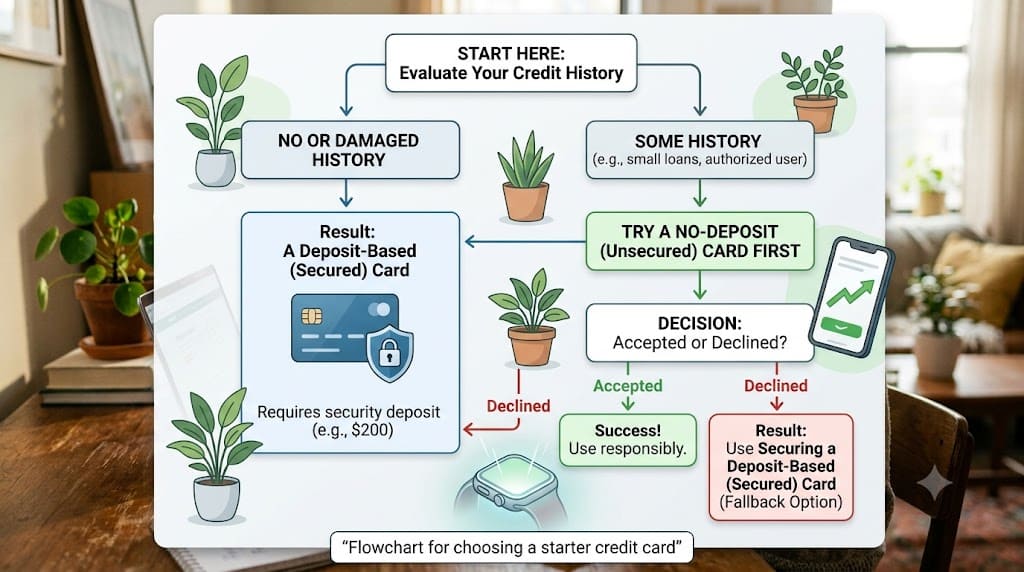
Rule of thumb: if you’ve never had credit or you’re rebuilding after real damage, start secured. If you have some history, even from being an authorized user, try unsecured first and fall back to secured if you’re declined.
The best no annual fee cards to build credit right now
| Card | Annual Fee | Type | Deposit | Rewards | Reports to 3 Bureaus |
|---|---|---|---|---|---|
| Discover it® Secured | $0 | Secured | $200–$2,500 | 2% gas/restaurants (capped), 1% else, matched first year | Yes |
| Capital One Quicksilver Secured | $0 | Secured | $200 min | 1.5% flat cash back | Yes |
| Chase Freedom Rise® | $0 | Unsecured | None | 1.5% flat cash back | Yes |
| Petal® 2 Visa® | $0 | Unsecured | None | 1%–1.5% cash back | Yes |
| Capital One Platinum | $0 | Unsecured | None | None | Yes |
As of July 2026, based on issuer terms and figures reported by Forbes Advisor, WalletHub, and Chime. Rates and rewards change often; confirm current terms directly with the issuer before applying.
Discover it® Secured doubles your first year’s cash back automatically, which is a genuinely unusual perk for a secured card. The deposit range ($200 to $2,500) also doubles as your credit limit, and Discover reviews accounts for an unsecured upgrade after seven months of responsible use.
Capital One Quicksilver Secured keeps it simple: flat 1.5% cash back on everything, a $200 minimum deposit, and automatic review for a credit line increase after six months without adding more money down.
Chase Freedom Rise® is one of the few genuinely unsecured, no-deposit options built for people new to credit, though your approval odds jump noticeably if you already have $250 or more sitting in a Chase checking or savings account.
Petal® 2 Visa® doesn’t run a traditional credit check the same way. It looks at banking activity through a “Cash Score,” which can help if your credit file is thin rather than damaged.
Capital One Platinum skips rewards entirely, and that’s sort of the point: it’s the cheapest possible way to get three-bureau reporting while you focus purely on payment history.
One thing all five share: high variable APRs, typically in the high-20s%. That’s normal for credit-building cards and shouldn’t scare you off, since it only costs you money if you carry a balance. Pay your statement in full and the APR never actually applies to you.
Are there no annual fee cards with $500 or $1,000 sign-up bonuses?
Realistically, no. Large welcome bonuses in that range show up on cards built for people with established, good-to-excellent credit, where the issuer is competing for high spenders. Cards aimed at building credit from scratch or bad credit occasionally offer something small (a $25–$50 statement credit for enrolling in autopay, for example), but a four-figure bonus tied to a beginner card is a red flag worth double-checking before you apply anywhere.
If a bonus this large shows up attached to a “credit builder” card, read the fine print closely. It usually means the card actually requires good credit to qualify, or the offer isn’t what the ad implies.
Can a no annual fee card still earn rewards?
Yes, and several of the cards above prove it. Discover it Secured, Capital One Quicksilver Secured, Chase Freedom Rise, and Petal 2 all pay cash back with no annual fee attached. The rewards rates are modest by design, since credit-building cards usually carry lower limits, but there’s no reason to settle for a $0-rewards card unless it’s genuinely your cheapest approval path.
First credit card with no annual fee: what to actually look for
If this is your first card, prioritize approval odds over rewards. A card that gets denied earns you nothing. Look for issuers that explicitly market to people with limited or no credit history, check whether a banking relationship with that issuer improves your odds (Chase and Discover both do this), and confirm the card reports to all three bureaus before you apply, not after.
How to actually build credit once you have the card
The card matters less than what you do with it. Payment history and credit utilization are the two biggest levers, and neither depends on which no-fee card you picked.
- Pay on time, every time. Set up autopay for at least the minimum so a forgotten due date never turns into a reported late payment.
- Keep utilization under 30%. The Consumer Financial Protection Bureau specifically recommends staying under that threshold, and paying your statement balance in full each month keeps you well under it automatically.
- Use it for one small recurring bill. A streaming subscription or a tank of gas, paid off in full, shows consistent activity without any real risk.
- Don’t chase a credit limit increase too early. A higher limit helps your utilization ratio, but only ask once you’ve built a few months of clean payment history.
If you want a gut check on whether your monthly numbers actually support paying a statement in full (rather than carrying a balance you can’t quite afford), it’s worth running your income and expenses through FinToku’s Budget Planner & 50/30/20 Calculator before you apply. Fixing the budget first will do more for your credit score than any specific card will.
Key Takeaways
- No annual fee doesn’t limit how fast a card builds credit. What matters is on-time payments and reporting to all three bureaus, which most $0-fee starter cards already do.
- Secured cards like Discover it Secured and Capital One Quicksilver Secured are the most reliable approval path with no or damaged credit, usually with a $200–$300 refundable deposit.
- Unsecured, no-deposit options like the Chase Freedom Rise and Petal 2 Visa skip the deposit but typically want at least some credit history or a banking relationship to approve you.
- Large sign-up bonuses ($500 or $1,000) essentially don’t exist on genuine credit-building cards. Treat any offer that big as a signal to read the fine print.
- Keeping utilization under 30% and paying in full each month will move your score more than which specific no-fee card you choose.
Frequently Asked Questions
Do no annual fee credit cards build credit as well as ones with a fee? Yes. The fee has no bearing on how a card is scored by the credit bureaus. What matters is whether the issuer reports to Experian, Equifax, and TransUnion, and whether you pay on time, which no-fee cards do exactly as reliably as fee-charging ones.
Can I get a credit card with no annual fee and no deposit? Yes, though your options narrow. Cards like the Chase Freedom Rise and Petal 2 Visa are unsecured with no deposit requirement, but they typically want some credit history or an existing banking relationship to approve you without one.
Do the $500 or $1,000 sign-up bonuses you see advertised actually exist on these cards? Realistically no, not on cards genuinely built for credit-building. Bonuses that large are reserved for cards targeting established, good-to-excellent credit. Be skeptical of any “credit builder” card advertising a bonus in that range.
What’s the best first card for someone applying with zero credit history? Prioritize approval odds first. A secured card like Discover it Secured or Capital One Quicksilver Secured is the safest first application if you have zero credit history, since the deposit removes most of the issuer’s risk.
Can a $0-fee credit-building card still earn cash back or other rewards? Yes. Discover it Secured, Capital One Quicksilver Secured, Chase Freedom Rise, and Petal 2 all pay modest cash back at zero cost to hold, so there’s rarely a reason to settle for a card that pays nothing at all.
If you’re deciding between a secured and an unsecured option, start with whichever one your existing bank or credit union offers, since an existing relationship often improves your approval odds without changing your out-of-pocket cost.
Disclaimer
This article is for general informational purposes only and shouldn’t be taken as financial advice. Card terms, APRs, and rewards rates change frequently and the ones referenced above are current as of the writing date, not guaranteed. Before applying for any card, confirm the current terms directly with the issuer and consider checking with a qualified financial advisor if you’re unsure which option fits your situation. You can also read FinToku’s full Financial Disclaimer.
Published by Saad Faisal for FinToku (fintoku.com) · Published July 29, 2026 · Updated July 29, 2026 FinToku provides free finance tools and guides to help you make smarter money decisions.