

Credit report errors are more common than most people assume, and they don’t always look dramatic. Sometimes it’s just an old address that never got updated. Other times, like with a friend of mine, it’s a stranger’s unpaid collection account sitting on your file, quietly costing you a loan you should’ve qualified for. She got denied for an auto loan over an account that wasn’t hers. Same last name, wrong city, wrong person, and nobody at the dealership questioned it before she did.
Here’s the direct answer: you have a free, legal right to dispute anything inaccurate on your credit report, and the credit bureau has to investigate it, usually within 30 days. You do this by pulling your report, marking the error, and sending a dispute, in writing or online, to both the credit bureau and the company that reported the bad information. No fee. No lawyer required for a first attempt.
A credit report dispute is a formal request to a credit bureau (Equifax, Experian, or TransUnion) asking it to investigate information you believe is inaccurate, incomplete, or unverifiable. The bureau has to look into it for free, usually within 30 days, and either fix the item, remove it, or tell you why it’s staying.
What you’ll need before you start
- A current copy of your report from all three bureaus (get free weekly reports at AnnualCreditReport.com)
- Anything that proves your side: a paid receipt, a bank statement, a police report if it’s fraud, even a signature sample if someone forged yours
- About 20 minutes to write the letter, plus patience, because the investigation itself takes up to 45 days
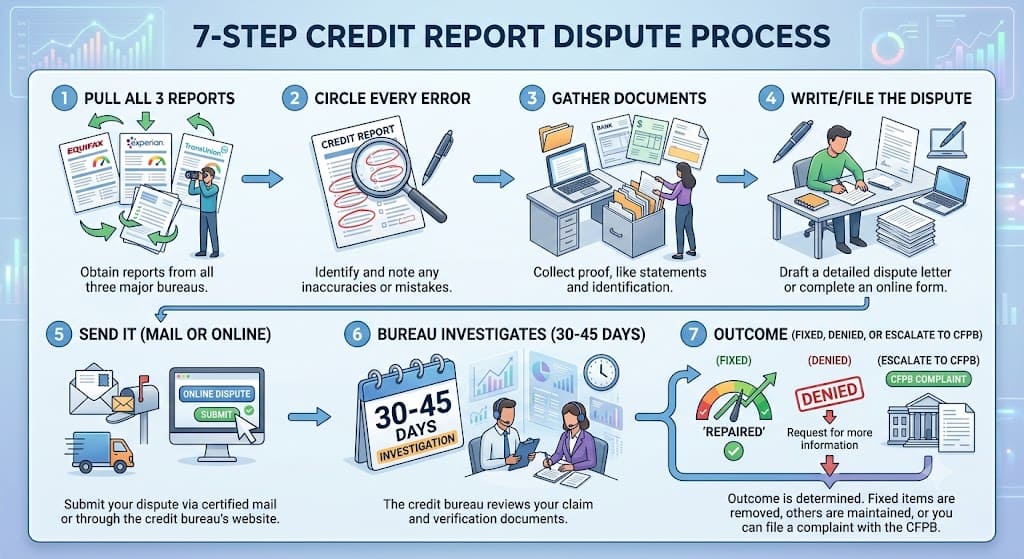
Step 1: Pull all three reports, not just one
Equifax, Experian, and TransUnion don’t share data in real time, so an error on one report might not exist on the other two. I’ve seen people fix a mistake with Experian and assume they’re done, only to get denied again three months later because the same wrong account was still sitting on their Equifax file. Pull all three free at AnnualCreditReport.com and go through each one separately.
Step 2: Circle every error, no matter how small
Look for accounts you didn’t open, payments marked late that you made on time, balances that are wrong, old debts that should’ve aged off, or someone else’s information mixed into your file. One item people flag as an error that usually isn’t: an unfamiliar inquiry. Most of those are hard inquiries tied to a real application you forgot about, not fraud, so check your own records before spending a dispute cycle on it. A soft inquiry, like checking your own score, never needs disputing since it doesn’t affect your credit at all. Circle or highlight each genuine error on a printed or saved copy. This becomes your reference for the letter and for what you’re circling in the copy you send.
Step 3: Gather documents that back up your side
You don’t need a lawyer’s file, just something concrete. A canceled check, a letter from the original creditor confirming the account is paid, a police report for fraud, or a bank statement showing the payment cleared. Never send originals. Copies only, since the bureau generally can’t return what you mail in.
Step 4: Write the dispute (or file it online)
Every bureau lets you dispute online, and it’s the fastest option for small, clear-cut errors like a wrong address or a paid-off balance. For anything bigger, like a fraudulent account or a bankruptcy that isn’t yours, a written letter carries more weight and creates a paper trail an online form doesn’t.
Your letter should include:
- Your full name, address, and phone number
- Each specific item you’re disputing and why
- A request that it be corrected or removed
- A copy of the report page with the disputed item circled
- Copies of your supporting documents
The CFPB has a free sample dispute letter you can adapt instead of starting from a blank page.
Step 5: Send it the right way
Online disputes go straight into the bureau’s system: Equifax, Experian, and TransUnion all have their own portals. If you’re mailing a letter instead, send it certified with a return receipt requested. That $5 or so is worth it, because if the bureau ever claims it didn’t get your dispute, you’ll have proof it did.
Step 6: Track the investigation
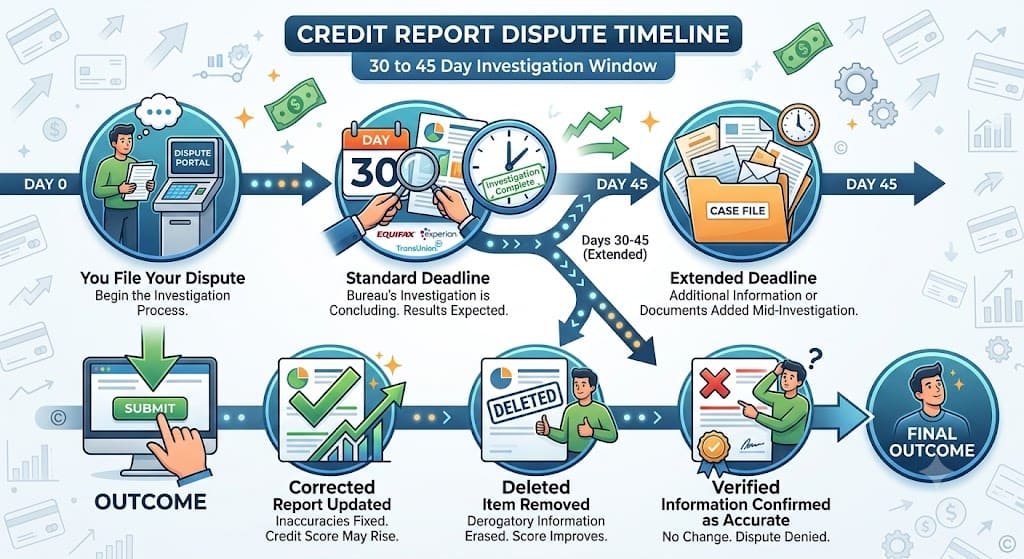
Once the bureau receives your dispute, it has to forward your documents to the company that originally reported the information, called a furnisher, such as your bank or a collection agency. That furnisher has to investigate and report back, usually within 30 days, sometimes 45 if you submitted extra documentation partway through. You’ll get the results in writing, and if anything changed, a free updated copy of your report.
Step 7: Handle whatever the outcome is
If the item gets fixed or removed, check your report again in a few weeks to confirm it actually happened, because updates don’t always show up instantly across all three bureaus. If the bureau says the information was “verified” and won’t budge, you have two real options left: add a 100-word consumer statement explaining your side, which stays attached to the file for anyone who pulls your report, or file a complaint with the CFPB, which forwards it directly to the company and tracks a response.
A quick worked example
Say your report shows a $340 medical collection you already paid off eighteen months ago. You’d pull the report, circle that line item, attach a copy of the paid receipt or a letter from the collector confirming zero balance, and either file online with whichever bureau shows it or mail a letter with everything attached. Within 30 to 45 days, the collector has to confirm to the bureau that it’s paid, and the bureau either deletes the account or updates it to “paid collection,” which still shows the original 7-year clock but stops looking like an open debt to anyone reviewing your file.
Common mistakes and the 609 dispute question
A few things trip people up on their first dispute:
- Disputing too vaguely. “This account is wrong” without saying why gives the bureau nothing to investigate, and it can get tossed out as frivolous.
- Sending originals instead of copies. You generally won’t get them back.
- Assuming one bureau’s fix applies everywhere. It doesn’t. Dispute with each bureau reporting the error.
- Expecting accurate negative information to disappear. A dispute only removes information that’s wrong, incomplete, or unverifiable. A late payment you actually made stays on your report; it doesn’t come off just because it’s bad news.
You’ve probably also seen “609 dispute letter” come up in search results or social media, sometimes marketed as a loophole that erases accurate negative marks. Here’s the honest version: Section 609 of the Fair Credit Reporting Act (FCRA) is just the part of the law giving you the right to request the specific method a bureau used to verify an account. Sending a “609 letter” doesn’t force deletion of accurate information. It can occasionally surface a genuine verification gap, but it isn’t a shortcut around the FCRA’s actual accuracy standard, and treating it as a magic phrase wastes a dispute cycle you could spend on a real error.
How the three bureaus compare on disputes
| Equifax | Experian | TransUnion | |
|---|---|---|---|
| Standard investigation window | 30 days | 30 days | 30 days |
| Extended window (if you add documents) | up to 45 days | up to 45 days | up to 45 days |
| Online dispute available | Yes | Yes | Yes |
| Cost to dispute | Free | Free | Free |
| Mailing address for written disputes | P.O. Box 740256, Atlanta, GA 30374-0256 | P.O. Box 4500, Allen, TX 75013 | P.O. Box 2000, Chester, PA 19016-2000 |
As of July 2026, per each bureau’s published dispute process and the FTC’s sample dispute resources. Confirm current mailing addresses on your own credit report before sending, since they can shift.
If you’re working on rebuilding credit at the same time you’re cleaning up errors, it’s worth reading FinToku’s guide on how to build credit with no credit history, since a lot of the same documentation habits apply. And once your report is accurate, checking what actually qualifies you for an FHA loan is a natural next step if a home purchase is what prompted you to check your credit in the first place.
Key Takeaways
- You have a free, legal right under the FCRA to dispute anything inaccurate, incomplete, or unverifiable on your credit report, and the bureau must investigate, usually within 30 days.
- Pull reports from all three bureaus separately at AnnualCreditReport.com, since an error on one doesn’t mean it’s fixed everywhere.
- A written dispute sent by certified mail creates a paper trail; online disputes are faster for small, clear-cut errors.
- Accurate negative information, like a late payment you actually made, cannot be removed through a dispute. Only wrong, incomplete, or unverifiable items qualify.
- The “609 dispute method” is a real FCRA provision for requesting verification details, not a guaranteed way to erase accurate negative history.
Frequently Asked Questions
Can errors on a credit report really be reversed? Yes. If the credit bureau or the furnisher can’t verify the disputed information as accurate, it must correct or delete it, generally within 30 to 45 days of your dispute.
What is the 609 dispute method, and does it work? It refers to Section 609 of the FCRA, which lets you request the method a bureau used to verify an item. It can occasionally expose a real gap, but it isn’t a loophole that removes accurate information.
How long does a credit report dispute take? Most investigations wrap up within 30 days. If you submit additional documentation partway through, the bureau gets up to 45 days.
Will disputing an error hurt my credit score? No. Filing a dispute itself has no impact on your score. If the dispute results in a correction or deletion, your score may change because of that update, not because you disputed.
What if the credit bureau won’t fix my error? You can add a 100-word consumer statement to your file explaining your side, or file a complaint with the CFPB, which forwards it to the company and tracks a response.
If you’re staring at a report full of red flags right now, the fastest next move is just pulling all three reports today and circling everything that looks off. You can always sort out the paperwork after you know exactly what you’re disputing.
Read More
- How to Build Credit With No Credit History (2026 Guide)
- Best No Annual Fee Credit Cards for Building Credit
- Bad Credit Loans: How to Actually Get Approved (2026 Guide)
Disclaimer
This article is for general informational purposes only and shouldn’t be taken as financial or legal advice. The dispute timelines and mailing addresses above reflect each bureau’s published process as of July 2026, but rules and addresses can change, and your specific situation, especially anything involving fraud or identity theft, may need different steps. Before relying on this for a real dispute, it’s worth double-checking current instructions directly with the bureau you’re disputing with, and consulting a consumer-rights attorney if a bureau or furnisher won’t cooperate after a full FCRA dispute. You can also read FinToku’s full Financial Disclaimer.
Published by Saad Faisal for FinToku (fintoku.com) · Published July 30, 2026 · Updated July 30, 2026 FinToku provides free finance tools and guides to help you make smarter money decisions.