

Somewhere between picking a car seat and packing a hospital bag, the actual math of having a baby tends to get skipped. Nobody hands you a form for it. There’s no deadline reminder on your phone that says “figure out your finances before this kid shows up.”
I found that out the hard way. My employer’s health plan gave me a hard 30 day window to add a new dependent, and I didn’t realize it. I spent the better part of a week on hold trying to fix it after the fact.
So here’s the direct version. A financial checklist before having a baby comes down to nine moves: health insurance, a real baby budget, your emergency fund, life insurance, a Dependent Care FSA or HSA, the right tax credits, a will, your beneficiary designations, and an education fund, roughly in that order. None of these require extra cash sitting around. They mostly require a decision, made before the deadlines start stacking up.
1. Add your baby to your health insurance
Most employer health plans give you 30 to 60 days from the birth (or adoption) to add your baby as a dependent. Miss that window and you can end up paying full price for care until the next open enrollment.
Call your carrier or your HR department as soon as you know the birthdate or placement date, not after. You’ll typically need the birth certificate or a verification-of-birth letter from the hospital, plus a Social Security number once it’s issued. Once you add the child, coverage is usually backdated to the day of birth. That means those first few weeks aren’t a coverage gap while the paperwork catches up.
If you and your partner both have coverage through work, compare the two plans before you pick one. The deductible, the out-of-pocket maximum, and which pediatricians are in-network can vary more than people expect. Once you pick a plan, it usually locks you in until the next open enrollment period.
2. Build a real baby budget, not a guess
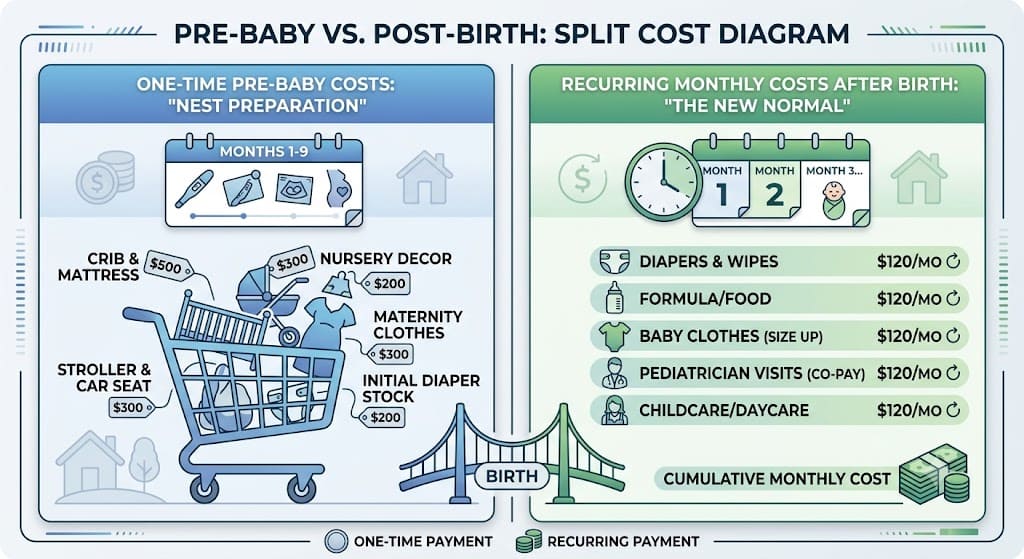
A baby budget has two very different halves. The first is one-time costs before the birth: car seat, crib, stroller, hospital bag basics. The second is recurring costs that show up every month after: diapers, formula, child care, extra pediatrician visits. Treating both halves as one lump guess is how new parents end up surprised in month three.
Start with what you’re already spending. Then add a placeholder for child care specifically, since it’s usually the largest recurring line item and the one people underestimate most. If you haven’t priced daycare, a nanny, or family care in your area yet, do that before the baby arrives rather than after. Waitlists at good daycare centers can run months long.
The 50/30/20 rule (needs, wants, savings) is a reasonable starting frame here. It’s usually the “wants” slice that shrinks first once a baby budget lands on top of an existing one.
3. Rebuild your emergency fund for a bigger household
You probably sized your old emergency fund target for one or two adults. A baby adds a person who gets sick more often and needs care on short notice. That turns “my car needs a repair” into “my car needs a repair, and I still have to get to daycare pickup.”
The Consumer Financial Protection Bureau recommends building toward a specific savings goal rather than an arbitrary number. For most households, that lands somewhere around three to six months of essential expenses, once you recalculate for the new baby-related costs from step 2. If you’re short of that, automating even a small transfer on payday tends to work better than waiting for a month with money left over.
4. Get or increase your life insurance
If something happens to you, life insurance is what replaces your income for the people depending on it. That calculation changes the moment a dependent exists. A common rule of thumb is coverage worth somewhere between 7 and 10 times your annual income. The right number for you depends on your debts, your partner’s income, and how many years of support you’re trying to cover.
Term life insurance is usually the cheapest way to get meaningful coverage while your child is young. It’s worth checking whether your employer already offers a base policy, since that’s often not enough on its own but can lower what you need to buy separately.
5. Put a Dependent Care FSA or HSA to work
If your employer offers a Dependent Care FSA, it lets you pay for daycare, a nanny, or after-school care with pretax dollars. That’s a real discount on money you were going to spend anyway. The contribution limit jumped substantially for 2026 under new federal rules. It’s worth re-checking even if you looked at this a year or two ago and decided it wasn’t worth the paperwork.
If you’re on a High Deductible Health Plan, an HSA is a separate account worth considering too. It covers medical costs directly related to your baby, from copays to certain baby-care items your doctor recommends. Unlike some FSAs, HSA balances roll over year to year instead of disappearing at year-end.
Health FSA vs. Dependent Care FSA vs. HSA (2026)
| Account | What it covers | 2026 contribution limit | Rolls over? |
|---|---|---|---|
| Health FSA | Medical, dental, and vision costs not covered by insurance | $3,400 per employee | Up to $680 carryover (employer-dependent) |
| Dependent Care FSA | Daycare, nanny, after-school care, summer day camp | $7,500 per household ($3,750 if married filing separately) | No, use-it-or-lose-it |
| HSA (family coverage) | Medical costs, paired with a High Deductible Health Plan | $8,750 for family coverage | Yes, balance carries over indefinitely |
Figures reflect 2026 IRS and OBBBA-adjusted limits, as of mid-2026. The Dependent Care FSA limit rose from $5,000 to $7,500, its first permanent increase since 1986.
6. Claim the Child Tax Credit and Dependent Care Credit
For the 2026 tax year, the Child Tax Credit is worth up to $2,200 per qualifying child. Up to $1,700 of that is refundable, even if you don’t owe much in taxes. It phases out above $200,000 in income for single filers or $400,000 for joint filers, and your child needs a Social Security number to qualify.
Separately, the Child and Dependent Care Credit covers a share of what you pay for child care so you can work. The IRS caps it at $3,000 of expenses for one child or $6,000 for two or more. Starting in 2026, that credit covers up to 50% of qualifying expenses for many families, up from the older 20 to 35% range. That’s worth claiming even if you skipped it before because the math didn’t seem worth the paperwork.
You can claim both in the same tax year if you qualify for each.
7. Write or update your will
If you don’t have a will yet, having a baby is the moment that actually forces the question. Who takes care of your child if something happens to both parents? Without a will naming a guardian, a court makes that decision instead of you.
A basic will doesn’t need to be complicated or expensive to start. It names a guardian for your child and states how you want your assets handled. You can build on it later with a trust or more detailed estate planning once your situation gets more complex. Naming a guardian shouldn’t wait for that.
8. Update your beneficiary designations
Beneficiary designations on your retirement accounts, life insurance policy, and bank accounts override what your will says. That surprises a lot of new parents. Naming your child in your will isn’t enough if the beneficiary field on your 401(k) or life insurance policy still says something else.
Most of these updates take a few minutes online once you’re logged into the account. A few providers won’t let you name a minor directly as a beneficiary. A trust or a custodial designation usually solves that, so it’s worth asking the provider directly rather than assuming the standard form covers it.
9. Start saving for education, even a small amount
College is a long way off from a newborn, but a 529 plan is one of the few accounts where starting early does most of the work for you through compounding. Contributions grow tax-deferred, and withdrawals are tax-free when used for qualified education expenses.
You don’t need to fund it heavily on day one. Even a small automatic monthly contribution started now has years longer to grow than the same contribution started when your child is 10. If your child never uses the full balance, that’s not wasted money either. You can now roll up to $35,000 of unused 529 funds into a Roth IRA for them instead, so it isn’t stuck if plans change.
Key Takeaways
- A financial checklist before having a baby starts with health insurance: most plans give you only 30 to 60 days after birth to add your baby as a dependent.
- Build your baby budget around two categories separately: one-time costs before birth and recurring monthly costs after, with child care usually the biggest recurring line item.
- The 2026 Dependent Care FSA limit rose to $7,500 per household, its first increase since 1986, making it worth revisiting even if you skipped it before.
- The 2026 Child Tax Credit is worth up to $2,200 per child, and the Child and Dependent Care Credit can now cover up to 50% of qualifying child care expenses.
- A will and updated beneficiary designations matter immediately, not eventually, because they determine who cares for your child and who receives your assets if the worst happens.
Frequently Asked Questions
What’s the first step in financial planning for a baby?
Adding your baby to your health insurance is usually the most time-sensitive step. Most plans only give you 30 to 60 days after birth or adoption. After that, you’re often locked out until the next open enrollment period.
How long do I have to add my baby to my health insurance?
Most employer plans allow 30 days, and Health Insurance Marketplace plans typically allow 60 days. Coverage is usually backdated to the birth date once you complete enrollment. Missing the window entirely can mean waiting until the next open enrollment period.
I’m not financially ready for a baby but I’m already pregnant. What now?
Focus on the highest-impact, lowest-cost steps first. Confirm your health insurance enrollment window. Start even a small automatic transfer into an emergency fund, and check whether your employer offers a Dependent Care FSA for when child care costs start. You don’t need every piece of this checklist finished before the birth, just started.
How much does having a baby actually cost in the first year?
Costs vary widely by location, insurance, and child care choices. The Brookings Institution’s 2022 estimate put the total cost of raising a child through age 17 at roughly $310,605, or about $18,000 a year on average. Child care plus health care are the biggest variables in year one specifically.
Do new parents need a will if they don’t have many assets yet?
Yes. A will’s most urgent job for new parents isn’t dividing assets, it’s naming a legal guardian for your child. Without that named in writing, the decision defaults to a court process instead of your own choice.
Run your baby budget through FinToku’s Budget Planner & 50/30/20 Calculator to see where the new recurring costs actually land before you commit to a number.
Read More
- Budgeting for a One-Income Household After Job Loss or Parental Leave
- Financial Goals You Should Set Every Year
- Joint vs Separate Accounts: Which Is Right for Couples?
Disclaimer
This article is for general informational purposes only and shouldn’t be taken as financial, tax, or legal advice. The FSA, HSA, and tax credit figures above reflect 2026 federal limits as of this writing and are examples of how the numbers work, not guarantees for your specific situation. Before making a real financial decision around your baby’s arrival, it’s worth checking with a qualified financial advisor or tax professional who can look at your income, state, and benefits specifically. You can also read FinToku’s full Financial Disclaimer.
Published by Saad Faisal for FinToku (fintoku.com) · Published July 29, 2026 · Updated July 29, 2026
FinToku provides free finance tools and guides to help you make smarter money decisions.