

A reader wrote in a few weeks ago asking where to even start. She’d decided the marriage was over. She hadn’t told her husband yet, and she had no idea what to do with the joint checking account, the 401(k), or the fact that her name wasn’t on the mortgage. That’s a more common starting point than people admit.
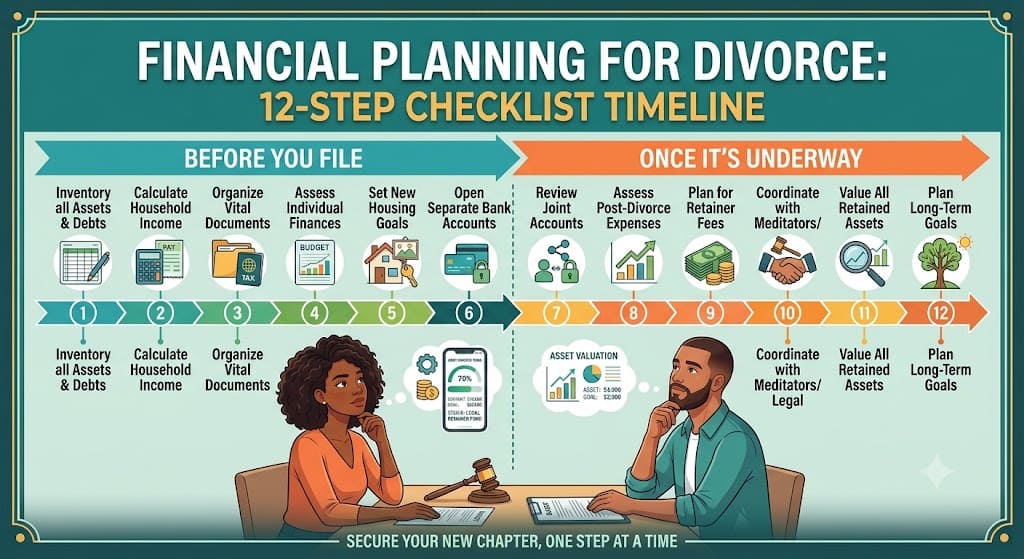
Here’s the direct answer: before you file for divorce, get your financial documents together, check your credit report, open your own bank account, and understand what happens to your retirement accounts and your tax filing status. Everything else on this checklist builds on those four moves.
Divorce is a legal and emotional process first. But it’s also, quietly, an accounting problem. The spouse who walks in with copies of every account, a clear budget, and a credit report in hand tends to come out the other side in much better financial shape than the one who’s scrambling to find a tax return from three years ago.
What you’ll need before you start
Set aside a weekend, not an afternoon. You’ll want access to (or copies of):
- The last 2-3 years of tax returns
- Statements for every bank, credit card, and investment account, joint or individual
- Retirement and pension statements (401(k), IRA, pension)
- Mortgage, auto loan, and other debt paperwork
- Insurance policies (life, health, disability, home, auto)
- Deeds, titles, and any prenuptial or postnuptial agreement
If some of this lives only in your spouse’s inbox or a shared filing cabinet, gather what’s genuinely accessible to you now, before things get more adversarial. This is about building your own accurate picture of the household finances, not concealing marital assets from a court or your spouse, which can backfire legally.
1. Gather your financial documents
Compile monthly statements for every account you can find, going back at least a year, and make copies for yourself separate from the originals. Locate your tax returns too, whether you filed jointly or separately, since your attorney and any financial advisor will ask for both almost immediately.
Don’t wait for your spouse to hand these over. Divorce paperwork moves slowly, and account access can get complicated fast once a filing is underway.
2. Pull your full credit report and start protecting your score
This is the step almost nobody’s checklist covers well, and it matters more than people expect. Request your free credit report from all three bureaus (Equifax, Experian, and TransUnion) and look for joint accounts, authorized-user cards, and anything that surprises you.
Here’s the part that trips people up: your marital status itself has no effect on your credit score. What can hurt you is a joint account your ex stops paying. According to the Consumer Financial Protection Bureau, joint accounts affect both spouses’ credit scores, and a divorce decree assigning a debt to one spouse doesn’t release the other from the original agreement with the lender. If your ex is ordered to pay off a joint card and doesn’t, the missed payments can still show up on your report.
3. Open your own bank account and start separating finances
Set up an individual checking account now, even if you’re not moving out yet. This gives you a place to receive your own income and cover your own expenses without every transaction running through a shared account.
If you’re weighing how far to take this before anything’s finalized, our guide on joint vs. separate accounts walks through the tradeoffs, including the ones that still apply once a marriage is ending rather than beginning.
4. Check your emergency fund, or start one
A gap in income, a deposit on a new place, an unexpected legal bill: divorce tends to produce exactly the kind of costs an emergency fund exists for. If you already have one, confirm it’s sitting in an account only you control. If you don’t, start one now, even a small one.
Our guide to building an emergency fund in six months breaks down a realistic target, and you can run your own numbers through FinToku’s Emergency Fund Calculator to see what a workable cushion looks like on your actual income.

5. Build a realistic post-divorce budget
Your household is about to become two households on one combined income, and that math rarely feels good the first time you run it. Add in the new line items divorce creates directly: legal fees, potential alimony or child support, a second rent or mortgage payment.
If there’s a real income gap between you and your spouse, or you’ll be the one with the kids most of the time, budget for the possibility of paying or receiving spousal or child support rather than assuming it away in either direction. Courts weigh things like how long you were married and each spouse’s earning capacity, so it’s genuinely case by case.
FinToku’s Budget Planner & 50/30/20 Calculator is a fast way to sanity-check whether your expected post-divorce income actually covers what you’re planning to keep.
6. Understand what happens to your retirement accounts
If part of a 401(k) or pension gets divided in the settlement, that transfer usually happens through a Qualified Domestic Relations Order, or QDRO. A QDRO lets you move your share into your own retirement account without triggering the usual 10% early-withdrawal penalty, even if you’re under 59½. IRA assets work a little differently since they’re handled through the divorce decree itself rather than a QDRO, and taking a cash payout instead of rolling it over will usually trigger income tax.
Once you know roughly what you’re keeping, FinToku’s Retirement Calculator can show you how that changes your long-term number.
7. Check whether you qualify for Social Security on your ex’s record
This one surprises a lot of people. If your marriage lasted at least 10 years, you may be able to claim Social Security based on your ex-spouse’s earnings record once you turn 62. Remarrying is the one thing that generally disqualifies you. Per the Social Security Administration, this benefit can be worth up to half of your ex’s benefit at their full retirement age, and claiming it doesn’t reduce what your ex receives.
If you’re close to that 10-year mark, the exact date your divorce becomes final can matter more than it seems like it should.
8. Update your beneficiaries and estate plan
Life insurance beneficiaries don’t update themselves. In many states, divorce automatically strips an ex-spouse’s beneficiary status on things like retirement accounts, but not always on life insurance, so check each policy individually rather than assuming. Review your will at the same time. If you don’t have one, this is a reasonable moment to write one.
9. Review your insurance coverage
Health insurance is the big one if you’ve been covered under your spouse’s employer plan: that coverage typically ends when the divorce is final, unless the decree says otherwise. COBRA can bridge the gap for up to 36 months, though it’s usually pricier than a Marketplace plan, so it’s worth comparing both. Take a look at life, disability, and auto or home policies too, since ownership and payor responsibilities often need to change.
10. Think through housing before you commit to anything
Whether you rent or own, resist the urge to make a housing decision under pressure. Selling, refinancing into one name, or simply continuing to co-own for now each carry different costs and risks. Get real numbers, not gut instinct, before you agree to keep or give up the house.
11. Understand your tax filing status is about to change
Your marital status on December 31 decides your filing status for the entire year, according to the IRS. If your divorce is finalized by year-end, you’re considered unmarried for the whole year and will typically file as single or, if you qualify, head of household. If it’s not final by December 31, you’re still filing as married for that year, jointly or separately.
| Filing status after divorce | When it applies | Key requirement |
|---|---|---|
| Married filing jointly/separately | Divorce not finalized by Dec. 31 | Still legally married on the last day of the tax year |
| Single | Divorce finalized by Dec. 31, no dependents | Legally unmarried on the last day of the tax year |
| Head of household | Divorce finalized by Dec. 31, with a qualifying dependent | Paid more than half the cost of keeping up a home for a dependent |
Source: IRS, “Filing Taxes After Divorce or Separation,” current as of July 2026.
12. Loop in your professional team early
A divorce attorney handles the legal split. A tax professional and a financial advisor, ideally one who works with divorce specifically, can catch the parts a lawyer isn’t trained to flag, like the tax cost hiding inside an “equal” asset split. Bringing all three in before you sign anything, rather than after, is the single biggest lever on how this goes financially.
A quick worked example
Say you and your spouse have a house worth $400,000 with $150,000 left on the mortgage, and a $200,000 401(k) in your spouse’s name. Splitting it “evenly” by giving you the house equity and your spouse the retirement account sounds fair on paper. But the $200,000 in a traditional 401(k) will owe income tax whenever it’s withdrawn, while home equity generally won’t, unless it’s sold well above what you paid for it. Run both sides through their real after-tax value before agreeing that a split is actually equal.
Common mistakes to avoid
- Signing anything before your attorney has reviewed it
- Making a big purchase or large withdrawal while the divorce is pending
- Assuming your state’s beneficiary “stripping” rule covers every account type, when it often applies to some (like retirement accounts) but not others (like life insurance)
- Rolling over a 401(k) distribution as cash instead of into a qualified account, and triggering an unnecessary tax bill
- Skipping the credit report step because “nothing’s changed yet”
Key Takeaways
- Before filing, gather your financial documents, pull your credit report, and open your own bank account so you’re working from an accurate, current picture.
- Retirement accounts usually move through a QDRO, and if you were married 10+ years, you may also qualify for Social Security on your ex’s record.
- Your tax filing status depends on whether the divorce is final by December 31, and beneficiaries and estate documents need updating regardless of state “stripping” rules.
- A financial advisor, tax professional, and attorney working together catch problems that any one of them alone would miss.
Frequently Asked Questions
Is there a free financial checklist before getting a divorce I can download? This article covers the same 12 steps most paid checklists include: documents, credit, accounts, retirement, taxes, and beneficiaries. Save or bookmark this page as your free version, and adapt the document list above to your own situation.
How do I prepare financially for divorce as a woman? The steps are largely the same regardless of gender, though women are statistically more likely to have been the lower earner or to have taken time out of the workforce, which makes the retirement and Social Security steps (6 and 7 above) especially worth double-checking.
Can I secretly prepare for divorce financially? Gathering copies of your own financial documents and opening an individual bank account in your own name is standard preparation, not concealment. Hiding marital assets from your spouse or a court is a different matter entirely and can carry real legal consequences, so keep those two things separate.
What’s a post-divorce financial checklist look like? Once the divorce is final, the focus shifts to finishing account separation, rebuilding a budget on your actual new income, and revisiting your long-term goals. That’s different enough from pre-divorce prep that it’s worth treating as its own checklist, which we may cover as a companion piece.
Is there such a thing as financial separation without divorce? Yes. A legal separation lets couples divide finances and living arrangements without ending the marriage, which some couples choose for insurance, tax, or religious reasons. The financial steps above mostly still apply, though a family law attorney can explain how your state treats separation differently from divorce.
Run your numbers through FinToku’s Budget Planner before your next conversation with your attorney or advisor. Seeing the actual numbers tends to make the conversation shorter and less emotional.
Read More
- Joint vs Separate Accounts: Which Is Right for Couples?
- How to Build an Emergency Fund in 6 Months (Even on a Tight Budget)
- Financial Checklist Before Having a Baby: 9 Steps to Get Ready
Disclaimer
This article is for general informational purposes only and shouldn’t be taken as financial, tax, or legal advice. Divorce law and tax rules vary by state and by situation, and the QDRO, Social Security, and filing-status examples above are general rules, not a substitute for advice on your specific circumstances. Before making any financial decision tied to a divorce, talk with a family law attorney, a tax professional, and a financial advisor who can look at your actual numbers. You can also read FinToku’s full Financial Disclaimer.
Published by Saad Faisal for FinToku (fintoku.com) · Published July 30, 2026 · Updated July 30, 2026 FinToku provides free finance tools and guides to help you make smarter money decisions.