

Your first work-study paycheck lands, you drop $40 into whatever savings account your parents opened when you were twelve, and by the end of the month it’s earned about four cents. That’s not a savings account doing its job. That’s a shoebox with extra steps.
The short answer: as of mid-2026, the strongest high-yield savings accounts for students pay somewhere between 3.25% and 4.00% APY, charge no monthly fee, and don’t require a minimum balance to open. SoFi, Synchrony, CIT Bank, Betterment Cash Reserve, and First Tech Federal Credit Union all clear that bar right now, though rates move often enough that it’s worth double-checking the live number before you actually open one. SoFi’s top rate also requires direct deposit, something most freshmen and sophomores won’t have yet, so don’t assume you’ll get the headline number on day one.
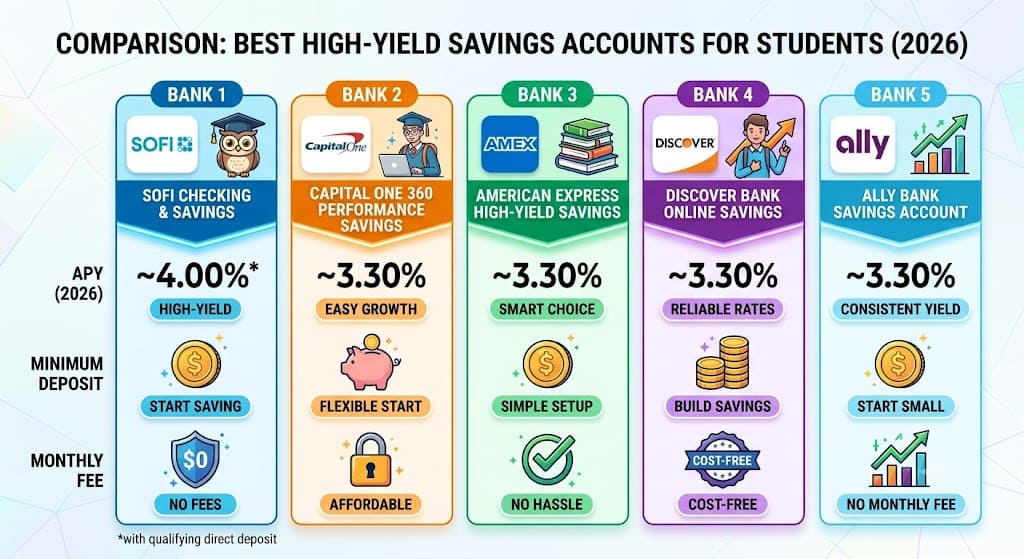
Quick Picks: Best High-Yield Savings Accounts for Students
| Account | Best for | APY (as of) | Min. to open |
|---|---|---|---|
| SoFi Checking and Savings | All-in-one checking + savings | Up to 3.80% with direct deposit, 1.00% without (7/17/26) | $0 |
| CIT Bank Savings Connect | A flat rate with no balance tiers | 3.65% (7/15/26) | $100 |
| Synchrony High Yield Savings | Truly zero balance requirements | 3.30% (7/2/26) | $0 |
| Betterment Cash Reserve | A savings app with a cash-management feel | 3.25% (7/19/26) | $0 |
| First Tech FCU Start Up Savings | Under 18, or want a credit union | Up to 4.00% (6/11/26) | $25 |
What Actually Makes an Account Good for a Student
A savings account earns the “good for students” label on three things: it doesn’t charge you for having a small balance, it doesn’t lock your money behind a minimum you can’t hit on a part-time paycheck, and you can manage the whole thing from your phone.
Everything else is marketing. Honestly, most “student savings accounts” aren’t meaningfully different from a regular high-yield savings account that happens to have no minimum. The label mostly signals who the bank’s marketing team is targeting, not a better product underneath.
What genuinely matters:
- No monthly fee, full stop, not one that’s “waived under 24”
- $0 or near-$0 minimum to open and to earn the advertised rate
- FDIC insurance up to $250,000 per depositor, per bank (FDIC)
- No direct deposit requirement to unlock the top rate, since most students don’t have one yet
- A decent mobile app, because you’re not walking into a branch between classes
The Best High-Yield Savings Accounts for Students, Ranked
1. SoFi Checking and Savings: Best All-in-One Option
SoFi pairs a fee-free checking account with a savings account that earns up to 3.80% APY (as of 7/17/26), the highest of the five accounts here, with $0 minimum balance and no monthly fee. The appeal for students specifically is that you don’t need two separate apps and two separate logins to manage spending money and savings.
The catch is real, though. That 3.80% requires eligible direct deposit or a $5,000 balance. Without either, the rate drops to around 1.00% APY, not far off a regular savings account. If you’re not getting paid via direct deposit yet, don’t count on the headline number.
2. CIT Bank Savings Connect: Best Flat Rate With No Balance Tiers
CIT’s Savings Connect account pays 3.65% APY (as of 7/15/26) on every dollar in the account, no matter your balance. There’s a $100 minimum deposit to open it, a real barrier if you’re starting from zero, but once you clear that, you earn the same rate whether you have $150 or $15,000.
Worth knowing: CIT also offers a separate Platinum Savings account that pays more, up to 4.10% APY, but only on balances of $5,000 or above. If you’re nowhere near that, Savings Connect is the more realistic pick.
3. Synchrony High Yield Savings: Best for Truly Zero Requirements
Synchrony doesn’t ask for a minimum balance, doesn’t charge a monthly fee, and pays 3.30% APY (as of 7/2/26), still close to 9 times the national average. There’s no student-specific version of this account, and that’s kind of the point. It’s a plain, no-catch online savings account that works fine at 19 or 39.
The trade-off is access. Synchrony has no physical branches, so if you want to talk to a human or deposit cash, you’re out of luck.
4. Betterment Cash Reserve: Best Cash-Management App
Betterment isn’t technically a bank; it’s a cash-management product backed by partner banks, currently paying 3.25% APY (as of 7/19/26) with FDIC coverage extended through those partners, up to $4 million for an individual account or $8 million for a joint one. No minimum, no monthly fee, unlimited withdrawals.
There’s no debit card or ATM access on this one. It’s built for parking money, not spending it, which is arguably exactly what a student’s savings should be doing anyway.
5. First Tech Federal Credit Union Start Up Savings: Best Credit Union Pick
First Tech’s Start Up Savings account is aimed squarely at younger savers and pays up to 4.00% APY, confirmed by both Forbes Advisor and a separate bank review as of June and July 2026. It requires a $25 minimum deposit and credit union membership, which is more open than it sounds; First Tech extends eligibility through a long list of partner organizations you can join online. Note that First Tech and Digital Federal Credit Union (DCU) merged into a single credit union in January 2026, so if you’ve seen DCU’s youth savings account mentioned elsewhere, it’s now the same institution.
If you’re under 18, a parent or guardian is required to stay on the account as a joint owner. A credit union’s youth-savings framing tends to fit that setup more naturally than a straight online bank does.
What Students on Reddit and Banking Forums Actually Pick
Scroll through a thread of recent grads and current students comparing notes, and the pattern that shows up again and again isn’t “chase the single highest number.” It’s people splitting the difference: keeping a familiar checking account at a big bank for everyday spending and ATM access, then routing savings into whichever online HYSA is paying well that quarter. Ally, CIT, and Synchrony come up constantly as the “boring but reliable” picks, even when a smaller, newer bank is technically paying a fraction of a point more.
That’s a reasonable instinct. A quarter-point of APY on a $500 student savings balance is a couple of dollars a year. Not having to fight with a sketchy mobile app during finals week is worth more than that.
Do You Need to Be 18 to Open One?
Not necessarily, but under 18 you’ll need a parent or guardian as a joint or custodial owner on the account. State law generally sets 18 as the age to open a bank account solo, so a 17-year-old heading into freshman year in a dorm still needs an adult’s name attached until they turn 18.
Once you’re 18, you can open most of the accounts on this list entirely on your own with a government-issued ID, a Social Security number, and whatever minimum deposit the bank requires. FinToku has a full breakdown of exactly what documents you need to open a bank account in the US if you want the specifics before you apply.
HYSA vs. CD vs. Checking: Where Should Your Money Actually Sit?
A high-yield savings account is the right home for money you want to keep growing but might need on short notice, tuition refunds, an emergency car repair, next semester’s textbooks. A CD locks your money in for a fixed term in exchange for a usually-higher rate, which only makes sense for cash you’re confident you won’t touch. Checking is for money you’re actively spending this week.
| Account type | Liquidity | Typical rate | Best for |
|---|---|---|---|
| High-yield savings | Withdraw anytime, some monthly limits | 3.25%-4.00% on the accounts above; up to 4.20% at the very top of the market (2026) | Emergency cushion, short-term goals |
| CD | Locked until maturity, early-withdrawal penalty | Around 2.49% avg. on a 1-year CD | Money you won’t need for months |
| Checking | Fully liquid, no restrictions | Near 0% at most banks | Everyday spending |
If you want to see what a CD would actually earn versus leaving the same amount in a HYSA, FinToku’s CD Calculator will run both scenarios side by side in under a minute.
How Much Should You Actually Keep In It?
There’s no single right number, and honestly, most advice that throws out a flat figure (“save $100 a month!”) ignores that a student working 10 hours a week has a very different budget than one with a full-time summer internship behind them. What matters more is the habit of setting something aside consistently, even a small amount, and having a real target instead of a vague one.
FinToku’s guide on how much you should save each month walks through a more realistic way to set that number based on your actual income, not a generic percentage. And if you’re starting from zero, the Budget Planner & 50/30/20 Calculator can show you what’s actually left over to save once rent, food, and the inevitable takeout run are accounted for.
A student savings account also doubles as the start of a real emergency fund, and FinToku’s guide on building an emergency fund in 6 months is worth a read if a laptop dying or a car repair would currently wipe you out.
Is the Interest You Earn Taxable?
Yes. Interest earned on a savings account, including a high-yield one, counts as taxable income at the federal level, according to the IRS. If you earn $10 or more in interest from a single bank in a year, that bank will send you a Form 1099-INT, and you’re expected to report it even if the amount is smaller than that threshold.
For most students, this ends up being a small number, a few dollars to maybe a couple hundred, depending on your balance and the rate. It’s still worth knowing it’s there before tax season surprises you with a form you weren’t expecting.
Key Takeaways
- Top high-yield savings accounts for students are paying roughly 3.25%-4.00% APY as of mid-2026, well above the roughly 0.38%-0.62% national average for a standard savings account.
- The best pick usually has $0 minimum balance, no monthly fee, and no direct deposit requirement, since most students don’t have steady direct deposit yet.
- Under 18, you’ll need a parent or guardian as a joint or custodial owner; at 18 you can open most of these accounts solo with an ID and Social Security number.
- Interest earned on any savings account is federally taxable, and banks issue a 1099-INT once you cross $10 in annual interest.
- A HYSA is best for money you might need on short notice; a CD only makes sense for cash you’re confident you won’t touch for months.
Frequently Asked Questions
What’s the difference between a “student” savings account and a regular high-yield savings account? Usually not much. A student account is often just a standard high-yield savings account marketed to a younger audience, sometimes with a waived fee “under 24” that a regular account might not offer, but the underlying APY and features are frequently identical.
Can a 17-year-old open a high-yield savings account? Yes, but with a parent or legal guardian as a joint or custodial owner. Most states require you to be 18 to open a bank account entirely on your own.
What happens to my student account after I graduate? Most banks automatically convert a student or youth account into a standard savings account once you hit the account’s age cutoff, usually 24 or 25. Your APY and fee structure can change at that point, so it’s worth checking the account terms before you assume nothing will shift.
Is a high-yield savings account also a good option for a teenager, not just a college student? Generally yes, though FinToku’s separate guides on savings accounts for kids and teens go deeper into age-specific features like parental controls and spending limits that matter more for a 14-year-old than a 20-year-old.
Do these accounts work for community college students or students outside the state where the bank is headquartered? Yes. Every account listed here is available nationwide online, so your state or which college you attend doesn’t affect eligibility.
If you’re still figuring out your savings target before you pick a bank, FinToku’s guide on how much to save each month is a good next stop.
Read More
- How Much Should You Save Each Month? A Realistic, No-Guilt Answer
- 40+ Common Banking Terms in the U.S. Everyone Should Know (2026 Glossary)
- Documents Needed to Open a Bank Account in the US
Disclaimer
This article is for general informational purposes only and shouldn’t be taken as financial or tax advice. The APY figures above change often, sometimes weekly, so treat them as a snapshot from the dates noted rather than a guarantee of what you’ll actually earn. Before opening an account, it’s worth checking the bank’s current rate directly and, if you have real questions about your tax situation, talking to a qualified tax professional. You can read FinToku’s full Financial Disclaimer for more.
Published by Saad Faisal for FinToku (fintoku.com) · Published July 19, 2026 · Updated July 19, 2026 FinToku provides free finance tools and guides to help you make smarter money decisions.