

My cousin had four debts and a plan to tackle them in whatever order felt most satisfying that week. It didn’t work. Six months in, she’d made a dent in a $600 medical bill. Her credit card sitting at 24% APR barely moved, still bleeding interest every single day.
That’s the whole argument for picking a method and sticking to it. The debt snowball has you pay off your smallest balance first, ignoring interest rates, to build quick momentum. The debt avalanche has you pay off your highest interest rate first, ignoring balance size. The goal there is to minimize what you pay in total. Both work if you actually follow them. They just get you there differently, and one of them usually fits your specific situation better than the other.
What Is the Debt Snowball Method?
The debt snowball method is a payoff strategy where you list your debts from smallest balance to largest. You put every extra dollar toward the smallest one while paying minimums on the rest. Once it’s gone, that payment rolls straight into the next-smallest debt.
Here’s what it looks like in practice. Say you owe $1,200 on a store card, $4,500 on a personal loan, and $9,000 on a car loan. You keep making minimum payments on the personal loan and car loan. Every spare dollar goes to the $1,200 card instead. Once it hits zero, that money rolls straight into the $4,500 loan. It’s your old minimum plus whatever extra you’d been adding. Repeat until you’re done.
The appeal isn’t complicated. You get a real, visible win in weeks or months instead of years. For a lot of people, that first “paid off” moment is what keeps them going. It carries them through debt two, three, and four. Ramsey Solutions built an entire program around this exact method. Momentum is a real behavioral lever, not just a nice-to-have.
The tradeoff: if your smallest balance also happens to have a low interest rate, you’ll pay more in total interest. That’s especially true if your largest balance is sitting at 22%; you’ll pay meaningfully more than with the avalanche method.
What Is the Debt Avalanche Method?
The debt avalanche method is a payoff strategy where you list your debts from highest interest rate to lowest. You put every extra dollar toward the highest-rate debt while paying minimums on the rest. Once it’s paid off, you move to the next-highest rate.
Take the same three debts from above, but sort them by rate instead of balance. The store card is 26% APR, the car loan is 7%, and the personal loan is 12%. Under the avalanche method, you’d attack the store card first. That’s true even though it’s already your smallest balance in this example. Then the personal loan, then the car loan last.
The math almost always favors this approach. Every dollar of extra payment goes toward the debt that’s costing you the most per day. Less of your total payment ends up as interest, and more of it actually chips away at what you owe.
The tradeoff: if your highest-rate debt also has a large balance, that first account can take a long time to hit zero. That’s exactly where people give up. Nearly every source I checked says the same thing. That includes the credit unions and banks that publish this comparison every year.
Debt Snowball vs. Avalanche: Side-by-Side Comparison
| Debt Snowball | Debt Avalanche | |
|---|---|---|
| Debts ordered by | Balance, smallest to largest | Interest rate, highest to lowest |
| First win | Fast, usually weeks to a few months | Slower if the highest rate is also the biggest balance |
| Total interest paid | Usually more | Usually less |
| Best for | People who need visible progress to stay motivated | People who are comfortable waiting for the math to pay off |
| Effort to set up | Easier, balances are simple to compare | Slightly harder, you need every account’s actual APR |
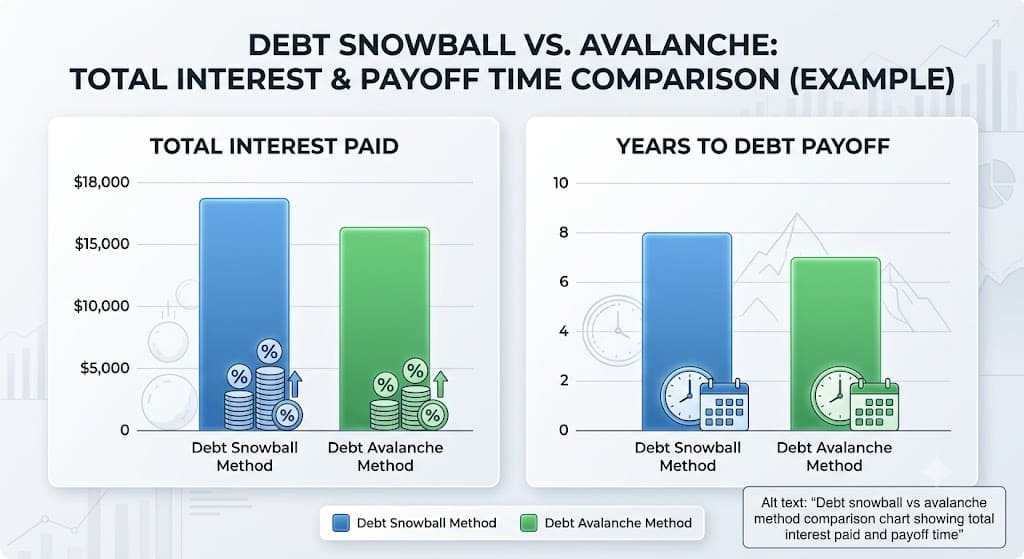
To put a number on that “usually less interest” claim, Fidelity ran a hypothetical with three loans. They used $20,000 at 20%, $100,000 at 6%, and $10,000 at 3%, plus an extra $100 a month on top. The avalanche method paid off the debt in 9 years for about $45,340 in total interest. The snowball method, same debts, same extra payment, took 10 years. It cost about $51,000 in interest, close to $6,000 more. That gap gets bigger the further apart your interest rates are. It shrinks, sometimes to almost nothing, if all your debts carry similar rates.
Current Interest Rates by Debt Type (as of May 2026)
This is where the avalanche method’s advantage becomes concrete. The bigger the gap between your highest and lowest rate, the more money the avalanche method saves you.
| Debt Type | Average APR | As of |
|---|---|---|
| Credit cards (accounts carrying a balance) | 22.15% | May 2026, Federal Reserve G.19 |
| Credit cards (all accounts, stated rate) | 20.94% | May 2026, Federal Reserve G.19 |
| Personal loans, 24-month (commercial banks) | 11.86% | Q2 2026, Federal Reserve G.19 |
| New car loans, 60-month (commercial banks) | 7.14% | May 2026, Federal Reserve G.19 |
That last row is the clearest illustration of why the avalanche method exists. A credit card at 22% sitting next to a car loan at 7% isn’t a close call. Every extra dollar belongs on the card first, no matter which balance is bigger.
If most of your debt sits in that credit-card range, the avalanche method usually wins. That’s true even if one balance is a lower-rate personal or auto loan. Its interest savings are worth the slower first payoff. If everything you owe clusters within a few points of each other, that gap shrinks. The snowball method’s motivation edge becomes the deciding factor instead.
Which Method Fits You?
Neither method is objectively “correct.” The Consumer Financial Protection Bureau frames this the same way most credit unions do. It comes down to whether you’re optimizing for psychology or for math, and both are legitimate things to optimize for.
Pick the snowball method if:
- You’ve tried a debt payoff plan before and lost motivation partway through
- Your debts are relatively close in interest rate, so the avalanche method wouldn’t save you much anyway
- You genuinely need to see accounts hit zero to keep going
Pick the avalanche method if:
- You’re disciplined enough to stick with a plan even without an early win
- At least one of your debts carries a noticeably higher rate than the rest (think a 24% credit card next to a 6% car loan)
- Minimizing the total interest you pay matters more to you than the emotional payoff
I’ll be honest, most of the “just pick avalanche, it’s mathematically superior” advice online skips one part. A plan you abandon in month four saves you nothing. A slightly worse method you actually finish beats a better method you quit.
The Hybrid Approach: Can You Combine Both?
Yes, and it’s a more common approach than most comparison articles let on. A workable hybrid is to knock out one or two small debts first, snowball-style, purely for the motivation boost. Then switch to avalanche ordering for everything that’s left once you’ve built momentum.
Another version: use the avalanche method for anything charging more than 15% to 18% APR, which is most credit cards. That’s where the interest cost is doing real damage. Treat any lower-rate debt, like a subsidized student loan or an auto loan, as lower priority regardless of balance.
There’s no rule that says you have to pick one system and follow it rigidly for years. The version that gets you to zero is the right one.
Before You Start: A Few Ground Rules
Whichever method you choose, a couple of things matter more than which order you pay debts off in.
Build a small cushion first. Every source I checked, from Wells Fargo to Fidelity to the CFPB, says some version of the same thing. Don’t throw every spare dollar at debt if you have zero savings. One car repair or medical bill without a buffer, and you’re back on the credit card you just paid down. Setting aside even $500 to $1,000 first keeps a bad month from becoming a bad year. FinToku’s Emergency Fund Calculator can help you size that number.
Stay current on every payment. Neither method works if you’re behind on the debts you’re not actively targeting. Late payments hurt your credit score and usually trigger penalty rates. That can undo whatever interest you were trying to save.
Know your real numbers before you sort anything. You can’t run either method without an accurate list of balances, rates, and minimum payments. I’d actually run your monthly numbers through FinToku’s Budget Planner & 50/30/20 Calculator first. It tells you exactly how much “extra” you realistically have to put toward debt each month. That number changes the whole timeline either way.
Key Takeaways
- The debt snowball method orders debts smallest balance to largest, prioritizing fast psychological wins over interest savings.
- The debt avalanche method orders debts highest interest rate to lowest, minimizing interest paid but delaying the first payoff win.
- In Fidelity’s worked example, the avalanche method saved close to $6,000 in interest and one year of payoff time. That’s compared to the snowball method on the same debts.
- The wider the gap between your highest and lowest interest rate, the more the avalanche method saves you. The closer your rates are, the less it matters.
- A hybrid approach is a legitimate third option that most comparison guides don’t mention. Snowball one small debt first, then switch to avalanche order.
Frequently Asked Questions
Is the debt snowball or debt avalanche method better?
Neither is universally better. The avalanche method usually saves more in total interest. The snowball method tends to help people stick with the plan longer because of the early wins. The “better” method is whichever one you’ll actually follow through to zero.
What’s the difference between a snowball budget and an avalanche budget?
They’re the same underlying budget, just sorted differently. A snowball budget lists debts from smallest balance to largest and directs extra payments to the smallest one. An avalanche budget lists the same debts by interest rate, highest to lowest. It directs extra payments to the highest-rate one instead.
Is debt consolidation better than the snowball method?
They solve different problems. Debt consolidation combines multiple debts into one loan at a lower rate, which simplifies payments and can cut interest cost. But it requires qualifying for a decent rate. It also doesn’t build the habit of paying extra every month the way the snowball or avalanche method does. Some people use consolidation first, then apply a snowball or avalanche approach to whatever’s left. If you’re weighing consolidation, a nonprofit credit counselor can look at your actual offers before you sign anything. The National Foundation for Credit Counseling is a good place to find one.
Is there a debt snowball vs. avalanche calculator I can use?
Not a dedicated one on FinToku yet. You can approximate the comparison by hand. Use the Budget Planner & 50/30/20 Calculator to see how much extra you have available each month. Then run that number against your own debt list using the two orderings above. A few personal finance apps also offer debt payoff calculators if you want an exact amortization schedule for each method.
Can I combine the snowball and avalanche methods?
Yes. A common hybrid pays off one or two small debts first for motivation. Then it switches to highest-interest-rate order for the rest. There’s no rule requiring you to use only one method the entire time you’re paying off debt.
Whichever method you land on, one number matters most: how much extra you can consistently put toward debt each month. That matters more than which order you list the accounts in. Run your real numbers through FinToku’s Budget Planner & 50/30/20 Calculator before you commit to either one.
Read More
- Financial Mistakes That Keep People Broke (and How to Actually Stop)
- Best Budgeting Apps in 2026: Which One Actually Fits How You Spend
- Financial Goals You Should Set Every Year
Disclaimer
This article shares general information, not financial or legal advice. The example debts, balances, and interest rates above are illustrative, aside from the Fidelity example and the Federal Reserve data. They’re not a recommendation for your specific situation. Before choosing a debt payoff strategy, run your actual numbers. Or check with a qualified financial advisor or nonprofit credit counselor who can look at your full picture. You can also read FinToku’s full Financial Disclaimer.
Published by Saad Faisal for FinToku (fintoku.com) · Published July 29, 2026 · Updated July 29, 2026 FinToku provides free finance tools and guides to help you make smarter money decisions.