

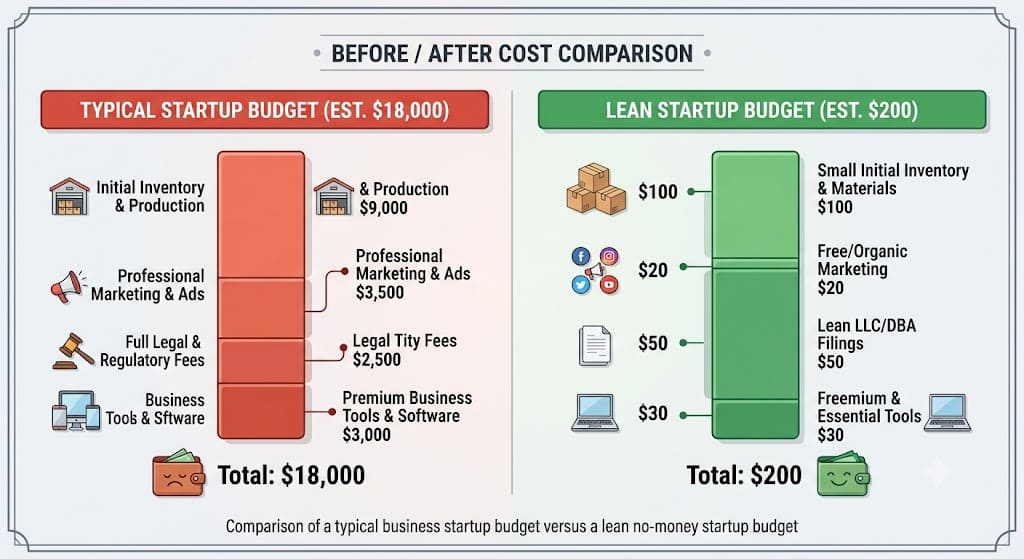
Two people I know started businesses this year. One spent $18,000 before he opened the doors: build-out, inventory, a logo package he probably didn’t need. The other spent about $60, on a domain name and a stack of business cards, and had her first paying client inside three weeks.
Same goal. Wildly different price tags. Only one of those paths requires money you don’t have.
Yes, you can start a business with little or no money. The move is picking a business model that doesn’t need inventory or a lease: freelancing, services, digital products. Validate it before you spend anything, then layer in outside funding, like SBA microloans or crowdfunding, only once you’ve proven people will actually pay. Everything below walks through exactly how.
Can You Really Start a Business With No Money?
Short answer: yes, though “no money” almost always means “very little money,” not literally zero. You’ll still need a domain, maybe a basic tool subscription, possibly a small permit fee. What you’re avoiding is the big stuff: inventory, a storefront lease, employees, expensive software you don’t need on day one.
U.S. Census data backs up how common this actually is. Seasonally adjusted business applications hit 496,443 in February 2026 alone.[1] Most of those are solo filers with no employees and no outside funding behind them. Most new businesses start lean, not funded.
The businesses that pull this off tend to share one thing: they sell a skill or a service before they sell a product. Skills don’t require a warehouse.
Business Ideas You Can Start With Basically $0
If you’re short on cash, the smartest move is picking a business that can run on a laptop and your own time. Here’s where I’d start looking.
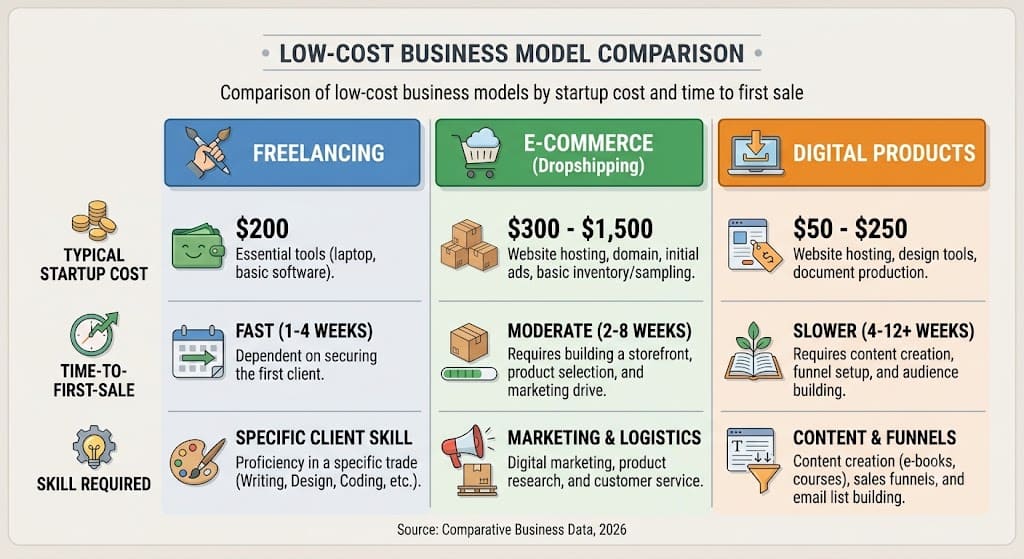
Freelancing and service-based work
Writing, bookkeeping, virtual assistance, social media management, tutoring, graphic design. If you can do it for one client, you can list it on Upwork or Fiverr and do it for ten. No inventory, no office, and you get paid before you spend a dime on marketing.
The fastest first move here isn’t a website. It’s telling your existing network what you’re now offering. Update your LinkedIn headline, post once, and see who replies before you build anything fancier.
E-commerce without holding inventory
Dropshipping and print-on-demand let you sell physical products without ever touching them. A supplier fulfills the order and takes their cut; you never pay for stock upfront. Platforms like Wix or a Shopify starter plan get a storefront live in an afternoon.
The tradeoff is thinner margins, so this works best when you already have an audience or a specific niche in mind, not as a “sell anything” starting point.
Digital products and content
Ebooks, templates, online courses, or a niche blog or newsletter with affiliate links. The upfront cost is your time, not cash, and once the product exists, it can sell while you sleep. This is also the cheapest option “as a teenager” or “as a kid,” since most digital-product platforms don’t require a business license to start selling.
Validate the Idea Before You Spend Anything
Before you build a website or print business cards, figure out if anyone actually wants what you’re selling. This step is free and it’s the one most people skip.
Ask five to ten people in your target market what they currently do to solve the problem you want to solve. Not “would you buy this,” which almost everyone answers politely with “sure.” Ask what they’re doing right now, today, and what frustrates them about it. That tells you far more than a hypothetical.
Once the idea holds up, sketch a one-page business plan: what you’re offering, who buys it, what it costs to deliver, and how you’ll get your first three customers. You don’t need forty pages. You need enough clarity to explain the business in two sentences without stumbling.
How to Fund a Business When You Have No Money
Here’s where most guides get vague. Let’s get specific about what’s actually available in 2026, what it costs, and what it doesn’t cover.
The grants myth, addressed directly: there are no federal grants for starting a business. That’s not my opinion, it’s the U.S. government’s own guidance.[2] If you see an ad promising “free government money” to launch your startup, it’s a scam, full stop. USAGov has a dedicated page for reporting exactly that kind of offer.[3] Grants that do exist (SBIR research grants, some state and local programs, minority- or veteran-specific funds) are narrow, competitive, and rarely for general startup costs.
| Funding option | Typical amount | Cost | Best for | As of |
|---|---|---|---|---|
| Bootstrapping (your own savings/income) | $0-$5,000 | No debt, no equity given up | Anyone willing to reinvest early revenue | 2026 |
| Friends and family | Varies | Often 0% interest, informal | Founders with a supportive network and a written agreement | 2026 |
| SBA Microloan | Up to $50,000 (avg. ~$13,000) | 8%-13% interest | New businesses needing small working capital, including thin/no credit history | SBA.gov, 2026[4] |
| Crowdfunding (Kickstarter, Indiegogo) | Campaign-dependent | ~5% platform fee plus payment processing | Product-based businesses with something to show backers | 2026 |
| SBA 7(a) or Express loan | $500,000-$5 million | Rate tied to prime (6.75%, holding steady since the Fed’s December 2025 cut) | Established ideas that need real growth capital later | Federal Reserve, as of July 2026[5] |
For most people reading this, bootstrapping and an SBA microloan cover it. The microloan program is worth knowing about specifically because it’s built for exactly this situation. It’s designed for startups, it works with thin or no credit history, and it’s administered through community lenders who look at more than your FICO score.
If you go the friends-and-family route, put terms in writing before money changes hands. Is it a loan with a repayment date, or is it equity? Decide that up front. It’s the single most common source of family fallout I hear about from people who skip it.
Keep Your Costs Near Zero While You Build
Funding is only half the equation. The other half is not spending money you don’t have yet.
- Use free-tier tools first. Canva, Google Workspace’s free tier, and most accounting apps offer a real free plan, not just a trial. Don’t pay for anything until the free version genuinely can’t keep up.
- Take every free trial, then cancel. Mark the cancellation date in your calendar the day you sign up, not the day it’s due.
- Barter where you can. If you do marketing, offer it in exchange for something you need, like bookkeeping or legal review. Every barter is cash you didn’t have to spend.
- Use your library. Many public libraries offer free business courses, meeting rooms, and even startup-focused databases you’d otherwise pay for.
- Track every dollar from day one. A simple budget, even a rough one, tells you exactly how much runway you actually have before you need revenue.
I’d run your numbers through FinToku’s Budget Planner & 50/30/20 Calculator before you spend anything. It’ll show what you can realistically set aside without touching rent or groceries.
The Legal Basics You Shouldn’t Skip
A sole proprietorship is the default if you do nothing else. It’s free to start, but there’s no legal separation between you and the business, so your personal assets are exposed if something goes wrong.
An LLC costs more upfront (state filing fees typically run $50-$500 depending on the state) but separates your personal and business liability. If you’re freelancing solo with low risk, a sole proprietorship is often fine to start. If you’re taking on clients, holding inventory, or bringing on a partner, the LLC’s protection is usually worth the fee.
Either way, you’ll likely need:
- An EIN (free, directly from the IRS, takes about ten minutes online) for opening a business bank account and, eventually, hiring
- Any local business license or home-occupation permit your city requires
- A separate bank account, even as a sole proprietor, so your bookkeeping and taxes aren’t a mess later
Once you’re earning, freelance and self-employment income comes with its own tax rules. I put together a full breakdown of what’s deductible in FinToku’s freelancer tax deductions guide, worth a look before your first quarterly filing.
Starting With No Money as a Teenager or With Bad Credit
Two situations come up constantly that most guides skip entirely.
As a teenager or with no clear idea yet: service and digital businesses are the easiest starting point. Most don’t require a business license until you’re earning consistently, and many (tutoring, social media help, pet sitting, digital templates) need nothing but a skill you likely already have. Start under a parent’s guidance if you’re a minor, since contracts and business bank accounts typically require an adult co-signer.
With bad credit or no credit history: this rules out most traditional bank loans, but not everything. SBA microloans are specifically designed to work with thin credit files, and bootstrapping, crowdfunding, and friends-and-family funding don’t check your credit at all. Building credit alongside the business (even a secured card used lightly) makes future funding easier. FinToku’s guide on building credit with no credit history walks through the specific steps.
Key Takeaways
- Starting a business with no money is realistic if you choose a service, freelance, or digital-product model that skips inventory and physical space.
- There are no federal grants for starting a business; anything promising free government startup money is a scam.
- SBA microloans cap at $50,000, with an average loan around $13,000, and are built to work with thin or no credit history.
- Validate demand with real conversations before spending anything on a website, logo, or inventory.
- A sole proprietorship is free to start; an LLC costs more upfront but separates your personal and business liability.
Frequently Asked Questions
Is it actually possible to start a business with little to no money?
Yes. Service businesses, freelancing, and digital products can start with under $100 in costs, since the main investment is your time and skill rather than inventory or a physical location.
What is the easiest business to start with no money?
Freelance or service work in something you already know how to do (writing, admin support, tutoring, social media help) is typically the fastest. List your services on a marketplace and you can start earning within days.
Can an LLC get grant money?
LLCs can apply for the same narrow pool of grants any small business can, mostly SBIR research grants or specific state, local, or demographic-targeted programs. Forming an LLC doesn’t unlock general startup grants, since none exist at the federal level.
Can I start a business with zero money?
Close to it. Freelancing, service work, and some digital products can start with essentially no cash outlay beyond what you already own, like a laptop or an internet connection. Most people still spend a small amount on a domain name or basic tools within the first month.
What is the best business to start with $1,000?
A service business with a modest tool or certification budget, or a lean e-commerce store with a small ad-testing budget, both work well at this level. $1,000 is enough to validate a dropshipping niche with test ads or to cover a few months of software for a freelance or consulting business.
Weighing whether to bootstrap or take on an SBA microloan? Run the numbers through FinToku’s US Business Federal Income Tax Calculator first. How you structure funding now affects what you owe once the business turns a profit.
Read More
- How to Build Credit With No Credit History (2026 Guide)
- Best Tax Deductions for Freelancers in 2026 (Full List + Worksheet)
- Paycheck Budgeting for Beginners: How to Make Your Money Last Between Paydays
Disclaimer
This article is for general informational purposes only and shouldn’t be taken as financial, tax, or legal advice. The funding amounts and rates above (SBA microloan caps, interest rate ranges, LLC filing fees) are examples based on current published figures. They aren’t guarantees for your specific situation or state. Before making a real funding or business-structure decision, it’s worth checking with a qualified accountant, attorney, or SBA-affiliated advisor who can look at your specific circumstances. You can also read FinToku’s full Financial Disclaimer.
Published by Saad Faisal for FinToku (fintoku.com) · Published July 25, 2026 · Updated July 25, 2026 FinToku provides free finance tools and guides to help you make smarter money decisions.
Sources cited: [1] U.S. Census Bureau, Business Formation Statistics, February 2026 release (March 11, 2026) – https://www.census.gov/econ/bfs/current/index.html [2] USAGov, “How to start and fund your own business,” updated February 17, 2026 – https://www.usa.gov/start-business [3] USAGov, “Avoid ‘free money’ from the government scams,” updated November 13, 2025 – https://www.usa.gov/no-free-money [4] U.S. Small Business Administration, “Microloans” – https://www.sba.gov/funding-programs/loans/microloans [5] Federal Reserve Board, H.15 Selected Interest Rates, release dated July 23, 2026 – https://www.federalreserve.gov/releases/h15/