

You’ve got the account open. Money’s sitting in it. And now you’re staring at a search bar with thousands of tickers in it, not sure what to actually click “buy” on.
That’s the part nobody warns you about. Opening the account is the easy step. Figuring out what goes inside it is where most first-time investors freeze up.
Here’s the short version: building a first portfolio comes down to three decisions. How you split your money across stocks, bonds, and cash (your asset allocation). Whether you buy that exposure through index funds, individual stocks, or some mix of both. And how often you check back in on it. Get those three right and the rest is mostly patience.
What asset allocation actually means
Asset allocation is just the percentage split of your money across asset classes, usually stocks, bonds, and cash. It’s the single biggest driver of how your portfolio behaves, more than which specific stock or fund you pick. A 90% stock portfolio and a 40% stock portfolio can hold nearly identical funds and still behave like completely different investments.
The split that’s right for you depends on two things: how long until you need the money, and how you’d actually react if it dropped 20% in a bad month. Not how you think you’d react. How you actually would.
Index funds vs. individual stocks: which one first?
This is the fork in the road for almost every new investor, and honestly, for most people just starting out, it isn’t much of a contest.
Index funds (or the ETF version of the same idea) buy you a slice of hundreds or thousands of companies in a single purchase. You’re not betting on any one business doing well. You’re betting that the market, as a whole, keeps growing over time, which it has, reliably, for about a century.
Individual stocks mean picking specific companies. It can work. It can also mean your “portfolio” is really just three tech stocks you liked the sound of, which isn’t diversification, it’s a bet.
My honest take: start with index funds. Not because individual stocks are bad, but because most beginners who skip straight to picking stocks end up overconcentrated in whatever’s been hot lately, without realizing that’s what happened. A total-market or S&P 500 index fund gives you instant diversification while you’re still learning how you personally respond to a down month. If you want to pick a handful of individual stocks later with a small slice of your portfolio, once you’ve got a solid core, go for it. Just don’t make that slice the whole meal.
If you want the case for this made in more depth than one paragraph can cover, The Bogleheads’ Guide to Investing is the book most people who go this route end up reading anyway. Heads up, that’s a link I may earn a small commission on. See our Affiliate Disclosure for details.
How much to put where
There’s no single right split, but a few starting frameworks make the decision less paralyzing:
- Age-based rule of thumb. Subtract your age from 110 and that’s a rough starting stock percentage. A 25-year-old lands around 85% stocks, 15% bonds and cash. It’s a blunt tool, not gospel, but it’s a reasonable first anchor if you have no idea where to start.
- Goal-based split. Money you need in 3 years or less (a house down payment, an emergency fund top-up) generally doesn’t belong in stocks at all. Money you won’t touch for 15+ years can handle a heavier stock weighting, because you have time to ride out the bad years.
- The simplest version. A single all-in-one fund, sometimes called a target-date or asset-allocation fund, does the stock-bond split for you and adjusts it automatically as you age. It’s a genuinely fine choice if you’d rather not manage the mix by hand.
Whatever split you land on, the same principle holds: more time until you need the money generally means more room for stocks, and less time means more room for bonds and cash.
What the asset classes have actually returned
It helps to see the tradeoff in real numbers instead of the abstract. Here’s the long-run picture:
| Asset class | Avg. annual return | What it’s actually for |
|---|---|---|
| U.S. large-cap stocks (S&P 500) | ~10.0% | Long-term growth; most volatile year to year |
| 10-year Treasury bonds | ~4.5% | Stability, ballast against stock drops |
| Cash / 3-month T-bills | ~3.4% | Safety and liquidity, minimal growth |
| A 60% stock / 40% bond blend, rebalanced annually | ~8.3% | A middle ground between the two |
As of year-end 2025. Geometric (compound) annualized nominal returns, 1928–2025, calculated from the raw year-by-year dataset. Source: NYU Stern, Aswath Damodaran, Historical Returns on Stocks, Bonds and Bills.
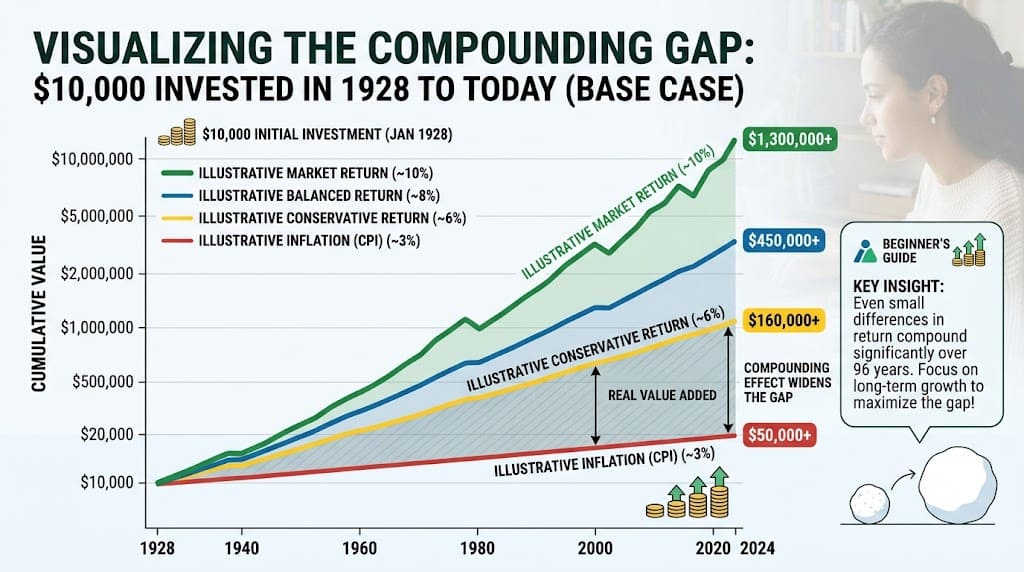
Notice the gap between stocks and cash compounds hugely over decades, which is the whole argument for owning stocks at all if your timeline is long. It’s also why an all-cash “portfolio” quietly loses ground to inflation over time, even though it feels the safest.
The mistake that trips up almost everyone
You will, at some point, check your portfolio during a rough week and feel a very strong urge to sell. This is normal. It’s also usually the wrong move.
The investors who do worst over time aren’t the ones who picked bad funds. They’re the ones who sold low during a scary month and bought back in later, after the recovery had already started. If you’ve picked a reasonable asset allocation for your actual timeline, the plan is boring on purpose: keep contributing, rebalance occasionally, and mostly leave it alone.
Rebalancing, in case the word is new to you, just means selling a bit of whatever’s grown to be an oversized slice of your portfolio and buying more of whatever’s shrunk, to get back to your original split. Once or twice a year is plenty. More than that and you’re just generating trading costs and second-guessing a plan that was probably fine.
Key Takeaways
- Your asset allocation, the stock-bond-cash split, matters more to your results than which specific fund or stock you pick.
- Index funds give beginners instant diversification in one purchase; individual stocks work better as a smaller add-on once you have a core in place, not as the whole portfolio.
- A common starting point is “110 minus your age” for a rough stock percentage, adjusted for how soon you’ll need the money.
- Historically, stocks have outperformed bonds and cash by a wide margin over long periods, but with far more short-term volatility.
- Check in on your allocation once or twice a year and rebalance if it’s drifted, rather than reacting to every market swing.
Frequently Asked Questions
What’s a good investment portfolio for a beginner? For most beginners, a simple two-or-three-fund mix works well: a broad U.S. stock index fund, a bond index fund, and optionally an international stock fund. The exact split depends on your timeline, but this core gets you diversified without needing to pick individual companies.
How do I start investing with little money? Most brokerages now let you buy fractional shares, so you can start with $25 or $50 in an index fund rather than needing hundreds of dollars for a full share. The habit of investing something regularly matters more early on than the exact starting amount.
Should I choose index funds or individual stocks first? Index funds first, for most people. They spread your risk across many companies automatically. Individual stocks can be a smaller, separate slice later, once you’ve built a diversified core and have time to actually research the companies you’re picking.
What does a balanced investment portfolio example look like? A common “balanced” example is 60% stocks and 40% bonds, roughly the blend in the table above. A 25-year-old investing for retirement might run heavier on stocks, while someone five years from retirement might flip that ratio toward bonds.
How often should I check or rebalance a new portfolio? Once or twice a year is enough for most people. Checking daily tends to trigger emotional decisions that hurt returns more than it helps.
If you’re investing through a systematic monthly plan, run your numbers through FinToku’s SIP Calculator to see how compounding shapes your contributions over time, alongside the return assumptions in the table above.
Read More
- Common Investing Terms Explained (So They Actually Stick)
- What Is a Fiduciary? Definition, Duties, and How to Spot One
- Financial Goals You Should Set Every Year
Disclaimer
This article is for informational purposes only and isn’t financial or investment advice. Historical returns don’t guarantee future performance, and all investing carries the risk of loss, including loss of principal. See our full Financial Disclaimer for more.
Published by Saad Faisal for FinToku (fintoku.com) · Published August 2, 2026 · Updated August 2, 2026 FinToku provides free finance tools and guides to help you make smarter money decisions.