

Roughly one in three new businesses with employees don’t make it past their second year, according to the Small Business Administration’s Office of Advocacy. That’s not meant to scare you off. It’s meant to explain why “just start” is bad advice, and why the businesses that survive tend to be the ones that got the boring stuff right early.
Here’s the step-by-step version: starting a small business in the US comes down to ten sequential steps, from validating your idea and choosing a legal structure, through registering, funding, and insuring it, to launching with a way to track what’s actually working. Do them roughly in that order and most of the paperwork problems that sink new businesses never show up.
I’ve watched enough first-time owners, and been one myself for a much smaller side project than I’d like to admit, skip straight to the fun part. Building the website and picking the Instagram handle happens fast because it’s enjoyable. The boring middle steps are what keep that fun part legal.
What You’ll Need Before You Start
You don’t need a lawyer on retainer or six figures in savings. A few things will make every step below faster, though:
- A business idea tested against real people who aren’t your friends or family (they’ll tell you it’s great no matter what)
- A Social Security number or ITIN, since you’ll need one to apply for an EIN
- A rough budget for your first three to six months, even napkin-math is fine
- An hour to look up your specific state and city’s requirements, since licensing rules genuinely differ by location
- A decision on which bank you’ll use once you’re registered
None of this needs to be perfect. It needs to exist.
The 10-Step Checklist to Start a Small Business
Here’s the full sequence at a glance. Each step gets its own section below.
- Validate your idea and do market research
- Write a lean business plan
- Choose a business structure
- Pick a business name
- Register your business and get an EIN
- Get the licenses and permits you actually need
- Open a business bank account and set up bookkeeping
- Fund your startup costs
- Get business insurance
- Launch, and track what’s working
1. Validate Your Idea and Do Your Market Research
Start by figuring out if anyone besides you wants what you’re selling. Market research means talking to potential customers, checking what competitors already charge, and being honest about whether there’s a real gap you can fill.
I’d rather see someone spend two weeks having ten real conversations with potential customers than two weeks building a perfect logo. The logo doesn’t tell you if people will pay. Ask what they currently do to solve the problem, what they’d pay for a better option, and where they’re already frustrated.
Free resources help here too. The Census Bureau publishes market data by industry and zip code, and the SBA offers free local mentoring through SCORE, usually paired with someone who’s already run a business like yours.
2. Write a Lean Business Plan
A business plan isn’t a 40-page document for a bank you’ll never show. For most new small businesses, one page covering your mission, target customer, pricing, and first-year costs does the job.
Answer four questions honestly: what are you selling, who’s buying it, how will they find you, and what does it cost you to deliver it. If you can’t answer all four in a paragraph each, that’s useful information. It means step 1 needs more work before you move on.
3. Choose a Business Structure
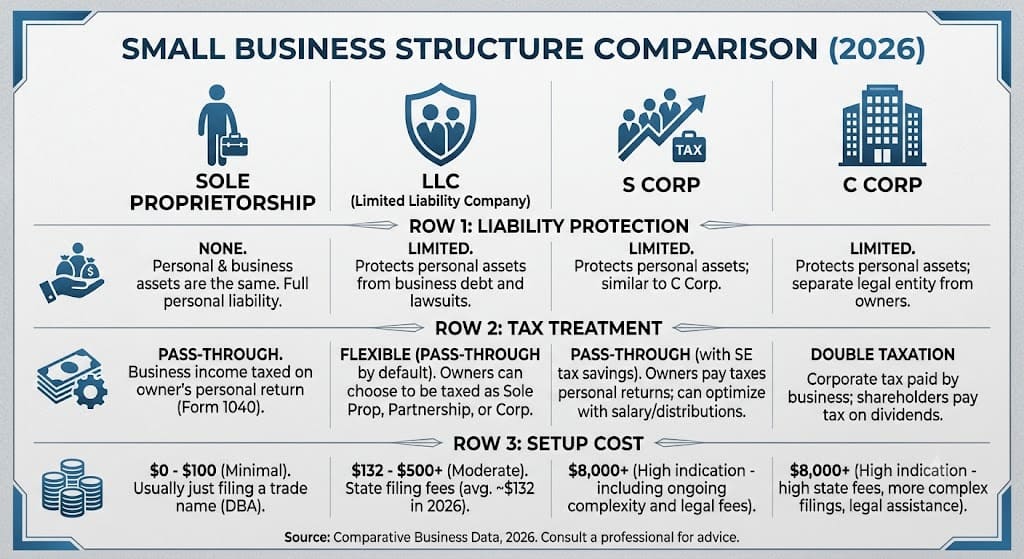
This decision shapes your taxes, your paperwork, and how exposed your personal assets are if something goes wrong. Most small businesses pick one of four structures: sole proprietorship, partnership, LLC, or corporation.
A sole proprietorship is the default if you file nothing at all. There’s no separate legal identity, so your personal assets are on the hook for business debts. An LLC (limited liability company) separates you from the business legally. One-time state filing fees range from $35 to $500 depending on where you live, though most states fall in the $50 to $200 band, and it’s what most owners with any real risk exposure end up choosing. Corporations, S corp or C corp, make more sense once you’re bringing on investors or trying to reduce self-employment tax on a growing profit, but they carry more paperwork than most first-year businesses need.
4. Pick a Business Name (and Confirm It’s Actually Available)
Your name needs to clear three checks, not just sound good: it can’t already be trademarked, it needs a domain and social handles you can realistically get, and it has to be available in your state’s business registry.
Search the USPTO trademark database before you fall in love with a name. I’ve seen people order signage before checking this step, which is exactly backward.
5. Register Your Business and Get an EIN
Once you’ve picked a structure and a name, register with your state, usually through the Secretary of State’s website, and apply for an Employer Identification Number from the IRS. It’s free, the online application takes about ten minutes, and you’ll need it to open a business bank account, hire anyone, or file most business tax forms.
Sole proprietors with no employees can technically use their Social Security number instead. Getting an EIN anyway keeps that number off business paperwork, which is worth the ten minutes on its own.
6. Get the Licenses and Permits You Actually Need
This is the step people either skip entirely or wildly overdo. What you need depends on your industry, city, county, and state, not a generic checklist. A home-based consulting business might need nothing beyond a general business license. A food business needs health permits, and considerably more paperwork.
Check your city or county clerk’s office and the SBA’s licensing and permits guidance directly, since requirements can genuinely change within a few miles in some metro areas. Skipping this step doesn’t save time. It just moves the paperwork to a worse moment, usually right after an inspector shows up.
7. Open a Business Bank Account and Set Up Basic Bookkeeping
Mixing personal and business money is the fastest way to make tax season miserable, and if you formed an LLC, it can quietly undermine the liability protection you paid for. Most banks ask for your EIN, formation paperwork, and a government ID to open a business account.
Set up simple bookkeeping from day one, even if it’s just a dedicated spreadsheet at first. You’ll thank yourself in April.
8. Fund Your Startup Costs
Startup costs vary enormously by business type. A service business run from a laptop might need a few hundred dollars. A retail storefront or restaurant can run into the tens of thousands before opening day.
Most small business owners lean on personal savings to get started, so you’re in good company if that’s the plan. Beyond savings, common options include SBA-backed loans through a local lender, small business grants tied to your industry or demographic, crowdfunding for consumer products, and, once you’re a few months in, a business line of credit. Whatever you use, build a simple budget first so you’re raising toward an actual number, not a guess.
9. Get Business Insurance
General liability insurance protects you if a customer sues over an injury or property damage, and it’s often required before you can sign a commercial lease. If you have employees, most states require workers’ compensation too. Depending on your industry, professional liability or cyber liability coverage might matter more than general liability does.
An independent insurance agent who works with small businesses can usually tell you in one call what you actually need, versus what a generic checklist claims every business needs.
10. Launch, and Set Up a Way to Track What’s Working
Launch day isn’t the finish line. It’s the point where you start collecting real data instead of guesses. Track a small number of things from day one: revenue, your top few expenses, and where your customers are actually coming from.
Revisit your one-page plan from step 2 every month for the first year. Whatever assumption turns out to be wrong the fastest is the one worth fixing first.
A Quick Worked Example
Say you’re starting a freelance graphic design business from home. A realistic first-90-day path looks like this: line up two or three paying clients before you quit your day job, form a single-member LLC in your home state (roughly $50 to $200 in filing fees for most states), apply for a free EIN online, open a business checking account, and check whether your city requires a general business license for home-based work (many don’t, but some do). Total cash outlay before your first invoice: usually under $500.
That’s a lot lighter than most people assume “starting a business” requires, which is exactly why “how to start a business without money” shows up so often in searches on this topic. Most service businesses genuinely can start on a few hundred dollars. Product and storefront businesses are a different story.
Small Business Snapshot: Key Numbers for 2026
| Metric | Figure | Source / As of |
|---|---|---|
| Small businesses in the US | 36.2 million (99.9% of all firms) | SBA Office of Advocacy, Feb 2026 |
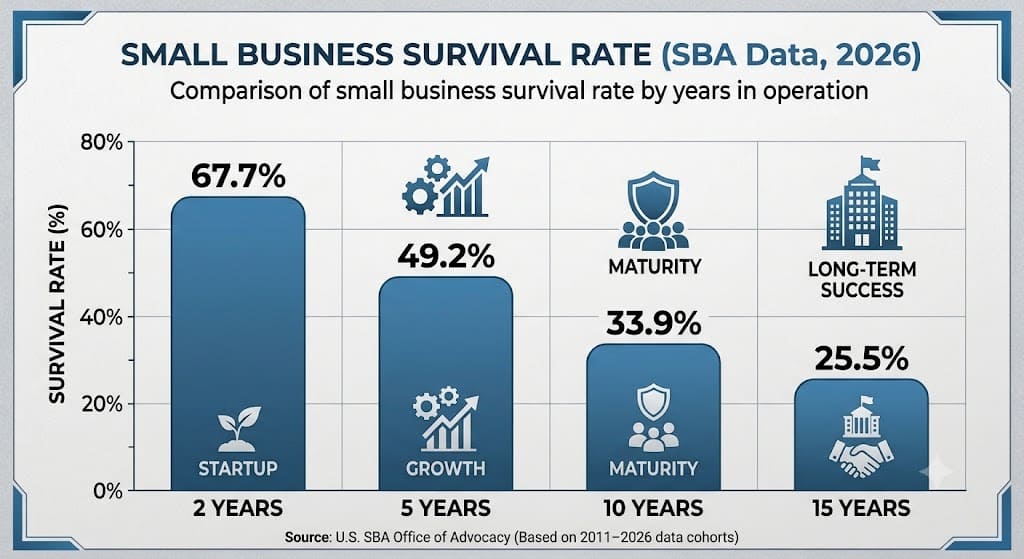
| New businesses surviving at least 2 years | 67.7% (1994-2022 average) | SBA Office of Advocacy, Feb 2026 |
| New businesses surviving 5 years | 49.2% | SBA Office of Advocacy, Feb 2026 |
| New businesses surviving 10 years | 33.9% | SBA Office of Advocacy, Feb 2026 |
| New businesses surviving 15 years | 25.5% | SBA Office of Advocacy, Feb 2026 |
| Most common structure for new nonemployer businesses | Sole proprietorship (86.7%) | SBA Office of Advocacy, Feb 2026 |
| Most common structure once a business hires employees | S corporation (55.0% of small employers) | SBA Office of Advocacy, Feb 2026 |
| LLC state filing fee range | $35-$500, most states $50-$200 | State filing fee data, 2026 |
| EIN application cost | $0, direct through IRS | IRS.gov |
Business-count and survival figures come directly from the SBA Office of Advocacy’s February 2026 report. The LLC filing-fee range is compiled from multiple state filing-fee trackers rather than a single government dataset, since no federal source publishes one aggregate figure; it’s a reliable ballpark but worth confirming against your own state’s Secretary of State site.
Common Mistakes That Slow People Down
- Registering before validating. Filing LLC paperwork for an idea nobody’s confirmed they’ll pay for just adds a bill to an unanswered question.
- Skipping the EIN because it “seems optional.” It’s free and takes ten minutes. There’s no good reason to put your Social Security number on business paperwork instead.
- Guessing at licenses instead of calling the city. A five-minute call to your county clerk’s office beats an afternoon of forum posts.
- Mixing personal and business bank accounts. This causes real damage at tax time, and it can weaken your LLC’s liability protection if it’s ever tested.
Key Takeaways
- Starting a small business follows a predictable sequence: validate the idea, plan, pick a structure, register, get licensed, bank, fund, insure, then launch.
- An LLC’s one-time state filing fee ranges from $35 to $500, most commonly $50 to $200, and separates personal assets from business liability, which is why it’s the default choice for owners with real risk exposure.
- An EIN from the IRS is free and takes about ten minutes online, whether or not you have employees yet.
- About two out of three new employer businesses in the US survive at least two years, and the ones that don’t usually fail on funding or planning, not on the idea itself.
- Most home-based or service businesses can realistically start for a few hundred dollars, not the thousands many people assume.
Frequently Asked Questions
How do I start a small business for beginners?
Start with market research to confirm people will pay for what you’re offering, then write a one-page business plan, choose a legal structure (an LLC is the most common pick for new owners), register with your state, get a free EIN from the IRS, and open a business bank account before spending on anything else.
Do I need an LLC to start a business?
No. You can legally operate as a sole proprietor with no formal filing at all. An LLC isn’t required, but it separates your personal assets from business debts and lawsuits, which is why most owners choose one once real money or risk is involved.
What’s the easiest small business to start?
Service-based businesses you can run from a laptop, like consulting, freelance writing, virtual assistance, or design work, tend to be easiest to start since they need minimal upfront investment and no inventory or physical location.
Can I start a business with no money?
You can start many service businesses with very little money, since the main costs are usually a state filing fee and tools you probably already own. A completely free start is rare, but a few hundred dollars covers most home-based or freelance businesses.
How much does it cost to start a small business?
It depends heavily on the type of business. A home-based service business can start for a few hundred dollars in filing fees and basic tools. A retail storefront commonly starts around $20,000 for a lean setup and climbs from there with inventory and buildout, while a full-service restaurant typically needs anywhere from the low six figures upward once you factor in lease deposits, kitchen equipment, and permits. The numbers vary a lot by concept and location, which is exactly why the SBA publishes a free startup costs worksheet instead of a single figure. Fill it in with your own lease quotes and supplier costs rather than relying on a generic range like the one above.
Once you’re registered and thinking about what you’ll actually owe, FinToku’s US Business Federal Income Tax Calculator can give you a realistic estimate before your first quarterly payment catches you off guard.
Read More
- Tax Deductions for Self-Employed Workers (2026 List)
- Home Office Tax Deduction Rules: Who Actually Qualifies in 2026
- Best Tax Deductions for Freelancers in 2026 (Full List + Worksheet)
Disclaimer
This article is for general informational purposes only and shouldn’t be taken as financial, tax, or legal advice. The filing fees, timelines, and figures above are illustrative and current as of this writing, but requirements change by state and industry. Before registering a business or committing money, it’s worth checking with a licensed attorney, accountant, or your state’s Secretary of State office for your specific situation. You can read FinToku’s full Financial Disclaimer for more.
Published by Saad Faisal for FinToku (fintoku.com) · Published July 25, 2026 · Updated July 25, 2026 FinToku provides free finance tools and guides to help you make smarter money decisions.