

Your savings account balance went up this year. Check what that balance actually buys against a year-ago receipt for the same cart of groceries, and the picture flips. Inflation doesn’t touch the number in your account. It touches what the number is worth, and for most savers earning less than the inflation rate, that means losing ground every single month even while the balance climbs.
What Inflation Actually Is
Inflation is the rate at which prices for everyday goods and services rise over time, measured in the US through the Consumer Price Index (CPI). When inflation runs at 3%, something that cost $100 last year costs about $103 this year. Your money hasn’t changed. What it can buy has.
How Inflation Shrinks a Savings Account You Never Touched
This is the part that trips people up: you don’t have to withdraw a cent for inflation to cost you money. Say your bank pays 1.5% interest and inflation is running at 3.5%. Your balance grows by 1.5% in dollar terms, but your real return, the return after inflation, is negative 2%. You’re richer on paper and poorer in what that paper can actually buy.
Economists call this the difference between the nominal rate (the number on your statement) and the real rate (what you actually gained or lost in purchasing power). The nominal rate is what your bank advertises. The real rate is the one that matters, and it’s just the nominal rate minus inflation.
I ran this through FinToku’s own Budget Planner for a hypothetical $10,000 sitting in a traditional savings account paying 0.38%, the national average APY the FDIC reports as of July 2026, and most of the big brick-and-mortar banks pay even less than that. At 3.5% inflation, that money is worth roughly $9,690 in real terms after just one year. Nothing was spent. It just lost ground.
Where US Inflation Actually Stands Right Now
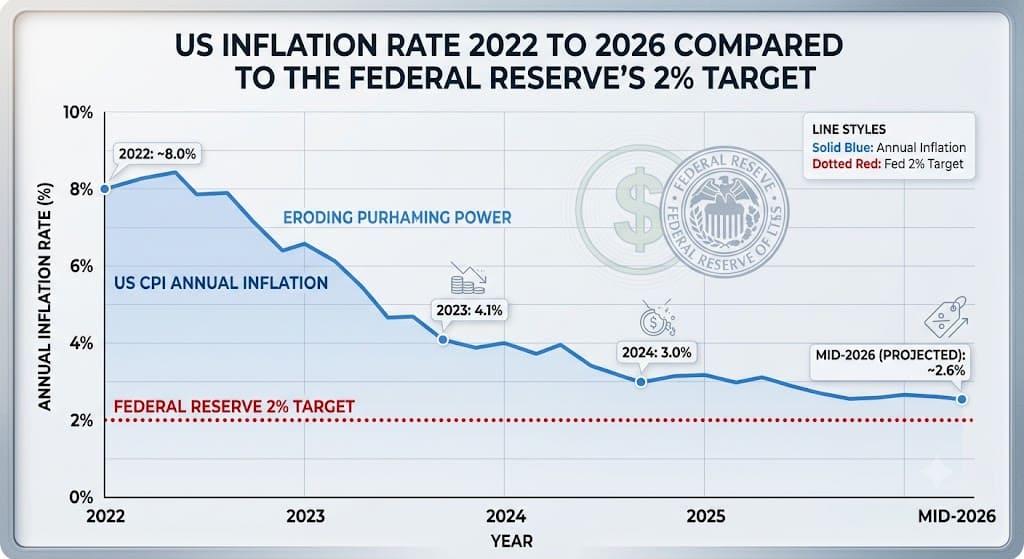
Here’s the current picture, since “inflation is high” means something different depending on which year you’re reading this in.
| Measure | Figure | As of | Source |
|---|---|---|---|
| US annual inflation rate (CPI-U) | 3.5% | 12 months ending June 2026 | U.S. Bureau of Labor Statistics, released July 14, 2026 |
| Core inflation (excludes food & energy) | 2.6% | June 2026 | U.S. Bureau of Labor Statistics |
| Calendar-year 2025 inflation | 2.7% | Full year | U.S. Bureau of Labor Statistics |
| Post-pandemic peak | ~9.1% | June 2022 | U.S. Bureau of Labor Statistics |
| Federal Reserve’s long-term inflation target | 2% | Standing policy | Federal Reserve |
| Fed funds target range (the rate that indirectly drives savings/CD rates) | 3.50%-3.75%, unchanged since March 2026 | Through the June 17, 2026 meeting | Federal Reserve |
So current inflation sits above the Fed’s 2% target but well off the 2022 peak. That still matters for savers, because even 3.5% is higher than what most traditional savings accounts pay.
Not Every Saver Feels This the Same Way
Inflation isn’t evenly distributed. Someone on a fixed income, a pension, an annuity, a bond ladder that pays the same dollar amount every month, gets hit harder than someone whose paycheck rises with inflation. Wages tend to catch up with prices eventually, at least partially. A fixed payment never does. If you’re living on a set monthly amount, every year of 3%+ inflation quietly shrinks what that check covers, with no adjustment coming unless the payment itself is explicitly inflation-indexed (Social Security is one of the few that is, through its annual cost-of-living adjustment).
This is also why retirees and near-retirees tend to worry about inflation more acutely than someone in their 20s still building an income. It’s not paranoia. The math is genuinely different for a fixed income.
The Savings Accounts That Actually Keep Pace
Not all savings accounts respond to inflation the same way, and this is where a lot of the confusion in competitor guides on this topic comes from. Here’s how the main options actually stack up.
| Account type | Typical rate right now | As of | Keeps pace with 3.5% inflation? | Trade-off |
|---|---|---|---|---|
| Traditional savings account | 0.38% national average | July 2026, FDIC | No, by a wide margin | Easiest access, FDIC insured |
| High-yield savings account | Up to 4.5% APY at top online banks | July 23, 2026, Curinos data via Fortune | Close to even, sometimes ahead | Online-only for most, rate can drop with Fed cuts |
| Money market account | Roughly 3.5%-4.2% APY at top accounts | July 2026 | Close to even | Often has check-writing, may need higher minimum balance |
| 1-year certificate of deposit (CD) | 2.01% national average, up to 4.30% at top banks | July 23, 2026, Bankrate/NerdWallet | Yes, at top rates; no, at the average | Early withdrawal penalty, rate locked even if inflation rises further |
| Series I Savings Bond (I Bond) | 4.26% composite rate | Bonds issued May 1-Oct 31, 2026, TreasuryDirect | Yes, by design (it’s inflation-indexed) | 1-year minimum hold, 3-month interest penalty if redeemed before 5 years |
The Real Gap in Dollars
The gap between the average traditional savings account and a top high-yield one isn’t small. On $10,000, the difference between 0.38% and 4.5% APY is over $400 a year in interest you’re simply leaving on the table by not moving the money. I plugged a few term lengths into FinToku’s CD Calculator while writing this, and a 1-year CD at 4.15%, close to what Bankrate lists as the top rate right now, turns $10,000 into $10,415 before tax, which actually beats the current 3.5% inflation rate by a small but real margin.
The Catch With Locking In a Rate
CDs come with a catch worth naming honestly: you lock in the rate the day you open the account. The Fed has held its benchmark rate steady at 3.50%-3.75% through four straight meetings in 2026, but if that changes and inflation climbs faster than expected, you’re stuck earning a fixed rate until the CD term ends, with an early withdrawal penalty if you bail. That’s the trade you’re making for the guaranteed rate.
If you want to compare a couple of CD terms against each other before committing, our CD Laddering Strategy guide walks through spreading money across multiple terms so you’re not locked into one rate for years at a time.
When It Makes More Sense to Invest Than Just Save
For money you won’t need for five years or more, the math usually favors investing over parking cash, even with the extra risk. Stocks and real estate have historically outpaced inflation over long stretches, precisely because companies raise prices (and often profits) along with the general price level, and property owners tend to raise rent in step with inflation too.
That’s not true of every year, and it’s not a guarantee. Diversifying, spreading money across stocks, bonds, and maybe some inflation-protected assets, is less about beating inflation every single year and more about not having all your money exposed to the years it doesn’t.
The honest framing here is about time horizon, not risk tolerance alone. Money you need within a year or two belongs in cash or a short-term CD, inflation risk or not, because market drops don’t wait for your timeline. Money you won’t touch for a decade can afford to ride out a bad year or two in exchange for a real shot at outpacing inflation.
Credit Card Debt Gets More Expensive Too
It’s easy to focus only on the savings side and miss that inflation pushes credit card APRs up as well, since card rates are tied to the same benchmark rates the Fed uses to fight inflation. If you’re carrying a balance, that’s a second, quieter cost showing up at the same time your savings are losing ground. Paying down high-interest debt often earns a better guaranteed “return” than almost any savings account will during an inflationary stretch.
Key Takeaways
- Inflation reduces what your savings can buy even if the account balance keeps growing, because what matters is the real return (interest rate minus inflation), not the nominal one.
- US annual inflation was 3.5% for the 12 months ending June 2026, according to the Bureau of Labor Statistics, above the Federal Reserve’s 2% long-term target.
- Traditional savings accounts (0.38% national average, per the FDIC) lose real value fastest; top high-yield savings accounts, money market accounts, and CDs paying 4%+ can come close to or beat current inflation, and I Bonds are indexed to inflation by design.
- Fixed incomes (pensions, annuities, most private bond payments) lose more purchasing power to inflation than wages, which tend to adjust upward over time.
- For money you won’t need for five-plus years, diversifying into stocks or real estate has historically outpaced inflation better than cash, though with more year-to-year risk.
Frequently Asked Questions
What happens to savings when inflation is high?
The dollar amount in the account keeps growing from interest, but its real value, what it can actually purchase, shrinks whenever the interest rate earned is lower than the inflation rate. High inflation just makes that gap wider and the loss more noticeable.
How can I beat inflation with savings alone?
Move cash out of accounts paying under 1% and into a high-yield savings account, money market account, or CD paying at or above the current inflation rate. As of July 2026, top high-yield accounts pay up to about 4.5% APY and top 1-year CDs pay up to about 4.3%, both comfortably above the 3.5% inflation rate, though the average saver earning closer to the 0.38% national average is still losing ground. It won’t guarantee you beat inflation every month, but moving out of a near-zero account closes most of the gap.
What is the relationship between inflation and interest rates?
The Federal Reserve raises interest rates to slow inflation down and lowers them to encourage borrowing and spending when inflation is low. That’s also why savings account rates and CD rates tend to rise when inflation is high. Banks are competing for deposits in the same rate environment the Fed is steering.
Why does inflation affect people with fixed incomes differently?
A fixed income, like a pension or an annuity, pays the same dollar amount regardless of what’s happening to prices. Wages usually get raises over time that at least partially track inflation. A fixed payment doesn’t adjust unless it’s explicitly indexed to inflation, so every year of price increases quietly reduces what that same payment can buy.
What percentage of Americans have $20,000 in their bank account?
There’s no single official government count of exactly that threshold, but the Federal Reserve’s Survey of Consumer Finances puts the median American household’s transaction-account balance (checking, savings, and money market combined) at around $8,000, with an average closer to $62,000 skewed upward by higher-income households. Separate consumer surveys have put the share of adults with $20,000 or more in liquid savings at under 4 in 10, which lines up with how uneven savings are by age and income.
If you’re building toward a number like that, running your own timeline through FinToku’s Sinking Fund vs. Emergency Fund guide is a reasonable next step, since it breaks down which kind of account that money should actually sit in.
Run your own numbers through FinToku’s CD Calculator to see what a specific balance would actually earn at today’s rates before you decide where to move it.
Read More
- Sinking Fund vs. Emergency Fund: Which One Do You Actually Need?
- High-Yield Savings Account vs CD: Which Wins in 2026?
- Lifestyle Inflation: How Your Wants Quietly Become “Needs”
Disclaimer
This article is for general informational purposes only and shouldn’t be taken as financial or tax advice. The rates above (savings, CD, and I Bond figures) were accurate as of the third week of July 2026, but they shift with every Fed decision and bank rate change, sometimes within days. Before moving money based on anything here, check current rates directly with your bank or on TreasuryDirect.gov, and for larger decisions, talk to a qualified financial advisor who can look at your specific situation. You can also read FinToku’s full Financial Disclaimer.
Published by Saad Faisal for FinToku (fintoku.com) · Published July 24, 2026 · Updated July 24, 2026 FinToku provides free finance tools and guides to help you make smarter money decisions.