

Here’s the direct answer if you’re weighing whether to buy Ethereum right now, or you already own some and want to know what you owe the IRS. Ethereum is trading around $1,823 as of July 18, 2026, well off its all-time high near $4,954 from August 2025. Every single sale, swap, or staking reward you touch is also a taxable event under current IRS rules. Whether that combination makes it a good investment depends entirely on your time horizon and your appetite for volatility, not on anything a headline can tell you.
What Ethereum actually is (in plain English)
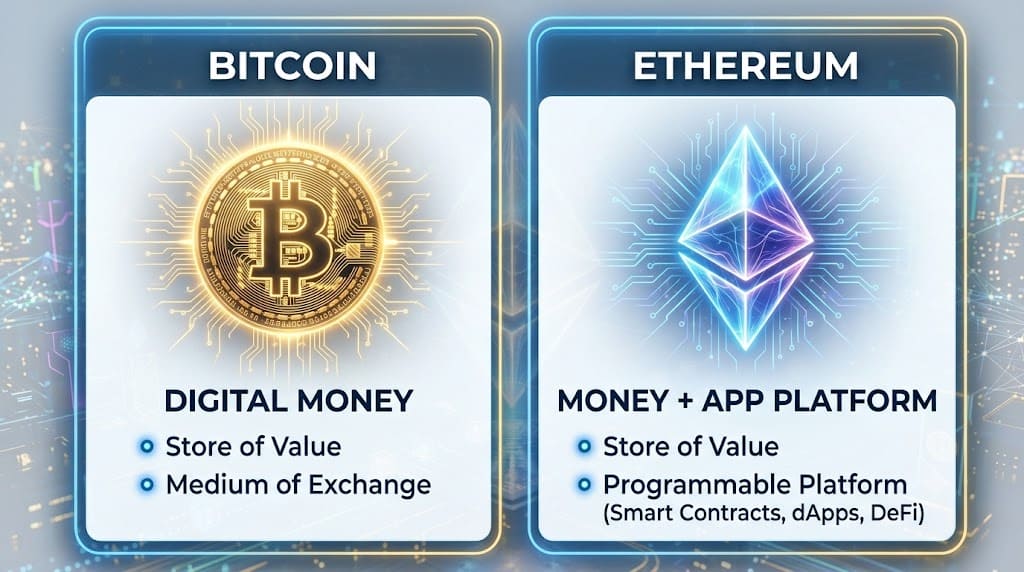
Ethereum isn’t just “another cryptocurrency” sitting next to Bitcoin. Bitcoin is mostly digital money. Ethereum is a decentralized computing platform: developers build apps directly on its blockchain network instead of renting server space from Amazon or Google, and those apps handle lending, trading, and borrowing without a bank in the middle.
The coin itself, ETH, is what pays for that computing power (called “gas”) and what you can lock up (“stake”) to help secure the network in exchange for yield. That dual role, currency plus infrastructure, is why analysts increasingly describe ETH as a “triple point” asset: part capital asset through staking, part consumable asset through gas fees, and part store of value through its built-in scarcity mechanics.
Ethereum price snapshot (as of July 2026)
| Metric | Figure | As of |
|---|---|---|
| ETH price | ~$1,823 | July 18, 2026 |
| Market capitalization | ~$220 billion | July 18, 2026 |
| Rank by market cap | #2, behind Bitcoin | July 2026 |
| All-time high | ~$4,954 | August 2025 |
| Share of DeFi total value locked | Over 67% | Mid-2026 |
Sources: Bybit’s live Ethereum market data and Fortune’s daily Ethereum price tracker. Crypto prices move by the minute, so treat this row as a same-day snapshot, not a current quote, and check a live exchange before you act on it.
That roughly 63% gap between the current price and the August 2025 peak is the whole story of why Ethereum feels like a different asset depending on when you bought in. Someone who bought at $4,900 is underwater. Someone who bought two years ago is still up.
Should you buy Ethereum directly, or through an ETF?
You’ve got two realistic paths into Ethereum as a US investor, and they suit different people.
Buying ETH directly on a crypto exchange gives you full ownership, the ability to stake it yourself for roughly 3% to 5% APY, and access to the wider DeFi ecosystem. It also means you’re responsible for securing your own wallet and tracking every transaction for tax purposes, which is more work than most people expect going in.
Spot Ethereum ETFs, now offered by firms including BlackRock (iShares) and Fidelity, hand you exposure through a normal brokerage account. Your broker sends you a 1099-B like any other investment, which makes tax season dramatically simpler. Some 2026 ETF versions even pass through a portion of the native staking yield to shareholders. The tradeoffs: management fees running roughly 0.15% to 0.25% a year, and you don’t get direct access to DeFi or self-custody.
I’d lean ETF if tax-season simplicity matters more to you than yield optimization. I’d lean direct ownership if you actually plan to use the DeFi ecosystem, not just hold and hope.
| Direct ETH ownership | Spot Ethereum ETF | |
|---|---|---|
| Tax reporting | You track every transaction yourself | Broker sends 1099-B |
| Staking access | Yes, full 3-5% APY, self-managed | Only on staking-enabled ETF versions, yield passed through |
| Annual fees | Network gas fees only | ~0.15%-0.25% management fee |
| DeFi/Web3 access | Full access | None |
| Custody | You control the private keys | Broker holds the shares |
What’s actually driving Ethereum in 2026
A few concrete developments explain why institutional money keeps showing up even with the price well below its 2025 peak:
- The Pectra upgrade raised the maximum effective balance for validators from 32 ETH to 2,048 ETH, which let large banks and hedge funds consolidate staking operations instead of running thousands of small validator nodes. That’s a big reason staking now gets pitched to institutions as something closer to a high-yield digital bond.
- Staking yield currently runs roughly 3.5% to 5% APY, on top of whatever price appreciation happens, which is the part that’s shifted Ethereum’s pitch from pure speculation toward something closer to a yield-bearing asset.
- Analyst price targets for 2026 span a wide range: Citi’s cautious call sits around $3,175, while Standard Chartered’s bullish target reaches $7,500, with some long-term models projecting $15,000 to $25,000 by 2027-2030. That spread alone tells you how much disagreement still exists among people paid to have an opinion on this.
Read that last point again before you get too attached to any single number. When professional analysts are $4,000 apart on where an asset lands within the same year, that’s not a rounding error. That’s a sign nobody actually knows, and you should size your position accordingly.
How the IRS taxes Ethereum (this is the part people get wrong)
Here’s where I got burned that first year, and where I see the most confusion from readers. The IRS does not treat crypto as currency. Under Notice 2014-21, Ethereum is property, the same tax category as a stock or a rental house. That single classification triggers almost every rule below.
What counts as a taxable event
Selling ETH for dollars, trading ETH for another coin, or spending it on goods and services all count as a “disposal” in the IRS’s eyes. Swapping Bitcoin for Ethereum feels like a wash if you never touch a bank account. But the IRS Chief Counsel has specifically confirmed that crypto-to-crypto trades are taxable. The like-kind exchange rules that apply to real estate don’t apply to digital assets.
Your holding period sets your rate. Hold ETH for one year or less before selling, and you pay ordinary income tax rates on any gain, up to 37% depending on your bracket. Hold it more than a year, and it qualifies for long-term capital gains rates instead: for 2026, single filers pay 0% on taxable income up to $49,450, 15% up to $545,500, and 20% above that (per IRS Revenue Procedure 2025-32; married filing jointly the 0% band runs up to $98,900). A separate 3.8% Net Investment Income Tax can also apply on top of that rate if your income is high enough.
Staking rewards and the new 2026 reporting rules
Staking rewards work differently. You owe ordinary income tax on their fair market value the moment you receive them. That value then becomes your cost basis, so when you eventually sell those reward coins, you calculate a separate capital gain or loss from that new basis.
Reporting is also getting stricter, not looser. Starting in 2026, centralized exchanges have to report customer transactions to the IRS on Form 1099-DA, the same way a brokerage reports stock trades. Cost-basis reporting for 2026 sales kicks in when 2027 returns get filed. A mismatch between your return and what your exchange reported can trigger an automatic notice. The days of the IRS simply not knowing about your crypto activity are over.
None of this is optional guidance you can quietly skip. If you’ve been trading ETH for a few years and haven’t been tracking cost basis on every trade, it’s worth talking to a tax professional before you file, not after you get a letter.
Key Takeaways
- Ethereum traded around $1,823 on July 18, 2026, roughly 63% below its August 2025 all-time high near $4,954, and remains the second-largest cryptocurrency by market cap.
- The IRS taxes Ethereum as property: every sale, crypto-to-crypto trade, or purchase with ETH is a taxable event, and staking rewards count as ordinary income the moment you receive them.
- Long-term capital gains rates apply only if you hold ETH for more than one year: 0%, 15%, or 20% depending on income (per IRS Revenue Procedure 2025-32 for 2026), versus ordinary income rates up to 37% for shorter holds.
- Spot Ethereum ETFs from providers like BlackRock and Fidelity simplify tax reporting with a standard 1099-B, but charge roughly 0.15% to 0.25% in annual fees and don’t offer DeFi access.
- Starting in 2026, exchanges report your transactions directly to the IRS on Form 1099-DA, so unreported crypto activity is far more likely to get flagged than it used to be.
Frequently Asked Questions
Is Ethereum a good investment in 2026?
It depends on your time horizon. Ethereum’s price sits well below its 2025 peak. Analyst 2026 targets range from roughly $3,175 to $7,500, which shows genuine disagreement even among professionals. It’s best suited to investors who can handle real volatility and don’t need the money in the short term.
Is Ethereum better than Bitcoin?
They’re not really competing for the same job. Bitcoin functions mainly as a store of value, while Ethereum is a computing platform that also happens to have a valuable native coin. Many investors hold both rather than choosing one over the other.
How do I buy Ethereum in the US?
You can buy ETH directly on a cryptocurrency exchange with a US-linked bank account, or get exposure through a spot Ethereum ETF in a normal brokerage account. Most exchanges support fractional purchases, so you don’t need a full ETH to start.
Is staking Ethereum taxable?
Yes. The IRS taxes staking rewards as ordinary income, based on their fair market value the moment you receive them. That’s separate from any later capital gain or loss when you sell those coins.
Do I owe tax if I trade Ethereum for another cryptocurrency?
Yes. The IRS treats a crypto-to-crypto trade as a sale of the first asset at its dollar value on the trade date. That makes it a taxable event even if you never convert to cash.
What is a spot Ethereum ETF?
It’s a fund that holds actual ETH and trades on a stock exchange, giving you price exposure through a normal brokerage account without managing a crypto wallet yourself. Some versions also pass through a portion of staking yield.
If you’re still deciding whether Ethereum fits your portfolio, it’s worth sitting with the price and tax sections above for a day before you act. Neither the volatility nor the IRS paperwork goes away just because the decision feels urgent.
Disclaimer
This article is for general informational purposes only and isn’t financial, investment, or tax advice. Cryptocurrency is volatile and speculative, and tax rules for digital assets change frequently. Talk to a licensed financial advisor or tax professional about your specific situation before buying, selling, or reporting Ethereum. See FinToku’s full Financial Disclaimer for more.
Read More on FinToku
More investing and markets coverage:
- Nasdaq, S&P 500 Outlook: Can Tech Hold Up in a Hot Macro Week?
- Why US-Iran Tensions Are Rattling Stocks, Chips, and Oil Right Now
- TSMC to Invest Another $100 Billion in the US as Q2 Profit Blows Past Forecasts
- Can I Retire With $1 Million? Here’s How to Check Your Own Number
- Browse all FinToku blog posts
Free tools to plan around your investing:
- Budget Planner & 50/30/20 Calculator
- Paycheck Calculator
- US Business Federal Income Tax Calculator
- Browse all FinToku tools
Published by Saad Faisal for FinToku (fintoku.com) · Published July 18, 2026 FinToku publishes free, no-signup finance calculators and practical money guidance to help you make smarter decisions with your money.