

So, can you retire with $1 million? For most people, yes, but how comfortably depends on your withdrawal rate, your age at retirement, and how much Social Security fills the gap. A $1 million portfolio using the standard 4% withdrawal rule generates about $40,000 a year before taxes. Add an average Social Security check and a lot of retirees land somewhere between $60,000 and $70,000 a year combined, enough for a modest, secure retirement in most parts of the country, tighter in a handful of expensive metro areas.
The quick math: what $1 million actually pays you
Start with the number everyone in retirement planning reaches for: the 4% rule. Withdraw 4% of your portfolio in year one, adjust that dollar amount for inflation every year after, and historically your money has a good shot at lasting 30 years.
On $1 million, that’s $40,000 in year one, or about $3,333 a month. Not nothing. Not a lot on its own, either.
Here’s where it gets more real. Layer in Social Security, and the picture changes fast.
| Retirement age | 4% withdrawal (monthly) | Avg. Social Security (monthly) | Combined monthly income |
|---|---|---|---|
| 62 (early claim) | $3,333 | ~$1,575* | ~$4,908 |
| 67 (full retirement age) | $3,333 | ~$2,071* | ~$5,404 |
| 70 (delayed claim) | $3,333 | ~$2,600* | ~$5,933 |
*Social Security figures are illustrative averages based on typical benefit ranges. Your own benefit depends on your earnings history. Check your actual estimate at ssa.gov before planning around any number here.
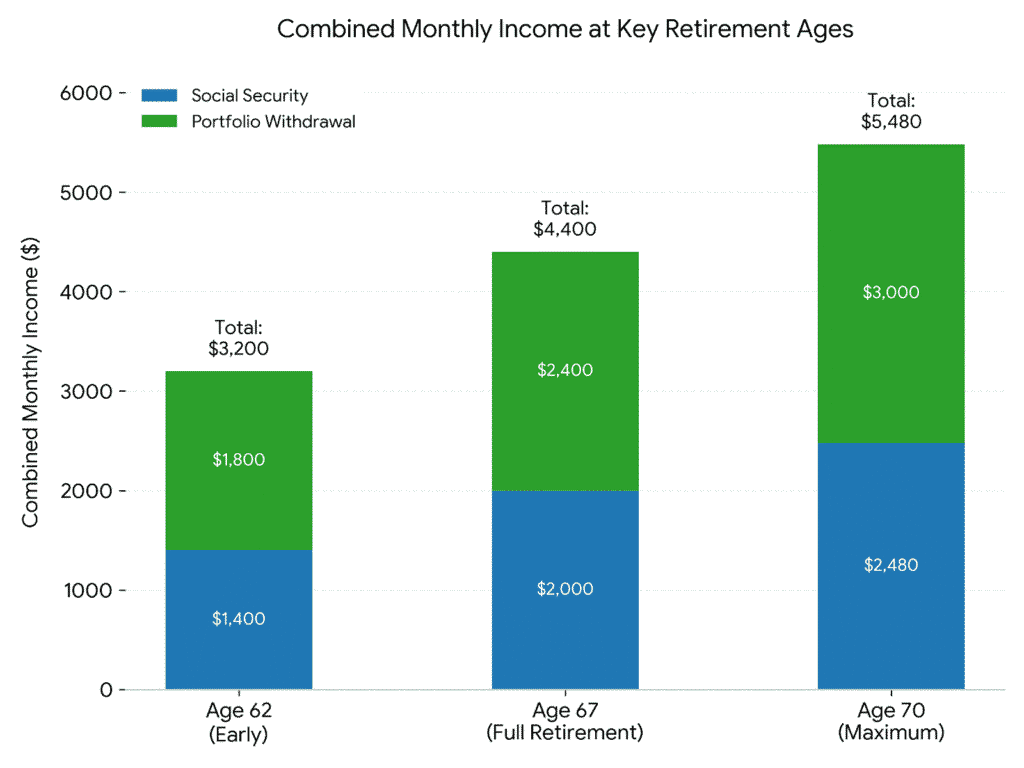
I’ll be honest, when I first ran a version of this table for myself, the “combined” column was the one that changed my mind. $40,000 a year alone sounded thin. $65,000 with Social Security in the mix sounded like an actual retirement.
Is $1 million actually enough, or is that outdated advice?
It depends less on the million and more on what you spend. The average American age 65 and older spends around $55,000 a year, according to Bureau of Labor Statistics data. If that’s roughly your number, $1 million plus Social Security likely covers it. If your target retirement budget runs $90,000 or more, $1 million alone probably falls short without a pension or other income.
A few things push the answer in either direction:
Retirement age. Retire at 55 and your money needs to stretch 35-40 years. Retire at 67 and it only needs to cover 20-25. That’s the single biggest lever most people underweight.
Where you live. $1 million goes a lot further in a lower cost-of-living state than in a major coastal metro. Housing alone can swing your annual budget by tens of thousands of dollars.
Health care before Medicare. If you retire before 65, you’re paying for private insurance out of pocket, and that’s a real dent, often $10,000+ a year for a couple. Once Medicare kicks in, the math gets friendlier, though premiums, copays, and any long-term care needs still count.
Whether $1 million is invested or just sitting in cash. A million dollars parked in a savings account loses ground to inflation every year. The same million, reasonably diversified across stocks and bonds, has a real shot at growing while you draw it down. That’s a big part of why the 4% rule assumes an invested portfolio, not a bank balance.
How to check your own number in 4 steps
Skip the generic rule of thumb and actually work this out for your situation. It takes ten minutes with a calculator.
1. Estimate your annual retirement spending. Not your current income, your actual expected spending. Housing, food, insurance, travel, the works. Building a range (low, expected, high) beats a single guess.
2. Subtract your guaranteed income. Social Security, any pension, rental income, whatever shows up whether the market cooperates or not. Say you need $60,000 a year and Social Security covers $28,000. Your portfolio only has to supply $32,000.
3. Divide that gap by your savings. $32,000 ÷ $1,000,000 = a 3.2% withdrawal rate. That’s comfortably inside the 4% guideline, which is a good sign. If your required rate comes out closer to 6% or 7%, that’s a flag that either the spending, the retirement age, or the savings goal needs adjusting.
4. Stress-test it against a bad decade. Markets don’t move in a straight line. If you retire right before a downturn, a rigid 4% withdrawal can drain a portfolio faster than the historical average suggests. Running a couple of “what if returns are lower for the first five years” scenarios, even roughly, beats assuming the average always shows up on schedule.
[GRAPHIC: A simple 4-step numbered flow diagram (Estimate spending → Subtract guaranteed income → Divide gap by savings → Stress-test) that a reader could screenshot as a quick worksheet]
What if $1 million falls short for your plan?
If step 3 above puts you well above a 4% withdrawal rate, you’ve got more levers than you might think, and you don’t need to pull all of them:
- Work two or three more years. Every year you delay both grows the portfolio and shrinks the number of years it has to cover.
- Delay Social Security. Waiting from 62 to 70 can boost your monthly benefit by roughly 75% over claiming early, one of the few guaranteed “raises” available in retirement planning.
- Trim the big-ticket expense first. Housing is usually the largest line item. Downsizing or relocating to a lower cost-of-living area often moves the needle more than cutting smaller discretionary spending.
- Add guaranteed income for the essentials. Some retirees use part of their savings to cover baseline expenses through an annuity or similar guaranteed income, keeping the rest invested for growth and flexibility.
None of these require abandoning the plan. They’re adjustments, not admissions that $1 million “isn’t enough.”
[GRAPHIC: Before/after style visual showing how delaying retirement from 62 to 67 to 70 shifts the required withdrawal rate down, paired with the growing Social Security benefit from the earlier table]
Key Takeaways
- A $1 million portfolio using the 4% rule generates about $40,000 a year before taxes, or roughly $3,333 a month.
- Combined with an average Social Security benefit, most retirees land somewhere between $60,000 and $70,000 a year in total income.
- Retirement age matters more than the dollar figure alone. Retiring at 55 requires stretching savings across 35-40 years, while retiring at 67 cuts that to 20-25.
- Whether $1 million is “enough” depends on your actual spending, not a generic benchmark. The BLS average for retirees 65+ is about $55,000 a year.
- If your required withdrawal rate comes out above 4-5%, working longer, delaying Social Security, or cutting housing costs are the highest-impact fixes.
Frequently Asked Questions
Can I retire at 55 with $1 million? It’s possible, but tighter than retiring later. A 35-40 year retirement horizon means a lower sustainable withdrawal rate, often closer to 3-3.5% instead of 4%, and you’ll need to cover private health insurance until Medicare eligibility at 65.
Can I retire at 65 with $1 million? For most people, yes. At 65 you’re eligible for Medicare and can claim near-full Social Security, which removes two of the biggest cost uncertainties earlier retirees face, and your money only needs to cover roughly 20-25 years.
How much monthly income does $1 million generate in retirement? Using the 4% rule, about $3,333 a month before taxes and before Social Security. Combined with an average Social Security benefit, total monthly income for many retirees falls between $4,900 and $5,900, depending on claiming age.
Is $1 million enough for a couple to retire? It can be, especially with two Social Security benefits supplementing the portfolio. The math works the same way: estimate combined spending, subtract combined guaranteed income, and check whether the remaining gap keeps your withdrawal rate near 4% or lower.
What is the 4% rule? It’s a withdrawal guideline suggesting you can withdraw 4% of your retirement portfolio in your first year, then adjust that dollar amount for inflation each year after, with a historically low risk of running out of money over a 30-year retirement. It’s a starting point, not a guarantee. It doesn’t account for taxes, fees, or unusually poor early returns.
How long will $1 million last in retirement? At a 4% withdrawal rate, historically around 30 years. At a more conservative 3% rate, it can stretch further, which is why many early retirees planning for 35-40+ years choose a lower initial withdrawal.
If you’re weighing your own numbers against these, running a full retirement projection with a fee-only financial advisor can catch details a general rule of thumb can’t, particularly around taxes and required minimum distributions.
Disclaimer
This article is for general informational purposes only and shouldn’t be taken as financial, tax, or legal advice. Everyone’s situation is different. The withdrawal rates, Social Security estimates, and spending figures I’ve used here are illustrative, not guarantees for your own retirement. Before making a real financial decision, it’s worth checking with a qualified financial advisor or tax professional who can look at your specific numbers. You can also read FinToku’s full Financial Disclaimer.
Published by Saad Faisal for FinToku (fintoku.com) · Published July 15, 2026 · Updated July 15, 2026 FinToku publishes free, no-signup finance calculators and practical money guidance.