
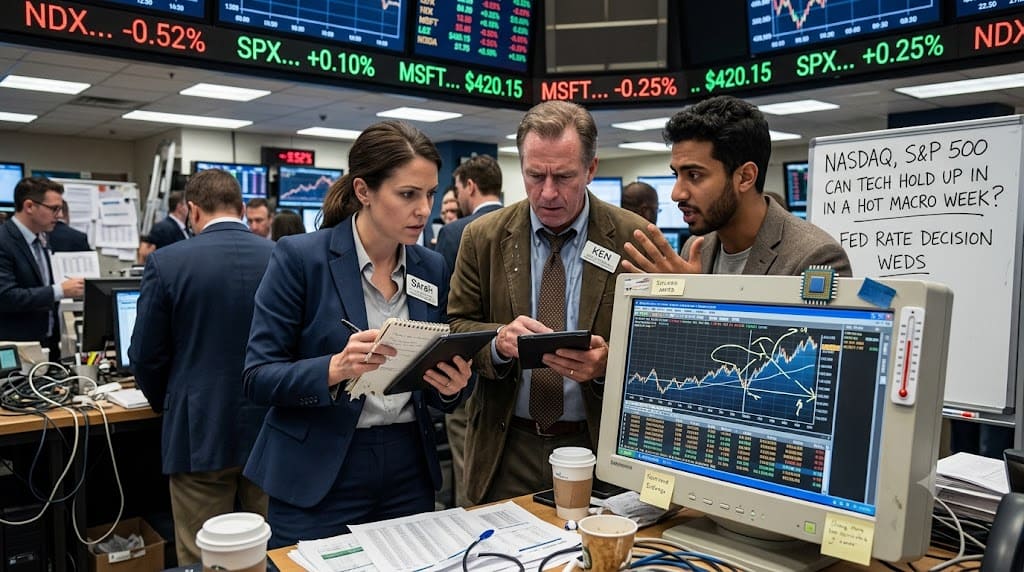
Whiplash is basically the whole story of this week.
Short answer: June’s CPI report came in much softer than expected. That briefly lifted the Nasdaq and S&P 500, especially chip stocks. But Fed Chair Kevin Warsh struck a hawkish tone in his testimony the same day, despite the good inflation news. Wednesday brings the Producer Price Index plus his second day of testimony. Either one could extend the tech rally or reverse it. A heavy slate of bank earnings adds even more crosscurrents on top.
What’s Driving the Nasdaq and S&P 500 This Week?
Three things are landing in the same five-day window. A full round of inflation data. The new Fed chair’s first congressional testimony. And the unofficial start of second-quarter earnings season. June’s Consumer Price Index fell 0.4% for the month – the largest monthly drop since April 2020. That brought annual inflation down to 3.5%, below the 3.8% economists expected, according to the Bureau of Labor Statistics. Core CPI, which strips out food and energy, held flat for the month.
That’s the kind of number that would normally send stocks sharply higher. It usually pushes rate-cut odds up too. It did the first part. The second part is where things got complicated.
Why Didn’t the Market Just Rally on Good Inflation News?
The same day the CPI dropped, Fed Chair Kevin Warsh gave his first semiannual testimony before Congress. He didn’t take a victory lap. Warsh told the House Financial Services Committee that “the members of our Committee have no tolerance for persistently elevated inflation.” That line reads as hawkish. It doesn’t matter how one month’s data looks. He testifies again before the Senate Banking Committee on Wednesday.
I don’t think Warsh was trying to talk down a good number out of stubbornness. One soft CPI print doesn’t erase months of elevated readings. Energy prices were the main reason June cooled off. They’ve already climbed higher again as Middle East tensions flared back up. Imagine if Warsh had sounded dovish instead. Then gasoline prices jump again next month, and he’s spent his first testimony digging himself a hole. Traders seemed to read it that way too. The initial post-CPI rally held. But traders walked back some of the enthusiasm once his prepared remarks hit the wire.
How Are Tech and Chip Stocks Actually Reacting?
Tech is the most reactive part of this market right now, in both directions. Lower inflation and lower rate-hike odds tend to help growth stocks more than value stocks. Why? A bigger share of a growth company’s expected profit sits years in the future. Discount that future profit at a lower rate, and it’s worth more today. That’s exactly what showed up Tuesday. The Nasdaq Composite outpaced the S&P 500 and Dow by a wide margin. Semiconductor names that sold off earlier in the week – Applied Materials, Teradyne, Monolithic Power – bounced hard.
The flip side showed up in the same session. IBM warned that software and infrastructure demand came in soft. The stock fell roughly 25%, on pace for one of its worst trading days on record. The Dow is price-weighted. So one expensive stock dragging that hard kept the blue-chip index roughly flat, even while the Nasdaq surged nearly 1%. That’s a good reminder: “the market” isn’t one number. A single earnings miss in a high-priced stock can make one index look weak while the broader market looks strong.
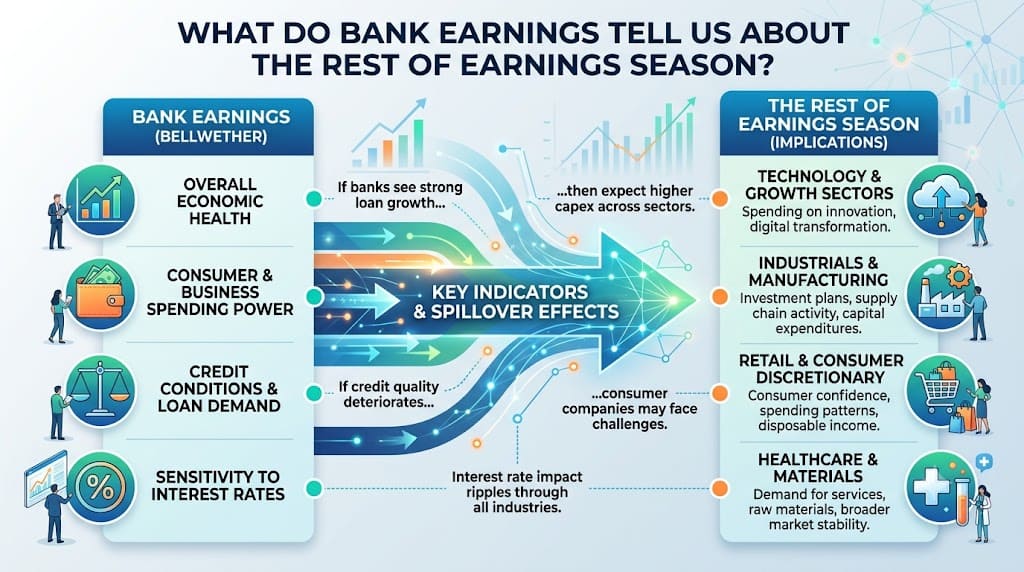
What Do Bank Earnings Tell Us About the Rest of Earnings Season?
Big banks kicked off Q2 earnings this week. The underlying results were stronger than the stock reactions suggested. JPMorgan beat estimates and grew markets revenue 35%. Its shares still slipped, after the bank raised its expense forecast for the year. Wells Fargo and Bank of America both beat too, with mixed follow-through in their stock prices. Goldman Sachs was the clean win of the group – its shares jumped sharply on its own beat.
The pattern across all four: solid numbers, but the market grades on a curve right now. Analysts expect S&P 500 earnings to grow roughly 24% year-over-year this quarter overall. For the technology sector specifically, that estimate jumps past 60%, according to FactSet’s Earnings Insight tracker. When expectations run that high, beating the consensus isn’t automatically enough. That’s why a JPMorgan beat can still send its stock down while a Goldman beat sends shares up 7%. Netflix, Taiwan Semiconductor, and UnitedHealth report later this week. Investors will watch TSM’s numbers especially closely. They’re a direct read on whether AI chip demand still matches what the stock prices assume.
What Should You Actually Watch For the Rest of This Week?
I’m not going to pretend to know whether Wednesday’s PPI report comes in hot or cool. Nobody credibly does. Same goes for how Warsh’s second day of testimony lands. But here’s what actually moves the needle from here:
- Wednesday’s Producer Price Index feeds into the Fed’s preferred inflation gauge. It will either reinforce or complicate Tuesday’s “inflation is cooling” story.
- Warsh’s Senate testimony matters most as a signal. A repeat of Tuesday’s hawkish tone means this is his real stance, not a one-day talking point.
- Thursday’s retail sales show whether consumers keep spending, even with higher gas prices from the Iran-driven oil rally.
- TSM and Netflix earnings matter more for sentiment than for the index itself. This market’s gains have stayed concentrated in a handful of names.
If you’re investing for a long-term goal, none of this week’s individual data points should change your plan by itself. The S&P 500 is still up more than 10% for the year despite all the noise. Pay closer attention only if you hold concentrated tech or chip positions. Those are the names swinging hardest on each headline right now.
Key Takeaways
- June CPI fell 0.4% for the month and rose 3.5% annually, cooler than the 3.8% economists expected. A 5.7% monthly drop in energy prices drove most of that.
- Fed Chair Kevin Warsh’s congressional testimony struck a hawkish tone the same day. That tempered the market’s initial rally off the soft inflation number.
- The Nasdaq outpaced the S&P 500 and Dow as chip stocks rebounded. IBM’s roughly 25% drop after a weak earnings report kept the price-weighted Dow nearly flat.
- Major bank earnings beat estimates overall, but stock reactions varied. JPMorgan fell despite a beat, while Goldman Sachs jumped on one.
- Wednesday’s Producer Price Index, Warsh’s second testimony, and Thursday’s retail sales are the next data points likely to move this week.
Frequently Asked Questions
Why did stocks rally after the CPI report but then pull back? June’s CPI came in cooler than expected. That initially lifted stocks and lowered rate-hike odds. Fed Chair Kevin Warsh’s hawkish testimony later the same day tempered that rally, as traders reassessed how much the Fed’s stance had actually shifted.
Why is the Nasdaq outperforming the Dow this week? Lower inflation and rate expectations tend to help growth and tech stocks more than the Dow’s older industrial and financial names. One large Dow component, IBM, also fell sharply on weak earnings, dragging that index specifically.
Are bank earnings a good sign for the rest of Q2 earnings season? The underlying numbers held up well – most big banks beat estimates. But stock reactions varied, since expectations already ran high. Expect that same pattern, a beat without a stock pop, to repeat as more companies report.
What’s the next big catalyst for the stock market this week? Wednesday brings the Producer Price Index and Warsh’s second day of Senate testimony. Thursday adds retail sales data, plus earnings from Taiwan Semiconductor and Netflix.
Want to see how a week like this shows up in your own numbers, not just the headlines? FinToku’s Currency Converter is a quick way to track how the dollar has moved alongside all this data.
Read More
- Why US-Iran Tensions Are Rattling Stocks, Chips, and Oil Right Now – the geopolitical side of this story. How the Strait of Hormuz, oil, and Fed rate expectations connect.
By Saad Faisal · Published July 15, 2026
Disclaimer
This article shares general information only. Don’t take it as financial or investment advice. Markets move quickly. The figures here reflect a snapshot in the middle of a fast-moving week, not a forecast of what comes next. Before making any investment decision, check with a qualified financial advisor who can look at your specific situation. You can also read FinToku’s full Financial Disclaimer.