

Only about 1 in 10 American adults actually used or held cryptocurrency in the past year, according to the Federal Reserve’s own household survey. That’s a smaller crowd than the headlines usually suggest.
Cryptocurrency is digital money that runs on a shared, encrypted record called a blockchain, with no bank or government in charge of it. Bitcoin was the first one, back in 2009. Thousands of others have shown up since, though most of them barely move the needle.
Here’s what cryptocurrency actually is, how it works under the hood, what it’s worth right now, and whether it’s something worth your time.
What Is Cryptocurrency, in Simple Words?
Cryptocurrency is a form of digital money secured by cryptography and recorded on a decentralized, shared ledger called a blockchain, rather than issued or controlled by a bank or government. Bitcoin was first; thousands of others, including Ethereum and various stablecoins, followed it.
No single company or country owns the ledger. Instead, a network of computers around the world keeps copies of it and agrees on what’s true.
That’s the whole pitch, really. Money that doesn’t need a middleman to move it or vouch for it.
How Does Cryptocurrency Actually Work?
Every cryptocurrency transaction gets bundled into a “block,” checked by the network, then permanently added to a chain of previous blocks. That’s the blockchain part.
Here’s the piece that trips people up: nobody at a bank clicks “approve” on your transaction. Instead, thousands of computers (called nodes) race to verify it using math, then agree on which version of the ledger is correct. This agreement process is called consensus, and it’s the actual innovation crypto brought to the table.
Bitcoin uses a consensus method called proof of work, better known as mining. Miners compete to solve a computational puzzle, and whoever wins gets to add the next block and collects a reward in Bitcoin. It’s energy-intensive by design. That’s what makes cheating the ledger too expensive to be worth it.
Newer networks like Ethereum switched to proof of stake instead, where validators lock up (or “stake”) their own crypto as collateral rather than burning electricity. It’s faster and cheaper to run, which is part of why Ethereum’s transaction fees dropped so much after its 2022 upgrade.
To actually hold crypto, you need a wallet, which stores the private keys that prove it’s yours, and typically an exchange like Coinbase or Kraken to buy and sell it in the first place.
Bitcoin, Ethereum, and Everything Else
Not all crypto does the same job. It’s easy to lump “crypto” together as one thing, but the three main categories behave pretty differently.
Bitcoin is the original, and it’s still the biggest by a wide margin. Most people treat it as digital gold: something to hold and hope appreciates, not something to spend on groceries.
Ethereum and similar networks are programmable. They can run “smart contracts,” self-executing pieces of code, so developers can build apps, tokens, and entire financial products directly on top of the blockchain. I wrote a full breakdown of whether Ethereum specifically is worth buying in this guide if that’s the one you’re actually weighing.
Stablecoins, like USDT and USDC, are pegged to the US dollar so their value doesn’t swing around. They’re the least exciting crypto to own and the most heavily used in practice. They process trillions of dollars in transfers a year because they’re the easiest way to move dollar value across crypto networks.
Beyond those three buckets sits a long tail of thousands of smaller “altcoins,” most of which have negligible real usage or value.
Cryptocurrency by the Numbers (as of Mid-2026)
Prices move by the hour, so treat this table as a snapshot rather than gospel. Still, it’s useful to see the actual scale of things instead of guessing.
| Metric | Figure | Source, as of |
|---|---|---|
| Total crypto market cap | ~$2.2-2.3 trillion | CoinGecko, July 2026 |
| All-time high market cap | $4.27 trillion | Oct 6, 2025 |
| Bitcoin’s share of total market | ~56-57% | CoinGecko, July 2026 |
| Cryptocurrencies tracked | 17,600+ | CoinGecko, July 2026 |
| Bitcoin’s all-time high price | $126,198 | Oct 2025 |
| US adults who used or held crypto in the past year | 10% (up from 7% in 2024) | Federal Reserve SHED survey, 2025 data |
| US adults with any direct crypto stake, incl. ETFs | 22% | Motley Fool Money 2026 Investor Survey |
Two things jump out. First, the market is still down almost half from its October 2025 peak, so anyone telling you crypto “only goes up” is selling something. Second, actual day-to-day usage is a lot smaller than ownership headlines imply. Most of that 10% are holding it as an investment, not spending it; only about 2% of US adults used crypto to actually buy something last year.
If you’re curious what your own dollars would be worth converted into a specific amount, FinToku’s Currency Converter can handle the fiat side of that math while you check a live crypto price elsewhere.
The Real Risks, Not the Scary-Headline Version
I’ll be straight with you: crypto’s risks aren’t really about hackers breaking the blockchain itself. They’re more mundane than that, which somehow makes them easier to ignore.
Volatility. Bitcoin dropping from a $126,000 peak to roughly half that within months isn’t a fluke. It’s just how this asset class behaves. If a 50% swing would wreck your month, this isn’t money to put there.
Losing access, not losing money. Forget your wallet’s private key or send funds to the wrong address, and there’s no customer service line to call. Nobody reverses a crypto transaction. This is where a hardware wallet earns its cost; I keep anything I’m not actively trading on one rather than an exchange. Ledger hardware wallet (Quick heads up, that’s an affiliate link, so FinToku may earn a small commission if you buy through it. Full details in our Affiliate Disclosure.)
Regulatory whiplash. Rules keep shifting. Exchanges have pulled operations from specific states or countries with little warning, and tax reporting requirements (more on that below) have tightened considerably since 2023.
Scams and hacks. Exchange collapses, phishing links, and fake “investment” schemes are common enough that the Federal Reserve’s own survey found roughly a third of people who’ve never bought crypto think the whole thing is a scam. That’s not an unreasonable starting assumption, even if it’s an overcorrection.
None of this makes crypto worthless. It makes it a genuinely risky asset, not a shortcut, and it deserves to be sized in your portfolio the way you’d size any other volatile bet.
How Cryptocurrency Is Taxed in the US
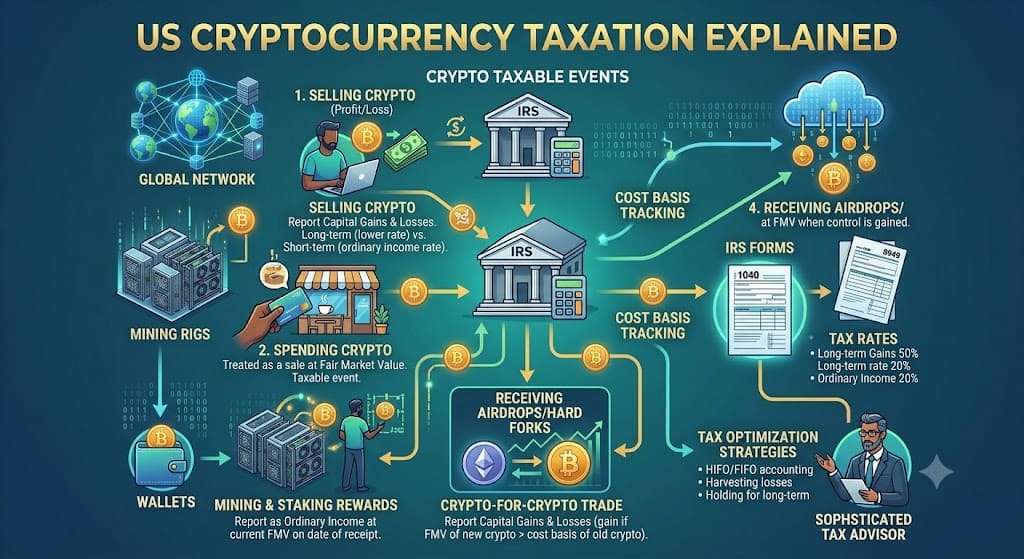
The IRS treats cryptocurrency as property, not currency, per Notice 2014-21. That single classification explains almost everything about how it gets taxed.
Selling crypto for cash, trading one coin for another, or spending it on a purchase all count as “disposals,” and each one can trigger a capital gain or loss. Hold for a year or less before disposing, and any gain is taxed as ordinary income (10% to 37%). Hold longer than a year, and you get the lower long-term rates instead (0%, 15%, or 20%, depending on your income).
Mining rewards, staking income, and airdrops count as ordinary income the moment you receive them, separate from whatever happens later when you sell.
As of 2026, centralized US exchanges report your transactions to the IRS directly via Form 1099-DA, so assuming the IRS won’t know stopped being realistic a while ago. Every Form 1040 now asks directly whether you received, sold, or exchanged any digital assets during the year.
Should You Actually Buy Cryptocurrency?
Honestly, I think most people overcomplicate this decision. The real question isn’t “is crypto good or bad.” It’s “can you afford to lose this specific amount, and would that actually be fine.”
If the answer is yes, and you’re mainly curious rather than trying to get rich fast, a small position (something like 1% to 5% of your investable money) in Bitcoin or Ethereum is a reasonable way to learn how it behaves without betting your rent on it. If losing that amount would genuinely hurt, skip it. There’s no rule that says you have to own crypto to be financially responsible in 2026.
Key Takeaways
- Cryptocurrency is digital money secured by cryptography and recorded on a decentralized blockchain, with no central bank or government controlling it.
- Bitcoin is the original and largest cryptocurrency; Ethereum adds programmable “smart contracts,” and stablecoins hold a steady dollar value.
- The total crypto market was worth roughly $2.2 to $2.3 trillion as of July 2026, down from an October 2025 peak of $4.27 trillion.
- About 10% of US adults used or held crypto in 2025 per the Federal Reserve, but only around 2% used it to actually buy anything.
- The IRS taxes crypto as property: short-term gains as ordinary income, long-term gains at 0%, 15%, or 20% depending on income, with exchanges now reporting transactions on Form 1099-DA.
Frequently Asked Questions
What is cryptocurrency in simple words? It’s digital money that exists only as entries on a shared, encrypted ledger called a blockchain, with no bank or government issuing or backing it. You store it in a digital wallet and move it directly to another wallet without a middleman approving the transfer.
What’s the difference between cryptocurrency and Bitcoin? Cryptocurrency is the entire category; Bitcoin is one specific cryptocurrency within it, and the first one ever created. Every Bitcoin is a cryptocurrency, but not every cryptocurrency is Bitcoin, the same way every Kleenex is a tissue but not every tissue is a Kleenex.
What is cryptocurrency mining? Mining is the process, used by Bitcoin and a handful of other networks, where computers compete to solve a math puzzle in order to verify transactions and add the next block to the blockchain. Whoever solves it first earns a reward in that cryptocurrency, which is also how new coins enter circulation.
Does crypto turn into real money? Yes. You can sell most cryptocurrencies on an exchange and withdraw the proceeds as US dollars to your bank account, usually within a few business days. The “realness” of the money isn’t in question; the risk is that the dollar amount you get back can be very different from what you put in.
Is cryptocurrency good or bad? Neither, really. It’s a tool with real uses (fast cross-border transfers, programmable finance) and real downsides (volatility, scams, no safety net if you make a mistake). Whether it’s “good” for you specifically depends on whether you can handle the risk, not on the technology itself.
If you’re still deciding whether to put real money into this, running the numbers before you commit tends to beat going on gut feeling alone.
Read More
- Is Ethereum a Good Investment in 2026? A US Guide to Buying, Staking, and Taxes
- Currency Converter: How It Works and Where Fees Hide
Disclaimer
This article is for general informational purposes only and shouldn’t be taken as financial, tax, or legal advice. The tax rates and thresholds above are current as of 2026 and can change; everyone’s actual situation (income, holding periods, state taxes) is different. Before buying, selling, or reporting cryptocurrency, it’s worth checking with a qualified financial advisor or tax professional who can look at your specific numbers. You can also read FinToku’s full Financial Disclaimer.
Published by Saad Faisal for FinToku (fintoku.com) · Published July 20, 2026 · Updated July 20, 2026 FinToku provides free finance tools and guides to help you make smarter money decisions.