
A few months ago, my aunt asked me to help her compare two CD offers. She was about to roll over some savings. One bank was advertising 3.90% APY on a 1-year CD. Another was quoting 4.00%, but it compounded monthly instead of daily. She assumed the second one just paid more, full stop. It didn’t. Once I ran the actual numbers, the daily-compounding CD at 3.90% edged it out by about $4 on a $10,000 deposit. It’s a small difference, but it’s exactly the kind of thing a CD calculator catches and a headline rate hides.
A CD calculator takes your deposit amount, term length, and APY. It tells you exactly how much interest you’ll earn, and what your balance will be when the CD matures. No manual compounding math required. Plug in FinToku’s CD Calculator and you’ll get both numbers in seconds, plus a breakdown of principal versus interest.
What Is a Certificate of Deposit (CD)?
A certificate of deposit is a fixed-term savings account. It pays a locked-in interest rate in exchange for leaving your money untouched for a set period. That period usually runs anywhere from three months to five years. Unlike a regular savings account, the rate won’t drop if the bank cuts its rates next month. You’ll typically pay a penalty, though, if you pull the money out early.
How to Use the CD Calculator
The inputs are the same three numbers every version of this tool asks for, FinToku’s included:
- Initial deposit: the lump sum you’re putting in. Most CDs only accept one deposit, ever, so this number is your entire principal.
- Term length: in months or years. Watch for the unit mismatch — a “12-month CD” and a “1-year CD” are the same thing. Banks just aren’t consistent about which one they list.
- APY: the annual percentage yield the bank is advertising, not the raw interest rate. (More on why that distinction matters below.)
Hit calculate, and you’ll see your total balance at maturity and, separately, just the interest portion. That second number is the one worth staring at: it’s the actual payoff for locking your money up.
The CD Calculator Formula
Behind the scenes, the calculator is running compound interest math:
FV = P × (1 + r)^t
Here, FV is your final balance and P is your principal. r is the annual rate as a decimal, and t is the number of years. Subtract your original deposit from FV and you get the interest earned. That’s it, that’s the whole formula.
Say you deposit $10,000 in a 3-year CD at 4.00% APY, compounded annually. You’d walk away with roughly $11,249 at maturity, about $1,249 in interest. Drop the rate to 3.00% APY on the same term and deposit. You’d end up with about $10,927 instead — $322 less. That’s the entire value of shopping around before you open one.
APY vs. Interest Rate: Why the Number You See Isn’t the Whole Story
Banks quote APY, not the plain interest rate, and the two aren’t the same thing. The interest rate is the base percentage before compounding. APY factors in how often that interest compounds — daily, monthly, quarterly. That’s why APY is almost always the higher, more honest number. When you’re comparing two CDs, compare APY to APY. Comparing one bank’s APY to another’s raw rate will make the second one look worse than it actually is.
This is also why compounding frequency quietly matters. A CD that compounds daily will out-earn one with an identical stated rate that only compounds quarterly. That’s because you’re earning interest on interest more often.

What Actually Moves the Number in the Calculator
Three inputs, three levers:
- Term length. Longer terms usually (not always) pay more, since the bank gets to hold your money longer. In 2026’s rate environment, some 1-year CDs are actually out-earning 3-year ones. That isn’t the historical norm.
- APY. The single biggest lever. A one-point difference in APY on a $25,000 deposit over five years is worth well over a thousand dollars.
- Deposit size. Some banks tier their APY by balance. A $50,000 “jumbo” CD sometimes earns a better rate than a $2,000 one at the same bank.
Don’t Forget Taxes on Your CD Interest
This is the part most CD calculators skip entirely, and it’s a real gap. Only one of the tools I researched for this piece even mentions it. In the U.S., the IRS treats CD interest as ordinary income. It’s taxable in the year it’s earned, even if you don’t touch the money until the CD matures years later. A $10,000 CD earning $400 in interest adds $400 to your taxable income for that year, full stop. The exception is a CD sitting inside a tax-advantaged account, like an IRA. If you’re in a CD outside a retirement account, run your expected interest through your marginal tax bracket. Do this before you get attached to the “headline” APY number. Your real, after-tax return is lower than what’s advertised.
Early Withdrawal Penalties: What They Really Cost You
Pull money out of a CD before maturity and you’ll typically pay a penalty. That penalty usually runs between 90 days and a year’s worth of interest, depending on the term and bank. On a short CD, that penalty can eat every dollar of interest you’ve earned and dip into your principal. Rule of thumb: only put money in a CD you’re confident you won’t need before the term ends. If there’s a real chance you’ll need the cash, consider a high-yield savings account instead. You give up some rate, but gain the flexibility to withdraw penalty-free.
CD Ladders: Spreading Your Money Across Terms
A CD ladder is what you build when you don’t want to lock all your money into one term. Instead of putting $15,000 into a single 3-year CD, you’d split it across three CDs — 1-year, 2-year, and 3-year. That way, one matures every year. Each time one comes due, you can reinvest at whatever the going rate is. Or you can pull the cash out if you need it. It’s a reasonable middle ground between chasing the higher rates on longer terms and keeping some flexibility.
Where CD Rates Stand Right Now
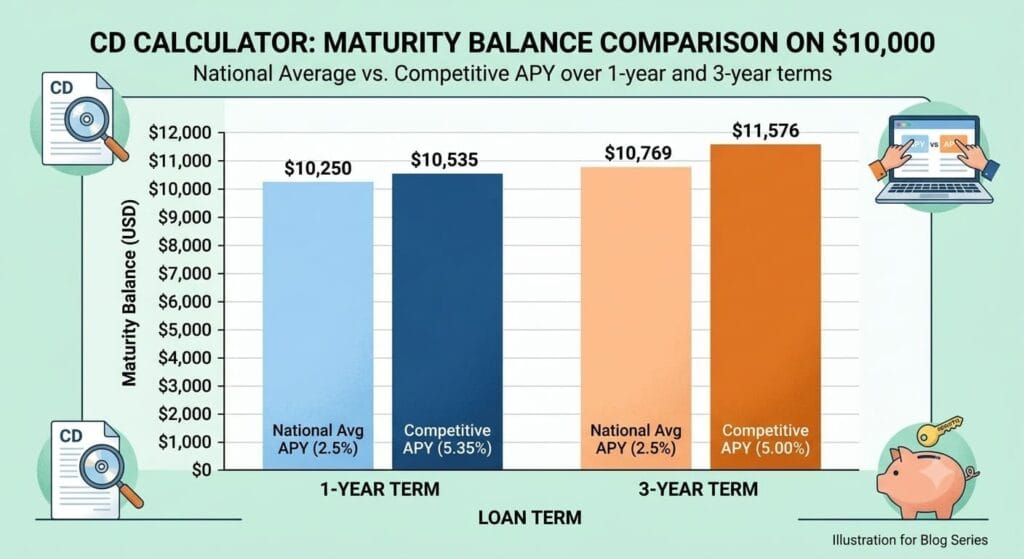
As of July 2026, the Federal Reserve’s benchmark rate sits at 3.50%–3.75%. That follows three rate cuts in late 2025 and no change since. National average CD rates have followed suit. Forbes Advisor’s most recent survey put the national average 12-month CD at around 1.65% APY. The 3-year average sits even lower, near 1.33%. The best available rates are a different story. NerdWallet and Bankrate both show online banks still offering 4.00%–4.30% APY on select terms as of early July 2026. That gap between “average” and “best” is exactly why running a few different APYs through the calculator is worth it. Do that before picking a bank — it only takes five minutes.
| Deposit | Term | APY | Interest Earned | Balance at Maturity |
|---|---|---|---|---|
| $10,000 | 1 year | 1.65% (national avg.) | ~$165 | ~$10,165 |
| $10,000 | 1 year | 3.90% (competitive) | ~$390 | ~$10,390 |
| $10,000 | 3 years | 1.33% (national avg.) | ~$404 | ~$10,404 |
| $10,000 | 3 years | 4.00% (competitive) | ~$1,249 | ~$11,249 |
Run your own deposit and term through FinToku’s CD Calculator to see where you’d land. It takes the guesswork out of comparing offers side by side.
Key Takeaways
- A CD calculator turns your deposit, term, and APY into a maturity balance, using the formula FV = P(1 + r)^t.
- Always compare APY to APY, not APY to a plain interest rate. APY already accounts for compounding, making it the more accurate number.
- CD interest is taxable as ordinary income in the year it’s earned, even before the CD matures. The exception is a tax-advantaged account.
- Early withdrawal penalties commonly cost 90 days to a full year of interest. So only lock up money you won’t need before the term ends.
- As of July 2026, the best available CD rates (around 4.00%–4.40% APY) are running well above the national average. The national average sits around 1.3%–1.65% APY. That gap makes it worth shopping around.
Frequently Asked Questions
What is a normal CD calculator, and how is FinToku’s different?
A “normal” CD calculator does one job. It takes your deposit, term, and APY, and returns your interest earned and total balance at maturity. FinToku’s version does the same core math. It also adds a plain breakdown of principal versus interest, so you’re not squinting at a single lump-sum number.
Can I use a CD calculator to check monthly interest?
Yes. Enter your deposit, APY, and term, then look at the accumulation schedule if the calculator shows one month by month. Just remember that most CDs only pay out interest at maturity or on a set schedule (monthly, quarterly), not continuously.
How much would a 3-month CD calculator show for a $5,000 deposit?
On a 3-month CD at a competitive ~4.00% APY, $5,000 would earn roughly $49 in interest. Short terms simply don’t have much time to compound. Longer terms or higher APYs move that number more than the term length alone.
Is CD calculator simple interest or compound interest?
Compound interest, in almost all cases. Simple interest calculations (principal × rate ÷ 365 × days) sometimes show up for very short-term CDs. But the standard CD calculator formula compounds, since that’s how banks actually credit CD interest.
Are CD rates the same as high-yield savings account rates?
Not usually. High-yield savings accounts (HYSAs) have variable rates that move with the market. CD rates, by contrast, are locked in for the term. Right now the best CDs and best HYSAs are often close in APY. So the real decision comes down to whether you need to keep the money accessible.
If you’re still deciding between a CD and keeping your savings flexible, bookmark this page. Run a few scenarios through the calculator above before you commit. It’s a five-minute check that can be worth real money either way.
Sources
- IRS Topic no. 403, Interest Received
- Federal Funds Target Range, FRED, Federal Reserve Bank of St. Louis
- FDIC National Rates and Rate Caps
- Best CD Rates of July 2026, Forbes Advisor
- Best CD Rates of July 2026, NerdWallet
- Best CD Rates of July 2026, Bankrate
Disclaimer
This article is for general informational purposes only and shouldn’t be taken as financial or tax advice. The rates and dollar figures above are current as of July 2026 and are illustrative examples. Your actual CD rate, tax situation, and penalty terms will depend on your bank and your specific circumstances. Before opening a CD or making a decision based on the tax section above, check with a qualified financial advisor or tax professional. You can also read FinToku’s full Financial Disclaimer.