

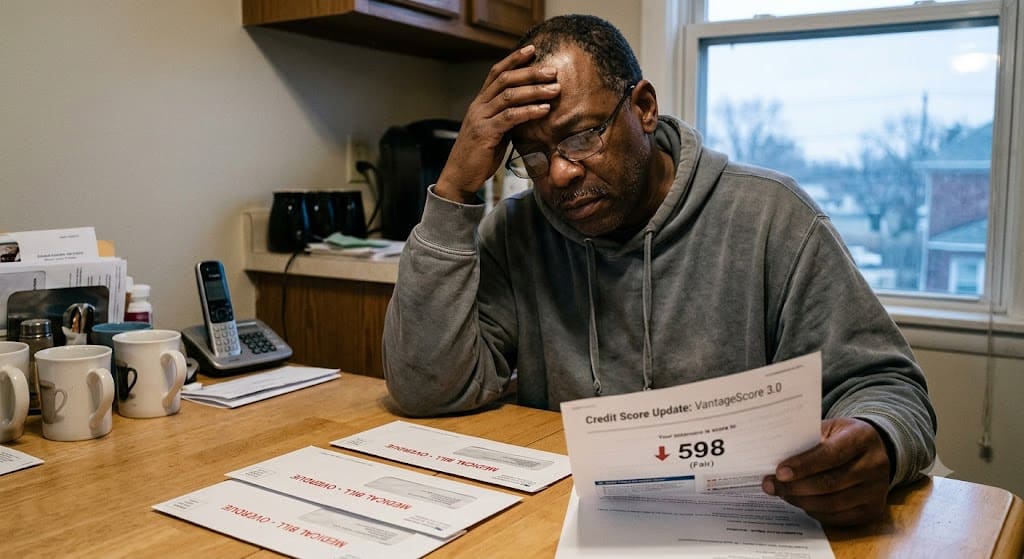
A $3,200 emergency room bill doesn’t care that your credit score is 560. It just needs to get paid, usually within 30 to 90 days before it lands in collections.
That’s the moment “no credit check” starts showing up in every search you type. I went down this exact rabbit hole for a reader who wrote in after a surprise gallbladder surgery bill, and the short answer is this: a personal loan for medical bills with no credit check almost always means a soft credit check up front, not no check at all, and it usually costs more than a loan that does look at your full credit history. The full answer takes a bit more unpacking, so let’s get into it.
What “no credit check” actually means for a medical loan
A “no credit check” medical loan is a personal loan where the lender skips a hard credit inquiry during pre-qualification and instead uses a soft pull, income data, or bank account history to make a lending decision. It still shows up as a loan you have to repay, usually with a higher interest rate than a lender would offer someone with strong credit.
Here’s the part that trips people up: almost no legitimate medical lender skips credit checks completely. LendingUSA, for example, advertises no credit check to apply, running a soft pull that doesn’t affect your score, but still pulls your full credit report if you move forward with the loan. That’s standard across the industry. “No credit check” is marketing shorthand for “no hard check just to see your rate,” not a promise that your credit history is irrelevant.
What lenders actually offer right now
Rates and minimum credit scores change often, so treat the table below as a snapshot, not a permanent number. I pulled these directly from each lender’s own published terms.
| Lender | Est. APR | Loan amount | Min. credit score | Notes | As of |
|---|---|---|---|---|---|
| Avant | 9.95% – 35.99% | $2,000 – $35,000 | 550-580 depending on the source cited | Admin fee up to 9.99% of the loan amount | July 2026 |
| Upstart | 6.20% – 35.99% | $1,000 – $75,000 | None stated; accepts scores as low as 300 in most states | Origination fee up to 12% | July 2026 |
| OneMain Financial | 11.99% – 35.99% | $1,500 – $30,000 | None stated | Offers joint and secured loans | July 2026 |
| LendingUSA | Up to 29.99% APR with an origination fee up to 8% | Up to $47,500 | Around 620 typically, some as low as 580 | 0% interest if paid in full within 6 months | July 2026 |
Avant’s minimum credit score is the one figure worth double-checking yourself before you apply. Its own rate card doesn’t publish a hard floor, and lender-review sites split between 550 and 580 depending on when they last confirmed it with the company.
A useful gut check here: the average rate borrowers with bad credit actually received after pre-qualifying on NerdWallet’s marketplace was 26.32% APR over the last 30 days it tracked. That’s the real-world number to plan around, not the low end of a lender’s advertised range.
Where “no credit check” turns into a bad deal
This is the part I actually worry about for readers. A true no-credit-check option, like a payday loan, isn’t the same product wearing a different label. It’s a different, much more expensive kind of debt.
The median fee on a storefront payday loan works out to about $15 per $100 borrowed on a typical 14-day term, which lands around 391% APR. More than four out of five payday loan borrowers take out a new loan within a month of the first one, usually right around the original due date, because the payment eats too much of the next paycheck to break the cycle. That’s not a rare outcome. It’s the typical one.
A bad-credit personal loan at 30% to 36% APR is expensive. A payday loan at close to 400% APR is a different category of problem entirely. If a “medical loan” offer looks identical to a payday loan (small dollar amount, due in full on your next payday, no fixed monthly installment plan), treat it as a payday loan and shop elsewhere first.
Does an unpaid medical bill even hurt your credit the way you think?
This is the question that actually changes the math for a lot of people, and it’s more unsettled than most articles let on. The CFPB finalized a rule in January 2025 to strip an estimated $49 billion in medical debt off credit reports for around 15 million people. A federal court in Texas vacated that rule in July 2025, ruling the CFPB had overstepped its authority, so as of mid-2026 there’s no active federal ban on medical debt appearing on your credit report.
What’s still standing, independent of that court fight, is voluntary policy from Equifax, Experian, and TransUnion: paid medical debt, collections under $500, and anything still inside its first 365 days shouldn’t show up on your report at all. About 15 states, including California, Colorado, and New York, also passed their own medical debt reporting bans that don’t depend on the federal rule to function. A CFPB interpretive rule from late 2025 argues federal law preempts those state laws too, though, so courts are still fighting over that protection in some places.
The practical takeaway: a medical bill still sitting with the original hospital billing office, not yet in collections, generally isn’t touching your score yet either way. That’s often the better first move, before financing anything. Given how fast this is moving, check consumerfinance.gov and your own state attorney general’s site for the current status before you assume either way.
Try these before you finance anything
I’ve watched people jump straight to a loan application because a bill felt urgent, then find out afterward that a five-minute phone call would have cut the balance in half. Worth doing first:
- Ask for the hospital’s financial assistance program. Federal law requires most nonprofit hospitals to offer discounted or free care to patients under a certain income level, and most patients never ask.
- Negotiate the bill directly, especially if you can offer to pay a lump sum. Hospitals routinely settle for 30% to 60% of the billed amount.
- Request an in-house payment plan. Providers may offer interest-free installment plans directly, though many now route this through third-party companies that can charge retroactive interest if you don’t clear the balance in time, so read the plan terms closely before signing.
- Check a credit union first, if you’re a member or can join one. Their personal loan rates typically run well below what online medical lenders quote for bad credit.
Run your own numbers side by side before you commit to any of this. I always plug the actual APR and term into FinToku’s Loan Comparator before picking between two offers, since a lower advertised rate with a bigger origination fee can end up costing more than the “higher rate” option once the fee is baked in.
How to actually apply without tanking your credit score
- Pre-qualify with two or three lenders using their soft-pull tool. This shows you an estimated rate with no score impact, so there’s no reason to apply blind.
- Compare the APR, not just the advertised rate. APR bakes in origination fees, so it’s the number that reflects the real cost.
- Only submit a full application, which triggers a hard inquiry, once you’ve picked a lender. One hard inquiry barely moves your score. Five in a week is a different story.
- Read the funding timeline. Same-day and next-day funding are common among the lenders above, but “same day” usually means same business day, not weekends.
- Set up autopay if the lender offers a rate discount for it. Universal Credit and a few competitors shave a fraction of a point off for this.
Personal loan vs. payday loan vs. hospital payment plan
| Option | Typical APR | Speed | Best for |
|---|---|---|---|
| Bad-credit personal loan | 10% – 36% | 1-2 business days | Bills you can’t negotiate down and need to pay off over 1-5 years |
| Hospital payment plan | 0% direct, higher if routed through a third party | Set up in a phone call | Bills under a few thousand dollars, willing to pay over 6-24 months |
| Payday/no-credit-check cash loan | ~300% – 400%+ | Same day | Should generally be a last resort, not a medical bill strategy |
| Credit union personal loan | Often 8% – 18% | A few days, membership required first | Anyone who already belongs to or can join one |
Key Takeaways
- “No credit check” for a medical loan almost always means a soft pull to see your rate, followed by a hard pull only if you accept the offer.
- Borrowers with bad credit who pre-qualified recently received an average rate of 26.32% APR, which is the realistic number to budget around, not a lender’s lowest advertised rate.
- A true no-credit-check payday loan runs close to 400% APR on average, and more than four out of five borrowers re-borrow within a month, so it’s a different, riskier product than a bad-credit personal loan.
- Hospital financial assistance and direct negotiation can shrink the bill itself before you finance anything, and are worth trying first.
- Medical debt’s credit-report treatment is genuinely in flux right now (no active federal ban, about 15 states with their own bans, and a federal preemption fight still playing out), so confirm the current rules before assuming an unpaid bill will or won’t hit your score.
Frequently Asked Questions
Can you actually get a personal loan for medical bills with no credit check at all? Not from a mainstream lender. What’s marketed as “no credit check” is a soft-pull pre-qualification step that doesn’t affect your score, followed by a full credit check only if you accept the loan offer.
What credit score do you need for medical financing? Some lenders like Upstart accept scores as low as 300 or no credit score at all, while others cluster around a 550 to 620 minimum. Expect a higher rate the lower your score sits.
Are “guaranteed approval” medical loans for bad credit real? Treat any guaranteed-approval claim as a red flag. Legitimate lenders always underwrite based on income, existing debt, and some read on your credit, even if it’s a soft one.
Is there free government help for medical bills? There’s no direct federal medical-bill loan program, but federal law generally requires nonprofit hospitals to offer charity care to low-income patients, and organizations like the Patient Advocate Foundation help with copays and treatment costs for people with chronic conditions.
What’s the fastest way to get emergency medical financing with bad credit? Pre-qualify with two or three lenders that offer next-day funding, like Avant or Universal Credit, and compare the real APR before applying. Most decisions come back within minutes, and funding often lands the next business day.
Before you decide, it’s worth running the actual numbers on FinToku’s Emergency Fund Calculator to see how a loan payment would sit against your monthly budget, not just whether you’d get approved.
Read More
- How to Build Credit With No Credit History (2026 Guide)
- Financial Mistakes That Keep People Broke (and How to Actually Stop)
- Paycheck Budgeting for Beginners: How to Make Your Money Last Between Paydays
Disclaimer
Treat this article as general information, not financial, tax, or legal advice. I pulled the APR ranges and credit score figures above from lenders’ published terms as of the date noted in the table, and they’re not a guarantee for your specific situation. Before financing a medical bill, it’s worth checking with a qualified financial advisor or your hospital’s billing office, since your actual options depend on your state, your provider, and your credit profile. You can also read FinToku’s full Financial Disclaimer.
A Few Resources Worth Having
A quick heads up: the book and product links below are affiliate links, so FinToku may earn a small commission if you buy through them. I only link to things I’d actually use myself. Full details in our Affiliate Disclosure.
If you want to go deeper on fighting a medical bill before financing it, “Never Pay the First Bill” by Marshall Allen is the one book I’d actually recommend on this. Allen is a former ProPublica investigative reporter who spent years covering medical billing, and the book walks through real negotiation scripts.
Once you’re juggling EOBs, itemized bills, and payment plan letters from three different providers, a cheap expanding file folder keeps them from turning into a shoebox of loose paper. The one I linked has 25 pockets, enough to separate by provider with room to spare.
If you end up settling old medical debt and want to shred the paperwork once it’s resolved, a basic cross-cut paper shredder is worth the one-time cost. Cross-cut beats strip-cut here, since it’s much harder for anyone to reconstruct even if someone digs through the trash.
Published by Saad Faisal for FinToku (fintoku.com) · Published July 28, 2026 · Updated July 28, 2026 FinToku provides free finance tools and guides to help you make smarter money decisions.