

The month my husband got laid off, I sat at the kitchen table with our bank statement and cried for about ten minutes before I even opened a spreadsheet. Then I opened the spreadsheet anyway, because the mortgage didn’t care that I was upset.
If you’re reading this because a paycheck just disappeared, whether from a layoff or because you or your partner is out on parental leave, here’s the direct answer: you rebuild your budget around your true fixed costs first, cut discretionary spending hard and fast, and treat any severance, unemployment, or paid-leave income as a bridge, not a bonus. The exact numbers change person to person. The order of operations doesn’t.
What actually changes when you go from two incomes to one
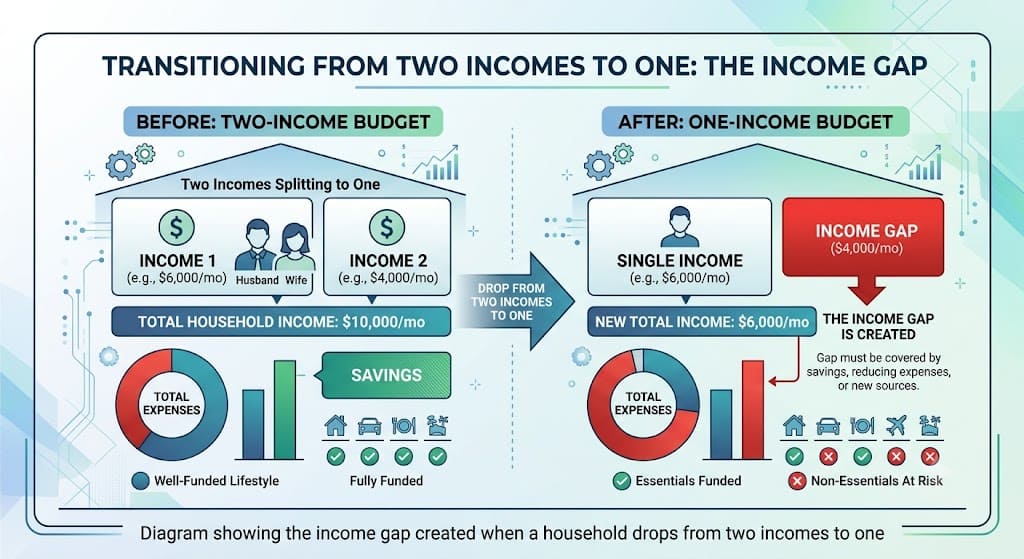
A one-income household budget is any budget built around a single paycheck, whether that’s because of a job loss, a parental leave, a health issue, or a choice to have one parent stay home. The math is the same in every case: your fixed costs stay roughly where they were, but the income covering them just got cut, sometimes to zero for a while.
That gap is the whole problem to solve. Everything below is about closing it as fast and painlessly as you can.
Step 1: Figure out what’s actually coming in
Before you touch a single expense, get a real number for your incoming cash over the next three to six months. This is different depending on why you’re down to one income.
If it’s a job loss: add up severance, accrued vacation payout, and your state’s unemployment insurance estimate. Most states replace only a portion of your old wage, and most require you to actively search for work and log that search weekly to keep collecting benefits, so check your state’s unemployment office directly rather than guessing. The Department of Labor’s unemployment insurance overview and CareerOneStop’s benefits finder will point you to your specific state’s site.
If it’s parental leave: find out what portion is paid through your employer, a state paid-family-leave program, short-term disability, or accrued PTO, and what portion is unpaid. The Department of Labor confirms FMLA guarantees up to 12 weeks of unpaid, job-protected leave for eligible employees, but whether any of that time is actually paid depends entirely on your state and employer, not on FMLA itself.
Write the real number down. Not the number you wish it was.
Step 2: Rebuild the budget around your fixed costs
Once you know what’s coming in, list your non-negotiable monthly costs: housing, utilities, groceries, minimum debt payments, insurance, and transportation to get to work or appointments. These get funded first, every time, before anything else.
This is where a lot of people freeze up because there’s too much to think about at once. Ramit Sethi’s book I Will Teach You to Be Rich argues that deliberate, conscious spending, not restriction, is what separates people who build wealth from people who don’t. You’re not guessing anymore, you’re assigning every dollar a job.
I did this on a legal pad the week my husband was laid off, because I couldn’t deal with opening a budgeting app that night. FinToku’s Budget Planner & 50/30/20 Calculator works just as well if you’d rather not do it by hand. The tool matters less than actually writing the numbers down.
Step 3: Cut the middle before you touch savings
Between “fixed costs” and “emergency fund” sits a big middle category: subscriptions, dining out, the streaming bundle nobody’s watched in a month, the gym membership you’re paying for out of guilt. This is where the real breathing room comes from, and it’s where most families can cut 10 to 20% of their monthly spending within a week without touching anything essential.
Vicki Robin makes a similar point in Your Money or Your Life: most people chase “having it all” without ever asking whether it’s actually making them happy. That’s not a guilt trip. It’s just true that most discretionary spending is habit, not necessity, and habits are exactly what a sudden drop in income forces you to look at honestly.
Cancel or pause anything you can live without for a season. Keep a short list of what you’re pausing so you remember to turn it back on later, not everything you cut needs to stay cut forever.
Step 4: Decide what your emergency fund is actually for right now
If you already have an emergency fund, this is what it exists for. Use it, but use it deliberately, not as a way to avoid making the cuts above.
Dave Ramsey’s The Total Money Makeover makes the point that managing money well comes down mostly to behavior, not spreadsheet knowledge. The math of an emergency fund is simple. Actually not touching it for non-emergencies while you’re stressed is the hard part.
If you don’t have one yet, or it’s thin, start rebuilding it the moment any income (severance, unemployment, paid leave) starts coming back in, even before you resume extra debt payments. FinToku’s Emergency Fund Calculator can help you figure out what target number actually makes sense for your household.
📖 The Total Money Makeover by Dave Ramsey (Quick heads up, that’s an affiliate link, so FinToku may earn a small commission if you buy through it. I only link to books I’d actually recommend. Full details in our Affiliate Disclosure.)
Job loss vs. parental leave: where the income actually comes from
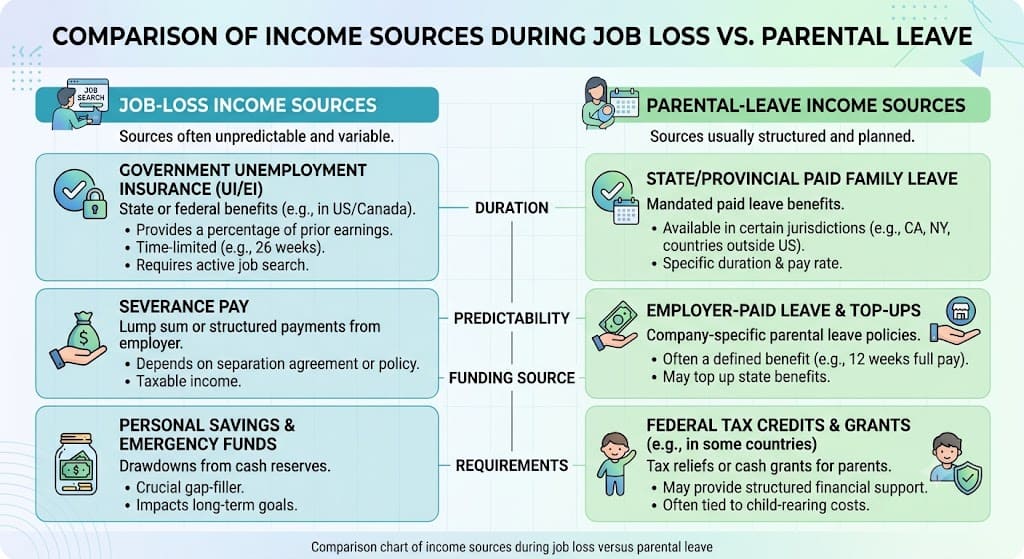
The mechanics of budgeting are nearly identical for both situations, but the income sources you’re working with are pretty different, so it’s worth laying out side by side.
| Situation | Possible income sources | Typical duration | Watch out for |
|---|---|---|---|
| Job loss | Severance, accrued PTO payout, state unemployment insurance, side income | Unemployment benefits vary by state, often 12-26 weeks if you keep meeting requirements | Most states require active, logged job searching to keep collecting benefits |
| Parental leave | Employer-paid leave, state paid-family-leave program, short-term disability, accrued PTO | FMLA guarantees up to 12 weeks unpaid, job-protected; paid portions vary widely | Not every worker or employer qualifies for a paid program, so confirm before you plan around it |
If your income is irregular even before factoring in a leave or layoff, our guide to budgeting on an irregular income walks through building a floor budget that works whether or not this month looks like last month.
The numbers worth knowing right now
Nearly a quarter of American households, about 24%, were living paycheck to paycheck in 2025, according to the Bank of America Institute’s analysis, and Bankrate’s 2025 emergency savings survey found that 60% of U.S. adults are uncomfortable with how much they have saved for emergencies. If that’s you, you’re not the outlier you might feel like right now.
| Metric | Figure | As of |
|---|---|---|
| Federal unpaid, job-protected leave under FMLA | Up to 12 weeks | 2026 (U.S. Dept. of Labor) |
| U.S. households living paycheck to paycheck | ~24% | 2025 (Bank of America Institute) |
| Americans uncomfortable with their emergency savings | ~60% | 2025 survey (Bankrate) |
| Commonly recommended emergency fund for a one-income household | 3 to 6 months of expenses | Ongoing guidance (personal finance planners, incl. The Total Money Makeover) |
Common mistakes people make on one income
- Cutting groceries before cutting subscriptions. Food and health come before a streaming bundle, every time.
- Paying extra on debt while the emergency fund is empty. Pause extra debt payments (minimums only) until you’ve got cash cushion again.
- Guessing at unemployment or paid-leave amounts instead of confirming them. A wrong guess by even a few hundred dollars a month throws off the whole plan.
- Treating the cuts as permanent. Most of this is temporary. Keep a list of what to restore once income normalizes.
Key Takeaways
- Rebuild your budget around confirmed income first (severance, unemployment, or paid leave), not estimated or hoped-for amounts.
- Fund your non-negotiable fixed costs before anything else, then cut discretionary spending hard.
- FMLA guarantees up to 12 weeks of unpaid, job-protected leave federally, but paid leave depends on your state and employer, not on FMLA itself.
- Use your emergency fund on purpose, and start rebuilding it as soon as any income returns.
- About 24% of U.S. households already live paycheck to paycheck, so a sudden one-income squeeze is common, not a personal failure.
Frequently Asked Questions
How much should our emergency fund be if we’re down to one income? Most planners suggest three to six months of essential expenses for a one-income household, on the higher end of that range if your income is variable or you have no severance cushion.
Can I collect unemployment if I leave my job to take care of a new baby? Generally no. Unemployment insurance is designed for people who lost work involuntarily and are able and available to work, so voluntarily leaving for parental leave typically doesn’t qualify. Paid family leave programs, where your state has one, are the relevant benefit instead.
What’s a simple budgeting rule for a sudden drop to one income? A common starting point is the 50/30/20 rule, roughly 50% of after-tax income to needs, 30% to wants, and 20% to savings and debt, though on one income the “wants” slice often needs to shrink temporarily to protect the “needs” and “savings” pieces. FinToku’s Budget Planner & 50/30/20 Calculator can split the numbers for you automatically.
Should we pause retirement contributions during a job loss or unpaid leave? Many households do pause employer-plan contributions temporarily to protect cash flow for essentials and the emergency fund, then resume once income stabilizes. This is a personal decision that depends on your specific plan and employer match, so it’s worth a conversation with a financial advisor if you’re unsure.
How long does FMLA leave actually last? Up to 12 workweeks in a 12-month period for a birth, adoption, or certain family and medical reasons, and it’s unpaid unless your employer or state supplements it.
One next step
If you haven’t actually written down your new income and fixed costs side by side yet, that’s the one thing to do today. Run them through the Budget Planner & 50/30/20 Calculator once you have real numbers, even before reading anything else on this list twice.
Read More
- How to Budget on an Irregular Income (2026 Guide)
- Paycheck Budgeting for Beginners: How to Make Your Money Last Between Paydays
- Financial Mistakes That Keep People Broke (and How to Actually Stop)
Disclaimer
This article is for general informational purposes only and shouldn’t be taken as financial or legal advice. Everyone’s situation, state benefits, and employer policies are different, so the percentages and timelines above, including the emergency fund and unemployment-duration ranges, are general guidance, not guarantees for your specific case. Before making decisions about unemployment, paid leave, or your emergency fund, it’s worth checking with your state labor office, your HR department, or a qualified financial advisor who can look at your actual numbers. You can also read FinToku’s full Financial Disclaimer.
Published by Saad Faisal for FinToku (fintoku.com) · Published July 27, 2026 · Updated July 27, 2026 FinToku provides free finance tools and guides to help you make smarter money decisions.