

Passive income and active income get treated as simple opposites in most personal finance content. One requires ongoing work, the other doesn’t. The tax code complicates that picture. Rental income, for example, generally counts as passive under IRS rules almost regardless of how much day-to-day work a property actually takes. The exception is if the owner qualifies as a real estate professional. There’s a specific test for this called “material participation”. It’s a big part of why the active-versus-passive line gets confusing in practice.
Here’s the direct answer. Active means trading time for pay right now, like a salary, freelance invoice, or commission. Passive means the money keeps coming in with little ongoing effort. That’s usually after the work or capital already went in upfront, through things like rental income, dividends, or royalties. Each is taxed differently, and each behaves differently in a downturn. Most people who reach financial independence end up building a mix of both, not just one.
What Is Active Income?
Active income is any money tied directly to your time and labor. Stop showing up, and the paycheck stops too.
Common sources of active income:
- Salaried or hourly wages from a job
- Freelance or consulting income, billed per project or hour
- Gig work, like driving or delivery
- Commissions and bonuses tied to performance
- Self-employment income from running a business you’re actively working in
I’ll be honest, this side of the equation gets a bit of a bad reputation in the “passive income” corners of the internet, like it’s the consolation prize. It isn’t. It’s usually more predictable, and for most people starting out, it’s also the only realistic source of capital for building the passive side later.
What Is Passive Income?
This is money earned from an asset or system you’ve already built, where your day-to-day involvement is minimal. It’s not free money. Almost every stream I’ve looked into required real upfront work, cash, or both, before it started paying out on its own.
Common sources of passive income:
- Dividend-paying stocks and index funds
- Rental property income (with a caveat below)
- Bank interest, including high-yield savings accounts
- Royalties from a book, song, patent, or course
- Automated or semi-automated online businesses
Notice rental income made both lists in a sense. That’s not a mistake. Whether rental income counts as passive really depends on material participation, not on how much work it actually takes.
The Missing Piece: Portfolio Income
Most articles on this topic treat it as a clean two-way split. It isn’t. The IRS and most tax professionals actually recognize three categories of income, and the third one, portfolio income, gets left out of almost every “active vs passive” explainer online, even though it’s genuinely useful to understand.
Portfolio income comes from investments like stocks, bonds, and mutual funds, specifically interest, dividends, and capital gains. It’s technically separate from passive income under IRS rules, even though it feels passive day-to-day. The distinction matters because passive losses (say, from a rental property that lost money) generally can’t be used to offset portfolio income, only other passive income.
So if you’re investing in the stock market and calling it “passive income,” you’re not wrong in the everyday sense, but you’re technically describing portfolio income. Most people never need to care about this distinction until tax season, and then it matters a lot.
Passive Income vs Residual Income: Are They the Same Thing?
Short answer, mostly yes, but with a nuance worth knowing. Residual income usually refers to money that keeps arriving from work you already finished, like royalties on a book you wrote years ago. Passive income is the broader umbrella term that includes residual income plus things like rental income and dividends, where the “work already done” might be an ongoing property or a portfolio rather than a single finished project.
In practice, people use the two terms interchangeably, and honestly, I don’t think the distinction changes what you’d actually do differently. I’m including it here mainly because it’s a real question people search for and deserves a straight answer instead of being ignored.
Active vs Passive vs Portfolio Income: 2026 Tax Treatment
This is the part that actually changes your bottom line, and it’s where the “which one is better” question gets a real answer instead of a vibe. Here’s how each is treated federally, based on the IRS’s 2026 inflation-adjusted figures (Rev. Proc. 2025-32).
| Income type | 2026 federal tax treatment | Rate range |
|---|---|---|
| Active (wages, self-employment) | Ordinary income tax brackets | 10% to 37% |
| Portfolio (long-term capital gains, qualified dividends) | Preferential capital gains brackets | 0%, 15%, or 20% depending on taxable income |
| Portfolio, short-term (held under 1 year) | Taxed as ordinary income | 10% to 37% |
| Passive (rental, most royalties) | Ordinary income rates, but losses have separate rules | 10% to 37% |
| High earners on investment income | Additional Net Investment Income Tax (NIIT) | +3.8% if MAGI exceeds $200,000 single / $250,000 married filing jointly |
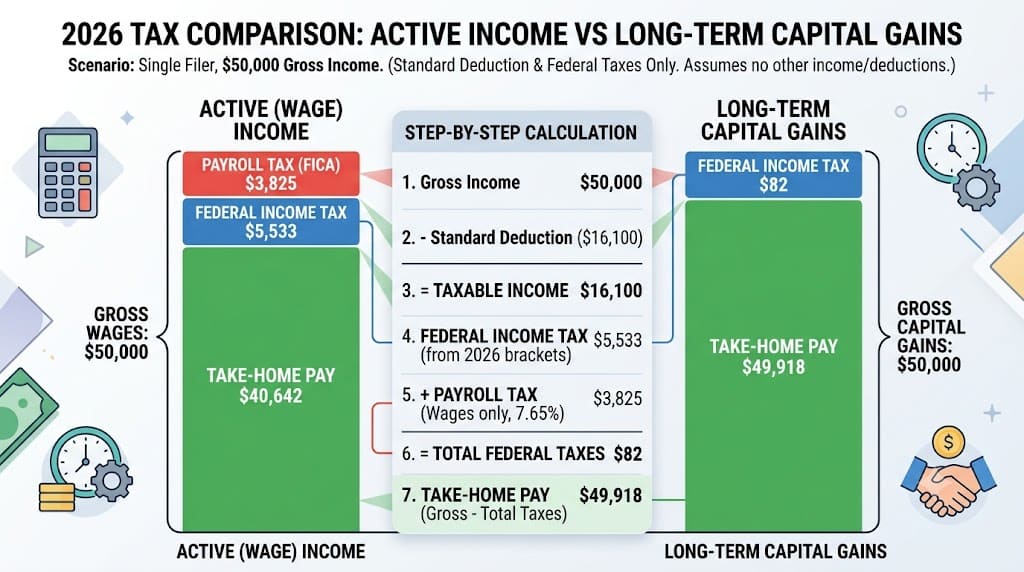
A quick example. Say you’re single, and in 2026 your taxable income (after the $16,100 standard deduction) sits at $83,900 from your job alone. If you also sell an investment held over a year for a $50,000 long-term gain, that gain stacks on top of your ordinary income. Because your combined income stays under the $545,500 threshold for the top capital gains bracket, the whole $50,000 gets taxed at just 15%, not your marginal wage rate. That gap, between what your salary gets taxed at and what a long-held investment gets taxed at, is the entire reason people chase portfolio and passive income once they’ve got some active income built up.
Pros and Cons: Which Should You Focus On?
Active income:
- Predictable and immediate
- No upfront capital required, just your time
- Ceiling is limited by hours in the day and your industry’s pay scale
- Stops the moment you stop working
Passive and portfolio income:
- Can keep paying you during a layoff, illness, or vacation
- Usually gets better tax treatment (see the table above)
- Requires real upfront capital, time, or both, before it produces anything
- Less predictable month to month, especially with rental vacancies or market swings
I don’t think one is objectively “better.” Building passive income without any active income first is nearly impossible for most people. You need the job or the business to fund the rental down payment or the brokerage account. The real goal, and this is the part most listicles skip, is using active income to deliberately build passive and portfolio income over time, not treating them as competing choices.
Which Fits You Right Now?
If you’re early in your career or rebuilding savings, active income is doing exactly what it should. Focus on growing it, then redirect a chunk toward an index fund or a high-yield savings account before worrying about “passive income streams” as a whole category.
If you already have 3 to 6 months of expenses saved and some investing experience, that’s usually when dividend investing or a first rental property starts making sense.
If you’re already living partly or fully off passive and portfolio income, the tax planning table above becomes genuinely worth a conversation with a tax professional, since NIIT and the capital gains brackets start to matter a lot more at that stage.
Key Takeaways
- Active income is money earned by trading time for pay right now, like wages, freelance work, or commissions, and it stops when you stop working.
- Passive income requires upfront effort or capital but keeps paying with minimal ongoing involvement, through sources like rental income, royalties, or dividends.
- Portfolio income, from stocks, bonds, and capital gains, is technically a third IRS category separate from passive income, even though people commonly lump it in with passive income.
- Long-term capital gains and qualified dividends get preferential 2026 federal tax rates of 0%, 15%, or 20%, compared to ordinary income rates up to 37% on active income.
- High earners with significant investment income may owe an additional 3.8% Net Investment Income Tax on top of standard rates once MAGI exceeds $200,000 (single) or $250,000 (married filing jointly).
Frequently Asked Questions
What are 5 examples of active income?
Salaried employment, freelance or consulting work, gig work like rideshare driving, sales commissions, and performance bonuses are all common examples of active income.
What is an example of passive income?
Rental income from a property, dividends from stocks, interest from a high-yield savings account, and royalties from a book or song are common examples of passive income.
Is passive income the same as portfolio income?
Not exactly. Portfolio income, from interest, dividends, and capital gains, is technically its own IRS category, separate from passive income like rental or royalty income, even though both feel “hands off” day to day.
Active income vs passive income, which is better?
Neither is objectively better. Active income is more predictable and requires no upfront capital, while passive income often gets better tax treatment but usually needs active income to fund it first. Most financially secure people rely on a mix of both.
How can I make $1,000 a month passively?
Realistically, this usually takes either a meaningful investment portfolio (roughly $200,000 to $300,000 in dividend-paying assets at typical yields), a paid-off or near-paid-off rental property, or a scaled digital product with an existing audience. There’s rarely a shortcut that skips the upfront capital or work.
One Next Step
If self-employment or freelance work is part of your active income mix, run your actual numbers through FinToku’s US Business Federal Income Tax Calculator before you file, so there are no surprises on what you owe.
(If you’re weighing a book or platform to get started with dividend or index investing on the passive side, a beginner-friendly investing book I’d point a friend toward is a solid place to start. Quick heads up, that’s an affiliate link, so FinToku may earn a small commission if you buy through it. Full details in our Affiliate Disclosure.)
Disclaimer
This article is for general informational purposes only and shouldn’t be taken as financial, tax, or legal advice. The tax brackets and example numbers above reflect 2026 federal figures, but everyone’s actual situation, state taxes, and filing details differ. Before making a real decision based on the capital gains or NIIT figures here, it’s worth checking with a qualified tax professional who can look at your specific numbers. You can also read FinToku’s full Financial Disclaimer.
Published by Saad Faisal for FinToku (fintoku.com) · Published July 24, 2026 · Updated July 24, 2026 FinToku publishes free, no-signup finance calculators and practical money guidance.