

Most self-employed workers don’t lose money on taxes because they didn’t earn enough. They lose it because they never matched their expenses against the full list of tax deductions for self-employed workers the IRS allows.
Sole proprietors, freelancers, and 1099 contractors can deduct any business expense that’s “ordinary and necessary” for their work, per the IRS Schedule C instructions. That covers your home office, vehicle mileage, health insurance, retirement contributions, and even half of your self-employment tax. Below is the full list for the 2026 tax year, with the current IRS numbers attached to each one.
Tax Deductions for Self-Employed Workers: What Counts as a Deductible Business Expense?
A tax-deductible business expense is any cost the IRS considers ordinary and necessary. “Ordinary” means common in your line of work. “Necessary” means helpful for earning your income. Self-employed workers report these on Schedule C of Form 1040. Every one you claim lowers the taxable income you pay tax on that year.
This isn’t a small list, either. Self-employed workers routinely underclaim by thousands of dollars a year. Vehicle costs, home office expenses, and retirement contributions alone add up fast, and most people simply don’t know a deduction existed. Here’s what to actually look for.
1. Home Office Deduction
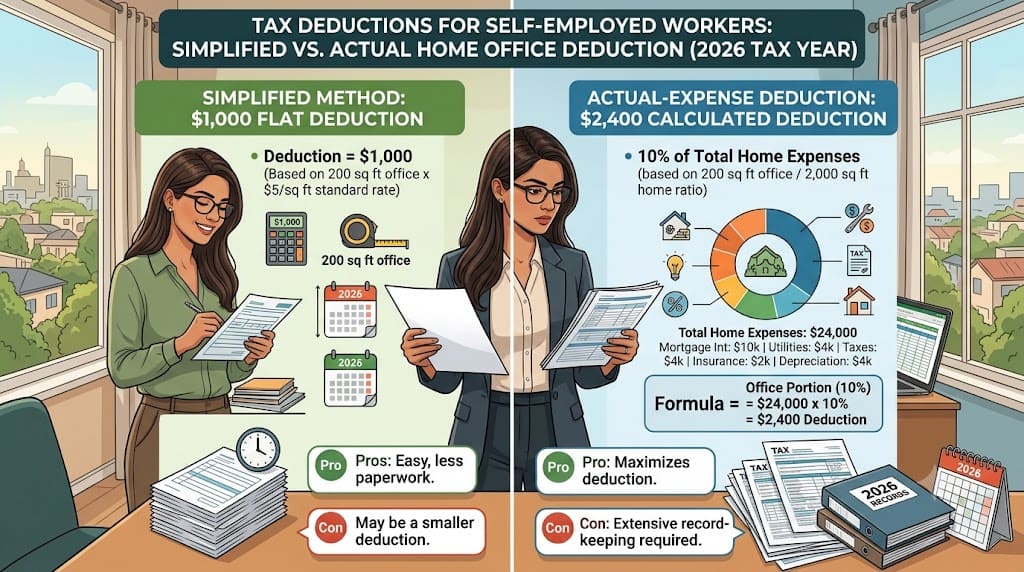
If you use part of your home regularly and exclusively for your business, you can deduct a portion of your housing costs. There are two ways to calculate it. It’s worth running both before you pick one.
The simplified method multiplies your office’s square footage (up to 300 square feet) by $5, capping the deduction at $1,500. No receipts required. The actual expense method works differently. You deduct the business-use percentage of your mortgage interest or rent, utilities, insurance, repairs, and property taxes, on Form 8829. It takes more record-keeping. But it usually produces a bigger deduction if your home office takes up a meaningful chunk of your square footage.
2. Vehicle and Mileage Deduction
Business use of your personal car, truck, or van is deductible. This includes driving to a client meeting or picking up supplies. You have two options here too.
The standard mileage rate for 2026 is 72.5 cents per mile from January through June. It jumps to 76 cents per mile for the second half of the year. Multiply your business miles by the applicable rate and add any parking or tolls. The actual expense method deducts the real cost of gas, insurance, repairs, and depreciation. You split it between business and personal use based on miles driven. Whichever method you pick, keep a mileage log. It’s the first thing an auditor asks for.
3. Health Insurance Deduction
Self-employed workers can generally deduct 100% of the health insurance premiums they pay for themselves, a spouse, and dependents. This applies as long as you’re not eligible for coverage through an employer-sponsored plan (your own or a spouse’s). You claim it on Schedule 1, not Schedule C. That means it reduces your income even if you take the standard deduction.
Long-term care insurance premiums count too, though the deduction is capped by age. For 2026, the caps run from $500 (age 40 or younger) up to $6,200 (age 71 or older). File this on Form 7206.
4. Retirement Contributions Deduction
Contributions to a SEP IRA, SIMPLE IRA, or Solo 401(k) reduce your taxable income while you save for retirement. The IRS-announced limits went up for 2026.
A Solo 401(k) lets you contribute up to $24,500 as an employee. Add an $8,000 catch-up if you’re 50 or older, or $11,250 if you’re 60 to 63. As the employer, you can also add a profit-sharing contribution. The combined employee-and-employer limit is $72,000 for 2026. A SEP IRA lets you contribute up to 25% of your net self-employment income, subject to that same overall cap. Retirement planning can feel like a separate project from taxes, but it isn’t. This is one of the few deductions where saving money and lowering your tax bill are the same action.
5. Self-Employment Tax Deduction
The self-employment tax rate is 15.3%: 12.4% for Social Security and 2.9% for Medicare, on top of regular income tax. It exists because you’re paying both the employee and employer share yourself, unlike a W-2 employee.
The good news: you can deduct half of what you pay in self-employment tax. You calculate it on Schedule SE and claim it on Schedule 1. One catch: an extra 0.9% Medicare tax kicks in above certain thresholds. That’s $200,000 for single filers or $250,000 for married filing jointly, and it applies only to income above the limit.
6. Qualified Business Income (QBI) Deduction
The QBI deduction lets eligible self-employed people write off up to 20% of their qualified business income. This comes on top of their regular business expense deductions. You claim it directly on Form 1040 using Form 8995 or 8995-A, not on Schedule C.
Full eligibility phases out at higher income for certain service-based businesses, like law, accounting, and consulting. The exact thresholds shift each year, so check the current figures before you file. Starting with the 2026 tax year, there’s also a new minimum QBI deduction of $400. It applies to anyone with at least $1,000 in qualified business income, even if the standard 20% calculation lands lower.
7. Business Travel and Meals Deduction
Travel expenses are fully deductible when you’re away from your tax home for business. This includes flights, hotels, taxis, and related costs like dry cleaning or baggage fees. Meals are trickier. You can generally deduct 50% of the cost of a business meal, whether that’s a client dinner or food during a work trip. Two conditions apply: the meal can’t be “lavish or extravagant,” and you or an employee must actually be present.
If you’d rather not save every meal receipt, there’s a simpler option. The standard meal allowance is a straightforward alternative to tracking actual costs. It’s based on GSA per diem rates for where you’re traveling.
8. Startup Costs Deduction
Money you spend getting your business off the ground is deductible up to $5,000 in your first year. This covers costs before you technically start operating. Things like market research, consulting fees, and early advertising all qualify. That $5,000 cap shrinks dollar-for-dollar once your total startup costs pass $50,000. You write off whatever you can’t deduct upfront gradually, over 15 years.
More Deductions Self-Employed Workers Often Miss
These don’t always get their own headline, but they add up:
- Business insurance: Premiums for liability, malpractice, or business-interruption insurance are generally deductible.
- Office supplies: Everyday items like paper, postage, and printer ink, deducted in the year you use them.
- Phone and internet: Deduct the business-use percentage of your bill. If you use your phone 40% for work, you deduct 40% of the bill.
- Advertising and marketing: Website costs, business cards, and ad spend aimed at bringing in work.
- Work-related education: Courses or certifications that maintain or improve skills you already use. This excludes courses that qualify you for a brand-new trade.
- Interest on business debt: Interest on a business credit card or loan used for business purposes.
- Depreciation and Section 179: For equipment and property with a useful life over one year, you can often deduct the full cost upfront. The Section 179 limit for 2026 is $2.56 million, phasing out once total purchases exceed $4.09 million. Bonus depreciation currently lets you deduct 100% of qualifying property the year you buy it.
- Charitable contributions: Deductible if you itemize. Starting in 2026, non-itemizers can also deduct up to $1,000 (single) or $2,000 (married filing jointly) in cash donations.
2026 Self-Employed Tax Deduction Numbers at a Glance
| Deduction | 2026 figure | Where it’s claimed |
|---|---|---|
| Self-employment tax rate | 15.3% (half deductible) | Schedule SE / Schedule 1 |
| Standard mileage rate | 72.5¢/mile (Jan–Jun), 76¢/mile (Jul–Dec) | Schedule C |
| Home office (simplified method) | $5/sq ft, up to 300 sq ft ($1,500 max) | Schedule C |
| Solo 401(k) employee contribution | $24,500 ($32,500 if 50+; $35,750 if 60–63) | Schedule 1 |
| Combined Solo 401(k)/SEP IRA limit | $72,000 | Schedule 1 |
| Section 179 expensing limit | $2.56 million (phases out above $4.09M) | Form 4562 |
| Non-itemizer charitable deduction | $1,000 single / $2,000 joint (cash only) | Form 1040 |
Figures reflect 2026 tax year rules as of publication. Confirm current limits with the IRS or a tax professional before filing, since several of these adjust annually.
Common Mistakes That Cost Self-Employed Workers Money
A few patterns show up again and again in how self-employed workers lose deductions:
Mixing personal and business spending. Running both through one bank account makes it nearly impossible to reconstruct a clean expense list at tax time. It’s the fastest way to lose a deduction you actually earned.
Skipping the mileage log. The IRS wants contemporaneous records, not a number you reconstruct in March. A simple notes app entry after each trip beats trying to remember months later.
Forgetting quarterly estimated payments. Deductions lower what you owe, but they don’t remove the requirement to pay as you go. Underpaying throughout the year can mean a penalty even if your final return shows a refund.
Assuming a deduction doesn’t apply because it seems too small. Office supplies, a portion of your phone bill, professional memberships: none of these move the needle alone. Together, they add up to more than people expect. I tested this on my own numbers. I ran a rough version of my Schedule C through FinToku’s US Business Federal Income Tax Calculator before writing this. The combined effect of the smaller deductions was what actually surprised me.
Key Takeaways
- Self-employed workers can deduct home office costs, vehicle mileage, health insurance, retirement contributions, and half of their self-employment tax. You report these across Schedule C, Schedule SE, and Schedule 1.
- The 2026 standard mileage rate is 72.5 cents per mile for the first half of the year. It’s 76 cents per mile for the second half.
- The Solo 401(k) contribution limit for 2026 is $24,500 as an employee. Add an $8,000 catch-up at 50+, or $11,250 for ages 60–63. The combined employee-and-employer cap is $72,000.
- The Section 179 expensing limit for 2026 is $2.56 million. That lets many self-employed workers deduct equipment costs in full the year they buy it.
- Mixing personal and business expenses is one of the most common reasons self-employed workers underclaim deductions they’ve earned.
Frequently Asked Questions
What can you write off on your taxes if you’re self-employed?
You can generally write off any expense that’s ordinary and necessary for your business. That includes home office costs, vehicle mileage, and health insurance premiums. It also includes retirement contributions, business insurance, supplies, and half of your self-employment tax.
What tax deductions can I claim as a 1099 worker?
The same deductions apply whether people call you a freelancer, independent contractor, or 1099 worker. You report income and expenses on Schedule C regardless of the label. The deduction list above applies in full.
Are self-employed tax deductions different from small business tax deductions?
Mostly not. A sole proprietor is a small business for tax purposes, so the deductions overlap heavily. The differences show up mainly around employee-related deductions (wages, benefits) if your business has grown to include staff.
Can I deduct tax prep or accounting software as self-employed?
Yes. You can deduct fees for tax preparation, accounting software, and bookkeeping services related to your business as ordinary business expenses on Schedule C.
What’s the easiest way to track self-employed tax deductions?
Keep business and personal spending in separate accounts. Log mileage as you drive rather than at year-end, and save digital receipts as you go. A dedicated bookkeeping app or spreadsheet updated monthly beats a shoebox of paper in April.
Want a rough sense of where your numbers land before you file? FinToku’s US Business Federal Income Tax Calculator is a fast way to estimate your federal tax liability after these deductions.
Read More
- Tax Planning Checklist 2026: What to Review Before You File
- Can I Contribute to Both IRA and 401k? (2026 Limits Explained)
- Small Business Loans: How They Work and How to Qualify
Disclaimer
This article is for general informational purposes only and shouldn’t be taken as tax or financial advice. The figures above reflect 2026 rules as of publication. Contribution limits, mileage rates, and thresholds adjust every year. Double-check current numbers against the IRS or a tax professional before you file. Everyone’s business is different. A qualified tax preparer who can see your actual return will always be more accurate than a general list. You can read FinToku’s full Financial Disclaimer for more.
Published by Saad Faisal for FinToku (fintoku.com) · Published July 23, 2026 · Updated July 23, 2026 FinToku provides free finance tools and guides to help you make smarter money decisions.