

I didn’t open a retirement account until I was 26. Not because nobody told me to, but because “retirement planning” sounded like something for people with mortgages and minivans, not someone still splitting rent three ways. Looking back, that gap between 22 and 26 probably cost me more than any other financial decision I’ve made since.
Retirement planning in your 20s comes down to three moves: build a small emergency cushion, capture any employer 401(k) match you’re offered, and open a Roth or traditional IRA even if you can only fund it with $50 a month. The exact amount matters far less than starting now, because money invested in your 20s has 35 to 40 years to compound before you need it.
Why your 20s carry more weight than they feel like they do
Compounding is the reason a small amount saved at 25 can outgrow a much larger amount saved at 35. As the SEC’s investor education office explains, each year your investments grow, that growth itself starts earning returns, so the earliest dollars you invest end up doing the most work over a lifetime.
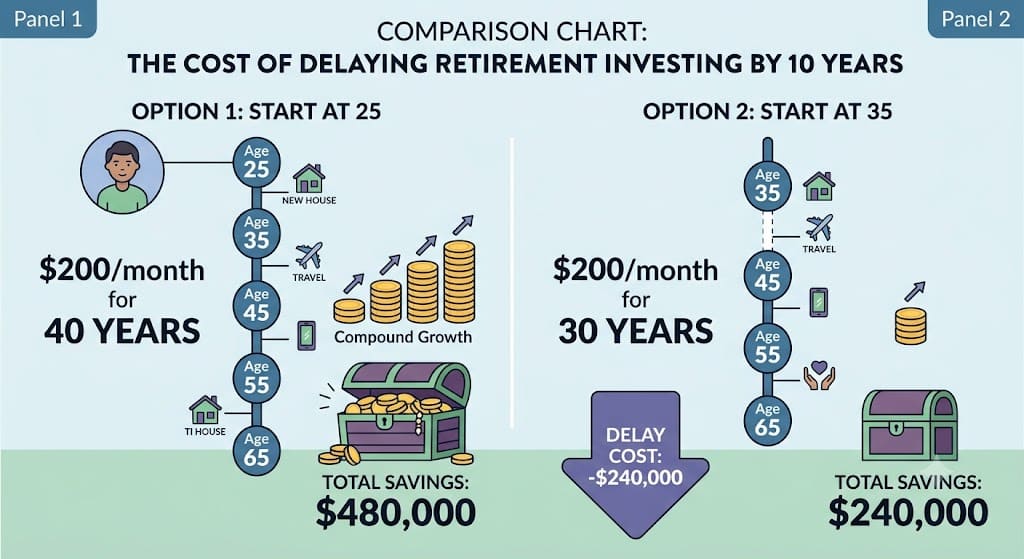
Here’s the math nobody shows you in plain numbers. Someone who invests $200 a month starting at 25, earning a 7% average annual return, reaches roughly $525,000 by 65. Wait until 35 to start, and you’d need to invest more than double that each month, about $430, to land in the same place. The ten years you “saved” by putting it off cost you real money, not just time.
That 7% isn’t a random guess. The S&P 500 has returned close to 10% a year on average since 1928, or around 7% once you adjust for inflation, though any single year can swing wildly in either direction.
The cost of waiting, in dollars
| Start age | Monthly contribution | Value at 65 (7% avg. return) |
|---|---|---|
| 25 | $200 | ~$525,000 |
| 30 | $200 | ~$360,000 |
| 35 | $200 | ~$244,000 |
| 35 | $430 | ~$525,000 |
Illustrative example, not a guarantee. Assumes a 7% average annual return with monthly contributions and no withdrawals. Actual returns vary and can be negative in any given year.
Run your own numbers with FinToku’s Budget Planner & 50/30/20 Calculator first, since how much you can actually invest depends on what’s left after rent, debt, and everything else.
Build the base before you build the portfolio
Retirement accounts work best when you’re not tempted to raid them the first time your car breaks down. Two things come before “start investing for retirement,” not after.
Get rid of high-interest debt first. If you’re carrying credit card debt at 20%+ APR, paying that down usually beats any realistic investment return. There’s no retirement strategy that outruns a balance compounding against you at that rate.
Keep three to six months of expenses somewhere accessible. FINRA puts this range forward specifically so an emergency doesn’t force you to sell investments at a bad time, or worse, pull money out of a retirement account early and eat the penalty. A high-yield savings account works fine here. FinToku’s guide to high-yield savings accounts for students is a decent starting point if you’re not sure where to park it.
Once those two are in place, retirement contributions stop feeling like a risk and start feeling like the obvious next step.
Where retirement money actually goes: 401(k) and IRA basics
A 401(k) is an employer-sponsored retirement account that lets you contribute directly from your paycheck, often with a partial match from your employer. An IRA (Individual Retirement Account) is one you open yourself, outside of work, with its own separate contribution limit and tax treatment.
If your employer offers a 401(k) match, contribute at least enough to get the full match before doing anything else with your investable income. A 50% match on the first 6% of your salary is an instant 50% return before your money has even touched the market. I’ve never seen an argument for skipping that.
2026 contribution limits (as of January 2026):
| Account | 2026 limit | Catch-up (age 50+) |
|---|---|---|
| 401(k) employee contribution | $24,500 | +$8,000 |
| Traditional or Roth IRA (combined) | $7,500 | +$1,100 |
Source: IRS, 401(k) limit increases to $24,500 for 2026, IRA limit increases to $7,500, November 2025.
Most people in their 20s won’t come close to maxing either account, and that’s fine. The limit is a ceiling, not a target.
Traditional vs. Roth: which one fits your 20s
| Traditional (401(k) or IRA) | Roth (401(k) or IRA) | |
|---|---|---|
| Tax break | Now (contributions reduce taxable income) | Later (withdrawals in retirement are tax-free) |
| Best fit if | Your tax rate now is higher than it’ll likely be in retirement | You’re in a lower tax bracket now than you expect later |
| 2026 IRA income limit | None for contributing (deduction may phase out) | Phases out $153,000–$168,000 MAGI, single filers |
For most people in their 20s, income is on the lower end of their career earning curve, which is exactly why a Roth tends to get recommended so often at this age. You pay tax on that income now, while your rate is probably lower than it’ll be later, and every dollar of growth comes out tax-free decades from now. It’s not universally the right call (someone in a high tax bracket at 27 might lean traditional), but it’s the reasonable default for a lot of 20-somethings.
If you’re weighing whether to split contributions between the two, FinToku has a full breakdown in Can I Contribute to Both IRA and 401k?
How aggressive should your investments actually be
Time is the advantage you have right now that you won’t have again. A 25-year-old can absorb a market crash and still have 30+ years for the recovery to play out. A 60-year-old five years from retirement doesn’t have that same runway.
A common starting rule is “100 minus your age” for a rough stock allocation percentage, which puts a 25-year-old around 75% stocks and a 30-year-old around 70%. It’s a blunt tool, not gospel, and plenty of younger investors go higher than the formula suggests. Your actual risk tolerance, job stability, and how you’d genuinely react to a 30% drop in your account matter more than any formula.
What that usually looks like in practice for someone in their 20s:
- A large majority in stocks, often through a low-cost, broadly diversified index fund rather than individual stock picking
- A small bond or cash allocation, mostly for psychological ballast rather than growth
- Rebalancing once a year, not every time the market has a bad week
Chasing whatever’s trending on social media isn’t a strategy. It’s the single fastest way to turn a decades-long advantage into a short-term gamble.
What if you genuinely can’t invest much right now
This is where a lot of guides quietly go silent, but it’s the actual situation for plenty of people in their 20s: rent went up, student loans are due, and $200 a month sounds like a fantasy.
Start smaller than feels meaningful. $25 a month into a Roth IRA isn’t going to fund your retirement on its own, but it builds the habit and the account, and both are worth more than the dollar amount suggests. Increase it by 1% of your income every time you get a raise, before that extra money quietly disappears into a nicer apartment or more takeout. Many brokerages also let you buy fractional shares, so a small contribution still buys diversified exposure instead of sitting in cash waiting to afford a full share.
The habit matters more than the number for the first few years. The number catches up once your income does.
Common mistakes people make in their 20s
Waiting for “enough” money to start. There isn’t a magic threshold. The account that exists and gets $50 a month beats the perfect plan you’ll start “next year.”
Mixing emergency savings with retirement savings. Don’t let a car repair turn into an early 401(k) withdrawal. The penalty and lost growth both cost more than the repair.
Ignoring the employer match. Turning down free money to keep slightly more take-home pay is, mathematically, one of the worst trades available to you.
Overreacting to a bad year. Markets drop. Selling during a downturn locks in a loss that a longer time horizon would likely have recovered from.
Key Takeaways
- Retirement planning in your 20s means an emergency fund, paying off high-interest debt, and starting retirement contributions early, in that order.
- A 25-year-old investing $200 a month can end up with roughly double what a 35-year-old investing the same amount ends up with by 65, purely from the extra decade of compounding.
- For 2026, the 401(k) employee contribution limit is $24,500 and the combined IRA limit is $7,500, per the IRS.
- If your employer offers a 401(k) match, contribute enough to capture the full match before funding anything else.
- Starting small (even $25-50 a month) beats waiting until you can “do it properly.”
Frequently Asked Questions
How aggressively should I invest in my early 20s?
Most people in their 20s can reasonably hold a stock-heavy portfolio, commonly in the 70-85% stocks range, since decades of time horizon can absorb short-term market drops. Your specific comfort with volatility and job stability should still shape the exact mix.
What are the best investments for someone in their early 20s?
Low-cost, broadly diversified index funds or target-date funds inside a 401(k) or Roth IRA are the most common starting point, since they spread risk across hundreds of companies without requiring you to pick individual stocks.
Is $50,000 saved by 25 good?
It’s well ahead of most 25-year-olds and puts you in a strong position, but “good” depends more on your income, debt, and goals than a single benchmark number. What matters more is whether your savings rate is sustainable going forward.
What if I invest $1,000 a month for 20 years?
At a 7% average annual return, $1,000 invested monthly for 20 years grows to roughly $520,000, of which about $240,000 is your own contributions and the rest is growth. Actual results depend entirely on real market performance over that period, which won’t move in a straight line.
Why is investing considered more powerful than just saving for long-term wealth?
Savings accounts preserve money but barely outpace inflation. Investing exposes your money to growth (and risk) that has historically outpaced inflation by a wide margin over long periods, which is what actually builds wealth rather than just protecting it.
If you’re still deciding where the money should live day to day, run your paycheck through FinToku’s Paycheck Calculator to see what’s realistically left over each month before you commit to a contribution amount.
Read More
- Can I Contribute to Both IRA and 401k? (2026 Limits Explained)
- Can I Retire With $1 Million? Here’s How to Check Your Own Number
- How Much Money Do You Need to Retire?
Disclaimer
This article is for general informational purposes only and shouldn’t be taken as financial, tax, or legal advice. Everyone’s situation is different, and the contribution amounts and growth figures used above are illustrative examples, not guarantees or promises of future returns. Before opening a retirement account or changing your investment mix, it’s worth checking with a qualified financial advisor or tax professional who can look at your specific situation. You can also read FinToku’s full Financial Disclaimer.
Published by Saad Faisal for FinToku (fintoku.com) · Published July 22, 2026 · Updated July 22, 2026 FinToku provides free finance tools and guides to help you make smarter money decisions.