

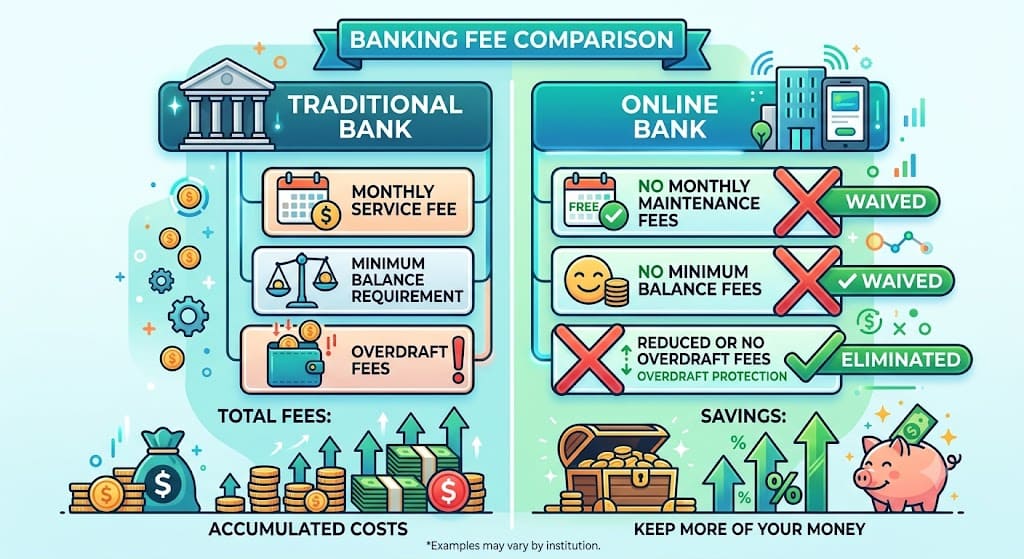
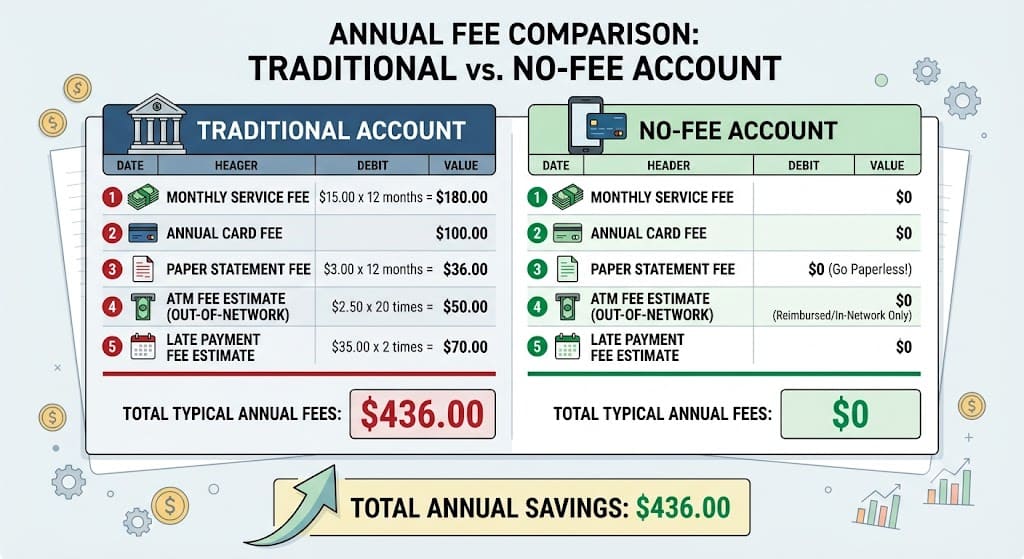
A $12 monthly maintenance fee doesn’t sound like much until you add it up. That’s $144 a year, gone, for the privilege of holding your own money in an account you already funded. Online banks figured out they didn’t need to charge for that. It’s why fintech checking accounts have basically reset what people expect a “normal” bank account to cost.
The short answer: SoFi, Capital One, Ally, NBKC, Chime, and Axos all currently offer checking accounts with no monthly fee, no minimum balance, and no minimum deposit to open. Which one fits you depends on what you actually care about, whether that’s earning interest, ATM access, a hybrid online-plus-branch setup, or just getting approved without a hard credit check. I’ll break down all of that below, plus the fees that can still show up even on a “free” account.
What Actually Counts as a “No Monthly Fee” Account?
“No monthly fee” is a little more slippery than it sounds. Usually it means the bank won’t charge a flat maintenance fee just for keeping the account open, and won’t tie that waiver to a minimum balance or a set number of monthly deposits. It doesn’t mean every possible fee disappears, though. Overdrafts, wire transfers, and paper checks are a separate conversation, and I’ll get into those further down.
The Best Online Banks With No Monthly Fees Right Now
Here’s how the current field stacks up. Rates change often, so treat the APYs below as a snapshot rather than gospel, and double-check the bank’s site before you apply.
| Bank | Monthly fee | APY (as of July 2026) | Minimum deposit | Fee-free ATM network |
|---|---|---|---|---|
| SoFi Checking and Savings | $0 | 0.50% | $0 | 55,000+ Allpoint |
| Capital One 360 Checking | $0 | 0.10% | $0 | 70,000+ (Capital One, Allpoint, MoneyPass) |
| Ally Bank Interest Checking | $0 | Varies by balance tier | $0 | 75,000+ (Allpoint, MoneyPass) |
| NBKC Everything Account | $0 | 1.75% | $0 | 90,000+ (MoneyPass, Allpoint) |
| Chime Checking Account | $0 | N/A (no interest) | $0 | 47,000+ |
| Axos Essential / Rewards Checking | $0 | Up to 3.30% with requirements | $0 | Unlimited domestic ATM fee reimbursement |
Sources: rates checked directly against each bank’s own rate page as of July 19, 2026, cross-referenced against NerdWallet’s and Forbes Advisor’s most recent checking-account roundups. A quick note on reading other roundups: several third-party sites conflate a bank’s savings APY with its checking APY. SoFi’s savings side, for instance, has run anywhere from 3.10% to 4.50% across different bonus periods, while its checking side has stayed steady at 0.50%. The figures above are checking-account rates specifically. APYs on tiered or requirement-based accounts (Ally, Axos) will vary based on your balance and activity, so check the bank’s own rate page for your exact number before applying.
A couple of these are worth a closer look.
SoFi Checking and Savings
SoFi bundles checking and savings into one account. Your whole balance earns interest instead of just the savings side, which is unusual. Most banks silo your spending money away from anything that pays a real rate.
There’s a real tradeoff, though. You can’t open just a checking account or just a savings account on its own; they come as a pair. That’s not the setup for anyone who wants the two kept fully separate. On the plus side, SoFi offers extra FDIC coverage through a deposit sweep program, running up to $3 million, well beyond the standard $250,000. That extra coverage matters if you’re parking a larger cash cushion.
Capital One 360 Checking
Capital One is the closest thing on this list to a hybrid. It runs like an online bank, with no monthly fee and no minimum balance. But it also keeps actual Capital One Cafés open in some cities, handy if you ever want a human and a coffee instead of an app. It has one of the broader ATM footprints here too, with fee-free access across three networks totaling more than 70,000 machines.
Ally Bank
Ally leans hard into budgeting tools rather than chasing the highest APY. Its “buckets” feature lets you split savings into labeled goals, and the checking side mirrors that with spending categories. Maybe you’ve tried three budgeting apps and given up on all of them. Having that structure built right into the account is worth something in that case.
Ally backs this up with real numbers too. It reimburses up to $10 per statement cycle in out-of-network ATM fees, on top of its own 75,000-ATM network, and it charges no overdraft fees at all.
NBKC Everything Account
NBKC calls it the “Everything Account” because that’s exactly the job it does, built to replace both checking and savings in one place. It backs that up with one of the higher APYs on this list at 1.75%, with no balance requirement to earn that rate. You also get access to more than 90,000 fee-free ATMs, plus up to $12 a month in reimbursements for the ones outside that network.
The catch: NBKC doesn’t run an overdraft program at all. If a transaction would overdraw the account, the bank simply declines it. For some people that’s a safety feature. For others it’s a dealbreaker.
Chime
Chime shows up constantly in searches for “no credit check” checking accounts, and it’s earned that reputation. It’s technically a financial technology company, not a bank itself; the underlying accounts actually sit with Bancorp Bank or Stride Bank, both FDIC members. Approval typically skips a hard credit inquiry, too, a big deal if you’re rebuilding your banking history after a rough patch with a previous account.
Chime’s SpotMe feature also lets qualifying members overdraw up to $200 without a fee. On top of that, you get access to more than 47,000 free ATMs, plus the option to get direct deposit up to two days early.
Axos Bank
Axos is the one to look at if ATM fees specifically are your pain point. Its checking accounts reimburse ATM fees from other banks without a cap, which is rare. Most competitors on this list either limit that reimbursement to a dollar amount per month or skip it entirely.
Axos also runs a Rewards Checking tier currently paying up to 3.30% APY, a genuinely strong rate for a checking account. Getting there takes some work, though. You’ll need to clear several requirements at once: a minimum direct deposit, a set number of debit card transactions, and sometimes a minimum balance in a linked Axos Invest account. Miss one and the rate steps down accordingly. Read the tier structure closely before assuming you’ll land on the top number. One more thing worth knowing: Axos skips the hard credit inquiry for checking or savings, though it may still check ChexSystems for your prior banking history.
The Fees That Can Still Sneak In
None of the accounts above charge a monthly maintenance fee, but “fee-free” and “free of every possible fee” aren’t the same claim. Based on the disclosures across these banks, here’s what still shows up most often:
- Wire transfers. Domestic outgoing wires commonly run $5 to $30 even at fee-light banks, and international wires cost more.
- Paper checks. Some accounts include your first batch free and charge for reorders; a few don’t support paper checks at all.
- Out-of-network ATM withdrawals. “Fee-free network” only covers the ATMs inside that network. Step outside it, and the machine’s owner can still charge you, even if your own bank doesn’t.
- Stop payment requests. Usually a flat fee, often $15 to $25, if you need to cancel a check after it’s written.
- Cash deposit fees at retail partners. A few fintech apps let you deposit cash at retail locations, but charge a small fee unless you use one of their designated free partners.
None of this cancels out the value of skipping a $10 to $15 monthly fee. It’s just worth reading the actual fee schedule first, usually a PDF at the bottom of the account page, rather than assuming “no monthly fee” means zero possible charges.
How to Open One (About 10 Minutes, Realistically)
Opening one of these accounts online follows roughly the same steps everywhere:
- Pick the account and start the application on the bank’s own site, not through a search ad or a third-party comparison page.
- Provide your Social Security number, a government photo ID, and your current address. Most banks verify this instantly.
- Fund the account if you want to start using it right away. Several banks here let you open with $0 and fund later, though a small initial transfer speeds up debit card issuance.
- Set up direct deposit if the account rewards it. SoFi and Axos both tie better rates to it.
- Order a physical debit card if the bank didn’t issue one automatically, and enable a virtual card in the meantime if the app offers one.
Did a ChexSystems report get you rejected elsewhere? Try Chime or a similar fintech account first, since they typically don’t run the same screening traditional banks use.
Is Your Money Actually Safe at an Online Bank?
Yes, with the same caveat that applies to any bank. The FDIC insures every account listed here up to $250,000 per depositor, per ownership category, either directly or through the bank’s partner institution. Chime, for example, gets that coverage through its partner banks rather than as a bank itself. You can confirm any institution’s coverage through the FDIC’s BankFind tool.
Online banks don’t have branches, so there’s no in-person fraud recovery conversation if something goes wrong. What they do have instead is 24/7 phone or chat support at most of the banks above. They also run the same encryption and two-factor authentication standards as brick-and-mortar banks. The risk profile is different here, not necessarily worse.
What If You Actually Want a Physical Branch?
Not everyone wants to bank entirely through an app, and that’s a fair preference, not a mistake. Want the option of walking into a location once in a while? Capital One is the strongest fit on this list, thanks to its café network. Credit unions are worth a look too. Many, including the larger national ones, offer no-fee checking with branch access and ATM-sharing networks that rival the big online banks. Membership eligibility rules do vary by institution, so check that first.
Key Takeaways
- Several online banks, including SoFi, NBKC, Chime, and Ally, currently offer checking accounts with no monthly fee, no minimum balance, and no minimum opening deposit.
- “No monthly fee” doesn’t mean no fees at all. Wire transfers, paper checks, and out-of-network ATM withdrawals can still cost extra depending on the bank.
- The FDIC insures every account on this list up to $250,000 per depositor, either directly or through a partner bank, the same protection traditional banks carry.
- Chime and similar fintech accounts typically skip the hard credit check that keeps some applicants out of traditional bank accounts, making them a common pick for rebuilding banking history.
- If you want fee-free checking with the option of an occasional branch visit, Capital One or a local credit union is a better fit than a pure app-based account.
Frequently Asked Questions
What’s the easiest bank account to open online with no deposit? Chime, SoFi, and NBKC all let you open an account with $0 to start. Approval is typically instant for most applicants since none of them require an opening deposit.
Can I get a free checking account with no credit check? Yes. Fintech accounts like Chime generally skip the hard credit inquiry and rely less on ChexSystems screening than traditional banks do. That makes them a common choice if a past account issue has made other banks say no.
Are there banks with free checking and no minimum balance? Yes. All six accounts above waive the monthly fee with no minimum balance required. That’s now closer to the industry norm among online banks than the exception.
Do any physical banks offer checking with no monthly fees? Some do. Capital One combines online banking with a limited café network. Many credit unions also offer no-fee checking with branch access, though eligibility to join a specific credit union can vary.
Can I really open a checking account online instantly? In most cases, yes. Identity verification usually runs on automated systems and takes just a few minutes. A small share of applications still need manual review, which can take a day or two.
Once you’ve picked an account and trimmed out the monthly fee, it’s worth putting that saved money somewhere on purpose rather than letting it blend back into everyday spending. FinToku’s Budget Planner & 50/30/20 Calculator is a quick way to see where an extra $10 to $15 a month actually fits in your budget.
Read More
- Documents Needed to Open a Bank Account in the US
- Bank Account in the USA: What to Know Before You Open One
- 40+ Common Banking Terms in the U.S. Everyone Should Know (2026 Glossary)
Disclaimer
This article is for general informational purposes only; it isn’t financial advice. Rates, fees, and account terms change often. The APYs above, like Axos’s tiered 3.30% rate or NBKC’s 1.75%, reflect a snapshot as of July 19, 2026, not a guarantee of what any bank will offer you. Before opening an account, check the bank’s current rate page and fee schedule directly. You can also read FinToku’s full Financial Disclaimer.
Published by Saad Faisal for FinToku (fintoku.com) · Published July 19, 2026 · Updated July 19, 2026 FinToku provides free finance tools and guides to help you make smarter money decisions.