

A home equity line of credit, or HELOC, lets you borrow against the value you’ve built up in your home and pay it back over time, similar to how a credit card works but secured by your house instead of your creditworthiness alone. You draw money as you need it, up to a set limit, and you only pay interest on what you’ve actually used. The catch: your home is the collateral, so falling behind on payments puts it at risk.
What Is a HELOC, Exactly?
A HELOC (home equity line of credit) is a revolving line of credit secured by your home, typically capped at 80% to 85% of your home’s value minus what you still owe on your mortgage. Unlike a home equity loan, which hands you a lump sum upfront, a HELOC works more like a credit card: you draw what you need, repay it, and can borrow again during the draw period.
That’s really the whole concept in one sentence. Everything else is details, but the details matter a lot here, so let’s get into them.
How Does a HELOC Work?
Every HELOC runs through two phases. First comes the draw period, usually 5 to 10 years, when you can pull money out as needed and often only have to cover the interest each month. Then comes the repayment period, typically 10 to 20 years, when the borrowing stops and you start paying down both principal and interest.
Here’s where people get tripped up: payments during the draw period can be deceptively low. If you’re only paying interest for years and then suddenly owe principal too, that jump can catch you off guard if you haven’t planned for it. I’d honestly say this is the single most under-discussed part of how HELOCs work, more than the rates themselves.
Most HELOCs also carry a variable interest rate, tied to the prime rate. That means your payment can go up even if you haven’t borrowed a single extra dollar, simply because the broader rate environment shifted.
Current HELOC Rates (as of July 2026)
Rates move week to week, so treat this table as a snapshot rather than a locked-in number. It’s still useful for seeing roughly where things stand.
| Loan type | Rate | Basis | As of |
|---|---|---|---|
| $30,000 HELOC (national average) | 7.43% | Bankrate’s weekly lender survey, ~700 FICO, 80% CLTV | July 15, 2026 |
| HELOC, well-qualified borrowers | 7.23% | Curinos market rate index, 780+ FICO, under 70% CLTV | July 17, 2026 |
| Fixed-rate home equity loan, well-qualified borrowers | 7.36% | Curinos market rate index, 780+ FICO, under 70% CLTV | July 17, 2026 |
| HELOC APR, posted lender range | 5.95% – 10.85% | U.S. Bank’s published variable-rate range | July 6, 2026 |
A few things drive that rate you’re quoted specifically: your credit score, your combined loan-to-value (CLTV) ratio, and whether the lender offers an introductory discount for the first several months. Homeowners with scores above 700 to 740 tend to land closer to the low end of that range.
How Much Can You Borrow With a HELOC?
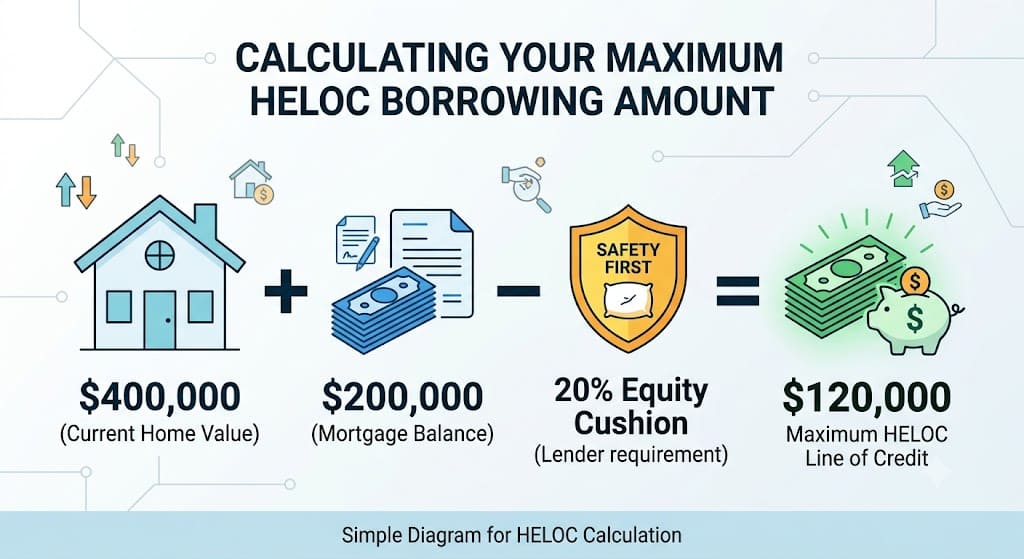
Lenders generally let you borrow up to 80% to 85% of your home’s appraised value, then subtract what you still owe on your mortgage. Say your home is worth $400,000 and you owe $220,000. At an 85% limit, you could access roughly $120,000 in equity.
That’s the math lenders run, but it’s not necessarily the number you should draw. Just because you can access $120,000 doesn’t mean you should, especially if a chunk of that would go toward something that doesn’t build value or savings, like a vacation or a car that depreciates the moment you drive it off the lot.
I ran a version of this math through FinToku’s Mortgage & Home Loan Calculator before writing this, mostly to double-check how quickly a full draw plus a rate bump would change my hypothetical monthly number. Worth doing with your own figures before you talk to a lender, not after.
HELOC vs. Home Equity Loan: What’s the Difference?
This is probably the question I get asked most, since the two products get used interchangeably in conversation but work very differently under the hood.
| HELOC | Home Equity Loan | |
|---|---|---|
| How you get funds | Draw as needed, up to a limit | One lump sum upfront |
| Interest rate | Usually variable | Usually fixed |
| Monthly payment | Can change, often interest-only during draw period | Fixed and predictable from day one |
| Best for | Ongoing or uncertain expenses (renovations in phases, emergencies) | One-time, known costs (debt consolidation, a specific project) |
| Repayment structure | Draw period, then separate repayment period | Fixed term from the start |
If you already know exactly how much you need and want a predictable payment, a home equity loan is usually the simpler fit. If your expenses are spread out or uncertain, a HELOC’s flexibility tends to win out, so long as you trust yourself not to overspend just because the credit is sitting there.
Is a HELOC a Trap? Weighing the Risks
I’ll be direct about this one, because it’s clearly something a lot of people are worried about when they search for HELOCs in the first place. A HELOC isn’t inherently a trap, but it can turn into one if you treat it like free money instead of debt secured by your house.
Here’s what actually goes wrong for people:
- The variable rate rises faster than expected. Your $400 monthly interest payment can climb to $600 or more if the prime rate jumps, and you’re still on the hook for it.
- The draw period ends and principal payments kick in. That’s often when the real payment shock hits, sometimes years after the HELOC was opened.
- Missed payments risk foreclosure. Because your home is collateral, this isn’t unsecured debt you can walk away from the way you technically could with a credit card.
- It’s easy to keep re-borrowing. Paying down the balance just to draw it right back out again defeats the purpose of using a HELOC to build financial stability.
None of this means avoid HELOCs entirely. It means go in with a repayment plan for the worst-case rate, not just the rate you were quoted on day one.
How to Qualify for a HELOC
Requirements vary by lender, but most want to see:
- A credit score of 620 or higher, though 680+ typically gets you meaningfully better rates
- At least 15% to 20% equity remaining in your home after the HELOC
- A debt-to-income (DTI) ratio under roughly 43%
- Stable, verifiable income and employment history
Lenders will also order an appraisal to confirm your home’s current value, since that number directly determines how much you can borrow.
What People Actually Use HELOCs For
The most common uses I see, roughly in order of frequency:
- Home improvements – kitchen and bathroom remodels, additions, repairs that add real value
- Debt consolidation – paying off higher-rate credit card debt with a lower HELOC rate
- Major one-time expenses – medical bills, tuition, a wedding
- Emergency cushion – having access to funds without keeping cash sitting idle
The renovation use case is the one that also comes with a tax perk, at least under current rules: interest on a HELOC used to “buy, build, or substantially improve” the home securing it can be deductible up to a combined mortgage debt limit of $750,000 ($375,000 if married filing separately), according to the IRS. Use the funds for something unrelated to the house, like paying off a car loan, and that deduction goes away.
Key Takeaways
- A HELOC is a revolving line of credit secured by your home, letting you borrow, repay, and borrow again up to a set limit during the draw period.
- The national average rate on a $30,000 HELOC was 7.43% as of July 15, 2026, according to Bankrate’s lender survey, though your actual rate depends on your credit score and loan-to-value ratio.
- Most HELOCs carry variable interest rates, so your payment can rise even if you haven’t borrowed additional money.
- A HELOC isn’t automatically a bad deal, but missed payments put your home at risk since it’s the collateral for the loan.
- HELOC interest is only tax-deductible when the funds go toward buying, building, or substantially improving the home that secures the loan.
Frequently Asked Questions
What does HELOC stand for?
HELOC stands for home equity line of credit. It’s a revolving credit line secured by your home that lets you borrow against your equity as needed, rather than in one lump sum.
What is the monthly payment on a $50,000 HELOC?
It depends heavily on your rate and whether you’re in the interest-only draw period or the repayment period. As a real example: at a 7.25% rate, interest-only payments on a fully drawn $50,000 HELOC during the draw period run about $302 a month, according to Curinos-sourced rate data. That number rises once principal payments kick in during the repayment period, and it moves whenever the underlying variable rate changes.
Is a HELOC a trap?
Not inherently, but it can function like one if you borrow more than you can comfortably repay or treat the credit line as extra income rather than debt against your house. The real risk is a rising variable rate combined with a repayment period that eventually requires principal payments, not the product itself.
How is a HELOC different from a home equity loan?
A HELOC gives you a revolving credit line you draw from as needed, usually at a variable rate. A home equity loan gives you one lump sum upfront at a fixed rate. If you want payment predictability, the loan is typically the simpler choice.
Is HELOC interest tax deductible?
Only if you use the funds to buy, build, or substantially improve the home securing the loan, and only up to a combined mortgage debt limit of $750,000 ($375,000 if married filing separately), per current IRS rules. Check with a tax professional for how this applies to your specific situation, since these rules can change.
Still weighing whether a HELOC fits your situation? Run your actual mortgage balance and home value through FinToku’s Mortgage & Home Loan Calculator first, it’s a much easier conversation with a lender once you already know your rough equity cushion.
Read More
- Best Home Loan in the US 2026: Rates by Credit Score
- How Much House Can You Really Afford? (Not What a Calculator Says)
- Unsecured Personal Loan vs. Secured Personal Loan: Which One Fits You?
- FHA Loan Requirements 2026: Credit Score, Down Payment & Limits Explained
- Mortgage & Home Loan Calculator
- Loan Comparator
- Budget Planner & 50/30/20 Calculator
Disclaimer
This article is for general informational purposes only and shouldn’t be taken as financial, tax, or legal advice. The rates and figures above are examples pulled from current lender surveys, not guarantees of what you’ll be offered. Before taking out a HELOC or home equity loan, it’s worth checking with a qualified financial advisor or tax professional who can look at your specific mortgage balance, credit profile, and goals. You can also read FinToku’s full Financial Disclaimer.
By Saad Faisal · Published July 18, 2026 · Updated July 18, 2026 (rates confirmed against live lender surveys)
Published by Saad Faisal for FinToku (fintoku.com) FinToku publishes free, no-signup finance calculators and practical money guidance.