
The first BRRRR deal I ever ran the numbers on, I got the rehab budget wrong by almost $9,000. Not because the contractor lied to me – because I forgot to ask what “rehab” actually included. I’d budgeted for paint and flooring. Nobody told me the water heater was on its last leg until it wasn’t.
That mistake taught me more about the BRRRR method than any spreadsheet ever did.
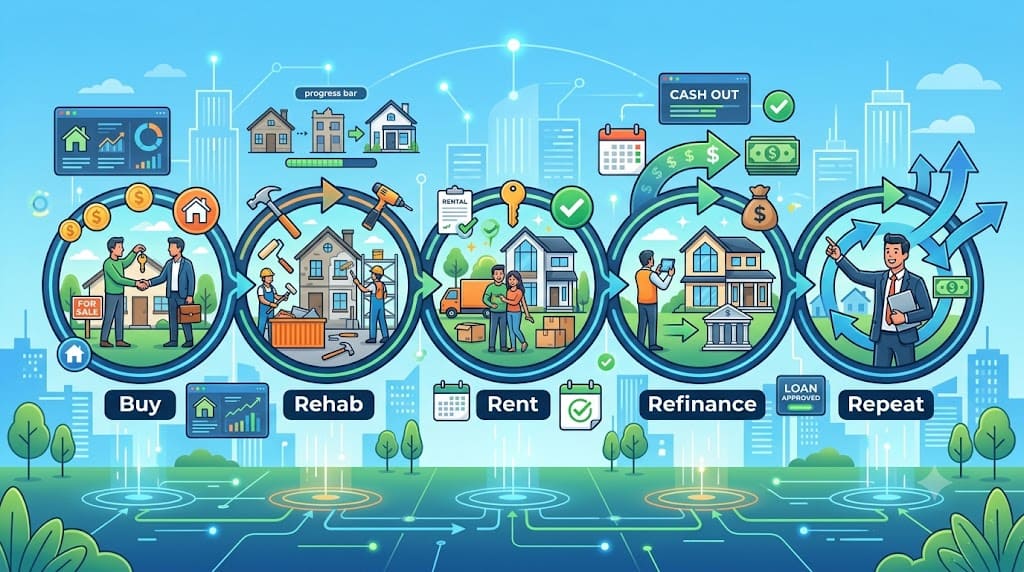
BRRRR stands for Buy, Rehab, Rent, Refinance, Repeat – a real estate strategy where you buy a property below market value and renovate it to force appreciation. You rent it to a tenant, then refinance based on the new higher value to pull your original cash back out. You use that cash to buy the next property, and the cycle repeats. Done right, it lets you build a rental portfolio without needing a fresh down payment for every single property.
That’s the pitch, anyway. Mortgage rates in 2026 are still sitting well above where they were a few years ago. The reality is a little more nuanced than the YouTube thumbnails make it sound. Let’s get into how it actually works, what it costs, and where people (myself included) get it wrong.
What Is the BRRRR Method?
The BRRRR method is a five-step real estate investing strategy – Buy, Rehab, Rent, Refinance, Repeat. An investor purchases a distressed or undervalued property and renovates it to increase its value. They rent it to a tenant, then refinance based on the new appraised value to recover most or all of the original cash invested.
The BiggerPockets community popularized the term, and it’s essentially a twist on house flipping. Instead of selling once the rehab is done, you keep the property as a rental. You use the equity you just created to fund your next deal.
The Five Steps, Broken Down
Buy
You’re not looking for move-in-ready. You’re looking for a property that’s underpriced because of its condition. It’s something a typical buyer would scroll past, but it has good bones in a rental-friendly location.
This is where the 70% rule comes in, and it’s the step that makes or breaks the whole deal. Get the purchase price wrong here and no amount of good renovation work fixes it later.
Rehab
Renovate with a purpose: raise the appraised value and the achievable rent, not just make the place look nice. Cosmetic work (paint, flooring, fixtures) usually has the best return relative to cost. Structural work (roof, foundation, systems) is sometimes unavoidable. It eats into your margin fast – that’s exactly the mistake I made on my first deal.
Get at least two contractor quotes and build in a contingency of 10-15% on top of your rehab budget. Something always comes up.
Rent
Once the rehab’s done, you rent it out at market rate to a qualified tenant. This step does double duty: it proves the property cash flows, and most lenders won’t refinance a BRRRR property until it’s actually rented. Some require a signed lease; others just want proof of occupancy.
I’d add one thing competitors tend to skip: screen harder than you think you need to. A bad tenant in month two undoes a lot of the value you just built.
Refinance
This is the step that recycles your capital. You take out a new mortgage – usually a cash-out refinance – based on the property’s new, post-rehab appraised value. If the appraisal comes in well above your purchase price plus rehab costs, the new loan can cover most or all of what you put in.
Two refinance paths show up most often for BRRRR deals:
- Conventional refinance – typically requires 6-12 months of “seasoning” (ownership time) before a lender will use the new appraised value instead of your purchase price. It usually needs a signed lease and W-2/tax-return income verification.
- DSCR loan (Debt Service Coverage Ratio) – a non-owner-occupied loan type that qualifies you based on the property’s rental income, not your personal income. Seasoning requirements are often shorter or nonexistent. These loans tend to carry a slightly higher rate than conventional financing in exchange for that flexibility.
Before you commit to either path, it’s worth running the actual numbers. I plugged a few refinance scenarios into FinToku’s Mortgage & Home Loan Calculator before writing this. Seeing how a quarter-point rate difference moved the monthly payment on a $250,000 cash-out loan made the “know your financing before you buy” advice below a lot more concrete.
Repeat
Whatever cash comes back from the refinance goes toward the next property’s down payment and rehab budget. Repeat the process.
One honest note: getting 100% of your capital back out is the exception, not the rule, especially in 2026’s rate environment. Investors call that a “full BRRRR.” Getting most of it back and ending up with a cash-flowing rental is still a win. Don’t let chasing the “perfect” BRRRR talk you out of a genuinely good deal.
The 70% Rule for BRRRR
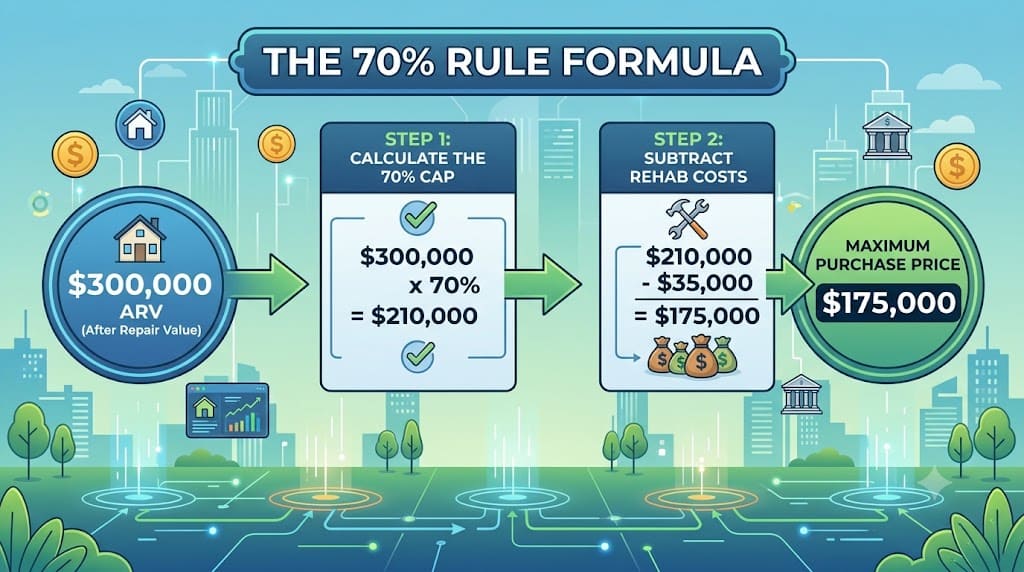
The 70% rule is a real estate investing guideline. It states that your total cost – purchase price plus rehab costs – shouldn’t exceed 70% of the property’s after-repair value (ARV). That leaves a built-in margin for profit, holding costs, and the unexpected.
The formula:
Maximum Purchase Price = (ARV × 0.70) – Rehab Costs
A Worked Example
Say you find a property that will be worth $300,000 once it’s fixed up (that’s your ARV), and you estimate the rehab at $35,000.
- Maximum total cost: $300,000 × 0.70 = $210,000
- Maximum purchase price: $210,000 – $35,000 = $175,000
If the seller wants $190,000, the deal doesn’t meet the 70% rule. That’s a signal to negotiate, walk away, or make sure your rehab estimate has room to shrink. This isn’t a law of physics. Some investors run at 75% in strong appreciating markets; others insist on 65% for extra cushion. But 70% is the standard starting point, and it’s the number that shows up across nearly every BRRRR resource for a reason. It protects you from the two things that kill BRRRR deals: an over-budget rehab, and an appraisal that comes in lower than expected.
How Much Money Do You Need to Start BRRRR?
Realistically, budget $75,000-$100,000 in accessible cash or financing to start your first BRRRR deal. That covers the down payment, closing costs, and rehab budget, with a buffer for overruns. That range shrinks if you finance the purchase and rehab with a hard money or bridge loan instead of paying all cash. Some hard money lenders finance up to 90-93% of the combined purchase-and-rehab cost. That lowers your own cash requirement to roughly 20% of that total, plus a reserve.
Here’s the part that trips people up: “BRRRR with no money” is a popular search for a reason, but it’s mostly aspirational. What’s actually possible is BRRRR with less of your own money, using leverage. Think a HELOC on your primary residence, a partner who funds the deal in exchange for a share of the equity, or seller financing. Anyone promising a genuinely zero-cash BRRRR is usually selling something.
If you’re weighing whether to keep saving toward a BRRRR deal or put that cash elsewhere in the meantime, FinToku’s Rent vs. Buy Calculator is a useful side check on the math. Run it while you build up your down payment fund.
Is BRRRR a Good Strategy in 2026?
BRRRR can still work in 2026, but the math is tighter than it was a few years ago. Conventional 30-year rates were averaging 6.49% as of early July 2026. Investment-property and DSCR pricing typically runs a bit above that owner-occupied number, often landing in the high-6% to mid-7% range. Many DSCR lenders also want a debt service coverage ratio above 1.20. A lot of deals produce thin cash flow right after the refinance rather than strong monthly income. Reserves matter more than they used to.
Investors sometimes call the response to this the “Slow BRRRR.” It means holding the property for 18-36 months before refinancing, instead of rushing the cash-out in three to six months. You lose some of the “velocity of money” that made BRRRR famous. In exchange, you gain a stronger appraisal, more equity cushion, and a lot less stress. If your rehab timeline slips or your first tenant search takes longer than expected, that’s not a failed BRRRR. That’s just BRRRR at a normal pace.
The bottom line: BRRRR is a good fit if you’re building long-term wealth through equity and portfolio growth. It also helps if you’re comfortable managing a renovation and a rental. It’s a poor fit if you need immediate strong monthly cash flow or want a fully passive investment. A straightforward buy-and-hold rental, a REIT, or a syndication will serve those goals better.
BRRRR vs. House Flipping: What’s the Difference?
| BRRRR | House Flipping | |
|---|---|---|
| End goal | Keep the property as a rental | Sell for a one-time profit |
| Income type | Ongoing rental cash flow + long-term appreciation | Lump-sum profit at sale |
| Capital recycling | Cash-out refinance returns most of your investment | Sale proceeds return your investment |
| Timeline | Longer – includes finding a tenant and often a seasoning period | Shorter – done once renovation and sale are complete |
| Ongoing responsibility | Landlord duties (tenants, maintenance, management) | None after the sale closes |
| Best for | Long-term wealth building, passive income goals | Faster capital turnover, hands-off after sale |
Neither is objectively better – it depends on your timeline, risk tolerance, and whether you want to be a landlord. Plenty of experienced investors do both. They choose per property based on what the numbers and the market are telling them.
Common BRRRR Mistakes (Learned the Hard Way)
- Underestimating the rehab budget. Build in a 10-15% contingency. Something you didn’t plan for will come up – it did for me, and it will for you too.
- Guessing at the ARV instead of pulling real comps. An optimistic ARV makes the 70% rule math lie to you.
- Refinancing before the seasoning period is up, then getting stuck because the lender won’t use the new appraised value yet.
- Taking maximum leverage on every refinance. Pulling 100% of your capital back out sounds great, but it also maximizes your new mortgage payment. That shrinks your monthly cash flow to almost nothing. Leaving 25-30% of your equity in the deal is a completely reasonable, conservative choice – not a failure to “do it right.”
- Not lining up financing for the refinance before you buy. Know whether you’re going conventional or DSCR, and roughly what seasoning period and credit score you’ll need, before you close on the purchase.
Key Takeaways
- BRRRR (Buy, Rehab, Rent, Refinance, Repeat) is a strategy for buying undervalued property, renovating it, renting it out, and refinancing based on the new value to recover your original capital.
- The 70% rule caps your total cost (purchase + rehab) at 70% of the after-repair value, which protects your margin if the rehab runs over or the appraisal comes in lower than expected.
- A realistic starting budget is $75,000-$100,000 in accessible cash, though financing the purchase and rehab can lower your actual out-of-pocket requirement.
- In 2026’s rate environment, a “full” 100%-capital-recovery BRRRR is uncommon – getting most of your cash back while keeping a cash-flowing rental is still a real win.
- BRRRR fits investors focused on long-term equity and portfolio growth who are comfortable managing renovations and tenants; it’s a weaker fit if you need strong immediate cash flow or a fully passive investment.
Frequently Asked Questions
What does BRRRR stand for? BRRRR stands for Buy, Rehab, Rent, Refinance, Repeat – the five steps of the real estate investing strategy.
What is the 70% rule for BRRRR? The 70% rule says your purchase price plus rehab costs shouldn’t exceed 70% of the property’s after-repair value. The formula is (ARV × 0.70) – Rehab Costs.
Is BRRRR better than flipping? Neither is universally better. BRRRR builds long-term rental income and equity but takes longer and requires landlord duties. Flipping delivers a faster one-time profit with no ongoing responsibility. The right choice depends on your goals and risk tolerance.
Is BRRRR a good strategy right now? BRRRR can still work in 2026, but tighter rates and DSCR requirements are changing how people run it. Many investors are shifting to a “Slow BRRRR” – holding 18-36 months before refinancing – rather than the fast three-to-six-month version that was common in the early 2020s.
How much money do you need to start BRRRR? Most investors budget $75,000-$100,000 in accessible cash for a first BRRRR deal. Financing the purchase and rehab through a hard money or bridge loan can lower the actual cash you need upfront.
Can you do BRRRR with no money? Not with truly zero money. You can significantly reduce your own cash needed by using leverage – a HELOC, a financing partner, or a hard money loan that covers most of the purchase and rehab cost.
If you’re weighing whether BRRRR fits your situation, a good next step is running the 70% rule against a couple of real listings in your market before you get attached to any single deal – the math will tell you fast whether the numbers actually work.
Disclaimer
This article is for general informational purposes only and shouldn’t be taken as financial or investment advice. The numbers I’ve used in the 70% rule example are illustrative, not a guarantee of what any specific deal will produce. Actual rehab costs, appraisals, and financing terms vary by property and market. Before committing capital to a BRRRR deal, talk to a qualified real estate professional, lender, and tax advisor who can look at your specific situation. You can also read FinToku’s full Financial Disclaimer.
If you want a deeper read on the strategy, Buy, Rehab, Rent, Refinance, Repeat by David Greene is the book that popularized the term. It remains one of the more thorough breakdowns out there. (Quick heads up – that’s an affiliate link, so FinToku may earn a small commission if you buy through it. Full details in our Affiliate Disclosure.)
Read More
- How Much House Can You Really Afford? (Not What a Calculator Says)
- Best Home Loan in the US: What the Data Actually Shows in 2026
- FHA Loan Requirements 2026: Credit Score, Down Payment & Limits Explained
- Try FinToku’s Rent vs. Buy Calculator
- Try FinToku’s Mortgage & Home Loan Calculator
Published by Saad Faisal for FinToku (fintoku.com) · July 18, 2026 FinToku publishes free, no-signup finance calculators and practical money guidance.