

A reader wrote in a few months back asking if she was “double dipping” by putting money into her company 401(k) and a Roth IRA at the same time. She wasn’t. So can I contribute to both IRA and 401k accounts in the same year? Yes, and she was just doing two smart things at once.
Yes, you can contribute to both IRA and 401k accounts in the same year. The two accounts have separate contribution limits, so funding both lets you shelter more money from taxes than either account alone. The only real wrinkle is that having a 401(k) can shrink or wipe out your ability to deduct a traditional IRA contribution, depending on your income.
What Each Account Actually Does for You
A 401(k) is a retirement account your employer sets up, and you fund it straight out of your paycheck. An IRA (individual retirement account) is one you open yourself, at any brokerage, completely separate from your job.
Because they’re unrelated accounts with unrelated limits, maxing out one doesn’t use up any room in the other. I think this is the part people miss. It’s not one big shared bucket. It’s two buckets, and you’re allowed to fill both.
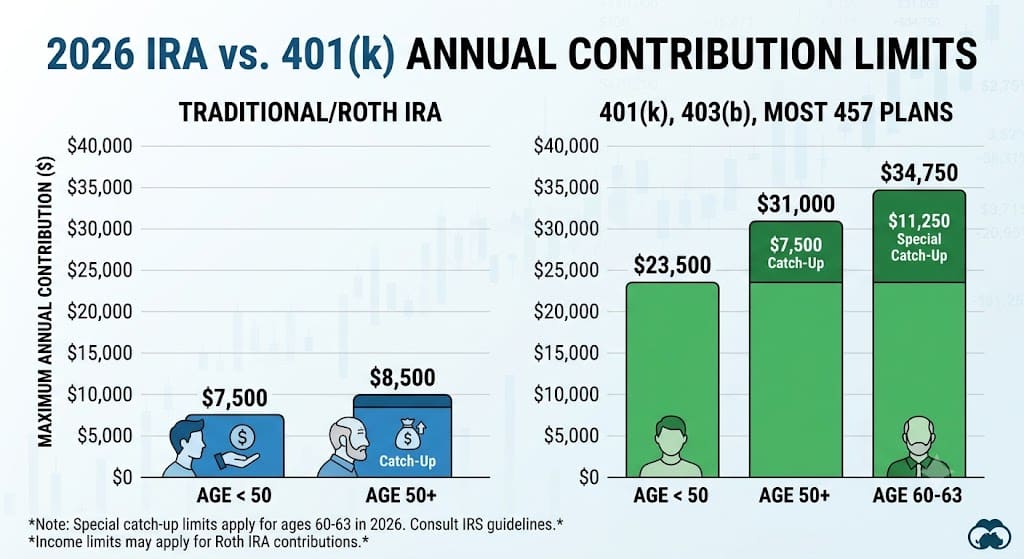
Contribute to Both IRA and 401k: How Much You Can Put In for 2026
The IRS bumped every one of these numbers up for 2026. Here’s where they landed, straight from IRS Notice 2025-67.
| Account | 2026 limit (under 50) | 2026 limit (age 50+) | Age 60-63 “super catch-up” |
|---|---|---|---|
| Traditional or Roth IRA (combined) | $7,500 | $8,600 | n/a |
| 401(k), 403(b), most 457 plans | $24,500 | $32,500 | $35,750 |
As of November 2025 (IRS Notice 2025-67, effective tax year 2026).
So under 50, that’s up to $32,000 across both accounts if you’re eligible for the full amount in each. That’s real money. If you’re 50 or older, it climbs to $41,100, and workers 60 to 63 can push it even higher using the extended 401(k) catch-up.
One catch worth flagging: starting in 2026, if your W-2 wages from that specific employer topped $150,000 in 2025, your 401(k) catch-up contributions have to go into a Roth account instead of pre-tax. That’s a SECURE 2.0 rule, not optional, and it’s based on wages from that one employer, not your total income if you have multiple jobs.
Does a 401(k) Kill Your IRA Tax Deduction?
Not automatically, but it can shrink it. If you (or your spouse) are covered by a workplace plan, the IRS phases out your traditional IRA deduction once your modified adjusted gross income (MAGI) crosses a threshold.
For 2026, single filers covered by a workplace plan can deduct the full amount below $81,000 MAGI, get a partial deduction between $81,000 and $91,000, and lose it entirely above that. Married filing jointly, the full deduction holds below $129,000, phases out through $149,000, and disappears above that.
If your spouse is covered by a 401(k) but you aren’t, the rules are more generous. Your own phase-out range is $242,000 to $252,000, since the IRS treats you as the non-covered spouse.
Roth contributions never get a deduction either way, so none of this applies if you’re going the Roth route. You’re trading the up-front tax break for tax-free withdrawals later, which is a different tradeoff, not a worse one.
Roth IRA Income Limits: Where You Might Get Shut Out
Your 401(k) doesn’t affect Roth IRA eligibility. Your income does. For 2026, you can contribute the full amount to a Roth IRA if your MAGI is under $153,000 (single) or $242,000 (married filing jointly). Above those numbers, your allowed contribution shrinks, and it disappears completely at $168,000 single or $252,000 joint.
If you’re over that ceiling, a Roth 401(k) through your employer has no income limit at all, which is worth asking your HR team about if yours offers one.
The Order I’d Actually Fund These In
Everyone’s numbers are different, but here’s the sequence I’d default to if I were starting from scratch.
- Get your full 401(k) match first. If your employer matches 50% up to 6% of pay, contribute at least 6%. Walking away from a match is walking away from free money, full stop.
- Fill the IRA next. Once the match is locked in, I’d rather have the extra flexibility and investment choice an IRA gives you than keep stacking pre-tax dollars into whatever funds your 401(k) happens to offer.
- Go back and max the 401(k). If you’ve still got room to save after steps one and two, this is where the bulk of your remaining tax-advantaged space lives.
- Look at backdoor Roth or self-employed options if you’re above the limits. High earners locked out of a direct Roth IRA can still convert a nondeductible traditional IRA contribution. Self-employed folks have SEP IRA and solo 401(k) options with much higher ceilings.
What Happens If You Contribute Too Much
This trips people up more than you’d think, especially after a mid-year job change with two employers’ worth of 401(k) withholding. Excess IRA contributions get hit with a 6% excise tax for every year they sit in the account uncorrected.
You generally have until the tax filing deadline (with extensions) to pull the excess out and avoid the penalty. If you’ve overcontributed, don’t just leave it and hope. Call your IRA custodian and ask for a “return of excess contribution,” and they’ll walk you through it.
Key Takeaways
- Yes, you can contribute to both IRA and 401k accounts in the same year. They have separate, independent limits.
- For 2026, that’s up to $32,000 combined under age 50, or $41,100 at 50 and older.
- Having a 401(k) can phase out your traditional IRA tax deduction based on income, but it never blocks the contribution itself.
- Roth IRA eligibility depends on your income, not on whether you also have a 401(k).
- Get your full employer match before anything else. It’s the highest guaranteed return you’ll find anywhere.
Frequently Asked Questions
Can I contribute to both IRA and 401k in the same year? Yes. The two accounts have completely separate IRS limits, so contributing to one doesn’t reduce how much you can put into the other.
Is there an income limit to contribute to both a 401(k) and an IRA? No income limit applies to 401(k) contributions. Traditional IRA contributions have no income limit either, though the tax deduction can phase out. Roth IRA contributions do have an income cap.
Can I contribute to a Roth IRA and a traditional 401(k) in the same year? Yes, and this is a common combination. As long as your income is under the Roth IRA limit, having a traditional 401(k) doesn’t affect your Roth IRA eligibility at all.
What happens if I contribute more than the IRA limit? You’ll owe a 6% excise tax on the excess for each year it remains in the account, unless you withdraw it (plus any earnings) before your tax filing deadline.
Should I prioritize my 401(k) match or my IRA contribution? Get the employer match first. After that, it comes down to whether you value the IRA’s broader investment choices or the 401(k)’s (usually) higher contribution ceiling.
I’m self-employed with a solo 401(k). Can I still contribute to an IRA? Yes. A solo 401(k) doesn’t block IRA contributions any more than a regular employer 401(k) does. The same deduction phase-out rules apply since you’re considered “covered” by a workplace plan either way.
If you’re not sure where your own numbers land on the deduction phase-out or Roth income limit, it’s worth running your actual MAGI past a tax professional before you lock in next year’s contribution rate. A quick conversation now beats an excess-contribution letter from the IRS later.
Read More
- IRS: 401(k) limit increases to $24,500 for 2026, IRA limit increases to $7,500, the source announcement for every number in this article
- IRS: Retirement Topics – IRA Contribution Limits, covering the deduction phase-out and excess-contribution rules in full
Disclaimer
This article is for general informational purposes only and shouldn’t be taken as financial, tax, or legal advice. The contribution limits and income thresholds above are current for 2026 as of this writing, but tax rules change, and everyone’s situation is different. Before adjusting your own contributions, it’s worth checking with a qualified financial advisor or tax professional who can look at your specific numbers. You can also read FinToku’s full Financial Disclaimer.
Published by Saad Faisal for FinToku (fintoku.com) Published July 17, 2026 · Updated July 17, 2026 FinToku publishes free, no-signup finance calculators and practical money guidance.