

A friend of mine makes almost exactly $60,000 a year and spent a solid month convinced she’d priced herself out of buying anything. She hadn’t. On a $60,000 salary, most lenders will qualify you for a home somewhere between $170,000 and $230,000, assuming average debt and a modest down payment. Your real number depends on your credit score, existing debt, and the interest rate you lock in, but that range is a fair starting point for almost anyone earning $60K today.
What $60,000 actually breaks down to
Before any of the mortgage math makes sense, it helps to see the number lenders actually work from. $60,000 a year is $5,000 a month before taxes. That $5,000 figure, not your take-home pay, is what every affordability formula in this article starts with.
Every lender uses some version of the same two limits: how much you can spend on housing, and how much you can spend on debt overall. Once you have those two numbers, figuring out a home price is mostly arithmetic.
The 28/36 rule, and what it means for you
Most conventional lenders lean on the 28/36 rule to sanity-check an application. It’s not a law, it’s a guideline, but it’s close to universal.
- 28% of your gross monthly income is your soft ceiling for housing costs (mortgage, taxes, insurance, and HOA dues combined).
- 36% is your soft ceiling for all debt, housing included, plus car payments, student loans, and credit cards.
Run that against a $5,000 monthly income and you get two hard numbers:
- Housing limit: $5,000 x 0.28 = $1,400/month
- Total debt limit: $5,000 x 0.36 = $1,800/month
Say you’re carrying a $350 car payment and a $100 minimum on a credit card. That’s $450 in existing debt, which leaves $1,350 of your $1,800 debt ceiling free for a mortgage payment, a bit under the $1,400 housing cap. Whichever number is smaller is the one that actually governs your budget. The Consumer Financial Protection Bureau has a good plain-language breakdown of how lenders calculate this debt-to-income ratio if you want to check your own math against theirs.
Here’s the part that trips people up: many loan programs will approve you well past 36%. FHA loans commonly allow total debt up to 45-50% for well-qualified borrowers. That doesn’t mean you should take it. A lender qualifying you for a $1,700 payment and you being able to comfortably live with a $1,700 payment are two different questions, and only you can answer the second one.
Sample payment scenarios on a $60K income
Numbers land better with a real example, so here’s the same $200,000 home priced three different ways. These use Freddie Mac’s current average 30-year rate of 6.55% as of July 16, 2026, plus typical property tax and insurance estimates. Treat the taxes and insurance figures as illustrative; yours will run higher or lower depending on your state.
| Down payment | Loan amount | Principal & interest | Taxes + insurance | PMI/MIP | Total monthly payment |
|---|---|---|---|---|---|
| 20% ($40,000) | $160,000 | ~$1,020 | ~$300 | $0 | ~$1,320 |
| 10% ($20,000) | $180,000 | ~$1,145 | ~$300 | ~$75 | ~$1,520 |
| 3.5% FHA ($7,000) | $193,000 | ~$1,225 | ~$300 | ~$90 | ~$1,615 |
Notice the gap between the top and bottom row is almost $300 a month, on the exact same house. That’s the down payment doing more work than most people expect. A 20% down payment also skips private mortgage insurance entirely, which is the single fastest way to shrink a monthly payment without touching the loan amount at all.
I’ll be honest, when I first ran a version of this table for my own place, the FHA row looked appealing right up until I added the mortgage insurance line. It’s not a bad option, it’s just not the free lunch it looks like at first glance.
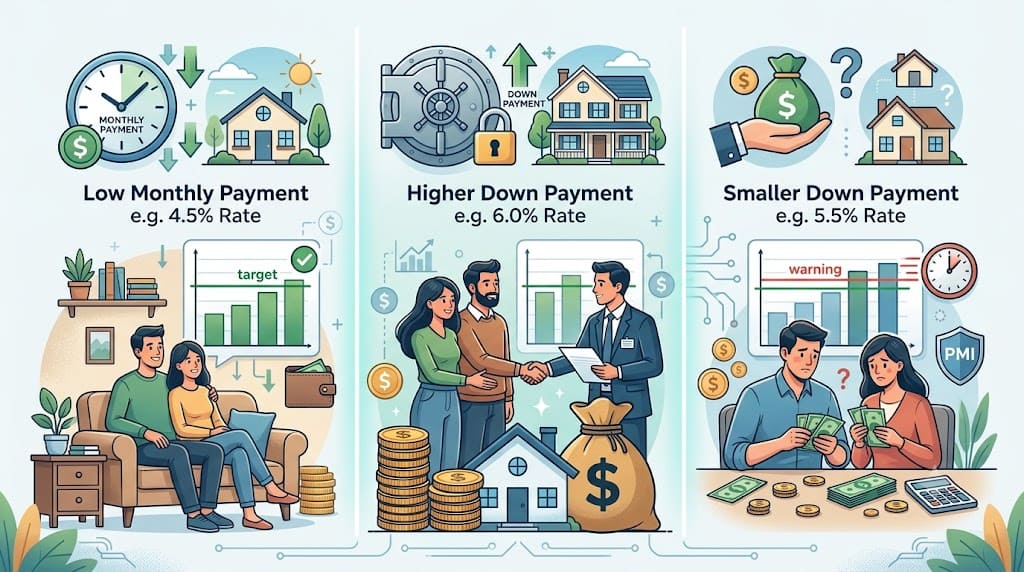
Where $60K stands against the national market
It’s worth seeing your $60K salary next to the actual national numbers, because the gap explains why “how much house” answers vary so much between $150,000 and $300,000 depending on who’s writing them.
| Metric | Figure | Source & date |
|---|---|---|
| Median U.S. household income | $83,730 | U.S. Census Bureau, 2024 |
| Median U.S. home sale price | $403,200 | U.S. Census Bureau, Q1 2026 |
| Average 30-year fixed mortgage rate | 6.55% | Freddie Mac PMMS, week of July 16, 2026 |
| Average 15-year fixed mortgage rate | 5.93% | Freddie Mac PMMS, week of July 16, 2026 |
A $60,000 income sits below the national median, and the national median home price is roughly double what a $60K income comfortably supports under the 28/36 rule. That’s not a reason to panic, it’s just why location does so much heavy lifting in this conversation. A $200,000 budget buys very different things in Cleveland than it does in Austin, let alone Boston.
What actually moves your number
Income sets the ceiling. These five things decide where you land underneath it.
Credit score. A stronger score gets you a lower rate, and rate changes compound fast. Drop your rate by even half a point on a $180,000 loan and you’re looking at real monthly savings, no other variable touched.
Down payment size. As the scenario table above shows, more down means less borrowed, no PMI past 20%, and a smaller monthly number across the board.
Existing debt. Every $100 of monthly debt payment you’re carrying eats directly into your mortgage budget, dollar for dollar, under the 36% ceiling.
Loan type. Conventional, FHA, VA, and USDA loans each set their own down payment minimums, mortgage insurance rules, and maximum DTI. The “best” one depends entirely on your situation, not on which lender advertises it loudest.
Location. Property tax rates, insurance costs, and home prices swing enough by state and even by zip code that the same salary can feel completely different in two markets an hour apart.
Loan programs worth knowing about
- Conventional loans work well if your credit is solid; down payments start around 3%, though 20% avoids PMI.
- FHA loans allow down payments as low as 3.5% with credit scores as low as 580, at the cost of mortgage insurance premiums that stick around for most of the loan.
- VA loans offer 0% down and no mortgage insurance for eligible veterans and active-duty service members, one of the strongest deals available if you qualify.
- USDA loans can mean zero down in eligible rural and some suburban areas, for buyers who fit the income limits.
A few ways to stretch a $60K budget further
- Pay down a credit card or car loan before you apply. Even a small drop in monthly debt frees up real mortgage budget.
- Ask about first-time buyer and down payment assistance programs in your state. Plenty go unused simply because buyers don’t know to ask.
- Consider a co-borrower. Combining incomes with a partner or family member can meaningfully change your DTI math.
- Widen your search radius. A 30-minute drive can sometimes mean a $50,000 difference in what the same money buys.
- Get preapproved before you fall in love with a listing. It turns a vague budget into a real number a seller will take seriously.
- Budget for closing costs separately. They typically run 2-5% of the loan amount and aren’t covered by the monthly payment math above.
Key Takeaways
- On a $60,000 salary ($5,000/month gross), the 28/36 rule caps housing costs around $1,400/month and total debt around $1,800/month.
- Most buyers in this income bracket can afford a home priced between $170,000 and $230,000, depending on debt load and down payment.
- A 20% down payment avoids PMI and can lower a monthly payment by a few hundred dollars compared to a 10% or FHA down payment on the same home.
- Credit score, existing debt, and loan type move the number as much as income does, sometimes more.
- The current 30-year average mortgage rate is 6.55% as of mid-July 2026, per Freddie Mac; check today’s rate before running your own numbers.
Frequently Asked Questions
How much house can I afford making $60,000 a year? Most lenders will qualify a $60,000 salary for a home between $170,000 and $230,000, based on the 28/36 rule and average debt levels. Your exact number depends on your credit score, existing debt, and down payment.
What is the 28/36 rule for home affordability? It’s a lending guideline capping housing costs at 28% of gross monthly income and total debt at 36%. On a $60,000 salary, that works out to about $1,400 and $1,800 a month.
Can I buy a house on a $60K salary with a small down payment? Yes. FHA loans allow as little as 3.5% down, and VA loans offer 0% down for eligible veterans. A smaller down payment means a higher monthly payment and, on conventional and FHA loans, added mortgage insurance.
What credit score do I need to buy a house on a $60K salary? There’s no universal minimum. FHA loans can work with scores as low as 580, while conventional loans typically want 620 or higher for the best terms. A higher score generally means a lower interest rate.
Can I afford a $300,000 house on a $60K salary? It’s a stretch under standard guidelines. A $300,000 home would likely push your monthly payment well past the 28% housing ceiling unless you have a sizable down payment, very low existing debt, or a co-borrower’s income added in.
Is $60,000 a good salary to buy a house? It can be, especially outside high-cost metro areas. The bigger factors are your debt load, credit score, and how much you’ve saved for a down payment, not the salary figure alone.
If you’re still working out your own number, running a few of these scenarios yourself with your actual debt and credit profile is worth more than any single article’s range, including this one.
Disclaimer
This article is for general informational purposes only and isn’t financial or mortgage advice. The payment scenarios above use current published rates and typical tax and insurance estimates, but your actual quote will depend on your lender, credit profile, and location. Before making a real home-buying decision, it’s worth talking to a mortgage lender or financial advisor who can look at your specific numbers. You can read FinToku’s full Financial Disclaimer for more.
Keep reading
- Freddie Mac Primary Mortgage Market Survey: the source for current 30-year and 15-year average rates used above.
- CFPB: What is a debt-to-income ratio?: a plain-language walkthrough of the DTI math lenders actually use.
- U.S. Census Bureau: Income in the United States, 2024: the source for the median household income figure used above.
Published by Saad Faisal for FinToku (fintoku.com) · July 17, 2026 FinToku publishes free, no-signup finance calculators and practical money guidance.