
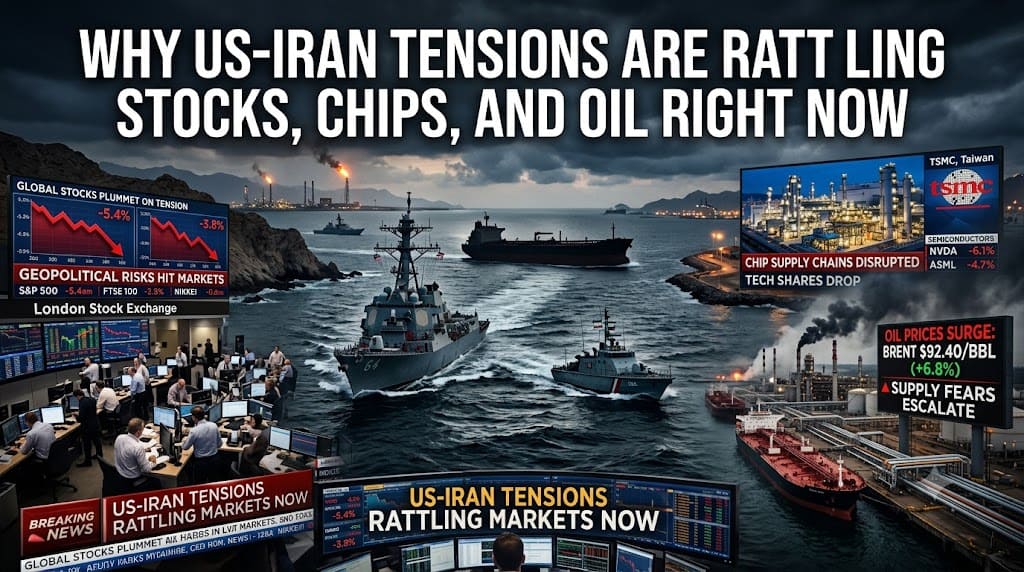
Renewed US-Iran military strikes have raised the threat of a disruption to the Strait of Hormuz, a chokepoint that carries roughly a fifth of the world’s oil. That pushed oil prices sharply higher, revived inflation fears, and shifted what investors expect the Federal Reserve to do next – and all three of those together are why stocks, and semiconductor stocks especially, have been so volatile this week.
What’s Causing the Stock Market Volatility Right Now?
The US and Iran resumed strikes in the Middle East after a ceasefire frayed in mid-June, and Iran has threatened to close the Strait of Hormuz. That threat sent Brent crude up over 9% in a single day – its biggest one-day jump in more than six years. This landed in the same week as a separate, largely unrelated selloff in semiconductor stocks, which is why the moves across the Dow, S&P 500, and Nasdaq have looked so sharp.
How Does a Middle East Conflict Actually Move US Stock Prices?
A war overseas doesn’t move US stock prices directly – it moves them through a chain, and every link matters.
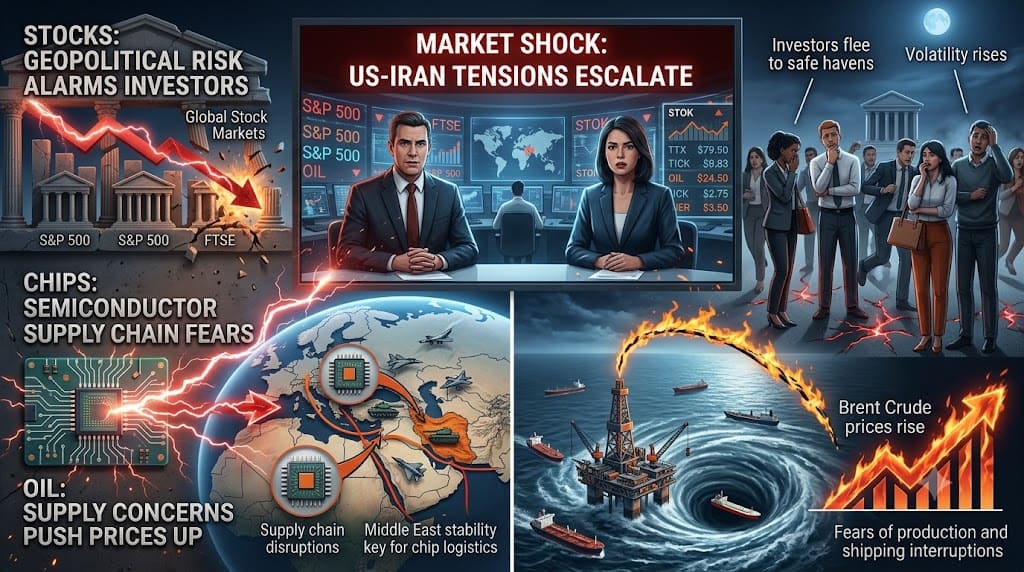
Link 1: Oil supply risk. The Strait of Hormuz carries about one-fifth of the world’s oil, according to the US Energy Information Administration, and has very few practical bypass routes. Even a threat to close it is enough to spike oil futures, because traders price in risk before it happens, not after.
Link 2: Oil feeds inflation. Higher crude means higher gas prices and higher input costs across shipping and manufacturing. That shows up in the Consumer Price Index a month or two later, which is exactly why this news landed right before a closely watched CPI report.
Link 3: Inflation changes the Fed math. A week ago, futures markets tracked by the CME FedWatch Tool were pricing in roughly one rate cut by December. As of this week, they’ve flipped to pricing a possible rate hike as soon as October – a real reversal, not a minor tweak, and one that will get tested at the next FOMC meeting on July 28-29. Higher expected rates make future company earnings worth less in today’s dollars, which is the mechanical reason stocks fall when rate expectations shift up.
Link 4: Risk appetite drops across the board. Once traders are pricing in tighter money and higher costs at the same time, they tend to sell the most speculative, highest-valued parts of the market first – which brings us to chips.
Why Are Semiconductor Stocks Falling More Than the Rest of the Market?
Semiconductor stocks are down for two separate reasons landing in the same week, not one. The Philadelphia Semiconductor Index had already dropped more than 11% over two weeks before the latest Iran escalation, as investors questioned whether AI infrastructure spending can keep growing at its current pace. Then SK Hynix’s Nasdaq debut turned messy: shares popped nearly 13% on their first trading day, then reversed hard, falling double digits in both Seoul and US trading within days.
Layer geopolitical risk on top of a sector that was already jumpy about valuations, and you get exaggerated moves in either direction. JPMorgan’s own read on this is that the pullback looks more like crowded positions unwinding than the AI trade actually breaking, which matches two similar dips earlier this year. I don’t think that’s just spin – overcrowded trades really do behave this way, snapping back hard on any excuse to sell. Separately, reports that Nvidia has cut the number of Asian customers authorized to buy its AI chips, tightening export compliance, added a second geopolitical thread – US-China tech policy – on top of the Middle East one.
What Else Is Moving This Week: Earnings Season
Big US bank earnings – JPMorgan Chase, Goldman Sachs, Bank of America – kick off this week, alongside results from Netflix, UnitedHealth, and Taiwan Semiconductor Manufacturing, whose numbers are a direct read on AI chip demand. Analysts expect S&P 500 earnings to grow roughly 24% year-over-year for the quarter, according to FactSet’s Earnings Insight tracker. That matters here because it means investors are trying to price in geopolitical risk and a heavy earnings week at the same time, which is part of why the daily swings have felt bigger than the underlying news alone would explain.
Should You Actually Do Anything About This?
For most people reading this on a personal-finance site rather than a trading desk, probably not much – and that’s not a cop-out, it’s the actual math. Selling into a volatility spike locks in the loss and hands you the much harder problem of guessing when to buy back in. If you’re investing for a goal that’s years away, a two-week semiconductor wobble tied to a specific geopolitical event is close to noise by the time you retire.
Where it is worth paying attention:
- If you’re near a goal – buying a house next year, retiring within 12 months – this is a good week to check how much of your money sits in volatile assets versus something stable.
- If gas and shipping costs matter to your budget, oil above $80 is worth planning around even if it eases later.
- If you hold concentrated positions in chip stocks, understand that some of this move is sector-specific crowding, not just headline risk – the two are tangled together right now and hard to separate cleanly.
I’m not going to pretend I know whether oil keeps climbing or the ceasefire holds. Nobody credibly does, and anyone selling you certainty on that this week is selling you something else too.
Key Takeaways
- Iran’s threat to close the Strait of Hormuz, which carries about one-fifth of the world’s oil, pushed Brent crude up over 9% in a single session – its sharpest one-day jump in more than six years.
- Higher oil prices revived inflation fears, and futures markets shifted from pricing a rate cut by December to pricing a possible Fed rate hike as soon as October.
- Semiconductor stocks fell for two separate reasons at once: broader AI-valuation jitters that predate the Iran news, and a volatile Nasdaq debut for SK Hynix.
- Major US bank earnings and Taiwan Semiconductor’s results, arriving the same week, are adding to the volatility on top of the geopolitical news.
- The S&P 500 was still up more than 10% for the year and within 1% of its early-June record despite the volatility, as of mid-July 2026.
- For long-term investors, this kind of geopolitical-driven volatility is usually more relevant to near-term financial goals than to a multi-year plan.
Frequently Asked Questions
Why is the stock market down today because of Iran? Renewed US-Iran strikes and threats to close the Strait of Hormuz pushed oil prices sharply higher, which raised inflation concerns and shifted expectations for Fed interest rate policy – both of which weigh on stock valuations.
How does the Strait of Hormuz affect oil prices? Roughly a fifth of global oil shipments pass through this narrow waterway, per the EIA, with very few alternative routes. Any real or threatened disruption makes traders price in supply risk immediately, before an actual shortage occurs.
Why are semiconductor stocks falling more than the broader market? Chip stocks were already volatile from AI-valuation concerns and a messy SK Hynix Nasdaq debut before the Iran escalation added a second layer of risk-off selling on top.
Will the Fed raise interest rates because of this? It’s not certain, but futures markets have shifted meaningfully – now pricing in a possible rate hike as soon as October, versus pricing a cut just a week earlier. That shift alone moves stock prices before the Fed does anything.
Is this a good time to buy the dip? That depends on your own timeline and risk tolerance, not on this article. A short-term geopolitical selloff isn’t the same as a fundamental change in company earnings, but nobody can reliably time when it ends either.
If you’re watching how currency and commodity moves like this ripple into your own numbers, FinToku’s Currency Converter is a quick way to see how the dollar’s moves this week stack up against your own currency.
By Saad Faisal · Published July 15, 2026
Disclaimer
This article is for general informational purposes only and shouldn’t be taken as financial or investment advice. Markets are unpredictable, and the specific numbers and events referenced here are a snapshot of a fast-moving situation, not a forecast. Before making any investment decision based on geopolitical news, it’s worth checking with a qualified financial advisor who can look at your specific situation. You can also read FinToku’s full Financial Disclaimer.