

Building a real emergency fund in 6 months means picking a target (3-6 months of essential expenses, or a smaller $1,000-$2,000 starter goal if that’s more realistic), automating a fixed transfer to a separate high-yield savings account every payday, and layering in windfalls and one trimmed expense category to close the gap faster. The math matters more than the motivation. Below is the actual month-by-month version of that plan.
What you’ll need before you start
- One number: your essential monthly expenses (rent, utilities, groceries, minimum debt payments, insurance, transportation). Not your whole budget, just the “must-pay-or-something-breaks” line items.
- A separate account, ideally a high-yield savings account (HYSA), not your everyday checking account. Out of sight matters more than people admit.
- Your last 2-3 pay stubs or bank statements, so the automated amount is based on real numbers, not a guess.
- 6 months on the calendar. Write the actual end date down, not “eventually.”
The 6-month plan, month by month
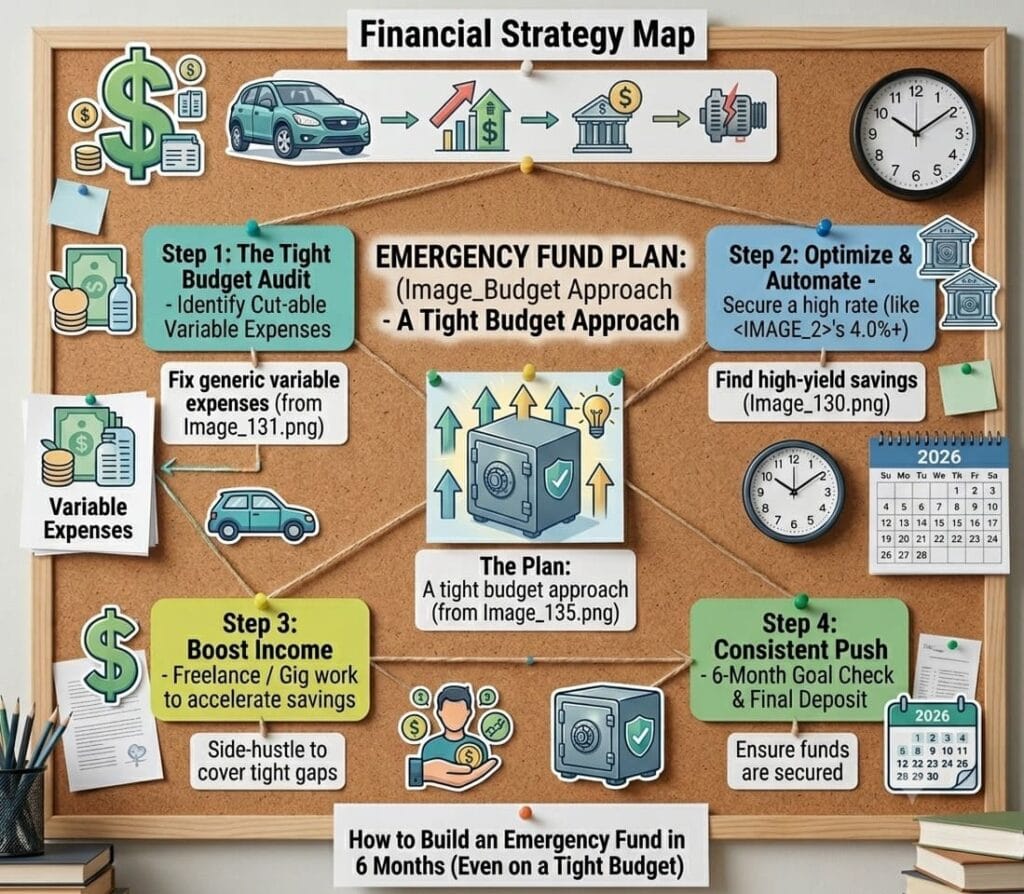
Month 1: Calculate the real target, then cut it in half. Add up your essential expenses and multiply by 3 (a lean but workable starting target for most people) or 6 (better if your income is irregular or you’re the sole earner in your household). Then, for a 6-month build, don’t panic-save the full number. Split it into two goals: a $1,000-$1,500 starter fund you can hit in 4-6 weeks, and the full target as the longer-term aim once the starter fund exists. Open the HYSA this week and set up one automatic transfer for payday, even if it’s just $25.
Months 2-3: Automate first, adjust second. Increase the automatic transfer to whatever your calculated “comfortable” number is, then find one expense category (not five) to trim for these two months specifically: subscriptions, dining out, or a temporary pause on a discretionary spend. One category, cut hard, beats five categories cut a little. Redirect all of it straight into the fund.
Months 4-6: Let windfalls do the heavy lifting. Tax refunds, work bonuses, cash gifts, a side-gig payment: route these directly to the fund before they touch your regular checking account, where they’re much more likely to quietly disappear into normal spending. This is usually the single fastest way to close the last third of the gap, faster than any amount of daily frugality.
A worked example
Say your essential expenses run $2,200 a month. A 3-month target is $6,600. Saving $30 a week on autopilot gets you to $780 by month 6, useful, but nowhere near the goal on its own. Add a $150/month trimmed category ($900 over 6 months) and a single $1,800 tax refund routed straight in, and you land at roughly $3,480, more than half the target in 6 months, with a clear, faster path to the rest once the starter fund and habit are both locked in. The point isn’t that $30 a week alone gets you there. It’s that automation plus one windfall plus one trim usually does.
Emergency fund savings benchmarks (as of July 2026)
| Metric | Figure | Source / date |
|---|---|---|
| Americans with enough saved to cover 3 months of expenses | 46% | Bankrate Emergency Savings Survey, May 2025 |
| Americans with no emergency savings at all | 24% | Bankrate Emergency Savings Survey, 2026 report |
| Americans who couldn’t cover a $1,000 emergency from savings | 43% | U.S. News 2026 Financial Wellness Survey, Jan. 2026 |
| Median emergency fund balance among those who have one | $5,000 | U.S. News 2026 Financial Wellness Survey, Jan. 2026 |
| Top high-yield savings account APY available | up to ~4.15%-4.50% | Bankrate / Fortune rate roundups, July 2026 |
| U.S. adults who say they’d need at least 6 months saved to feel comfortable | 63% | Bankrate Emergency Savings Survey, May 2025 |
Common mistakes that stall the 6-month timeline
- Keeping it in checking. If the money is one tap away from your debit card, it gets spent on things that don’t qualify as emergencies. A separate HYSA adds just enough friction.
- Waiting to start until you can “save big.” A $25 automated transfer started today beats a $200 transfer you keep planning to start next paycheck.
- Treating one goal as the whole plan. Skipping the starter-fund step is the most common reason people give up around month 2. Hitting $1,000 fast creates real momentum toward the bigger number.
- Confusing an emergency fund with a rainy-day fund. A rainy-day fund covers small, expected irregular costs (car registration, a holiday gift season). An emergency fund exists for the big, unplanned stuff: job loss, a major medical bill, a total income shock. Mixing the two means the big fund quietly gets drained on small stuff.
- Raiding it for anything that feels urgent. A concert ticket sale isn’t an emergency. If you’re not sure whether something qualifies, ask: would I go into debt to cover this if the fund didn’t exist? If no, it’s not what the fund is for.
I’ll admit I got the “one category” rule wrong myself the first time. I tried trimming five categories at once, groceries, subscriptions, coffee, rideshares, and clothes, and burned out on tracking all five within three weeks. Picking one and automating the rest turned out to be the part that actually stuck.
Key Takeaways
- A 6-month emergency fund build works best as two goals, not one: a $1,000-$1,500 starter fund first, then the full 3-6 months of essential expenses.
- Automating a fixed transfer on payday matters more than the exact dollar amount, since consistency, not size, is what actually gets people to the finish line.
- Routing windfalls (tax refunds, bonuses, gifts) directly into the fund before they reach checking is usually the fastest single lever for closing the last stretch of the goal.
- Only 46% of Americans currently have enough saved to cover 3 months of expenses, so falling short of a 6-month target on the first attempt is normal, not a failure.
- Keep the fund in a separate high-yield savings account rather than checking; the friction of a separate account is what keeps the money from quietly disappearing into regular spending.
Frequently Asked Questions
How much should I have in an emergency fund? Most financial guidance points to 3-6 months of essential expenses, weighted toward 6 if your income is irregular, you’re a single earner, or your job market is volatile. Start with the smaller end of that range and adjust once it’s built.
Is $1,000 enough for an emergency fund? As a starter goal, yes, it covers most single unexpected expenses like a car repair or a smaller medical bill. As a full emergency fund it’s not, since it won’t cover a genuine income shock like a job loss for more than a few weeks.
Where should I keep my emergency fund? A high-yield savings account at a separate bank from your everyday checking is the common recommendation: it earns meaningfully more interest than a standard savings account while staying liquid enough to access within a day or two.
Can I build an emergency fund while paying off debt? Yes, and most guidance suggests doing both at once rather than sequentially: build the $1,000-$1,500 starter fund first, then split extra money between debt payoff and the rest of the emergency fund so a new emergency doesn’t force you back into debt.
What’s the difference between an emergency fund and a rainy-day fund? A rainy-day fund covers smaller, semi-expected costs (a car registration renewal, a higher-than-usual utility bill). An emergency fund is reserved for major, unplanned events like job loss or a serious medical bill, and the two shouldn’t share a pool of money.
If you’re working out what counts as an essential expense versus one you could trim, run your actual numbers first rather than guessing from a percentage rule of thumb. (One resource I’ve found genuinely useful for the starter-fund mindset specifically: The Total Money Makeover, its $1,000 starter fund step is basically where this article’s Month 1 came from. Heads up, that’s a link I earn a small commission on if you buy through it, more on that on FinToku’s affiliate disclosure page.)
Bookmark this if you’re mid-build. Six months moves fast once the transfer is automated, and it’s worth a return visit to check your number against your progress at the 3-month mark.
Disclaimer
This article is for general informational purposes and isn’t personalized financial advice. Savings account rates, terms, and features change often, confirm current numbers with your bank before opening an account. See FinToku’s full Financial Disclaimer for details.
Published by Saad Faisal for FinToku (fintoku.com) FinToku publishes free, no-signup finance calculators and practical money guidance.
By Saad Faisal · Published July 13, 2026