
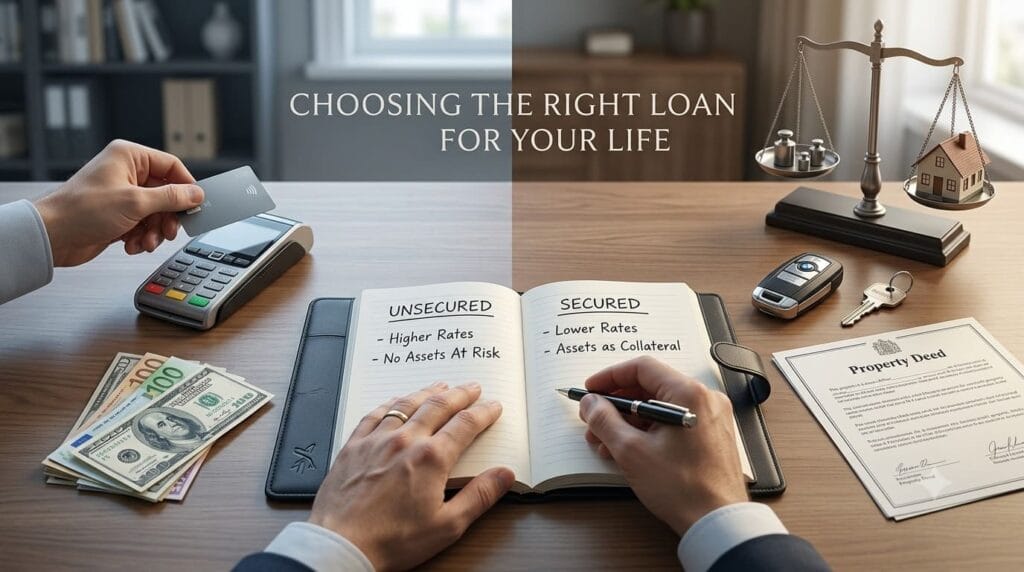
The difference between an unsecured personal loan and a secured personal loan comes down to one thing: collateral. A secured loan is backed by an asset the lender can take if you stop paying. An unsecured loan isn’t backed by anything except your promise to repay it. So lenders lean harder on your credit score and income instead. The Consumer Financial Protection Bureau draws this same line. Secured loans require collateral. Unsecured loans rely on the lender trusting your credit history.
I found this out the annoying way. A few years back I needed $8,000 for a car repair and some overdue dental work. I almost signed for a secured loan against my savings account because the rate looked better on paper. Then I actually ran the math on what I’d lose access to for three years, and backed out. Not the wrong loan for everyone, just the wrong one for me at that moment.
That’s really the whole decision: what are you willing to risk, and what does that risk actually buy you.
Secured vs. unsecured personal loans at a glance
| Secured personal loan | Unsecured personal loan | |
|---|---|---|
| Collateral required | Yes (savings, CD, vehicle, sometimes home equity) | No |
| Typical rates | Lower, often 20% or more below unsecured rates from the same lender | Higher, roughly 7% to 36% APR depending on credit |
| Loan amounts | Can go higher, tied to collateral value | Up to $100,000 with strong credit, less otherwise |
| Easier to qualify with bad credit | Often yes | Harder, usually needs a 580+ score, 670+ for good rates |
| What happens if you default | Lender can seize the collateral, plus credit damage | No asset seized, but collections and legal action possible, plus credit damage |
| Funding speed | Can take longer if collateral needs appraisal | Often same-day to a few days |
How does a secured personal loan work?
A secured personal loan requires you to pledge something you own, usually a savings account, a certificate of deposit, or a vehicle, as collateral for the loan. If you stop paying, the lender has the legal right to take that asset to cover what you owe.
Because the lender’s risk is lower, secured loans tend to come with meaningfully better pricing. One lender that offers both loan types reports its secured loan rates running roughly 20% lower on average than its unsecured rates.
Credit unions commonly offer “share secured” or “CD secured” loans, where you borrow against money you already have on deposit. You keep earning interest on that money while you repay the loan. Once the balance is paid off, you get full access back. It’s a strange feeling, using your own savings as leverage to borrow more money. But it works, because it de-risks the loan for the bank, not because you’re pulling from thin air.
The tradeoff is real, though. If a lender wants your car as collateral and you default, losing that car might also cost you your ability to get to work. Weigh what the asset means to your life, not just its dollar value.
How does an unsecured personal loan work?
An unsecured personal loan doesn’t require any collateral. Approval is based entirely on your creditworthiness, meaning your credit score, credit history, income, and debt-to-income ratio.
Because the lender is taking on more risk with nothing to repossess, unsecured rates run higher. Current unsecured personal loan APRs typically fall somewhere between 7% and 36%. The lowest rates go to borrowers with excellent credit. The Federal Reserve tracks average personal loan rates at commercial banks every quarter if you want to see where current averages sit. If your credit sits in the high 600s or above, you’re generally in a decent position to qualify.
The upside is flexibility. You’ll find unsecured loans at banks, credit unions, and online lenders, with far fewer restrictions on how you use the money. People use them for debt consolidation, medical bills, or home repairs that don’t require a home equity loan. Others use them for a single big expense they don’t want to put on a credit card.
Default still hurts, though. It won’t cost you a specific asset. But a missed payment gets reported to the credit bureaus, and an account that goes 90 days unpaid can be sent to collections, and eventually to court.
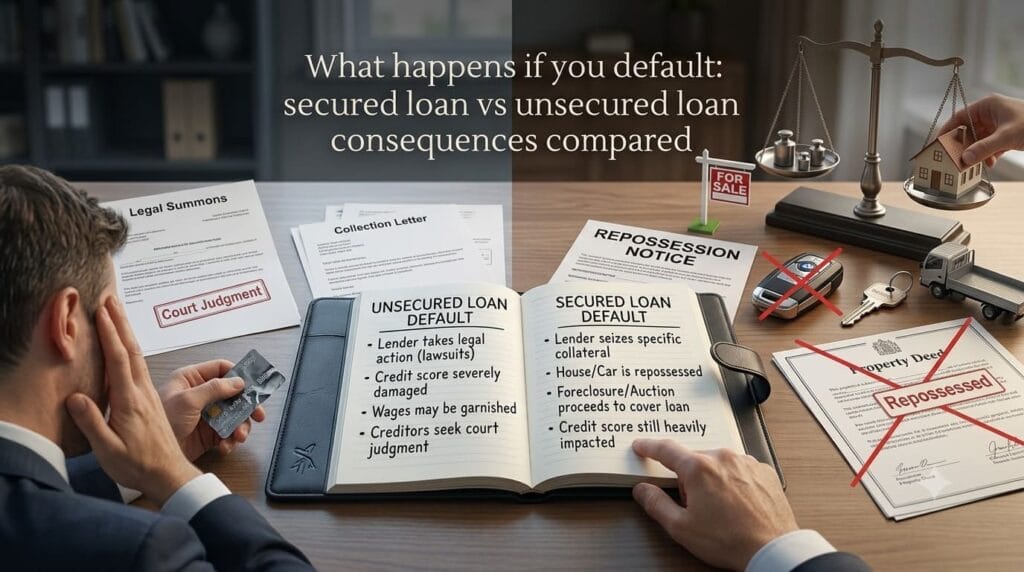
What happens if you default on a secured vs. an unsecured personal loan?
Missing payments has real but different consequences depending on which loan type you have, and it’s the part most comparison articles gloss over.
With a secured loan, missing payments puts a specific, named thing at risk. Your savings account gets drained to cover the balance. Your car gets repossessed. There’s no ambiguity about what you stand to lose. That’s exactly why it’s worth being honest with yourself, before you sign, about whether you can really make the payments.
With an unsecured loan, nothing gets seized automatically. But “nothing gets seized” doesn’t mean “nothing happens.” Your credit score takes a hit with each missed payment, and the debt can be sold to a collections agency. If it goes far enough, the lender can sue you. Only after winning a judgment in court can they get a garnishment order against your wages, and federal law caps how much of your paycheck they can take. The CFPB’s own advice here is worth repeating: contact your lender before you miss a payment, not after. Many lenders offer hardship plans that defer or lower payments, but only for borrowers who ask early.
Neither path is painless. One risks a specific asset, the other risks your credit and, eventually, legal exposure. I’d rather lose a bit more sleep over abstract credit damage than watch a repo truck take my car, but that’s a personal call, not a universal rule.
Which one fits you
A secured loan probably makes more sense if your credit isn’t strong enough yet for a competitive unsecured rate, or you have an asset you’re genuinely comfortable risking. It also fits if you want the lowest possible rate, or a bigger loan amount than your credit alone would support.
An unsecured loan probably makes more sense if you have solid credit and would rather not tie up an asset for years. It also fits if you want funds fast, without an appraisal step slowing things down.
Either way, pre-qualify with a few lenders before committing to anything. Pre-qualification uses a soft credit check, so it won’t ding your score. It also shows you real estimated rates, instead of a lender’s advertised “as low as” number. If you’re on the fence, run your numbers through FinToku’s Loan Comparator first, so you can see how the total repayment stacks up side by side before you apply anywhere.
Common mistakes people make
Chasing the lower rate without checking the fine print. A secured loan’s rate can look great until you notice the loan is restricted to a specific use, like a vehicle purchase, which some lenders require.
Assuming an unsecured loan is “risk-free.” It isn’t. It just moves the risk from a specific asset to your credit report and, potentially, a lawsuit.
Not pre-qualifying with more than one lender. Rates vary more than people expect between a bank, a credit union, and an online lender for the exact same credit profile.
Overlooking loan amount limits. If you need a large sum and your credit alone won’t support it, an unsecured loan may simply cap you lower than a secured one would.
Key Takeaways
- A secured personal loan requires collateral (savings, a CD, or a vehicle); an unsecured personal loan does not, and relies on your credit and income instead.
- Secured loans generally come with lower interest rates and higher borrowing limits; unsecured loans trade a higher rate for not putting any specific asset at risk.
- Unsecured personal loan APRs commonly range from about 7% to 36%, with the best rates going to borrowers with strong credit.
- Defaulting on a secured loan means the lender can seize your collateral; defaulting on an unsecured loan won’t take a specific asset but can lead to collections or a lawsuit.
- Pre-qualifying with multiple lenders before you apply won’t hurt your credit and shows your real estimated rate.
Frequently Asked Questions
Is it better to get a secured or unsecured personal loan? It depends on your credit and your comfort with risk. Secured loans usually offer lower rates and higher amounts but put a specific asset on the line. Unsecured loans cost more in interest but don’t require you to pledge anything.
What can be used as collateral for a personal loan? Common options include a savings account, a certificate of deposit, or a vehicle. Some lenders also accept home equity. That typically falls under a separate home equity loan or HELOC, though, rather than a standard personal loan.
What happens if you default on an unsecured personal loan? No asset is automatically seized. But your credit score drops, and the account can be sent to collections after about 90 days of nonpayment. The lender may eventually sue you to recover the balance.
Do secured loans always have lower interest rates than unsecured loans? Usually, but not guaranteed. Rates still depend on your credit profile, the lender, and the value of your collateral. A borrower with excellent credit might get a competitive unsecured rate that beats a weaker secured offer.
Can you turn an unsecured loan into a secured loan? Not directly, since most lenders treat them as separate products. If you want a lower rate after taking out an unsecured loan, refinancing into a new secured loan is the closer equivalent. That means restarting the underwriting process, though.
What credit score do you need for an unsecured personal loan? Many lenders look for a minimum around 580, but scores of 670 or higher generally unlock meaningfully better rates. Below that range, a secured loan or a co-signer may be easier to qualify for.
If you’re comparing offers right now, run the numbers through FinToku’s Loan Comparator before you commit to either type, so you’re deciding based on your actual repayment cost, not just the advertised rate.
By Saad Faisal · Published July 11, 2026
Disclaimer
This article is for general informational purposes and isn’t financial or lending advice. Loan terms, rates, and qualification requirements vary by lender and change often, so confirm current numbers directly with any lender before applying. See FinToku’s Financial Disclaimer for more.